Pump.fun announces $3mln fund for startups – A move away from memecoins?

ambcryptoPubblicato 2026-01-21Pubblicato ultima volta 2026-01-21

Introduzione

Following a brief revenue rebound, Pump.fun has announced the launch of the Pump Fund, a $3 million investment arm designed to back early-stage teams based on public traction rather than traditional venture processes. The initiative began with a "build in public" hackathon, using community engagement as the primary funding criterion. Selected teams receive funding based on how well their projects resonate publicly, requiring them to launch a token, retain a portion of the supply, and demonstrate visible progress. This move aims to let users decide which projects deserve capital and is part of Pump.fun's broader effort to reduce rug risks and support longer project lifecycles. The announcement comes as Pump.fun's core business shows signs of recovery. After weeks of low activity, a short memecoin rebound lifted the platform's weekly fee revenues to an estimated $7.6 million, returning to levels last seen in September 2025. This represents an increase from the prior $4-$6 million range, highlighting the platform's sensitivity to speculative activity. The 30-day rolling revenue total also rose from $21.6 million to $24.8 million. However, the improved fundamentals have not yet translated into sustained price gains for the PUMP token. After steady gains in early January, PUMP has struggled to maintain recent highs and is now consolidating sideways. Key indicators like RSI and MACD show weakened momentum, and the token's performance remains closely tied to memecoin sentiment and...

Following a brief rebound that pushed revenues back up, Pump.fun [PUMP] has announced the Pump Fund, an investment arm that backs teams based on public traction.

What’s it about?
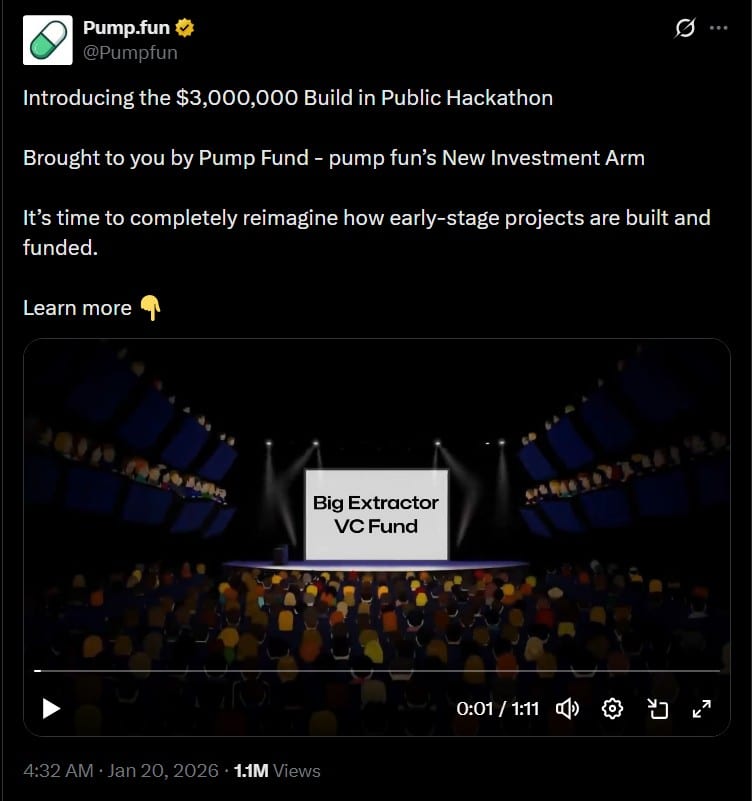
The Pump Fund is a new investment arm designed to back early-stage teams through participation, rather than traditional venture processes. The initiative opened with a $3 million “build in public” hackathon, making community traction the main funding filter.

Source: X

Instead of pitching to judges, selected teams receive funding based on how well their projects resonate publicly. Participants are required to launch a token, retain a portion of the supply, and show visible progress.

The idea is to let real users decide what deserves capital.

The move is the latest in Pump.fun’s recent efforts to reduce rug risks and support longer project lifecycles.

Revenues bounce back

These developments come as Pump.fun’s core business revives. After weeks of weak activity, a very brief memecoin rebound was enough to lift the platform’s fee revenues.

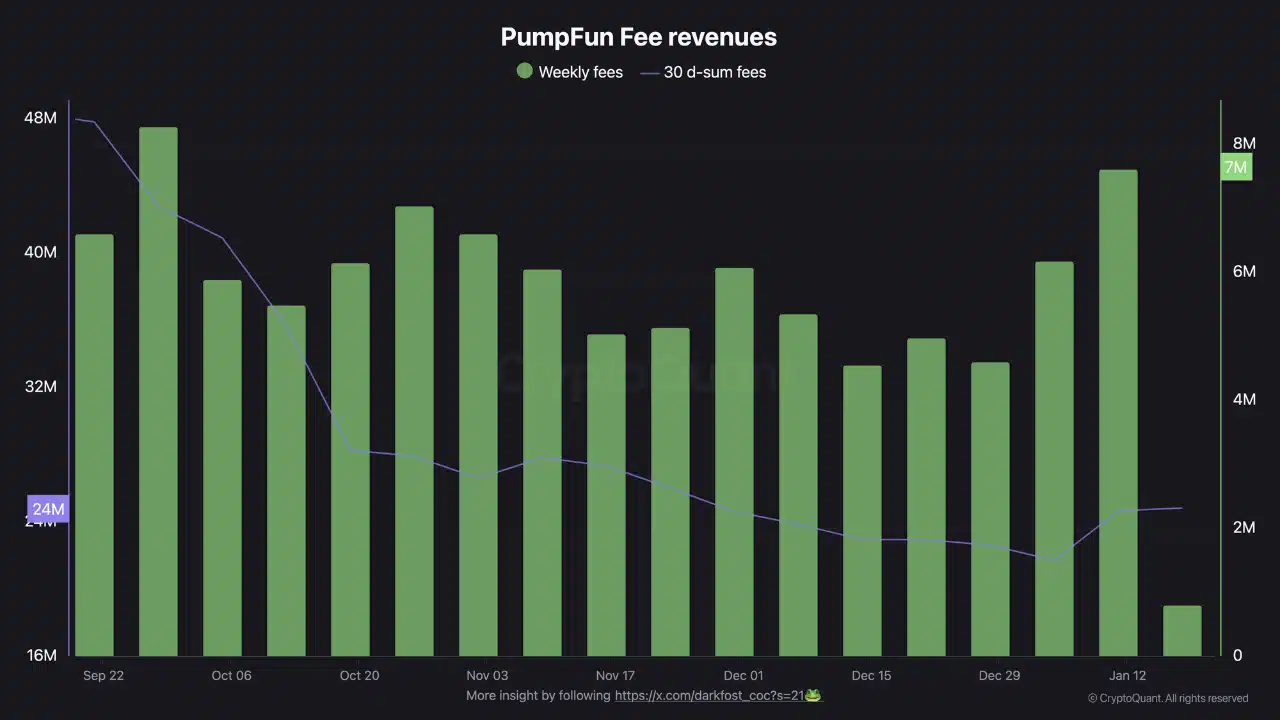
Over the past week, Pump.fun generated an estimated $7.6 million, back to levels last seen in September 2025.

Source: CryptoQuant

For much of the prior period, weekly fees had settled in a $4-$6 million range, so the platform is sensitive to even modest bursts of speculation. The improvement also showed up on a longer view, with the 30-day rolling total rising from $21.6 million to $24.8 million.

PUMP price slows

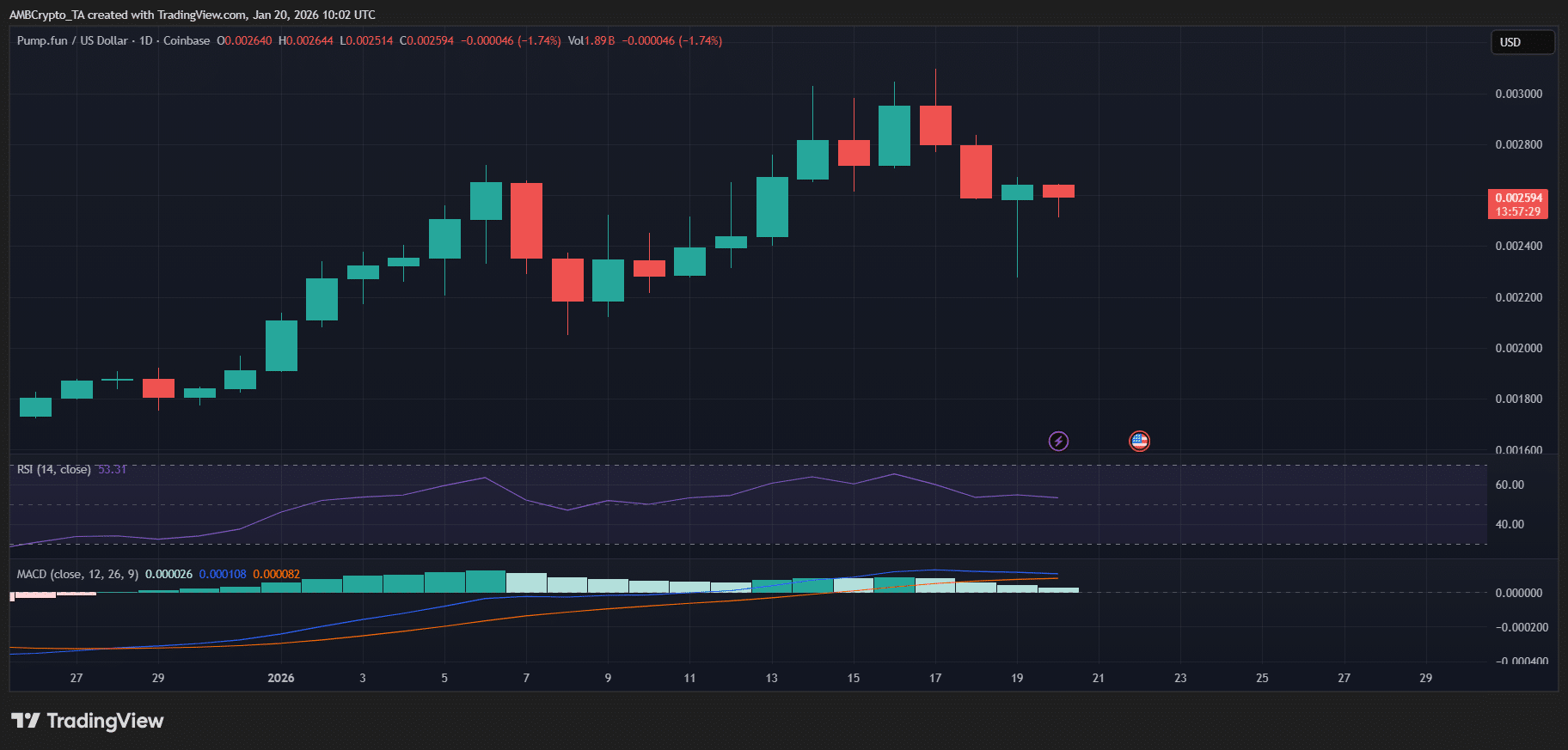
After going up steadily in early January, PUMP struggled to hold recent highs and is now moving sideways. RSI slipped toward neutral territory, while MACD had flattened.

Upside strength is lesser, and the pullback is indicative of consolidation.

Source: TradingView

PUMP remains closely tied to sentiment around memecoins and platform activity. It remains to be seen whether the latest developments result in prolonged demand.


Final Thoughts

  • Pump.fun’s $3M Pump Fund will fund projects that the public deem worthy.
  • With weekly fee surges and token consolidation, the platform’s long-term turn hasn’t yet reflected in price.
Next: Bitcoin price nears 60-day consolidation mark – Is $107K jump imminent?
Share
  • Share
  • Tweet

Crypto di tendenza

Domande pertinenti

QWhat is the purpose of the newly announced Pump Fund by Pump.fun?

AThe Pump Fund is a $3 million investment arm designed to back early-stage teams based on public traction through a 'build in public' hackathon, rather than traditional venture processes.

QHow does the Pump Fund's selection process differ from traditional venture capital?

AInstead of teams pitching to judges, funding is awarded based on how well projects resonate publicly, with participants required to launch a token, retain a portion of the supply, and show visible progress.

QWhat recent financial performance did Pump.fun experience prior to this announcement?

APump.fun's weekly fee revenues rebounded to an estimated $7.6 million, returning to levels last seen in September 2025, after weeks of weaker activity in the $4-$6 million range.

QHow is PUMP's token price performing according to technical indicators?

APUMP's price is moving sideways with RSI slipping toward neutral territory and MACD flattening, indicating consolidation after struggling to hold recent highs from early January.

QWhat broader shift does this fund represent for Pump.fun's business strategy?

AThe move represents Pump.fun's effort to reduce rug risks and support longer project lifecycles, potentially signaling a shift away from its memecoin-focused origins toward more sustainable project development.

Letture associate

Can Generative Models Finally Be Trained End-to-End? The Core Is a For Loop

This article introduces a novel training paradigm for generative models called Explorative Modeling (XM), which enables true end-to-end training. Traditionally, powerful generative models like autoregressive and diffusion models are not trained end-to-end. They are trained to predict a single small step but require iterative multi-step sampling for inference. This "exposure bias" leads to error accumulation and limits performance. The core challenge XM addresses is "mode blurring." In generative tasks, a single input (e.g., "generate a dog") corresponds to many valid outputs (multiple modes). Standard training objectives like reconstruction loss force the model to average these modes, producing unrealistic, blurry outputs. To avoid this, existing models break generation into many small, almost deterministic steps, sacrificing end-to-end training. XM tackles this by restructuring the training loop itself. Its key insight is to amplify "generative expressivity." For each training input, instead of generating one sample, the model generates K candidate outputs. Only the candidate closest to the real data is used for computing the loss and updating the model via backpropagation. This simple "best-of-K" mechanism is implemented as a short for-loop. By exploring multiple possibilities, the model learns to distribute its guesses across different modes rather than collapsing to their uninformative average. The paper demonstrates that "exploration" acts as a new, powerful scaling axis. Gains from XM increase with model size, data scale, and compute. Experiments show improvements in FID scores for image generation and significant efficiency gains, sometimes outperforming larger models without exploration. When pushed to the limit, XM enables fully single-step, end-to-end generative models. In robotics tasks, an "Explorative Policy" matched the performance of a 100-step Diffusion Policy with a single forward pass, drastically improving inference speed. While the best-of-K concept is not entirely new, the authors' contribution lies in formally understanding it as a direct method to boost generative expressivity without fragmenting the generation process. This work suggests that as models scale, enhancing exploration during training may become crucial for overcoming fundamental performance bottlenecks.

marsbit7 min fa

Can Generative Models Finally Be Trained End-to-End? The Core Is a For Loop

marsbit7 min fa

Annual Salary of Millions Competing for Electricians, Meta Rushes to Open Its Own Technical School

The AI boom is facing an unexpected bottleneck: a severe shortage of skilled construction workers and electricians. As tech giants like Meta, OpenAI, and Alphabet race to build massive data centers—such as OpenAI's $16 billion "Stargate" project—they are hitting a critical labor wall. The U.S. needs an estimated 130,000 more electricians, 240,000 construction workers, and 150,000 supervisors by 2030 for AI infrastructure alone, but tens of thousands of electrician jobs go unfilled each year. While AI companies offer high premiums, with electricians earning up to $280,000 annually, worker scarcity still causes massive losses—delays on a single project can cost $14.2 million per month. The complexity of building AI data centers, which require immense power (equivalent to powering hundreds of thousands of homes), sophisticated electrical systems, and advanced liquid cooling solutions, demands highly skilled technicians who are in short supply. To combat this, companies are investing heavily in training. Meta has committed $115 million to a free training school offering tuition, housing, and stipends, targeting 5,000 new workers. OpenAI is partnering with unions to secure skilled labor. These efforts are paying off, with a significant rise in Gen Z interest in trade schools over college. However, the power demands are staggering. AI data centers are driving a rapid surge in electricity consumption, projected to account for up to 12% of U.S. power use by 2028 and raising costs for consumers. Furthermore, the construction boom is project-based, leading to a potential future glut of trained workers once building peaks, which could depress wages industry-wide. The race for AI supremacy now depends as much on skilled hands as on advanced chips.

marsbit1 h fa

Annual Salary of Millions Competing for Electricians, Meta Rushes to Open Its Own Technical School

marsbit1 h fa

Trading

Spot

Articoli Popolari

Come comprare MOVE

Benvenuto in HTX.com! Abbiamo reso l'acquisto di Movement (MOVE) semplice e conveniente. Segui la nostra guida passo passo per intraprendere il tuo viaggio nel mondo delle criptovalute.Step 1: Crea il tuo Account HTXUsa la tua email o numero di telefono per registrarti il tuo account gratuito su HTX. Vivi un'esperienza facile e sblocca tutte le funzionalità,Crea il mio accountStep 2: Vai in Acquista crypto e seleziona il tuo metodo di pagamentoCarta di credito/debito: utilizza la tua Visa o Mastercard per acquistare immediatamente MovementMOVE.Bilancio: Usa i fondi dal bilancio del tuo account HTX per fare trading senza problemi.Terze parti: abbiamo aggiunto metodi di pagamento molto utilizzati come Google Pay e Apple Pay per maggiore comodità.P2P: Fai trading direttamente con altri utenti HTX.Over-the-Counter (OTC): Offriamo servizi su misura e tassi di cambio competitivi per i trader.Step 3: Conserva Movement (MOVE)Dopo aver acquistato Movement (MOVE), conserva nel tuo account HTX. In alternativa, puoi inviare tramite trasferimento blockchain o scambiare per altre criptovalute.Step 4: Scambia Movement (MOVE)Scambia facilmente Movement (MOVE) nel mercato spot di HTX. Accedi al tuo account, seleziona la tua coppia di trading, esegui le tue operazioni e monitora in tempo reale. Offriamo un'esperienza user-friendly sia per chi ha appena iniziato che per i trader più esperti.

305 Totale visualizzazioniPubblicato il 2024.12.13Aggiornato il 2026.06.02

Come comprare MOVE

Discussioni

Benvenuto nella Community HTX. Qui puoi rimanere informato sugli ultimi sviluppi della piattaforma e accedere ad approfondimenti esperti sul mercato. Le opinioni degli utenti sul prezzo di MOVE MOVE sono presentate come di seguito.

活动图片