Profits Fall by a Quarter: Why Tether Abandoned Its $20 Billion Financing Plan

marsbitPubblicato 2026-02-05Pubblicato ultima volta 2026-02-05

Introduzione

In the face of a cooling crypto market and investor skepticism, Tether, the world's largest stablecoin issuer, has significantly scaled back its ambitious fundraising plans. Initially targeting $15-20 billion, which would have valued the company at $500 billion, the firm is now considering raising only about $5 billion. CEO Paolo Ardoino downplayed the original target, calling it a "misunderstanding" and a maximum cap, not a goal, while emphasizing that Tether is highly profitable and doesn't urgently need the capital. Despite the success of its USDT stablecoin, which has a market cap of approximately $185 billion, Tether faces persistent investor caution. Concerns revolve around its $500 billion valuation—comparable to major AI firms and SpaceX—ongoing regulatory scrutiny, and the lack of a full independent audit, relying instead on quarterly attestations. Ardoino defended the valuation, contrasting Tether's substantial profits with the losses of highly-valued AI companies. While new U.S. stablecoin legislation and competitor Circle's IPO have boosted momentum, regulatory risks and Tether's controversial history remain hurdles. The company's profits fell by about a quarter in 2025, attributed to declining Bitcoin prices, though it gained $8-10 billion from its gold holdings. Tether's massive scale has made it a major player in U.S. Treasuries and gold markets, positioning it as a critical bridge between traditional finance and the volatile crypto world.

Editor's Note: Against the backdrop of a cooling crypto market and pressured valuation narratives, Tether finds itself in a delicate position. On one hand, the continued expansion of USDT has made it an undeniable 'new financial player' in the U.S. Treasury and gold markets. On the other hand, a lofty $500 billion valuation expectations, an incomplete comprehensive audit, and long-standing regulatory and compliance controversies continue to make potential investors cautious.

Tether's next move may reflect not only its own choices but also the practical boundaries the entire stablecoin industry is facing.

The following is the original text:

As investors expressed skepticism about its $500 billion valuation target, the CEO of Tether, the world's largest stablecoin issuer, proactively downplayed expectations and attention regarding its financing scale.

This crypto group, registered in El Salvador, initiated financing negotiations last year, planning to raise $15 to $20 billion. Had the deal been completed, it would have placed Tether among the world's most valuable private companies.

But according to informed sources, after encountering investor hesitation, Tether's advisors have begun exploring the possibility of raising only about $5 billion.

Tether CEO Paolo Ardoino downplayed the potential financing scale, calling the previously stated $15 to $20 billion target "a misunderstanding."

"That number was not our target; it was just the maximum we were willing to sell," he said in an interview. "We would be equally happy not selling a single cent."

Ardoino stated that Tether is highly profitable and has received "significant interest" at the $500 billion valuation level. He added that the company has not yet decided how much equity to sell, partly because insiders are reluctant to reduce their holdings.

The company's dollar-pegged stablecoin, USDT, currently has a scale of approximately $1.85 trillion and is regarded as the "reserve currency" of the digital asset market. Control of Tether is concentrated in the hands of a small group of long-serving executives.

The market has been closely watching Tether's progress in attracting well-known investors, seeing it as a key indicator of investor interest in the crypto industry. It is widely believed that this move is more about consolidating Tether's credibility and network, as the company, generating billions of dollars in profit annually, does not urgently need new capital.

Following Trump's election as president, the market was once boosted by expectations of a more friendly U.S. regulatory environment for digital assets. However, over the past six months, as traders retreated from high-risk speculative assets, the crypto market has seen a significant pullback.

Some investors have privately expressed concerns about the $500 billion valuation, which would place Tether among the top private companies globally, alongside AI firms like OpenAI and Anthropic, as well as Musk's SpaceX and TikTok's parent company ByteDance.

Ardoino argued that Tether—which disclosed profits of approximately $10 billion last year, primarily from returns on the asset reserves backing USDT's value—deserves a valuation comparable to these still-unprofitable AI model companies.

"These AI companies make about the same amount of money as we do, just with a huge minus sign in front," he said. "If you're willing to believe an AI company with a massive minus sign in front is worth $800 billion, that's your choice."

Both Tether and its financing advisor, Cantor Fitzgerald, declined to comment on the size of this financing. The investment bank, run by the children of U.S. Commerce Secretary Howard Lutnick, also holds a stake in Tether.

Informed sources cautioned that the negotiations are ongoing and the financing terms could still change; if the overall crypto market strengthens again, investor sentiment could also reverse.
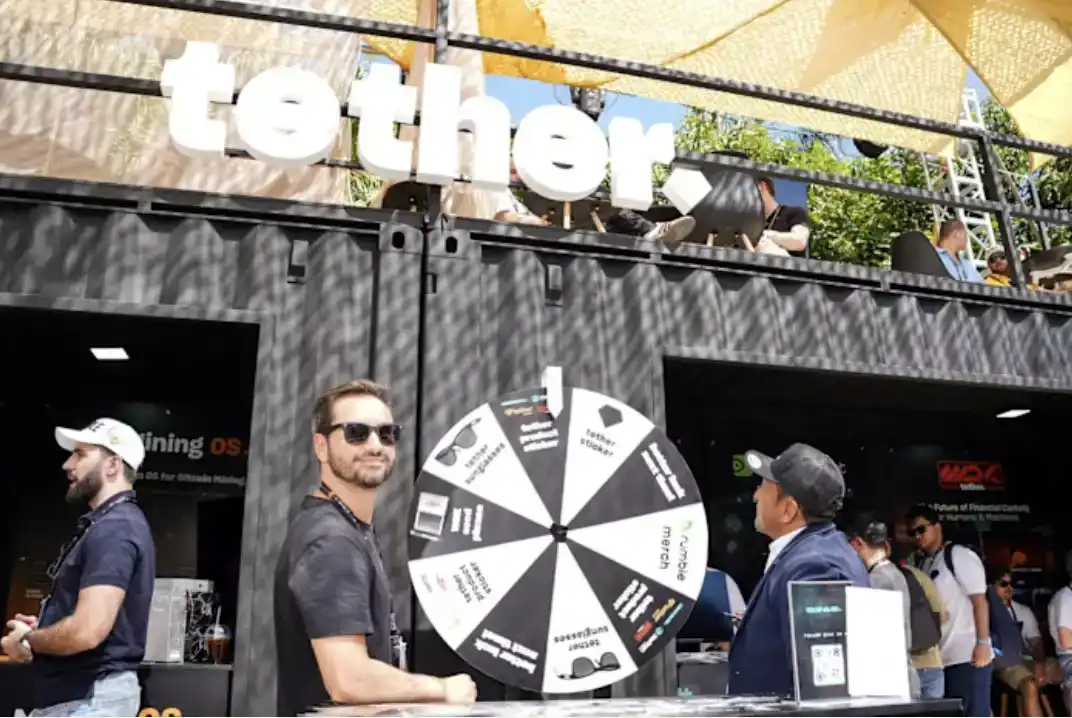
Ardoino stated that the new U.S. stablecoin legislation signed into law by Trump, coupled with the listing of U.S. rival Circle last year, has further increased market attention and momentum for Tether. Tether recently also launched a new token in the U.S. that complies with this regulatory framework.

But informed sources said some potential investors remain cautious about the regulatory risks surrounding Tether. Since its founding in 2014, this crypto group has long faced scrutiny, with controversies primarily focusing on whether its tokens are used for illegal activities and the transparency and quality of its asset reserves.

In recent years, Tether has begun publishing quarterly reserve attestations by the accounting firm BDO Italia, but it has never undergone a full independent audit.

Ardoino stated that the company has demonstrated the depth of its technical tools for collaboration with various law enforcement agencies to potential investors, to prove its capabilities in compliance and law enforcement cooperation.

S&P Global Ratings downgraded Tether's reserve rating to the lowest tier in its system late last year, citing its increasing exposure to high-risk assets like Bitcoin and gold. In response, Ardoino said at the time: "We wear your disdain as a badge of honor."

Since 2020, the growth of USDT has significantly accelerated, making Tether one of the world's largest buyers of U.S. Treasuries and, in recent months, a major player in the gold market.

Asset allocation on such a massive scale makes Tether one of the most critical connecting nodes between the global financial system and the highly volatile world of cryptocurrency.

Compared to the previous year, Tether's profits for 2025 fell by about a quarter. Ardoino attributed this change to the decline in Bitcoin's price. He added that the company gained approximately $8 to $10 billion in profits from its gold holdings, benefiting from rising precious metal prices.


Domande pertinenti

QWhy did Tether significantly scale back its fundraising target from up to $20 billion to potentially only $5 billion?

ATether's CEO, Paolo Ardoino, stated that the initial $15-20 billion figure was a 'misunderstanding' and represented the maximum they were *willing* to sell, not a target. Investor hesitation over the company's $500 billion valuation and internal shareholders' reluctance to sell their stakes contributed to the reduced scale.

QWhat was the primary reason for Tether's 25% profit decline in 2025, according to its CEO?

APaolo Ardoino attributed the approximately 25% profit decline in 2025 primarily to a decrease in the price of Bitcoin.

QWhat are the main regulatory and transparency concerns that make some potential investors cautious about Tether?

APotential investors are cautious due to Tether's long history of scrutiny over whether its tokens are used for illicit activity, the transparency and quality of its asset reserves, and the fact that it has not undergone a full independent audit, relying instead on quarterly attestations from BDO Italia.

QHow does Tether's CEO justify the company's proposed $500 billion valuation compared to major AI companies?

APaolo Ardoino argues that Tether, which is highly profitable, deserves a valuation comparable to major AI companies that are still reporting losses, stating, 'These AI companies make about the same money as us, just with a big minus sign in front.'

QWhat two major roles does Tether now play in the broader financial system, according to the article?

ATether has become one of the world's largest buyers of U.S. Treasury bonds and a significant participant in the gold market. This makes it a critical connecting node between the global financial system and the highly volatile world of cryptocurrencies.

Letture associate

SpaceX, OpenAI, Anthropic: The Three AI Giants Racing for IPO, Which One Is Worth Betting On?

SpaceX, OpenAI, and Anthropic are poised for historic IPOs within weeks, potentially raising a combined $180 billion—a sum exceeding the entire internet bubble's fundraising. The hosts of the Limitless Podcast argue this isn't just individual company financing but an unprecedented capital concentration for AI infrastructure, driven by an insatiable need for compute, data centers, power, and chips. SpaceX's IPO is notable for reportedly changing market index rules to allow faster inclusion, potentially funneling trillions in passive retirement funds into its stock, despite its unproven space-based data center business model. In contrast, Anthropic demonstrates explosive growth, with ARR reportedly hitting $45 billion and approaching profitability, fueled by strong enterprise adoption of products like Claude Code. Google's separate $80 billion raise highlights the immense capital pressure, even for giants. The discussion acknowledges bubble risks but leans optimistic. The hosts contend the massive spending is building essential physical infrastructure for the next technological era. A key bottleneck isn't capital but the real-world limits of chip manufacturing and construction speed. As long as demand for AI compute outstrips supply, this investment cycle represents a foundational build-out rather than a purely financial bubble. All three companies are seen as foundational bets on the future, with Anthropic often cited as the most immediately compelling due to its proven revenue trajectory.

marsbit1 h fa

SpaceX, OpenAI, Anthropic: The Three AI Giants Racing for IPO, Which One Is Worth Betting On?

marsbit1 h fa

From 'Old Guys' to 'New Favorites': How AI Is Revaluing Old Infrastructure from Dell to Nokia?

From "Vintage Tech" to "New AI Darlings": How AI Revalues Old Infrastructure One year ago, tech giants like Dell, Nokia, Cisco, and Western Data were seen as slow-growth, low-valuation stories, far from the AI spotlight dominated by players like Nvidia. Now, these legacy tech stocks are gaining market attention, sparking debate on whether this is genuine industry revaluation or a temporary narrative. As AI moves from model parameters to real-world data centers, the market is recognizing companies with proven delivery and infrastructure capabilities. This shift marks a change in the AI investment thesis: from pure model and GPU focus to the complex systems engineering required for deployment. Companies like Dell, HPE, and Corning are being revalued not for being "sexy" AI innovators, but for their decades of accumulated expertise in supply chains, enterprise delivery, and infrastructure—assets that have become critical in the AI buildout phase. The revaluation is unfolding across three key infrastructure lines: 1. **Servers & System Integration:** Dell and HPE are emerging as crucial system integrators or "general contractors" for AI data centers, translating GPU orders into complete, deployable server racks integrated with power, cooling, and networking. 2. **Networking & Connectivity:** AI's scale demands robust high-speed connections. Corning (fiber optics), Nokia (AI-RAN, 6G), and Cisco (data center switches) are gaining importance for enabling efficient data transfer within and between AI clusters. 3. **Storage:** Beyond high-speed memory (HBM/DRAM), the AI data explosion is driving demand for high-capacity hard drives (HDDs) from companies like Western Digital and Seagate to handle training data, logs, and cold storage cost-effectively. For this revaluation to be substantive and not just a narrative, three criteria are key: 1) Concrete AI-related order and revenue growth (e.g., Dell's AI server sales), 2) Upward revisions to company financial guidance, and 3) Sustainable improvements in profit quality, not just top-line revenue spikes. In essence, AI's transition to a real construction phase is re-pricing "old assets" against "new demand." The opportunity, however, is selective. Only those legacy firms that are demonstrably integrated into the capital expenditure chains of data center and enterprise AI deployment are likely to experience a true "logic re-rating" rather than just a temporary valuation bounce.

marsbit1 h fa

From 'Old Guys' to 'New Favorites': How AI Is Revaluing Old Infrastructure from Dell to Nokia?

marsbit1 h fa

The Merger of Codex and ChatGPT Marks the Beginning of a Major Reshuffle in Programming Tools

OpenAI is shifting its strategic focus from ChatGPT to Codex, merging them along with the browser tool Atlas into a unified desktop super-app. This move signals an internal belief that Codex, originally a programming tool, represents the next evolution of AI more than conversational models like ChatGPT. Over the past year, Codex's weekly active users have surged past 5 million. The key distinction is that while ChatGPT answers questions, Codex executes tasks. Enterprises increasingly value this ability to get work done over simply receiving advice. Consequently, Codex is attracting professionals beyond developers, including analysts, bankers, marketers, and product managers. OpenAI's reorganization and increased investment in Codex stem from recognizing that the future of AI competition lies in execution capabilities, not just conversation. The company is launching role-specific plugins (e.g., for data analysis, sales, design) to transform Codex into a broad knowledge work platform that automates and redefines white-collar workflows. Beyond being a tool, Codex reflects OpenAI's ambition to redefine software. New features like "Sites"—which generates interactive websites from documents—and collaborative "Annotations" aim to create a paradigm where the AI understands the goal and handles the tools and steps, functioning more like a digital colleague than traditional software. The ultimate goal is a unified experience where the user cares only about the completed task.

marsbit1 h fa

The Merger of Codex and ChatGPT Marks the Beginning of a Major Reshuffle in Programming Tools

marsbit1 h fa

Interpreting Investment Opportunities in the Age of Great Navigation, Invesco Great Wall Fund Releases '2026 Report on Chinese Enterprises Going Global'

Invesco Great Wall Fund has released its "2026 China Corporate Globalization Report," titled "The 'Great Navigation Era' of Chinese Enterprises." The report analyzes the new trends and investment opportunities as Chinese companies expand globally, moving from simple product exports to comprehensive overseas operations involving services, branding, and local production. Driven by factors like trade friction, the pursuit of higher profit margins abroad, and policy support, globalization is becoming essential for Chinese companies. The report outlines an evolution: from early product export ("Globalization 1.0") to the current "Globalization 2.0," characterized by overseas capacity, capital goods investment, consumer brand expansion, and service exports. Chinese firms' competitive advantages are highlighted, including a vast engineer talent pool, low-cost and robust infrastructure, and complete industrial clusters. Specific sectors with significant出海 potential are identified: * **Capital Goods** (e.g., engineering machinery, power equipment): Benefiting from global demand, especially in Belt & Road markets and the AI-driven power grid upgrade cycle. * **Consumer Brands**: Transitioning from cost to brand advantage, leveraging供应链 efficiency. * **Technology & Innovation**: Including AI applications, optical modules within global tech supply chains, and new energy vehicles focusing on local production. * **Pharmaceuticals**: Chinese biotech firms are becoming preferred partners for global pharma, with potential for breakthrough drugs in areas like oncology and weight loss. The report concludes that corporate globalization represents a sustained, core theme for China's capital markets, though companies must navigate challenges like geopolitics and localization.

marsbit1 h fa

Interpreting Investment Opportunities in the Age of Great Navigation, Invesco Great Wall Fund Releases '2026 Report on Chinese Enterprises Going Global'

marsbit1 h fa

Trading

Spot
Futures
活动图片

