
Primitive Ventures: The Crypto World Feels a Bit Dead

marsbitPubblicato 2026-01-13Pubblicato ultima volta 2026-01-13

Introduzione

Primitive Ventures' Dovey Wan argues that despite Bitcoin hitting new all-time highs in 2025, the crypto market feels stagnant and disconnected. Key issues include a lack of altcoin momentum, underperformance against traditional assets like stocks and gold, and a significant divergence between onshore (U.S.) buying and offshore selling. U.S. investors bought spot Bitcoin, while international traders sold into strength and used leverage. Structural shifts, including Bitcoin ETFs and institutional products, changed liquidity dynamics. Retail interest declined, and miners sold Bitcoin to fund AI ventures. Major sell pressure came from early whales, miners, and gray market entities. The traditional 4-year cycle is broken; future performance depends on macro conditions and institutional adoption. Crypto must evolve from speculative asset to utility-driven technology to attract new cycles of investment.

Author: Dovey Wan, Founding Partner of Primitive Ventures

Compiled by: Dayu

In 2025, the cryptocurrency industry achieved almost all its expected goals. Structurally, this should have been a glorious year.

But why does it feel... so lifeless?

It's not just that "prices didn't rise" and it's all over. Bitcoin hit new highs. But the atmosphere, sentiment, internal confirmation, follow-through from other cryptocurrencies, and retail enthusiasm have all changed. Perhaps most worryingly, the former "hot money leading asset" has now lost its appeal in terms of wealth effect and volatility.

Related cryptocurrency assets no longer move in sync with Bitcoin and Ethereum as they did in previous cycles:

1. Memecoins topped the charts from Q4 2024 to Q1 2025, and the launch of Trump tokens pushed this trend to its peak.

2. Crypto stocks peaked around the Circle IPO and began to fall back between May and August 2025.

3. Most altcoins never formed a sustained trend. There was asymmetry on the way up, and the decline was entirely dominated by all participants.

Zooming in, the situation becomes even stranger.

Despite a friendly policy environment, Bitcoin's performance in 2025 lagged behind almost all major traditional financial assets, including gold, U.S. stocks, Hong Kong stocks, A-shares, and even some bond benchmark indices.
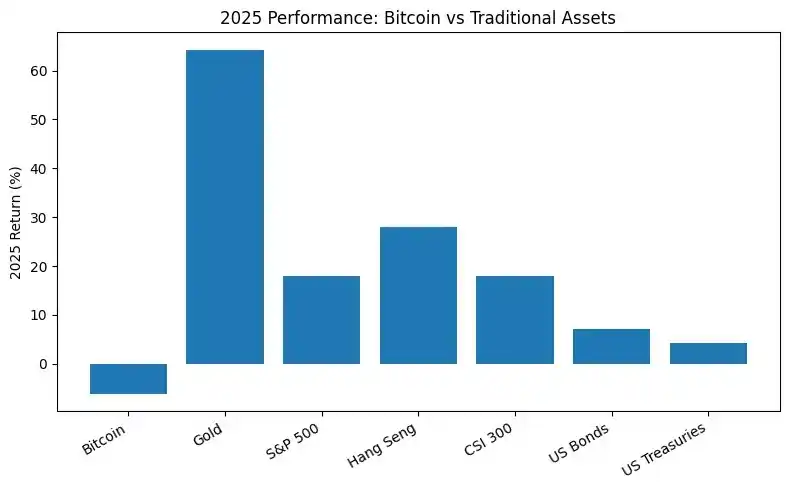
(Bitcoin's performance compared poorly to other assets)

This is the first time Bitcoin's performance has decoupled from all other asset classes.

This divergence is crucial: prices hit new highs, but there was no internal confirmation, and other markets performed better. This reveals a simple yet unsettling fact: Bitcoin's liquidity supply chain has undergone significant changes, and its original four-year settlement cycle has been altered by greater forces in other markets.

Therefore, we will delve into who was buying at the highs, who exited the market, and where the price bottom lies.

The Great Divide: Onshore vs. Offshore Operations

We experienced three distinct phases in this cycle—

  • Phase A (November 2024 to January 2025): Trump's election victory and a more friendly regulatory environment triggered FOMO among both domestic and foreign investors. Bitcoin's price broke through $100,000 for the first time.

  • Phase B (April to mid-August 2025): After deleveraging selling, BTC resumed its upward momentum and broke through $120,000.

  • Phase C (Early October 2025): BTC hit its current local all-time high in early October, then experienced a flash crash on October 10th and entered a correction phase.

In each phase, we saw a significant divergence between U.S. buying and overseas selling—

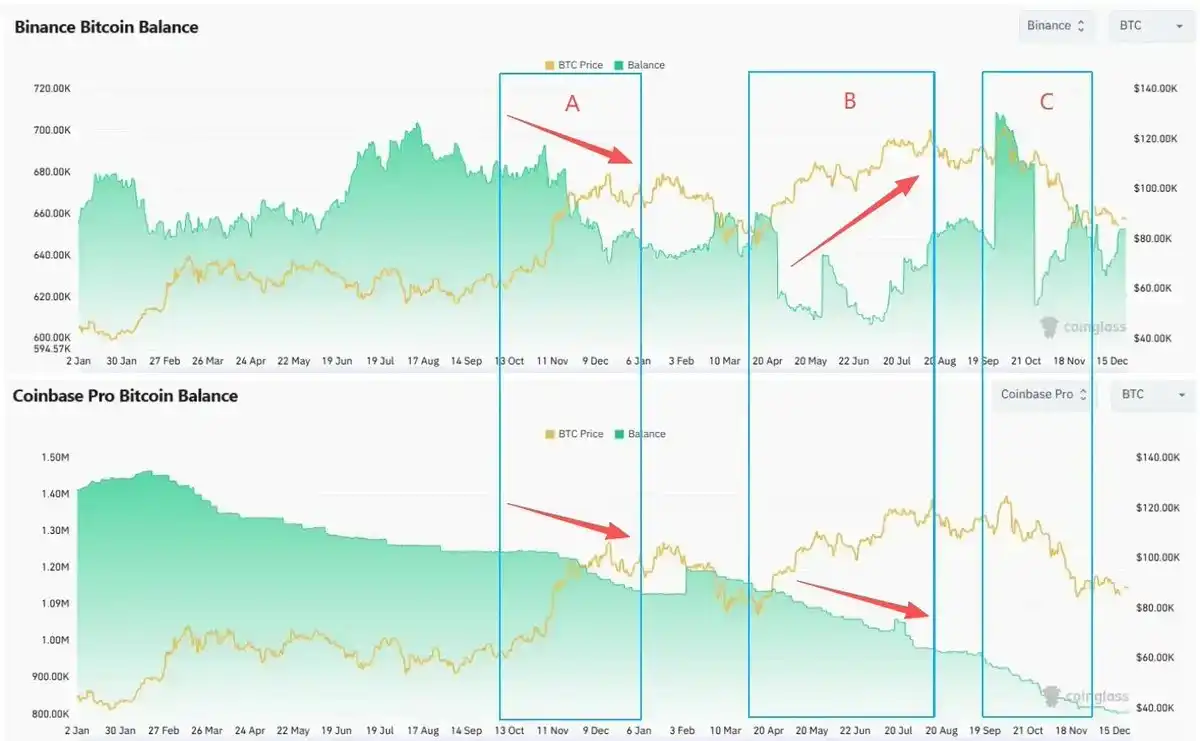
Spot: Onshore buying on breakouts, offshore selling on strength.
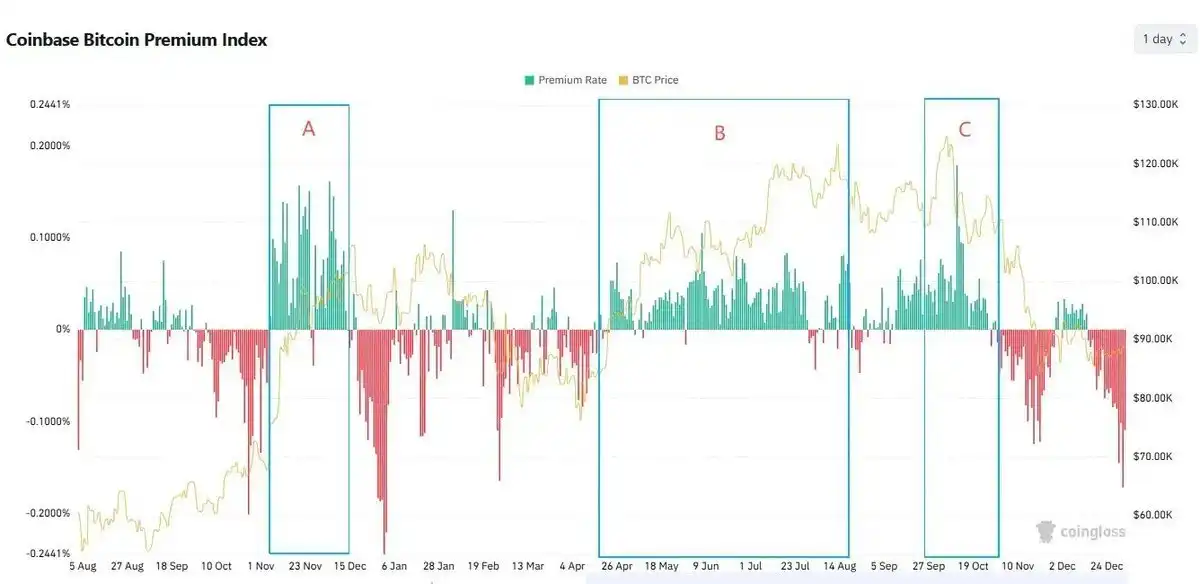
  • Coinbase Premium remained positive in Phases A, B, and C. High levels of buy-side demand primarily came from onshore spot funds.

  • Coinbase BTC balances showed a declining trend throughout the cycle. Sellable inventory on the U.S. side decreased.

  • As prices rebounded in Phases B and C, Binance balances increased significantly. Offshore spot holders replenished inventory, increasing potential selling pressure.
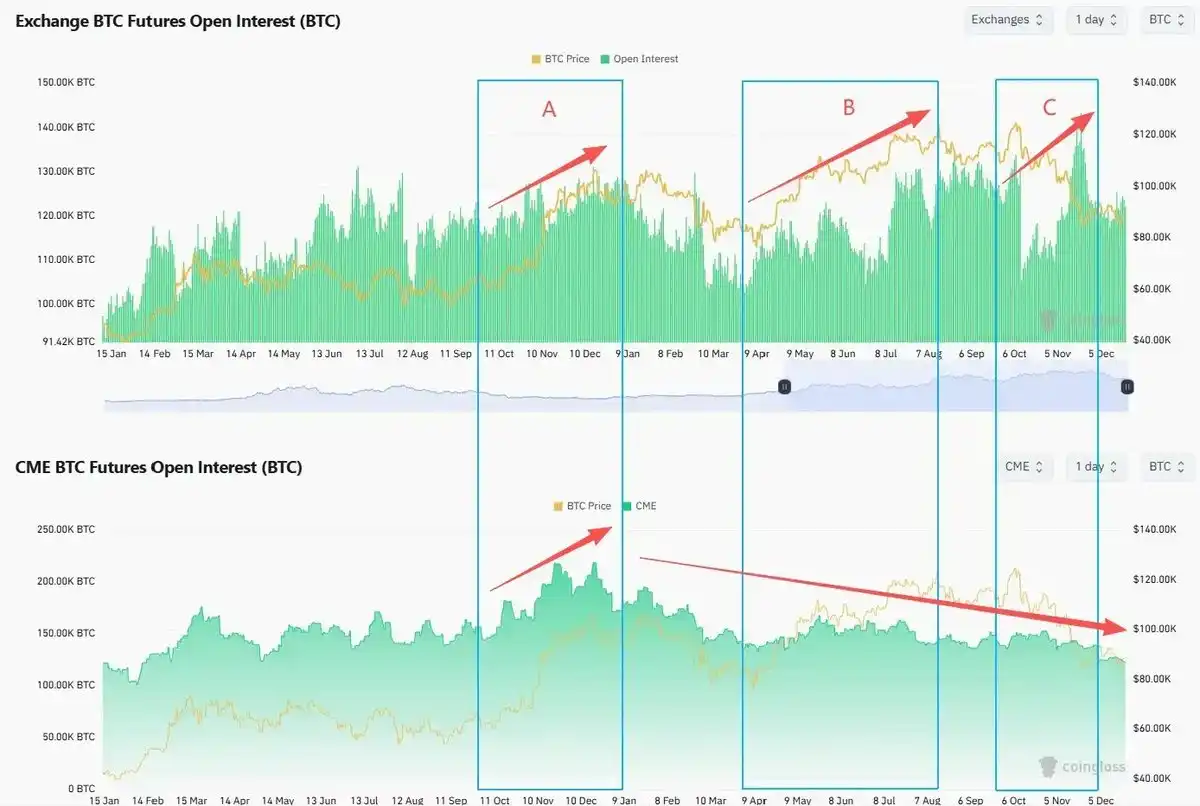
Futures: Offshore leverage rises, onshore positions decline

Offshore open interest (Binance and other offshore exchanges) climbed during Phases B and C. Leverage increased. Even after October 10th, leverage quickly recovered and returned to or exceeded previous peaks.

Onshore open interest (CME) has been on a downward trend since early 2025. Institutional investors did not increase their risk exposure as contracts hit new highs.
Meanwhile, Bitcoin volatility diverged from price action.

In August 2025, when Bitcoin's price first surpassed $120,000, DVOL was near a local low. The options market did not adequately compensate for continued risk.
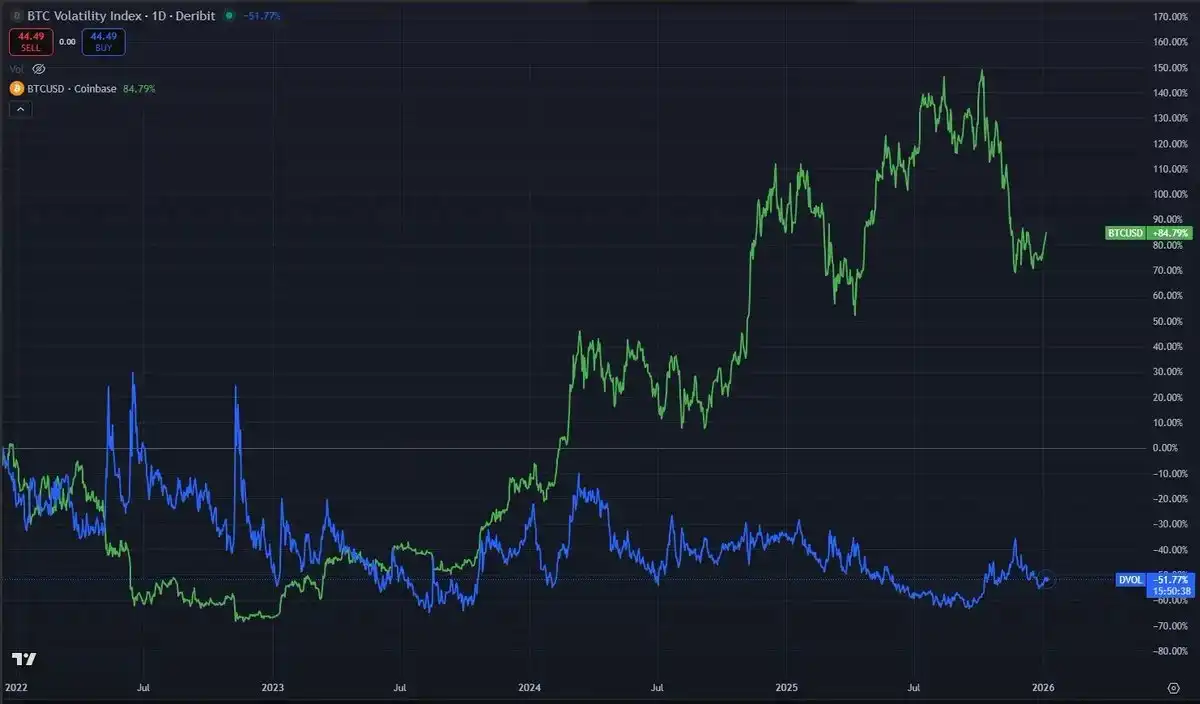
Each "top" seemed to reflect a divergence between onshore and offshore traders. When onshore spot funds pushed prices to break out, offshore spot traders sold into strength. When offshore leveraged capital chased the rally, onshore futures and options traders reduced positions and stayed on the sidelines.

Where are the marginal buyers? Who is left to buy?

Glassnode estimates that the number of Bitcoins held by corporate and DAT-like tools increased from about 197,000 in early 2023 to about 1.08 million by the end of 2025, a net increase of about 890,000 over two years. DATs have become one of the largest structural investment vehicles in the Bitcoin system.

Another often misunderstood area is ETFs. By the end of 2025, U.S. spot Bitcoin ETFs held approximately 1.36 million, a year-on-year increase of about 23%, accounting for about 6.8% of the circulating supply.

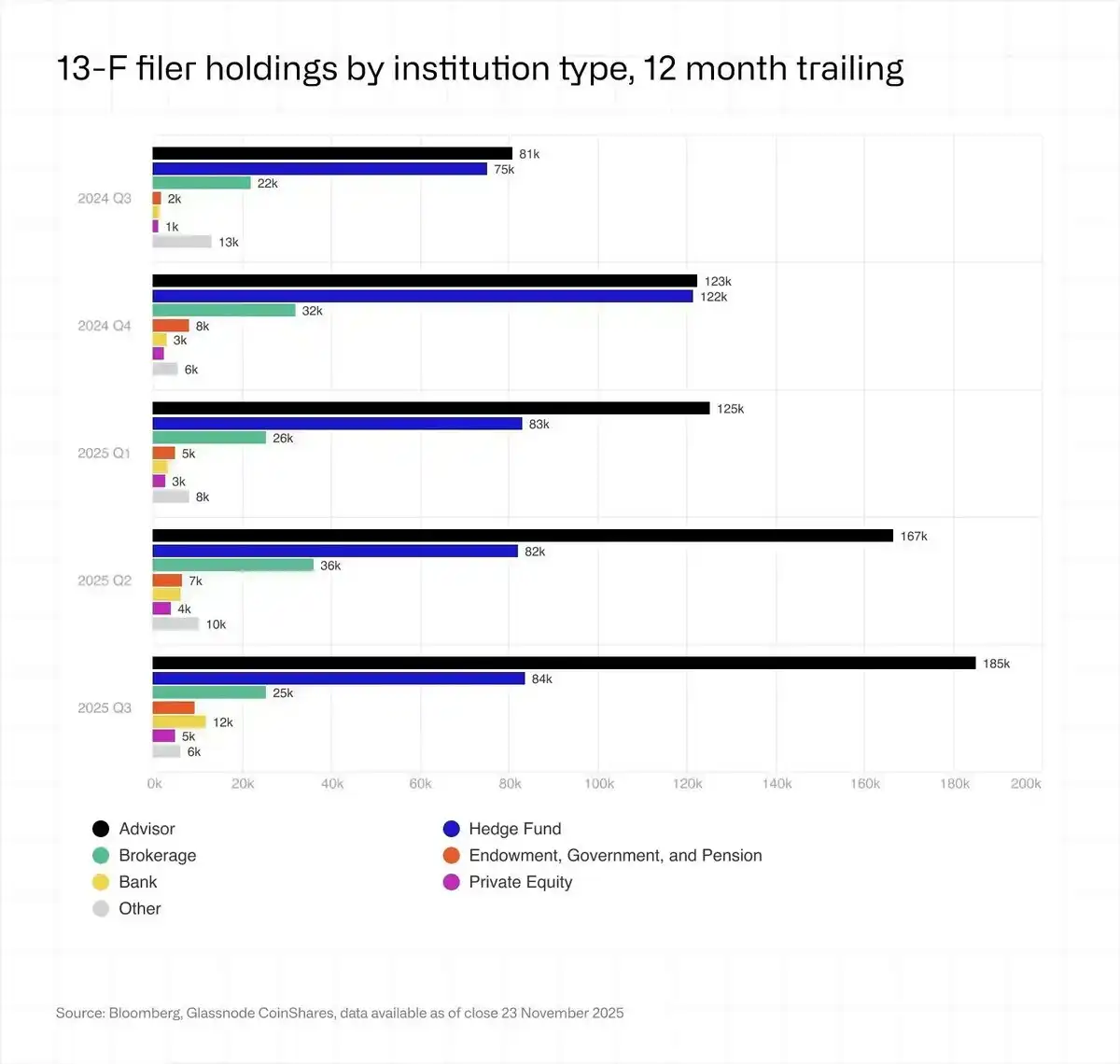
Institutional investors (13F filers) hold less than a quarter of the total ETF amount, and most of these are hedge funds and investment advisors, clearly not the "diamond hand" families we know.
The Death of Retail

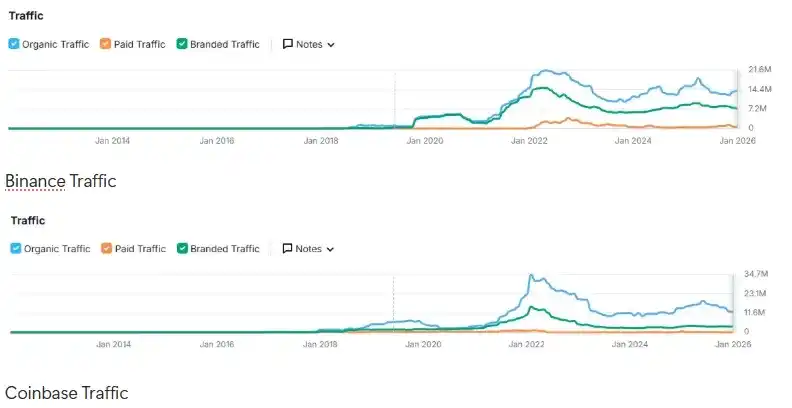
Since early 2025, flow data from Binance, Coinbase, and other top exchanges clearly shows that retail investor weakness has continued since Trump sold his "memecoins".

Furthermore, overall social sentiment among retail investors has actually been bearish since early 2024.

Overall website traffic has been on a downward trend since peaking in 2021.

Bitcoin's price hitting new highs did not bring traffic back to previous levels.
You can read more on this topic in our article from last year. "Who is the marginal buyer?"

Exchange strategies have also adjusted. Facing high customer acquisition costs and low activity from existing users, exchanges have shifted from "striving for growth" to "retaining existing capital through yield products and multi-asset trading (actively listing U.S. stocks, gold, and forex)".

Everywhere Else, It's a Bull Market

The real "wealth effect" in 2025 was not in crypto: the S&P 500 (+18%), Nasdaq (+22%), Nikkei (+27%), Hang Seng Index (+30%), KOSPI (+75%), and even A-shares rose 19%, all posting strong gains. Gold (+70%) and silver (+144%) also surged, making "digital gold" seem somewhat ridiculous by comparison.

AI stocks, 0DTE (zero-day to expiration) options, and commodities like gold and silver further eroded its appeal.

Speculative money did not rotate into alternative investments. Many exited altogether, returning to equity volatility markets, while new speculators happily profited in U.S. stocks or their domestic equity markets.

Even Korean retail investors sold off Upbit to bet on the KOSPI index and U.S. stocks: Upbit's average daily trading volume in 2025 fell about 80% compared to 2024. During the same period, the KOSPI rose over 75%. Korean retail investors net bought about $31 billion in U.S. stocks.

Who Are the Biggest Sellers?

Every cycle has whales selling at local highs, but interestingly, the timing of seller distribution this cycle coincided perfectly with the RSI divergence points.

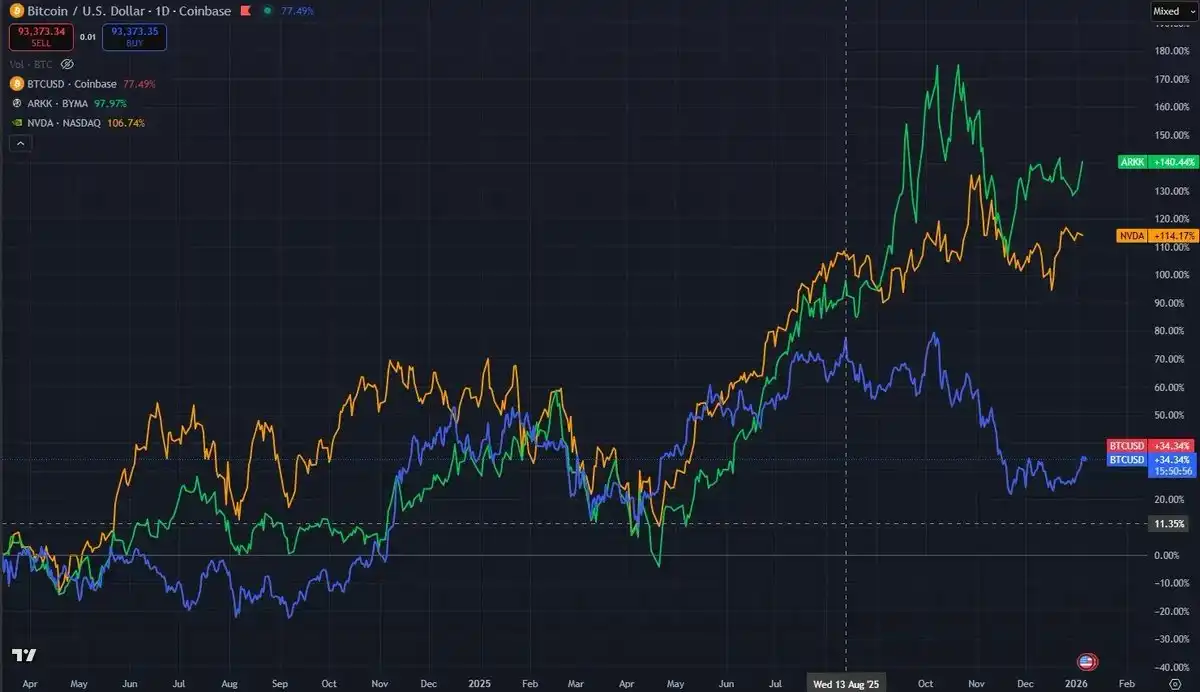
Bitcoin had previously moved closely in line with U.S. tech stocks until around August 2025, when Bitcoin began to significantly lag ARKK and Nvidia, followed by the October 10th flash crash, and it has yet to close the gap since.

Just before this divergence appeared, in late July, Galaxy disclosed in its earnings report and media briefings that it had executed a sell order of over 80,000 Bitcoins on behalf of an established holder. This transaction brought the phenomenon of "Satoshi-era whale profit-taking" into public view.
Miners Selling for AI Capex

From the 2024 Bitcoin halving to the end of 2025, miner reserves experienced their most sustained decline since 2021. By year-end, reserves were around 1.806 million Bitcoins. Hash rate fell about 15% year-on-year.

  • Under the "AI Diversion Plan," miners transferred approximately $5.6 billion worth of Bitcoin to exchanges to fund the construction of AI data centers.

  • Bitfarms, Hut 8, Cipher, Iren, and others are converting sites into AI and high-performance computing campuses, signing 10 to 15-year compute contracts, treating power and land as "gold in the AI era."

  • Riot, a representative HODLer, announced in April 2025 that it would begin selling all coins mined monthly.

It is estimated that by the end of 2027, about 20% of mining power capacity could be redeployed to AI workloads.

China took more severe measures. In December 2025, Xinjiang again became a target for the People's Bank of China and various ministries. About 400,000 ASIC miners were forced offline, causing global hash rate to drop 8% to 10% in a few days.

Gray Whales: Bitcoin's Black Hangover

Similar to the significant impact of the PlusToken scam in the 2021 cycle, several large-scale fraud and gambling cases in 2025, including Qian Zhimin's Ponzi scheme/cult network and the Cambodia Prince Group/Chen Zhi case, were likely major behind-the-scenes drivers of Bitcoin's price action.

Both cases involved the seizure of tens of thousands of Bitcoins, totaling at or above the level of 100,000 black coins.

This may also add potential selling pressure from governments, while significantly inhibiting large gray market long-term holders of Bitcoin, which could create selling pressure in the medium term but is overall positive in the long run.

2026 Outlook

Under this new structure, the original "four-year halving cycle" is no longer a feasible self-fulfilling path.

The next phase of the regime is primarily driven by two axes.

  • Vertical: Macro liquidity and credit conditions, interest rates, fiscal stance, AI investment cycle.

  • Horizontal: Valuation and premium levels of DATs, ETFs, and other Bitcoin alternative assets.
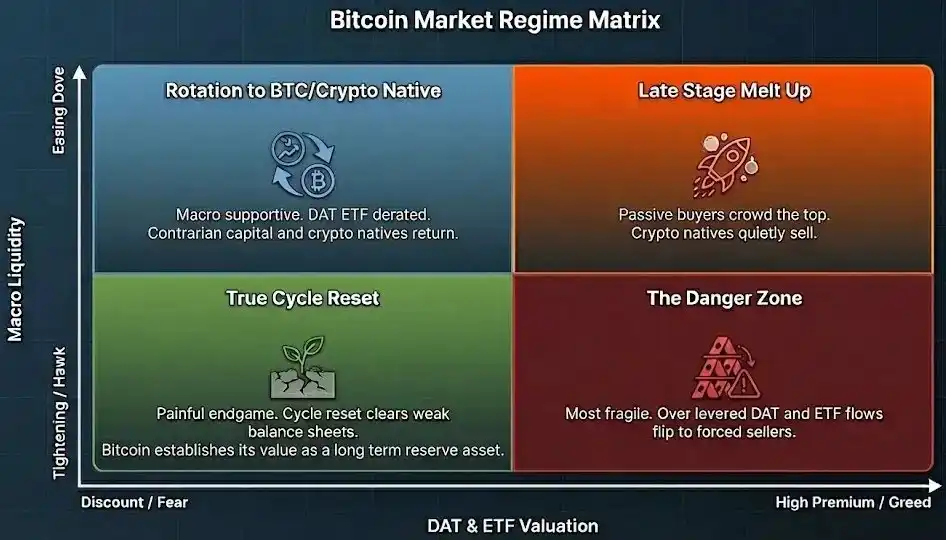
Early Bitcoin winners, including OGs, miners, and Asian gray whales, are distributing tokens to passive ETF holders, DAT structures, and long-term national capital.

Bitcoin's trajectory seems similar to that of FAANG between 2013 and 2020: the market is slowly shifting from a high-beta strategy dominated by early retail and growth funds to a passive allocation strategy dominated by index funds, pension funds, and sovereign wealth funds.

Bitcoin is now the crypto asset you can own easily without touching crypto. You can buy it through a brokerage account, custody it like an ETF, account for it clearly, and explain it to a trader investment committee in five sentences.

Whereas the valuation of most other crypto assets does not stem from their actual utility or legitimacy in the physical market and Wall Street.

We always look forward to the next bull market, but it would be great if this bull market wasn't just about price increases, but also about utility increases, translating the legitimacy of the ETF era into on-chain demand, converting passive holding into active use, and bringing real yield returns, not just constantly shifting narratives.

If that happens, today's "bag holders" won't look like fools trapped at the cycle's peak, but rather like the first investors of the new cycle.

Bitcoin finally becomes national reserve currency

Code is eating the bank

Crypto still needs to evolve into a new tool of civilization.

Crypto di tendenza

Domande pertinenti

QAccording to the article, why does the crypto world feel 'dead' despite Bitcoin hitting new highs in 2025?

AThe article states that while Bitcoin hit new highs, the atmosphere, sentiment, internal confirmation, follow-through from other cryptocurrencies, and retail enthusiasm have all changed. It points to a lack of wealth effect and volatility appeal, poor performance compared to other asset classes, and a significant shift in Bitcoin's liquidity supply chain and its traditional four-year cycle.

QWhat key divergence does the article highlight between onshore (US) and offshore trading activity for Bitcoin?

AThe article highlights a major divergence where onshore (US) spot buyers were the primary demand driving breakouts, while offshore spot holders sold into strength. Conversely, offshore futures leverage increased during rallies, while onshore futures and options traders reduced their positions and remained on the sidelines.

QWho does the article identify as the largest structural investment vehicle in the Bitcoin system by the end of 2025?

AThe article identifies DATs (Digital Asset Trusts, likely referring to products like Grayscale's GBTC) as the largest structural investment vehicle in the Bitcoin system by the end of 2025, holding an estimated 1.08 million BTC.

QWhat are the two main drivers the article proposes for Bitcoin's price trajectory in 2026, replacing the old 'four-year halving cycle'?

AThe article proposes that Bitcoin's trajectory in 2026 will be driven by two main axes: 1) The vertical axis: macro liquidity and credit conditions, interest rates, fiscal stance, and the AI investment cycle. 2) The horizontal axis: the valuation and premium levels of DATs, ETFs, and other Bitcoin proxy assets.

QBesides early whales and miners, what other significant source of selling pressure ('black whales') does the article mention?

AThe article mentions 'black whales' or 'grey whales' as a significant source of selling pressure, referring to large-scale fraud and gambling cases like the Qian Zhimin Ponzi scheme/cult network and the Cambodia Prince Group/Chen Zhi case, which involved the seizure of tens of thousands of Bitcoin, potentially adding over 100,000 black coins to the market and government selling pressure.

Letture associate

7 Months After the Collapse of Huiwang, Southeast Asia's Escrow Platforms Undergo a Major Reshuffle

Following the collapse of Huione Pay—dubbed the "Alipay of Southeast Asia"—seven months ago, the region's underground financial guarantee platform sector is undergoing a significant reshuffle. This power vacuum has been swiftly filled by emerging platforms such as XinBi, Tiger/Navigator, JinBei (renamed JinBo), Dali/Tiancheng, and FullyLight. These platforms, operating largely via Telegram and offering services like escrow for illicit transactions, have absorbed the vast user base and markets left behind by Huione. While positioning themselves as "trust intermediaries," their primary clientele consists of networks involved in online scams, money laundering, illegal gambling, and even human trafficking. For instance, the Tiger/Navigator platform explicitly provides "escrow" services for kidnapping-for-ransom operations ("强押车交易"). Data underscores the immense scale: Huione alone processed over $103 billion in cryptocurrency payments and facilitated over $31 billion through its escrow market before its downfall, linking it to Cambodia's notorious Prince Group. Since its collapse, competitors have seen explosive growth. For example, the XinBi platform has accumulated over $1.6 billion in total USDT revenue, while platforms like NewPay, OkPay (under Dali), and FullyLight Wallet collectively processed over $4.8 billion in USDT in a single year. This ecosystem thrives in regions like Cambodia and Myanmar, where regulatory gaps allow these platforms to act as critical financial infrastructure for sprawling cybercrime industries, from scam compounds to online casinos. The article concludes that the moniker "Southeast Asian Alipay" is a misnomer, obscuring the platforms' fundamental role in enabling serious criminal enterprises rather than representing legitimate financial innovation.

Odaily星球日报17 min fa

7 Months After the Collapse of Huiwang, Southeast Asia's Escrow Platforms Undergo a Major Reshuffle

Odaily星球日报17 min fa

The Changing Landscape: What Are Crypto VCs Experiencing?

Title: The Shifting Landscape of Crypto Venture Capital The era of dedicated crypto venture capital funds is undergoing a significant transformation. Once essential for navigating the sector's complexity and high risk, these specialized funds are now facing an identity crisis as the market matures. This shift mirrors historical patterns in other specialized investment classes like cleantech and SPACs, where initial information advantages dissipate as technologies become mainstream and integrated into existing industry frameworks. The article argues that crypto is reaching a critical inflection point, transitioning from a "building phase" to an "integration phase." Major players like Stripe, BlackRock, and Visa now engage with crypto not for its novel mechanics but as a foundational financial infrastructure. Their needs—regulatory compliance, banking partnerships, distribution channels—align with traditional fintech, a domain easily understood by large, generalist funds like Sequoia and Founders Fund. This evolution creates a "barbell effect" within the VC landscape. On one end are massive, diversified platforms that can incorporate crypto as one vertical among many. On the other are small, nimble funds focused on niche, experimental projects. The middle ground—medium-sized dedicated crypto funds—is being squeezed out. Their typical fund size makes it impossible to generate sufficient returns solely from early-stage crypto bets, yet they cannot compete with giants for later-stage deals. Consequently, leading crypto-native firms like Paradigm and Framework Ventures are expanding into AI, robotics, and other sectors, driven partly by LP pressure for better returns amid a broader VC DPI crisis. Others, like Dragonfly and a16z, have narrowed their crypto focus predominantly to financial infrastructure like stablecoins, reframing the sector's core narrative. For crypto entrepreneurs, this consolidation presents challenges. While generalist funds offer larger checks and broader resources, crypto projects now compete fiercely with AI for attention and capital within these firms. Furthermore, the long-term, non-commercial foundational work that built the ecosystem—funded by dedicated crypto VCs—is less likely to attract generalist capital focused on direct returns. The conclusion is that "crypto investor" as a standalone category is becoming obsolete, akin to "internet investor." Crypto is becoming a baseline infrastructure layer. The future will see a barbell structure: large-scale growth financing handled by generalist funds, while pioneering, speculative projects are funded by small, specialized vehicles. The dedicated crypto funds of the 2017-2021 boom, which incubated core infrastructure, are giving way to this new, bifurcated reality.

Foresight News34 min fa

The Changing Landscape: What Are Crypto VCs Experiencing?

Foresight News34 min fa

As Consensus Accelerates, What Are Young Investors Betting On?

Title: As Consensus Forms Faster, What Are Young Investors Betting On? In the rapid evolution of tech investment, a new generation of young investors is navigating a landscape where AI, robotics, commercial aerospace, and quantum computing are advancing simultaneously. Traditional investment logic based on financial models is giving way to a need for deep technical understanding and the ability to act before industry consensus forms. An analysis of trends from the "WAIC FUTURE TECH" list of young investment leaders reveals key shifts in focus. The first major trend is the movement of AI from the digital screen into the physical world. Investment is shifting from large language models and chatbots towards embodied AI, robotics, AI hardware, and edge computing. While demonstrations generate excitement, the real challenge lies in achieving scalable, reliable, and cost-effective delivery in complex real-world environments like factories and logistics. Success depends not just on algorithms but on the integration of sensors, actuators, and control systems. Second, the competitive focus for large models is moving beyond raw capability toward building an "intelligence flywheel." The goal is to create self-reinforcing systems where user interaction generates data, improving the model, which in turn enhances the user experience and attracts more engagement. Companies that successfully embed AI into workflows to create these closed-loop systems can build lasting value that isn't easily erased by the next model upgrade. Third, facing a potential bottleneck in high-quality human-generated data, investors are looking at new underlying technologies. Reinforcement learning and self-play, as demonstrated by AlphaGo Zero, offer paths for AI to generate its own experience. Scientific foundation models, which aim to build general AI capabilities for fields like life sciences and materials discovery, represent a non-consensus direction that could unlock new frontiers of knowledge and data. Finally, in deep-tech areas like quantum computing, commercial aerospace, and space-based infrastructure, patient capital is essential. These fields have long, uncertain development and validation cycles involving complex engineering, supply chains, and regulations. Investment here requires a long-term view, focusing on foundational team capabilities and the eventual emergence of market demand, even if commercial returns are distant. Collectively, these trends illustrate how young investors are adapting to a new era. They are learning to make earlier, technically-informed judgments, balance hype with real-world viability, and provide the patient capital needed to build the deep-tech foundations of the future.

marsbit1 h fa

As Consensus Accelerates, What Are Young Investors Betting On?

marsbit1 h fa

Trading

Spot

Articoli Popolari

Come comprare WAN

Benvenuto in HTX.com! Abbiamo reso l'acquisto di Wanchain (WAN) semplice e conveniente. Segui la nostra guida passo passo per intraprendere il tuo viaggio nel mondo delle criptovalute.Step 1: Crea il tuo Account HTXUsa la tua email o numero di telefono per registrarti il tuo account gratuito su HTX. Vivi un'esperienza facile e sblocca tutte le funzionalità,Crea il mio accountStep 2: Vai in Acquista crypto e seleziona il tuo metodo di pagamentoCarta di credito/debito: utilizza la tua Visa o Mastercard per acquistare immediatamente WanchainWAN.Bilancio: Usa i fondi dal bilancio del tuo account HTX per fare trading senza problemi.Terze parti: abbiamo aggiunto metodi di pagamento molto utilizzati come Google Pay e Apple Pay per maggiore comodità.P2P: Fai trading direttamente con altri utenti HTX.Over-the-Counter (OTC): Offriamo servizi su misura e tassi di cambio competitivi per i trader.Step 3: Conserva Wanchain (WAN)Dopo aver acquistato Wanchain (WAN), conserva nel tuo account HTX. In alternativa, puoi inviare tramite trasferimento blockchain o scambiare per altre criptovalute.Step 4: Scambia Wanchain (WAN)Scambia facilmente Wanchain (WAN) nel mercato spot di HTX. Accedi al tuo account, seleziona la tua coppia di trading, esegui le tue operazioni e monitora in tempo reale. Offriamo un'esperienza user-friendly sia per chi ha appena iniziato che per i trader più esperti.

221 Totale visualizzazioniPubblicato il 2024.12.11Aggiornato il 2026.06.02

Come comprare WAN

Discussioni

Benvenuto nella Community HTX. Qui puoi rimanere informato sugli ultimi sviluppi della piattaforma e accedere ad approfondimenti esperti sul mercato. Le opinioni degli utenti sul prezzo di WAN WAN sono presentate come di seguito.

活动图片













