Prediction Markets Plunge into Major Controversy Again: Are You Trading Facts or Rules?

marsbitPubblicato 2026-04-08Pubblicato ultima volta 2026-04-08

Introduzione

The prediction market sector, particularly platforms like Polymarket and Predict.fun, is facing significant controversy over event resolution rules that sometimes conflict with user expectations. Two recent cases highlight the issue. First, on Polymarket, a market asking “Will US forces enter Iran by a certain date?” was resolved as “Yes” after US special forces entered Iranian territory to rescue a downed pilot. While the rules technically defined such an operational entry as a qualifying "invasion," many users argued it contradicted the common-sense understanding of a military invasion, as the action was a limited humanitarian rescue, not a combat operation. Second, on Predict.fun, a market on “Will Polymarket launch a token?” was resolved as “Yes” after the platform announced a new stablecoin, Polymarket USD, pegged 1:1 to USDC. The rules defined a "token" as any fungible asset, but the community debated whether a stablecoin—a collateral tool rather than a governance or equity token—should truly count as the "launch" users were predicting, especially for a subsequent market on the project’s Fully Diluted Valuation (FDV). The core conflict is whether users are betting on real-world events or a platform’s specific, often technical, rules. These cases show that a high-probability bet can quickly become a loss if the rules are misinterpreted. The key takeaway for participants is to prioritize understanding the precise, written rules over their own assumptions to avoid unex...

Author | Asher(@Asher_ 0210)

Prediction markets are currently one of the most discussed sectors in Web3.

Trading around macro events, the crypto industry, and even entertainment topics continues to heat up, with discussion fervor and participation numbers constantly rising. However, as the market develops rapidly, some discordant voices have gradually emerged—some events, upon settlement, deviate from users' expectations based on common sense or "real-world understanding," sparking controversies over rule design, fairness, and even platform credibility.

Recently, two highly controversial events occurred in quick succession in prediction markets. Below, Odaily Planet Daily will sort through and discuss them.

Polymarket: U.S. Rescue of Downed Pilot in Iran Judged as U.S. Invasion of Iran

On April 3, a U.S. F-15E Strike Eagle fighter jet was shot down by Iranian air defense systems in southwestern Iran. The two crew members (one pilot, one Weapon Systems Officer/WSO) ejected; one was quickly rescued, while the other was missing for several days, hiding in the Iranian mountains.

  • The U.S. military subsequently launched a Search and Rescue (SAR) operation involving armed aircraft, helicopters, etc., ultimately successfully rescuing the second severely injured crew member (Trump personally announced "WE GOT HIM").
  • The rescue operation involved U.S. forces entering Iranian territory (mountain search and rescue, possible ground or low-altitude operations), which attracted attention given the current sensitive geopolitical conflict background.

Since U.S. forces entering Iranian territory could, in a way, be considered a U.S. invasion of Iran, this directly affected the prediction event on the Polymarket platform regarding when U.S. forces would enter Iran (US forces enter Iran by?).
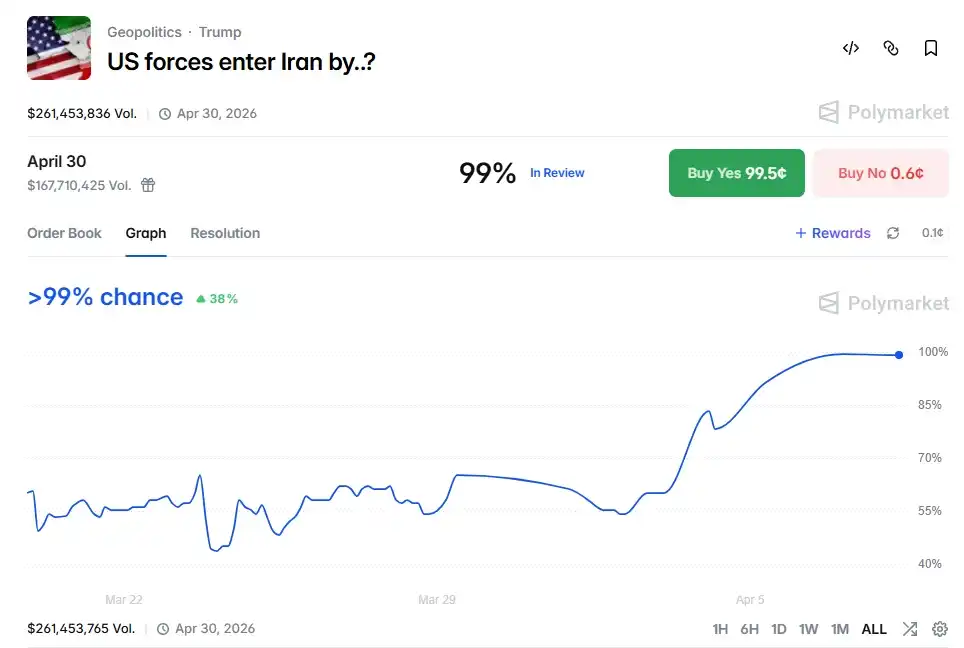
According to the settlement rules, active U.S. military personnel (including special operations forces) entering Iranian land territory before the specified date counts as an invasion. Downed pilots do not count as invasion, but the special forces sent by the U.S. military did indeed enter Iranian territory to rescue the pilot. Therefore, the special forces entering Iran to rescue the pilot met the criteria for judging "Yes" for a U.S. invasion of Iran.
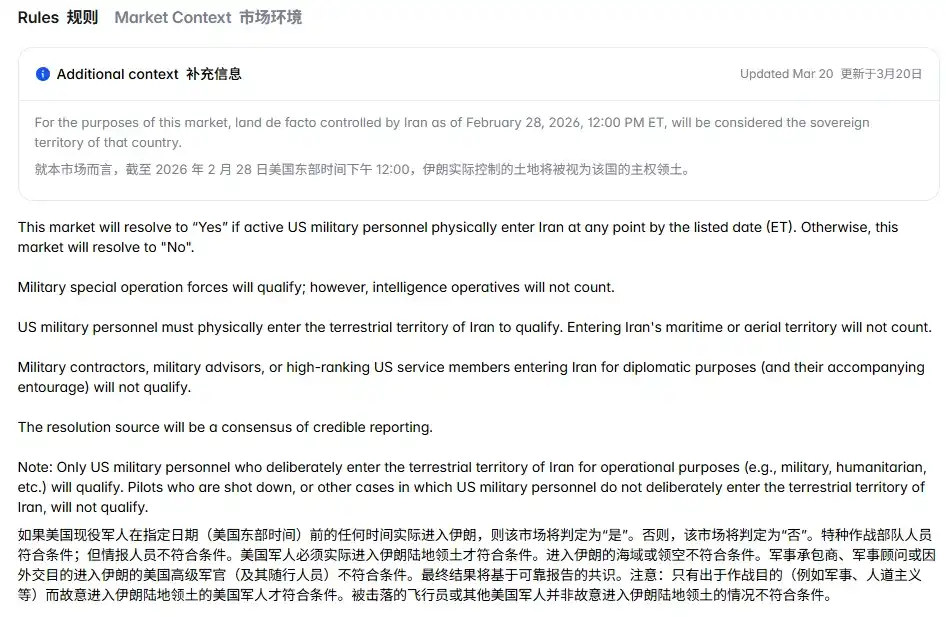
Polymarket's judgment that the "pilot rescue" event constituted a U.S. invasion of Iran has sparked strong controversy in the community.

Those supporting "counts as entry" (Yes side) argue that this operation meets the definition of "entry" in the rules. The U.S. special forces deliberately entered Iranian territory to execute a mission, and the rules explicitly state that "special operation forces will qualify," also covering "for operational purposes (including humanitarian)." Objectively, this is the first confirmed ground infiltration by U.S. forces in the current conflict context; U.S. personnel did set foot on Iranian soil, so it should be considered "entry."

Those opposing "counts as entry" (No side) believe this definition is an overextension. The action was essentially a short-term, limited-scale humanitarian rescue, not a combat invasion (invasion), nor did it have an intent to occupy, which does not align with the public's common-sense understanding of "U.S. forces entering Iran." Furthermore, the rules explicitly exclude "pilots who are shot down... will not qualify," and this operation was precisely about rescuing a downed pilot, possessing a nature of "forced entry" and should logically fall under a similar exception. Referring to past cases (e.g., similar regional actions were not considered invasions), rescue operations should not be equated with military entry; if judged as Yes, it might encourage marginal interpretations of the rules, weakening the market's seriousness and consistency. The Chinese community also generally believes that "entering Iran" should refer more to large-scale ground or amphibious operations, not short-term "rescue and leave" actions.

Predict.fun: Polymarket Issuing Stablecoin Judged as Token Launch

On the evening of April 6, Polymarket officially announced on X a comprehensive exchange upgrade:

  • Rebuilding the trading engine, upgrading smart contracts;
  • Launching a new native collateral token, Polymarket USD (1:1 pegged to USDC, to replace USDC.e and reduce bridging risks).

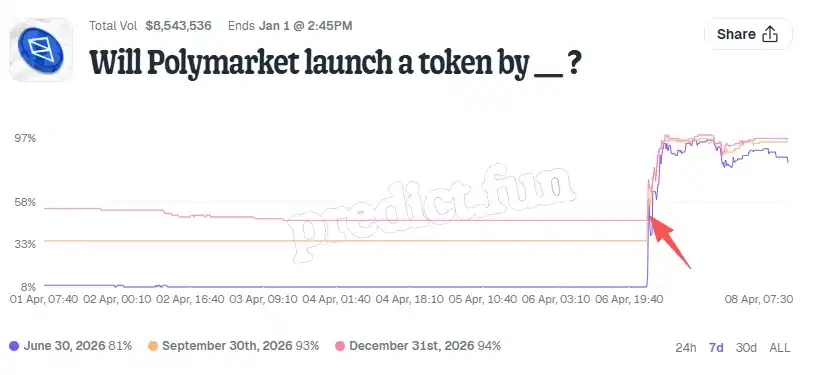
The second point, mentioning the launch of the native collateral token Polymarket USD, directly affected the probability of two related prediction events on the Predict.fun platform: one about token launch; the other about post-launch market cap:

1. When will Polymarket launch a token? (Will Polymarket launch a token by ___ ?)
2. Polymarket's FDV one day after launch (Polymarket FDV above ___ one day after launch?);
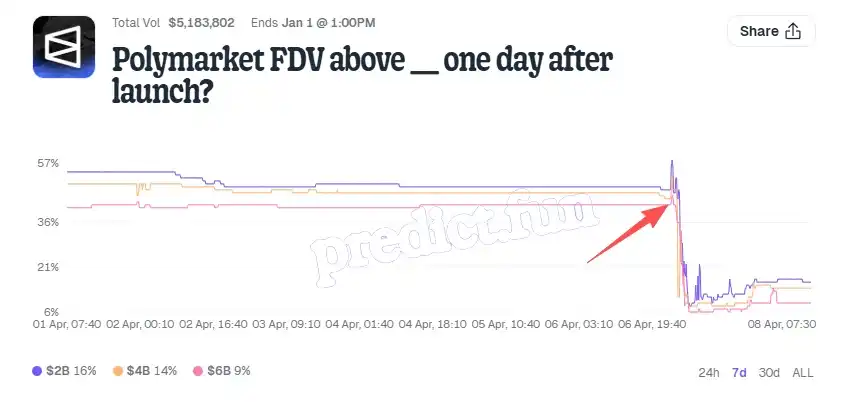
According to the settlement rules document, it clearly states that "any fungible token issued by Polymarket counts as a 'token launch' in this event", and stablecoins are of course no exception. Therefore, the Polymarket stablecoin meets the criteria for a Yes judgment.
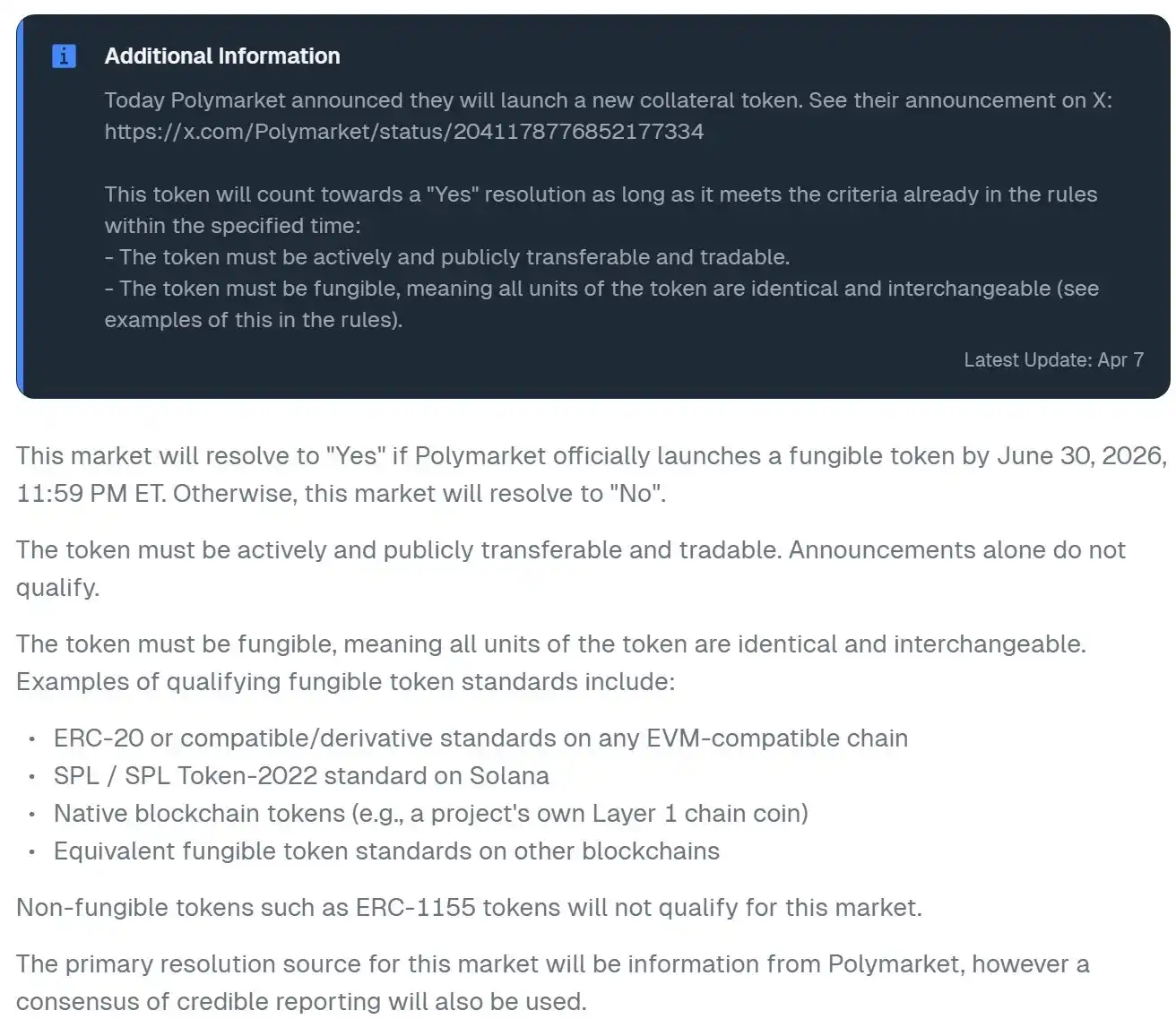
Relevant explanation of settlement rules

The community debated this issue.

Supporters argue that, literally from the rules, "issuing a token" is not limited to must be a "governance token," but is a general term for all tokens. Under this premise, Polymarket USD, as a fungible token (like ERC20/SPL) issued by Polymarket, essentially fits the definition of "token launch." Additionally, the official follow-up clarification was more a reiteration of the existing rules rather than a temporary change, so it has some legitimacy in terms of compliance.

However, skeptics do not accept this interpretation. On one hand, they believe including stablecoins in the "token launch" category is an overinterpretation of the rules, a typical play on words; on the other hand, even if stablecoins are acknowledged as "token launch," the core of this prediction market is "Polymarket FDV," not "Polymarket USD FDV." Stablecoins serve more as collateral or settlement tools; their market cap structure is fundamentally different from that of the project's main token (e.g., a POLY governance token), so they should not be directly equated or substitute for the project's overall valuation logic.

Which Side Are You On?

Overall, looking at these events, the controversies in prediction markets essentially revolve around a core question: are you betting on "reality" or are you betting on "rules"? Often, these two do not completely overlap.

For us participating in prediction markets, understanding the rules themselves might be more important than judging the direction of events. How the information source is defined, whether there are exception clauses, whether there is room for interpretation—these details can decisively determine win or loss at critical moments.

Precisely because of this, some high-probability events that look like "sure-win bets" are not without risk; they might instead be potential "lose-everything bets." Many reversals happen exactly in these overlooked details. Rather than betting blindly, taking an extra look at the rules is more useful than complaining after losing money.


Crypto di tendenza

Domande pertinenti

QWhat is the core issue discussed in the article regarding prediction markets?

AThe core issue is the discrepancy between user expectations based on common sense or 'real-world understanding' and the actual settlement based on predefined rules, leading to controversies about rule design, fairness, and platform credibility.

QWhy was the US rescue operation for a downed pilot in Iran considered an 'invasion' on Polymarket?

ABecause the settlement rules defined 'invasion' as active entry of US military personnel, including special operations forces, into Iranian territory for operational purposes (including humanitarian), which the rescue mission technically fulfilled.

QWhat was the controversy surrounding Polymarket's launch of Polymarket USD on Predict.fun?

AThe controversy was whether launching a stablecoin (Polymarket USD) counted as 'launching a token' under the platform's rules, as the rules broadly defined it as any fungible token, but users argued it misrepresented the intent of the prediction about a governance token and FDV.

QWhat lesson does the article suggest for participants in prediction markets?

AParticipants should prioritize understanding the specific rules and definitions of the market—such as information sources, exceptions, and interpretation space—over relying solely on common sense or real-world expectations to avoid unexpected losses.

QHow did the community react to the settlement of the 'US invasion of Iran' event on Polymarket?

AThe community was divided: supporters argued it met the rule-based definition of 'entry,' while opponents felt it was an overextension that contradicted common sense, as rescue operations shouldn't be equated with military invasion.

Letture associate

After Investing in Changxin, Hefei State Capital Makes Another Move

Two events unfolded within the same week. On July 13th, the Hefei Industrial Investment Xinzhi Xinyu Equity Investment Partnership with a pledged scale of 5 billion RMB was established. Three days later, ChangXin Technology launched its online and offline public offering at a price of 8.66 RMB per share, aiming to raise approximately 57.9 billion RMB. The link between these events is the Hefei Industrial Investment Group (Hefei ChanTou). Hefei ChanTou directly holds shares in ChangXin Technology through its wholly-owned subsidiary, ChangXin Integration, and is also behind the newly established 5 billion RMB fund. This highlights a strategic move: as ChangXin approaches its IPO, Hefei ChanTou establishes a new fund to prepare for the next round of industrial investment. Founded in 2015, Hefei ChanTou is a state-owned capital investment platform focused on industrial financing and innovation. Beyond direct equity holdings in major projects like ChangXin's 12-inch memory wafer manufacturing base, it manages various provincial and municipal government-guided funds. Its self-managed fund scale exceeds 100 billion RMB. ChangXin Technology, now China's leading DRAM manufacturer, exemplifies the classic "Hefei model." A decade ago, when founder Zhu Yiming sought entry into the capital-intensive DRAM sector, Hefei's state capital provided the crucial long-term support. Pre-IPO, entities within the Hefei ChanTou system hold significant direct and indirect stakes, with a theoretical combined value of roughly 116.2 billion RMB based on the IPO price. However, this long-cycle, concentrated investment model brings financial pressure. Hefei ChanTou's financials show significant liabilities, net outflows from investing activities, and reliance on investment income. The focus is now shifting alongside Hefei's broader "654X" industrial system, which encompasses six dominant industries, five emerging industries (like AI and biopharma), and four future industries (including quantum tech and nuclear fusion). The narrative is one of transition. As the ChangXin project reaches a major milestone with its IPO, the new 5 billion RMB fund symbolizes the beginning of the next investment chapter—targeting a more diverse and early-stage array of sectors within Hefei's expanded industrial vision.

marsbit2 min fa

After Investing in Changxin, Hefei State Capital Makes Another Move

marsbit2 min fa

Should Developers Build on Corporate Blockchains Like Base and Robinhood?

Should developers build on enterprise-backed public chains like Base, Robinhood, or Stripe's Tempo? While these chains offer enticing benefits—primarily access to the platform's existing user base for accelerated growth—they come with significant, well-documented risks stemming from the inherent conflict of interest when a company controls both the underlying chain and major on-chain applications. The core promise is traffic distribution: projects gain exposure through platforms like the Coinbase wallet or app. However, this model creates five major risks: 1. **Direct Competition**: The platform can leverage its data and position to launch and prioritize its own competing products, similar to Amazon creating private-label goods or Microsoft bundling Internet Explorer. 2. **Wallet Agnosticism**: Companion wallets (e.g., Coinbase Wallet) must support multiple chains and integrate top applications across the ecosystem to remain competitive, diluting the promised exclusive traffic advantage for the enterprise chain. 3. **Competitor Exclusion**: Rival platforms (e.g., Coinbase vs. Robinhood) have no incentive to promote applications built on a competitor's chain. 4. **Profit Extraction**: The party controlling end-users holds disproportionate bargaining power and can capture most of the value, squeezing protocol profits down to marginal cost. 5. **Unfulfilled Promises**: Promised traffic support can be deprioritized or withdrawn based on shifting corporate strategies. In contrast, neutral chains like Ethereum or Solana avoid these platform risks entirely. For developers considering enterprise chains, risk mitigation strategies include: evaluating substantial onboarding grants, seeking (though often weak) contractual guarantees, and, most crucially, pursuing a multi-chain strategy while building independent user acquisition channels. Enterprise chains may be useful for initial cold-start growth, but the ultimate goal should be cultivating a dedicated user base rather than long-term dependence on a single, conflicted platform.

marsbit3 min fa

Should Developers Build on Corporate Blockchains Like Base and Robinhood?

marsbit3 min fa

The Jacobian Conjecture that plagued Yitang Zhang for 7 years was overturned and disproven by Fable 5 overnight

**Summary:** The mathematical community was shocked when the longstanding **Jacobi Conjecture**—a core problem in polynomial mapping that had remained open for 87 years—was reportedly **disproven** by **Fable 5** (an AI model from Anthropic). The conjecture, first posed in 1939, asks whether a polynomial map with a constant, non-zero Jacobian determinant must have a polynomial inverse. Despite seeming intuitive, it had resisted numerous proof attempts by leading mathematicians. The breakthrough came when a researcher, Levent Alpoge, shared a succinct counterexample generated by Fable 5: a specific polynomial map from ℂ³ to ℂ³ whose Jacobian is the constant -2, yet which is not injective (mapping three distinct points to the same image). This elegantly falsifies the conjecture in its general form for dimensions ≥3. The counterexample is simple enough to be verified by hand or with tools like Wolfram Alpha. The event sparked intense discussion, with other AI models like GPT-5.6 quickly analyzing the result and even proposing a refined conjecture. It demonstrated AI's emerging capacity for genuine mathematical creativity, not just pattern matching. The story carries a poignant human dimension: renowned mathematician **Yitang Zhang** had devoted seven years of his early career to this problem under his PhD advisor, using a flawed lemma provided by the advisor. This setback contributed to Zhang leaving academia for years, including a period working at Subway, before his later breakthrough on the Twin Prime Conjecture. The AI's swift resolution underscores the tragic waste of his early effort on a conjecture now shown to be false in higher dimensions. It's important to note the disproof specifically targets the generalized (n-dimensional, n≥3) conjecture. The 2-dimensional case, which Zhang worked on, remains open and is considered mathematically distinct and even more challenging. Nonetheless, the event marks a significant moment, prompting reflections on AI's future role in mathematical discovery.

marsbit29 min fa

The Jacobian Conjecture that plagued Yitang Zhang for 7 years was overturned and disproven by Fable 5 overnight

marsbit29 min fa

Bought Bitcoin at $117,000, Sold at $62,000 in Tears: This Company’s Faith Only Lasted a Year

Wall Street's once-hot trend of corporate "Bitcoin hoarding" has hit a painful reality check. Empery Digital, formerly an electric motorcycle company, pivoted to Bitcoin in July 2025, accumulating over 4,000 BTC at an average cost of approximately $117,600 each. As Bitcoin's price plummeted, the company faced massive paper losses exceeding its total market value by early 2026, triggering internal conflict with a major shareholder demanding a sale. In a stark reversal from its earlier refusal to sell, Empery Digital recently sold 1,400 BTC at an average price of $62,000, locking in a significant loss of roughly $77 million on just those coins. The proceeds were used to pay down $10 million in debt, prepare for legal fees related to shareholder lawsuits, and, most notably, fund a new strategic shift: a $65 million investment for a 25% stake in an AI data center facility. This move completes a cycle of chasing market trends—from electric vehicles to Bitcoin treasury and now to AI infrastructure. Empery's case exposes the leveraged nature of the corporate "treasury model," where buying Bitcoin with borrowed money works only while prices rise. Once the asset fell below its cost basis, the company was forced to sell at a loss to service debt and pivot to the next opportunity. The company's remaining assets are 1,514 BTC and its ambitions in AI, demonstrating that its stated "long-term belief" in Bitcoin had a clear price tag: a 50% discount.

marsbit39 min fa

Bought Bitcoin at $117,000, Sold at $62,000 in Tears: This Company’s Faith Only Lasted a Year

marsbit39 min fa

Trading

Spot

Articoli Popolari

Come comprare ONE

Benvenuto in HTX.com! Abbiamo reso l'acquisto di Harmony (ONE) semplice e conveniente. Segui la nostra guida passo passo per intraprendere il tuo viaggio nel mondo delle criptovalute.Step 1: Crea il tuo Account HTXUsa la tua email o numero di telefono per registrarti il tuo account gratuito su HTX. Vivi un'esperienza facile e sblocca tutte le funzionalità,Crea il mio accountStep 2: Vai in Acquista crypto e seleziona il tuo metodo di pagamentoCarta di credito/debito: utilizza la tua Visa o Mastercard per acquistare immediatamente HarmonyONE.Bilancio: Usa i fondi dal bilancio del tuo account HTX per fare trading senza problemi.Terze parti: abbiamo aggiunto metodi di pagamento molto utilizzati come Google Pay e Apple Pay per maggiore comodità.P2P: Fai trading direttamente con altri utenti HTX.Over-the-Counter (OTC): Offriamo servizi su misura e tassi di cambio competitivi per i trader.Step 3: Conserva Harmony (ONE)Dopo aver acquistato Harmony (ONE), conserva nel tuo account HTX. In alternativa, puoi inviare tramite trasferimento blockchain o scambiare per altre criptovalute.Step 4: Scambia Harmony (ONE)Scambia facilmente Harmony (ONE) nel mercato spot di HTX. Accedi al tuo account, seleziona la tua coppia di trading, esegui le tue operazioni e monitora in tempo reale. Offriamo un'esperienza user-friendly sia per chi ha appena iniziato che per i trader più esperti.

354 Totale visualizzazioniPubblicato il 2024.12.12Aggiornato il 2026.06.02

Come comprare ONE

Discussioni

Benvenuto nella Community HTX. Qui puoi rimanere informato sugli ultimi sviluppi della piattaforma e accedere ad approfondimenti esperti sul mercato. Le opinioni degli utenti sul prezzo di ONE ONE sono presentate come di seguito.

活动图片