Prediction Markets Plunge into Major Controversy Again: Are You Trading Facts or Rules?

marsbitPubblicato 2026-04-08Pubblicato ultima volta 2026-04-08

Introduzione

The prediction market sector, particularly platforms like Polymarket and Predict.fun, is facing significant controversy over event resolution rules that sometimes conflict with user expectations. Two recent cases highlight the issue. First, on Polymarket, a market asking “Will US forces enter Iran by a certain date?” was resolved as “Yes” after US special forces entered Iranian territory to rescue a downed pilot. While the rules technically defined such an operational entry as a qualifying "invasion," many users argued it contradicted the common-sense understanding of a military invasion, as the action was a limited humanitarian rescue, not a combat operation. Second, on Predict.fun, a market on “Will Polymarket launch a token?” was resolved as “Yes” after the platform announced a new stablecoin, Polymarket USD, pegged 1:1 to USDC. The rules defined a "token" as any fungible asset, but the community debated whether a stablecoin—a collateral tool rather than a governance or equity token—should truly count as the "launch" users were predicting, especially for a subsequent market on the project’s Fully Diluted Valuation (FDV). The core conflict is whether users are betting on real-world events or a platform’s specific, often technical, rules. These cases show that a high-probability bet can quickly become a loss if the rules are misinterpreted. The key takeaway for participants is to prioritize understanding the precise, written rules over their own assumptions to avoid unex...

Author | Asher(@Asher_ 0210)

Prediction markets are currently one of the most discussed sectors in Web3.

Trading around macro events, the crypto industry, and even entertainment topics continues to heat up, with discussion fervor and participation numbers constantly rising. However, as the market develops rapidly, some discordant voices have gradually emerged—some events, upon settlement, deviate from users' expectations based on common sense or "real-world understanding," sparking controversies over rule design, fairness, and even platform credibility.

Recently, two highly controversial events occurred in quick succession in prediction markets. Below, Odaily Planet Daily will sort through and discuss them.

Polymarket: U.S. Rescue of Downed Pilot in Iran Judged as U.S. Invasion of Iran

On April 3, a U.S. F-15E Strike Eagle fighter jet was shot down by Iranian air defense systems in southwestern Iran. The two crew members (one pilot, one Weapon Systems Officer/WSO) ejected; one was quickly rescued, while the other was missing for several days, hiding in the Iranian mountains.

  • The U.S. military subsequently launched a Search and Rescue (SAR) operation involving armed aircraft, helicopters, etc., ultimately successfully rescuing the second severely injured crew member (Trump personally announced "WE GOT HIM").
  • The rescue operation involved U.S. forces entering Iranian territory (mountain search and rescue, possible ground or low-altitude operations), which attracted attention given the current sensitive geopolitical conflict background.

Since U.S. forces entering Iranian territory could, in a way, be considered a U.S. invasion of Iran, this directly affected the prediction event on the Polymarket platform regarding when U.S. forces would enter Iran (US forces enter Iran by?).
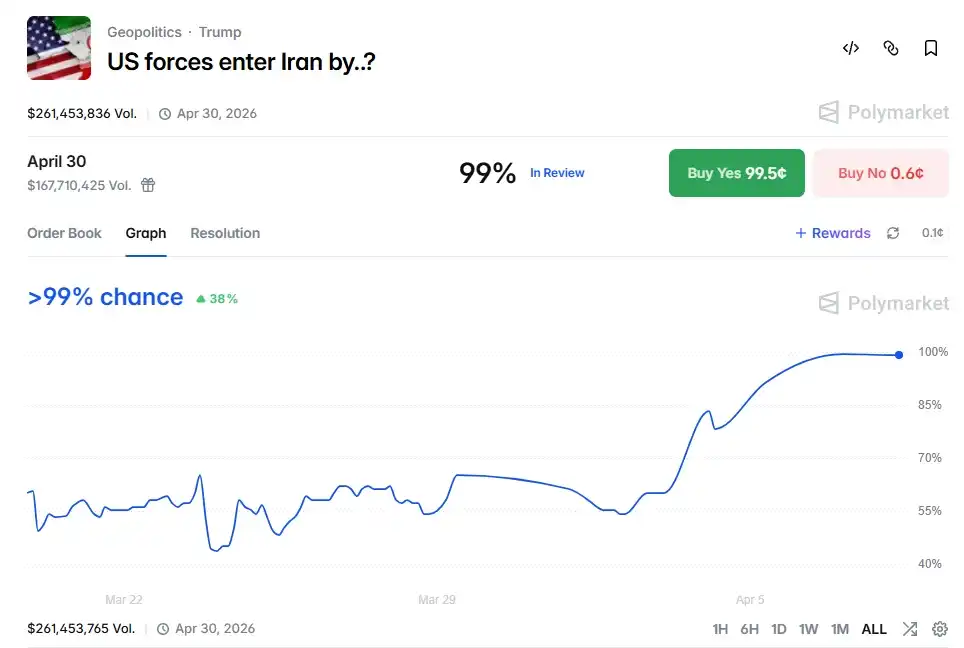
According to the settlement rules, active U.S. military personnel (including special operations forces) entering Iranian land territory before the specified date counts as an invasion. Downed pilots do not count as invasion, but the special forces sent by the U.S. military did indeed enter Iranian territory to rescue the pilot. Therefore, the special forces entering Iran to rescue the pilot met the criteria for judging "Yes" for a U.S. invasion of Iran.
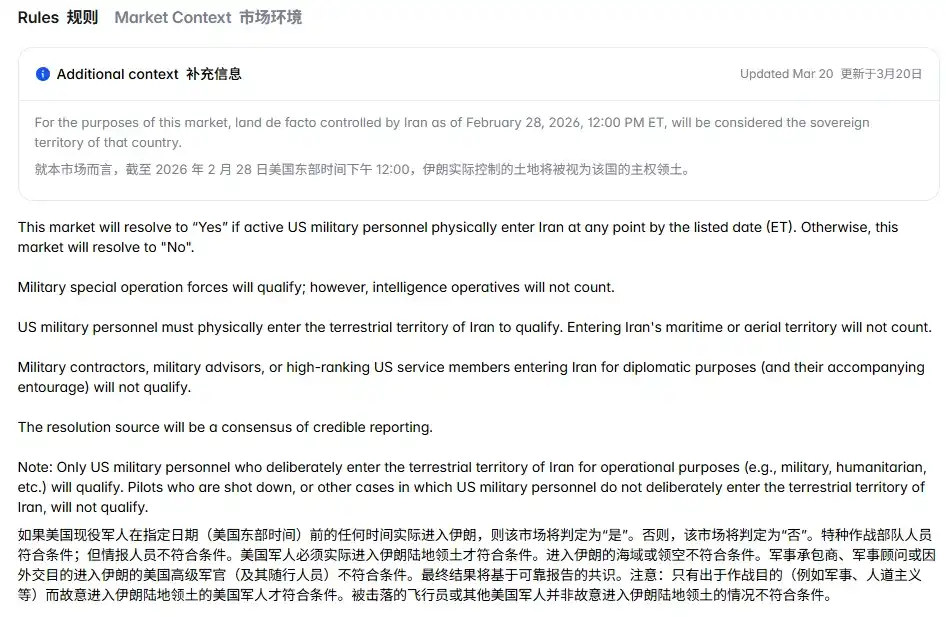
Polymarket's judgment that the "pilot rescue" event constituted a U.S. invasion of Iran has sparked strong controversy in the community.

Those supporting "counts as entry" (Yes side) argue that this operation meets the definition of "entry" in the rules. The U.S. special forces deliberately entered Iranian territory to execute a mission, and the rules explicitly state that "special operation forces will qualify," also covering "for operational purposes (including humanitarian)." Objectively, this is the first confirmed ground infiltration by U.S. forces in the current conflict context; U.S. personnel did set foot on Iranian soil, so it should be considered "entry."

Those opposing "counts as entry" (No side) believe this definition is an overextension. The action was essentially a short-term, limited-scale humanitarian rescue, not a combat invasion (invasion), nor did it have an intent to occupy, which does not align with the public's common-sense understanding of "U.S. forces entering Iran." Furthermore, the rules explicitly exclude "pilots who are shot down... will not qualify," and this operation was precisely about rescuing a downed pilot, possessing a nature of "forced entry" and should logically fall under a similar exception. Referring to past cases (e.g., similar regional actions were not considered invasions), rescue operations should not be equated with military entry; if judged as Yes, it might encourage marginal interpretations of the rules, weakening the market's seriousness and consistency. The Chinese community also generally believes that "entering Iran" should refer more to large-scale ground or amphibious operations, not short-term "rescue and leave" actions.

Predict.fun: Polymarket Issuing Stablecoin Judged as Token Launch

On the evening of April 6, Polymarket officially announced on X a comprehensive exchange upgrade:

  • Rebuilding the trading engine, upgrading smart contracts;
  • Launching a new native collateral token, Polymarket USD (1:1 pegged to USDC, to replace USDC.e and reduce bridging risks).

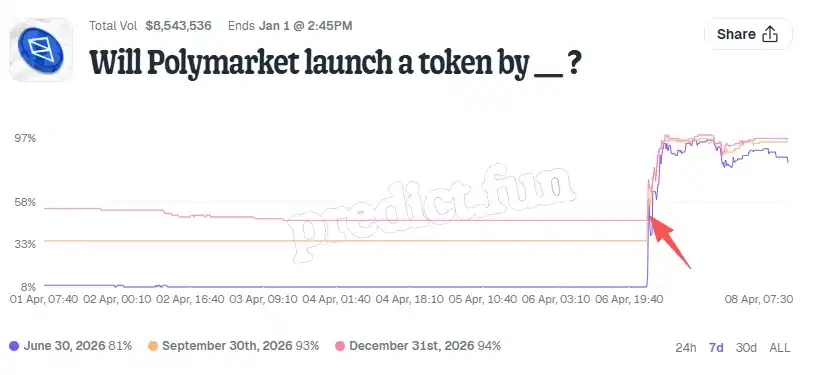
The second point, mentioning the launch of the native collateral token Polymarket USD, directly affected the probability of two related prediction events on the Predict.fun platform: one about token launch; the other about post-launch market cap:

1. When will Polymarket launch a token? (Will Polymarket launch a token by ___ ?)
2. Polymarket's FDV one day after launch (Polymarket FDV above ___ one day after launch?);
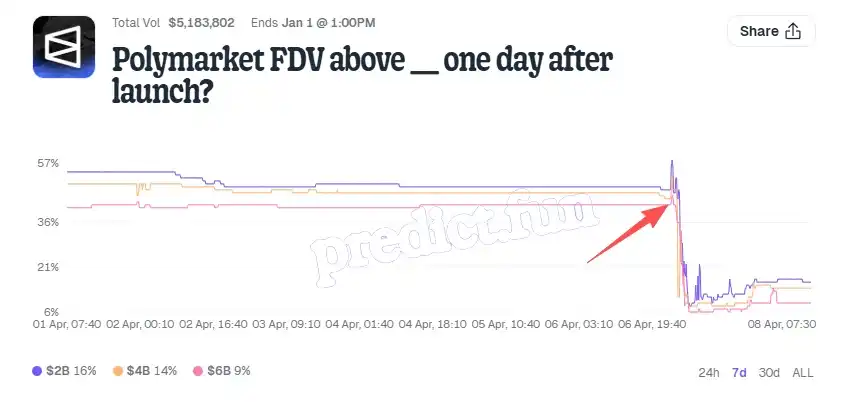
According to the settlement rules document, it clearly states that "any fungible token issued by Polymarket counts as a 'token launch' in this event", and stablecoins are of course no exception. Therefore, the Polymarket stablecoin meets the criteria for a Yes judgment.
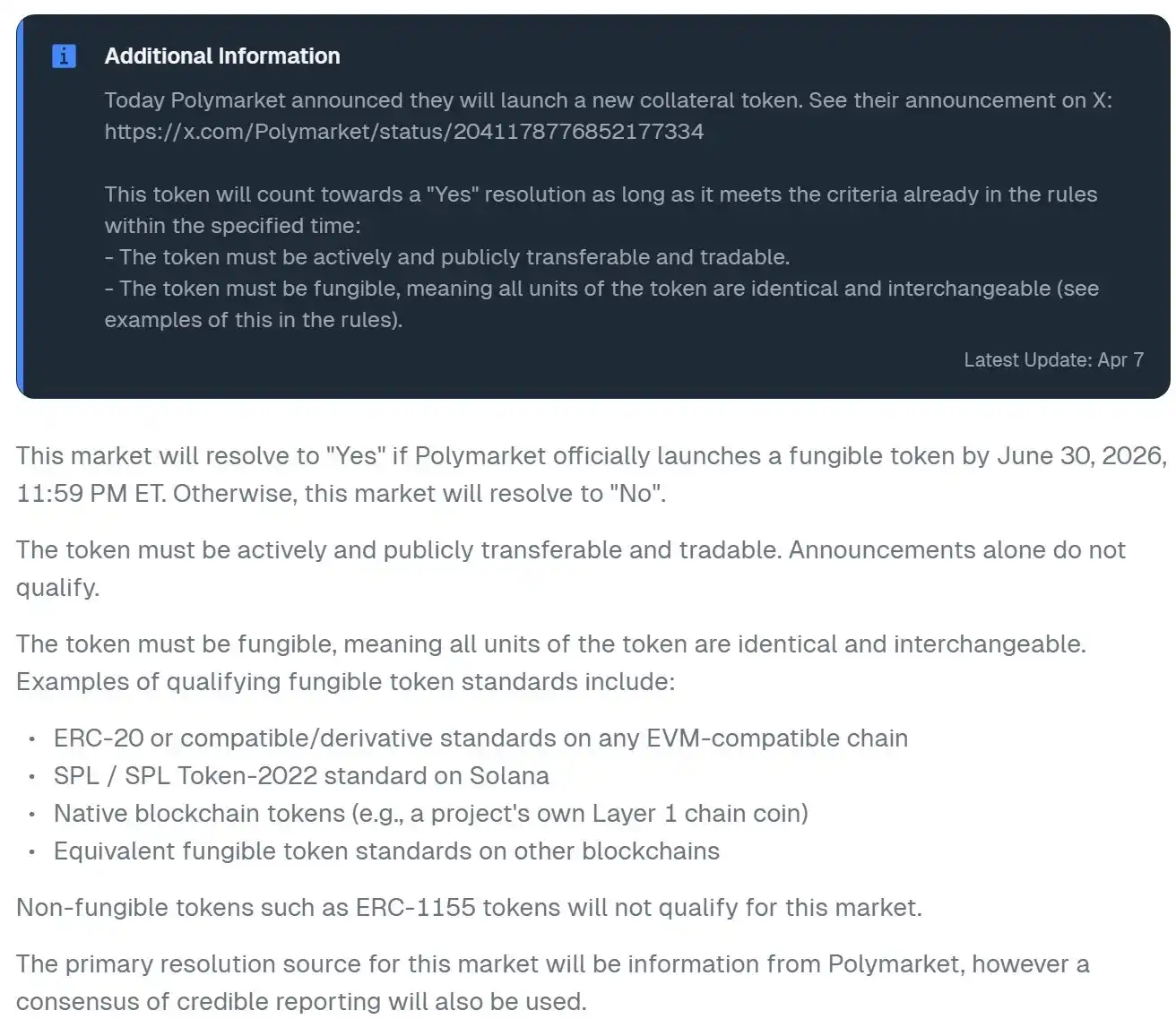
Relevant explanation of settlement rules

The community debated this issue.

Supporters argue that, literally from the rules, "issuing a token" is not limited to must be a "governance token," but is a general term for all tokens. Under this premise, Polymarket USD, as a fungible token (like ERC20/SPL) issued by Polymarket, essentially fits the definition of "token launch." Additionally, the official follow-up clarification was more a reiteration of the existing rules rather than a temporary change, so it has some legitimacy in terms of compliance.

However, skeptics do not accept this interpretation. On one hand, they believe including stablecoins in the "token launch" category is an overinterpretation of the rules, a typical play on words; on the other hand, even if stablecoins are acknowledged as "token launch," the core of this prediction market is "Polymarket FDV," not "Polymarket USD FDV." Stablecoins serve more as collateral or settlement tools; their market cap structure is fundamentally different from that of the project's main token (e.g., a POLY governance token), so they should not be directly equated or substitute for the project's overall valuation logic.

Which Side Are You On?

Overall, looking at these events, the controversies in prediction markets essentially revolve around a core question: are you betting on "reality" or are you betting on "rules"? Often, these two do not completely overlap.

For us participating in prediction markets, understanding the rules themselves might be more important than judging the direction of events. How the information source is defined, whether there are exception clauses, whether there is room for interpretation—these details can decisively determine win or loss at critical moments.

Precisely because of this, some high-probability events that look like "sure-win bets" are not without risk; they might instead be potential "lose-everything bets." Many reversals happen exactly in these overlooked details. Rather than betting blindly, taking an extra look at the rules is more useful than complaining after losing money.

Domande pertinenti

QWhat is the core issue discussed in the article regarding prediction markets?

AThe core issue is the discrepancy between user expectations based on common sense or 'real-world understanding' and the actual settlement based on predefined rules, leading to controversies about rule design, fairness, and platform credibility.

QWhy was the US rescue operation for a downed pilot in Iran considered an 'invasion' on Polymarket?

ABecause the settlement rules defined 'invasion' as active entry of US military personnel, including special operations forces, into Iranian territory for operational purposes (including humanitarian), which the rescue mission technically fulfilled.

QWhat was the controversy surrounding Polymarket's launch of Polymarket USD on Predict.fun?

AThe controversy was whether launching a stablecoin (Polymarket USD) counted as 'launching a token' under the platform's rules, as the rules broadly defined it as any fungible token, but users argued it misrepresented the intent of the prediction about a governance token and FDV.

QWhat lesson does the article suggest for participants in prediction markets?

AParticipants should prioritize understanding the specific rules and definitions of the market—such as information sources, exceptions, and interpretation space—over relying solely on common sense or real-world expectations to avoid unexpected losses.

QHow did the community react to the settlement of the 'US invasion of Iran' event on Polymarket?

AThe community was divided: supporters argued it met the rule-based definition of 'entry,' while opponents felt it was an overextension that contradicted common sense, as rescue operations shouldn't be equated with military invasion.

Letture associate

KOL's Perspective: Why Is SOL Set to Rise from This Point?

**Summary: Why SOL is Positioned for Growth at This Level** The article argues that SOL is poised for an upward move from its current price point, citing several key factors. Primarily, SOL has just broken out of a 4-month consolidation phase. This breakout signals a return of risk appetite to the broader crypto market, as SOL is seen as a key indicator of overall crypto health. The token's ownership has reportedly shifted from short-term traders and tourists to long-term accumulators, leading to low volume. Any meaningful increase in trading activity could thus trigger significant upward momentum. Fundamental strengths include strong institutional adoption, integration with DeFi and RWAs (Real-World Assets), and the potential benefits from the Clarity Act. Despite its high volatility—having dropped 70% from its all-time high but still up 12x from its bear market low—SOL is highlighted as one of the few tokens from the last cycle to reach new highs. It boasts a robust ecosystem of applications, users, and protocols. Future catalysts include the expected influx of AI developers following the Miami Accelerate conference, which focused on AI on Solana. Furthermore, Solana is positioned as the premier chain for memecoin activity, a trend expected to continue and drive network usage and fees. The article concludes that recent price action reflects a healthy transfer to long-term holders, setting the stage for growth.

marsbit27 min fa

KOL's Perspective: Why Is SOL Set to Rise from This Point?

marsbit27 min fa

Those Pre-Bitcoin PoW Protocols Have Recently Been Reimplemented

This article details a recent surge in replicating pre-Bitcoin Proof-of-Work (PoW) protocols, specifically focusing on Hal Finney's 2004 RPOW (Reusable Proofs of Work). Within five days in May 2026, multiple independent builders in the Bitcoin/cypherpunk community launched projects inspired by this early electronic cash proposal. The initiative began with Fred Krueger's `rpow2.com`, a centralized but auditable system that replaced RPOW's original IBM 4758 hardware with Ed25519 signatures. Initially a faithful replica, it later adopted Bitcoin-like features (21M supply cap, difficulty adjustment) and a controversial 5.24% founder allocation. This sparked rapid forks, including `rpow4.com` which incorporated full Bitcoin parameters, a prediction market (`rpowmarket.com`), and a DEX (`rpow2swap.com`). Concurrently, Mike In Space created a prototype of Wei Dai's 1998 b-money proposal (`b-money.replit.app`), pushing the historical exploration even further back. The article contrasts these centralized, server-dependent experiments with Bitcoin's core innovation of decentralized, trustless consensus. It also highlights a parallel development: the `HASH` project on Ethereum, which uses smart contract hooks to enable a purely fair-launch, browser-mineable PoW token with 0% allocations to team or VCs. The collective activity is framed as a meme-driven, educational exploration of cypherpunk history rather than a serious financial movement, with all projects heavily disclaiming any investment value.

marsbit32 min fa

Those Pre-Bitcoin PoW Protocols Have Recently Been Reimplemented

marsbit32 min fa

South Korean Exchanges 'Battle' Regulators, Challenging the Boundaries of Enforcement and Legislation

South Korea's cryptocurrency industry is engaged in a rare, direct confrontation with regulators. The Financial Intelligence Unit (FIU), the primary anti-money laundering (AML) watchdog, has recently imposed heavy penalties on major exchanges like Upbit and Bithumb for alleged violations involving unregistered overseas VASPs and AML procedures. However, exchanges are now actively challenging these actions in court and through industry associations. In a significant shift, the Seoul Administrative Court ruled in favor of Upbit's operator, Dunamu, overturning part of an FIU-ordered business suspension. The court found the FIU's penalty criteria and justification insufficiently clear. Similarly, the court suspended the enforcement of a six-month business suspension against Bithumb pending a final ruling, citing potential irreversible harm to the exchange. Beyond legal battles, the industry is contesting proposed legislative amendments. The Digital Asset eXchange Alliance (DAXA) strongly opposes a draft rule that would mandate Suspicious Transaction Reports (STRs) for all crypto transfers over 10 million KRW (~$6,800). DAXA argues this "poison pill" clause violates legal principles and would overwhelm the STR system, increasing reports from 63,000 to an estimated 5.45 million annually for major exchanges, thereby crippling effective AML monitoring. This conflict highlights a structural tension in South Korea's crypto governance: comprehensive digital asset laws are still developing, while regulators rely heavily on AML enforcement. The industry's move from passive compliance to active legal and legislative challenges signifies a new phase, pressing for clearer rules and more proportionate enforcement. While short-term disputes may intensify, this clash could ultimately lead to a more mature and sustainable regulatory framework for South Korea's vibrant crypto market.

marsbit1 h fa

South Korean Exchanges 'Battle' Regulators, Challenging the Boundaries of Enforcement and Legislation

marsbit1 h fa

After 50x Storage Surge, Justin Sun Always Looks to the Next Decade

Sun Yuchen, known for his controversial stunts like a $30 million lunch with Warren Buffett (canceled due to a kidney stone) and eating a $6.2 million duct-taped banana, is often overshadowed by a significant fact: his decade-long track record of spotting major investment trends. In 2016, he famously advised young people to invest in Bitcoin, Nvidia, Tesla, and Tencent instead of buying property. A hypothetical $20,000 investment in Nvidia and Tesla from that list would now be worth over 50 million RMB. His latest major call was on November 6, 2025, predicting a "50x storage opportunity" tied to the AI boom, which materialized with Sandisk's stock surging nearly 50-fold by 2026. Looking ahead, Sun now focuses on the next frontier: Physical AI. He identifies four key areas: 1. **Embodied AI/Robotics**: He sees this reaching its "iPhone moment," with companies like UBTech and Galaxy General leading in commercialization. 2. **Drones**: Viewed as the first commercially viable form of Physical AI, revolutionizing sectors from warfare (e.g., AeroVironment's Switchblade) to logistics. 3. **Spatial Computing**: Beyond VR, it's about AI understanding physical space, a foundational technology for robotics and autonomous systems, exemplified by Apple's Vision Pro. 4. **Space Exploration**: After a 2025 suborbital flight with Blue Origin, Sun advocates for space as the ultimate frontier, discussing blockchain's potential role in space asset management and data transactions. His investment philosophy involves betting on entire, inevitable trends rather than single companies. For robotics, he sees Tesla (the body/manufacturer) and Nvidia (the brain/AI platform) as complementary plays. In defense drones, he highlights companies making tanks obsolete (AeroVironment) and those augmenting fighter jets (Kratos). For space, he participated in Blue Origin's flight and anticipates SpaceX's potential IPO to redefine the sector's valuation. Sun Yuchen's vision frames the next two decades not as a revolution in information flow (like the internet), but in the fundamental operation of the physical world through AI-powered robots, autonomous systems, and spatial intelligence, ultimately extending human and AI activity into space. While many still focus on conventional assets, he continues to look toward the next technological horizon.

marsbit2 h fa

After 50x Storage Surge, Justin Sun Always Looks to the Next Decade

marsbit2 h fa

Trading

Spot
Futures

Articoli Popolari

Come comprare ONE

Benvenuto in HTX.com! Abbiamo reso l'acquisto di Harmony (ONE) semplice e conveniente. Segui la nostra guida passo passo per intraprendere il tuo viaggio nel mondo delle criptovalute.Step 1: Crea il tuo Account HTXUsa la tua email o numero di telefono per registrarti il tuo account gratuito su HTX. Vivi un'esperienza facile e sblocca tutte le funzionalità,Crea il mio accountStep 2: Vai in Acquista crypto e seleziona il tuo metodo di pagamentoCarta di credito/debito: utilizza la tua Visa o Mastercard per acquistare immediatamente HarmonyONE.Bilancio: Usa i fondi dal bilancio del tuo account HTX per fare trading senza problemi.Terze parti: abbiamo aggiunto metodi di pagamento molto utilizzati come Google Pay e Apple Pay per maggiore comodità.P2P: Fai trading direttamente con altri utenti HTX.Over-the-Counter (OTC): Offriamo servizi su misura e tassi di cambio competitivi per i trader.Step 3: Conserva Harmony (ONE)Dopo aver acquistato Harmony (ONE), conserva nel tuo account HTX. In alternativa, puoi inviare tramite trasferimento blockchain o scambiare per altre criptovalute.Step 4: Scambia Harmony (ONE)Scambia facilmente Harmony (ONE) nel mercato spot di HTX. Accedi al tuo account, seleziona la tua coppia di trading, esegui le tue operazioni e monitora in tempo reale. Offriamo un'esperienza user-friendly sia per chi ha appena iniziato che per i trader più esperti.

282 Totale visualizzazioniPubblicato il 2024.12.12Aggiornato il 2025.03.21

Come comprare ONE

Discussioni

Benvenuto nella Community HTX. Qui puoi rimanere informato sugli ultimi sviluppi della piattaforma e accedere ad approfondimenti esperti sul mercato. Le opinioni degli utenti sul prezzo di ONE ONE sono presentate come di seguito.

活动图片