Prediction Markets Plunge into Major Controversy Again: Are You Trading Facts or Rules?

Odaily星球日报Pubblicato 2026-04-08Pubblicato ultima volta 2026-04-08

Introduzione

The prediction market sector, particularly in Web3, is facing significant controversy over the interpretation of event outcomes versus predefined rules. Two recent high-profile cases highlight this tension. On Polymarket, a market asking "Will US forces enter Iran by a certain date?" was settled as "Yes" after US special operations troops entered Iranian territory to rescue a downed pilot. While the rules explicitly qualified such operational entries—including humanitarian missions—as valid, many users argued that a limited, rescue-focused operation should not be considered an "invasion," contradicting common understanding. On Predict.fun, a market asking if Polymarket would "launch a token" was triggered when the platform introduced a native stablecoin, Polymarket USD, pegged 1:1 to USDC. The rules defined "token" broadly as any fungible asset, but critics argued that issuing a stablecoin—a collateralized utility token—should not count as a "token launch," which is typically associated with governance or equity tokens. This raised questions about whether the outcome reflected market expectations about valuation (FDV) or merely technical rule compliance. The core issue is whether participants are betting on real-world events or narrowly defined rules. These cases show that even high-probability markets can become "lose-everything" scenarios if rule nuances are overlooked. Understanding the rules—including definitions, exceptions, and interpretation boundaries—is crucial, a...

Original | Odaily Planet Daily (@OdailyChina)

Author | Asher (@Asher_ 0210)

Prediction markets are arguably the hottest topic in Web3 right now.

Trading on predictions surrounding macroeconomic events, the crypto industry, and even entertainment topics continues to heat up, with discussion fervor and participation numbers constantly rising. However, as the market develops rapidly, some discordant voices have gradually emerged—some events, upon settlement, deviate from user expectations based on common sense or "real-world understanding," sparking controversies about rule design, fairness, and even platform credibility.

Recently, two highly controversial events occurred in quick succession within prediction markets. Below, Odaily Planet Daily will summarize and discuss them.

Polymarket: US Rescue of Downed Pilot in Iran Judged as US Invasion of Iran

On April 3rd, a US F-15E Strike Eagle fighter jet was shot down by Iranian air defense systems in southwestern Iran. The two crew members (one pilot, one Weapon Systems Officer/WSO) ejected; one was quickly rescued, while the other was missing for several days, hiding in the Iranian mountains.

  • The US military subsequently launched a Search and Rescue (SAR) operation involving armed aircraft, helicopters, etc., ultimately rescuing the second, severely injured crew member (Trump personally announced "WE GOT HIM").
  • The rescue operation involved US forces entering Iranian territory (mountain search and rescue, possible ground or low-altitude operations), which drew attention given the current sensitive geopolitical conflict backdrop.

Since the US military entering Iranian territory could, in a way, be considered a US invasion of Iran, it directly affected the prediction event on the Polymarket platform regarding when US forces would enter Iran (US forces enter Iran by?).
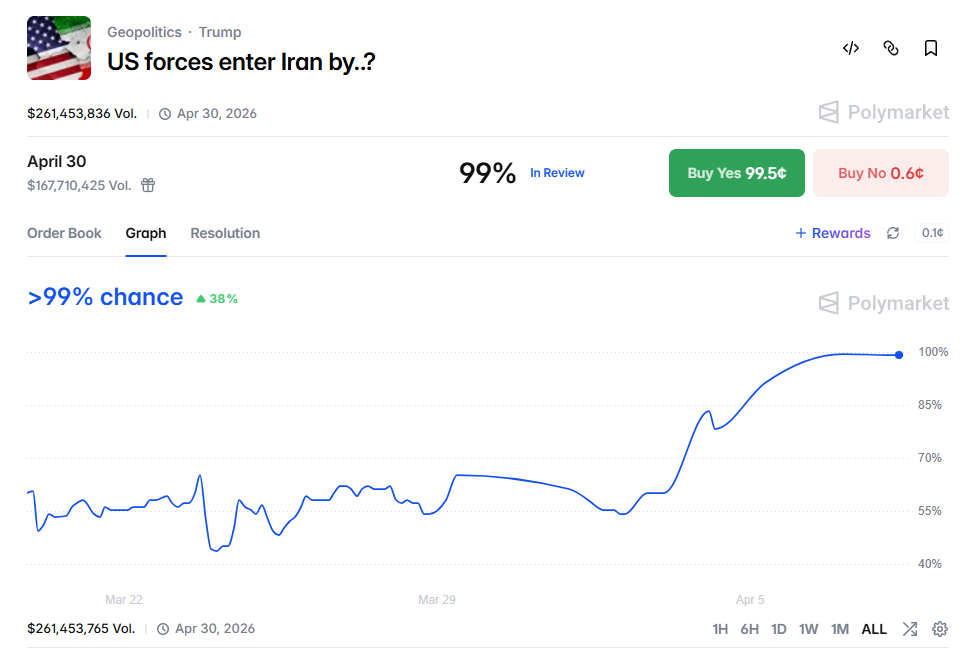
According to the settlement rules, active US military personnel (including special operations forces) entering Iranian land territory before the specified date counts as an invasion. Downed pilots do not count as invasion, but the special forces sent by the US military did indeed enter Iranian territory to rescue the pilot. Therefore, the special forces entering Iran for the rescue mission met the criteria for a Yes判定 on the US invasion of Iran.
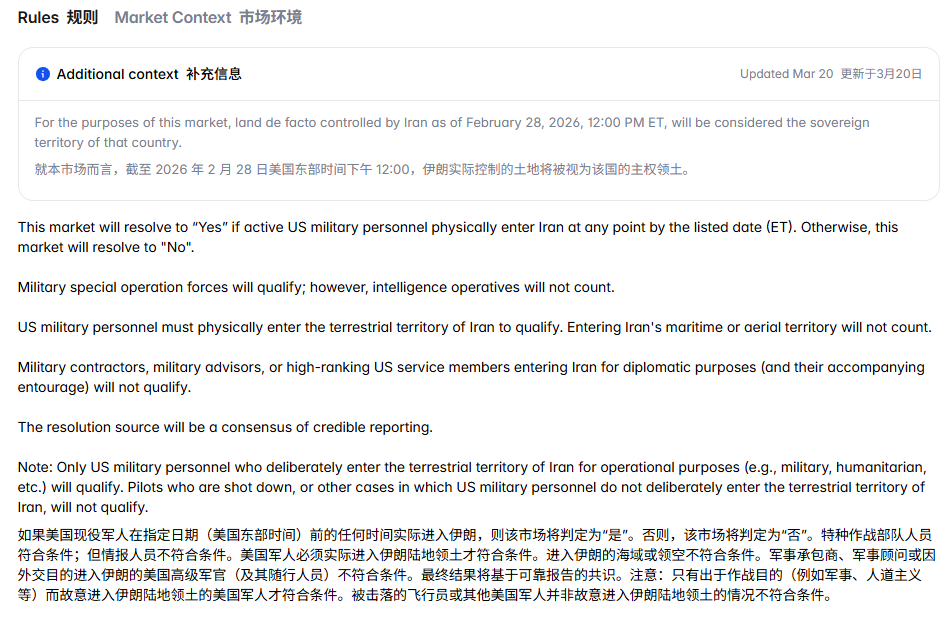
Polymarket's判定 of the "pilot rescue" event as a US invasion of Iran has sparked strong community controversy.

Those supporting "counts as entry" (Yes side) argue that this operation符合 the definition of "entry" in the rules. The US special forces deliberately entered Iranian territory to execute a mission, and the rules explicitly state "special operation forces will qualify", also covering "for operational purposes (including humanitarian)". Objectively, this is the first confirmed ground infiltration by US forces in the current conflict context; US personnel did set foot on Iranian soil, so it should be considered "entry".

Those opposing "counts as entry" (No side) believe this definition is an overextension. The action was essentially a short-term, limited-scale humanitarian rescue, not a combat invasion (invasion), nor did it have an intent to occupy,不符合 the public's common-sense understanding of "US forces entering Iran". Furthermore, the rules explicitly exclude "pilots who are shot down... will not qualify", and this operation was precisely centered around a downed pilot, possessing a "forced entry" nature, logically falling under a similar exception. Referencing past cases (e.g., similar regional actions not deemed invasions), rescue operations should not be equated with military entry;判定 it as Yes might encourage marginal interpretations of the rules, weakening the market's seriousness and consistency. The Chinese community also普遍 believes "entering Iran" should refer more to large-scale ground or amphibious warfare, not a short-term "rescue and leave" operation.

Predict.fun: Polymarket Issuing Stablecoin Judged as Token Launch

On the evening of April 6th, Polymarket官方 announced on X a comprehensive exchange upgrade:

  • Rebuilding the trading engine, upgrading smart contracts;
  • Launching a new native collateral token, Polymarket USD (1:1 pegged to USDC, intended to replace USDC.e and reduce bridging risks).

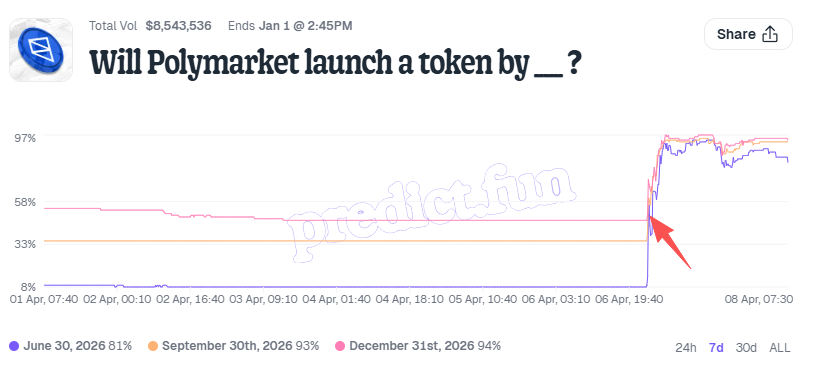
The second point, mentioning the launch of the native collateral token Polymarket USD, directly affected the probability of two related prediction events on the Predict.fun platform: one关于 token launch; the other about post-launch market cap:

1. When will Polymarket launch a token? (Will Polymarket launch a token by ___?)
2. Polymarket's FDV one day after launch (Polymarket FDV above ___ one day after launch?);
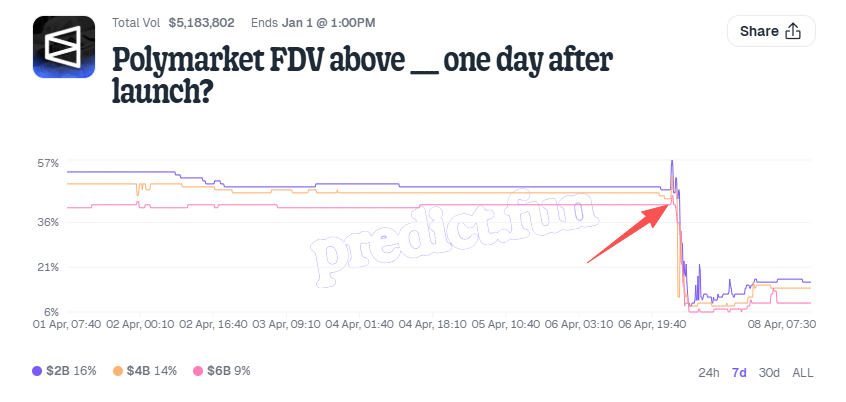
According to the settlement rules document, it clearly states that "Any fungible token issued by Polymarket counts as a 'token launch' for this event", and stablecoins are certainly no exception. Therefore, the Polymarket stablecoin meets the criteria for a Yes判定.
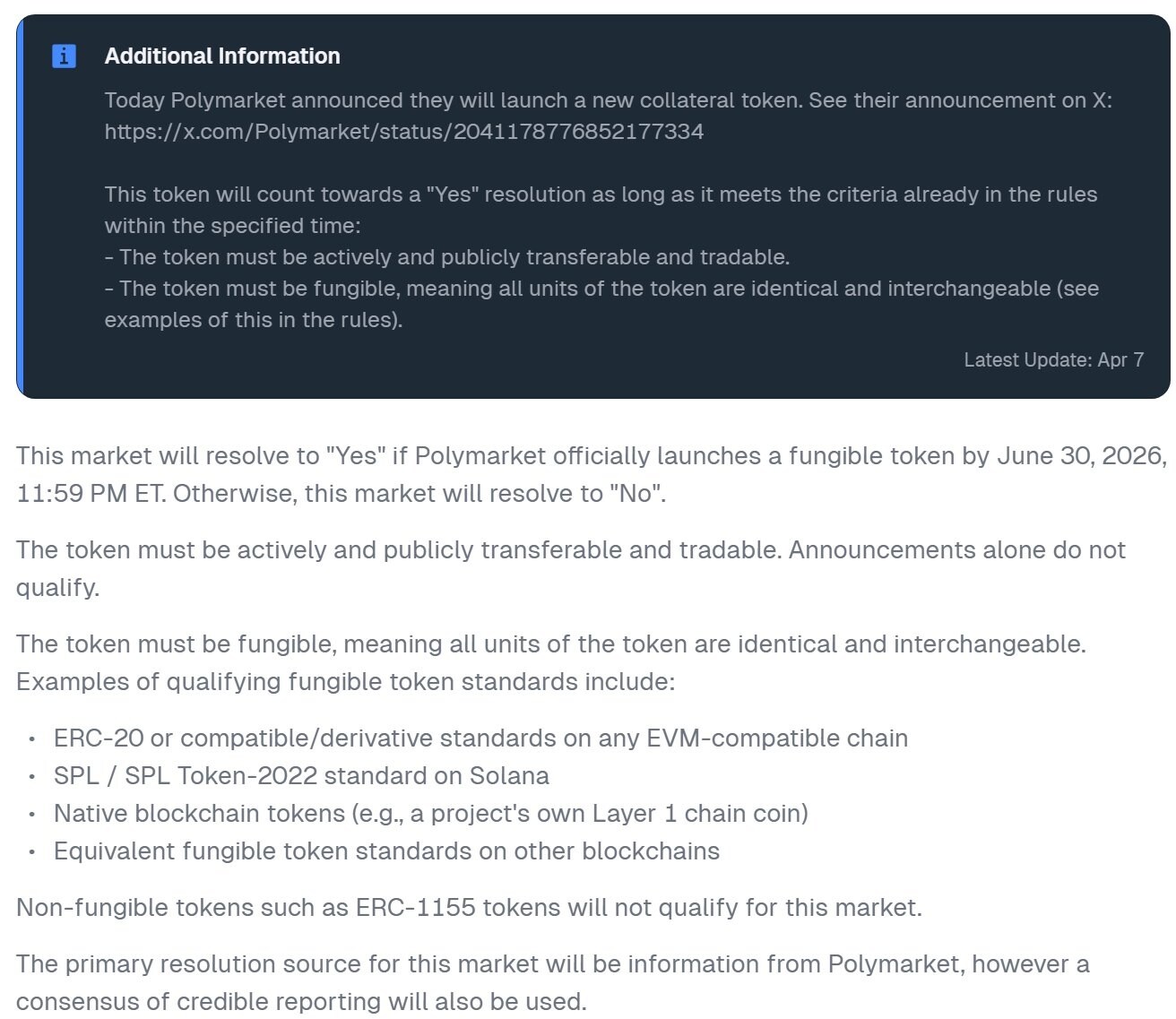
Relevant settlement rule说明

The community debated this.

Supporters argue that, literally from the rules, "issuing a token" is not limited to必须是 a "governance token" but is a general term for all tokens. Under this premise, Polymarket USD, as a fungible token (ERC20/SPL, etc.) issued by Polymarket,本质上符合 the definition of a "token launch". Additionally, the subsequent official clarification was more a reiteration of the existing rules rather than a临时 modification, so it has some legitimacy in terms of compliance.

However, skeptics do not accept this explanation. On one hand, they believe including stablecoins in the "token launch" category is an overinterpretation of the rules, a typical play on words; on the other hand, even if stablecoins are acknowledged as "token launches", the core of this prediction market is "Polymarket FDV", not "Polymarket USD FDV". Stablecoins serve more as collateral or settlement tools; their market cap structure is fundamentally different from that of a project's main token (e.g., a POLY governance token), and therefore should not be directly equated or substitute for the project's overall valuation logic.

Which Side Are You On?

Looking at the整体 picture, controversial events in prediction markets ultimately revolve around a core question: are you betting on "reality" or are you betting on "rules". Often, these two do not completely overlap.

For those of us participating in prediction markets, understanding the rules themselves might be more important than judging the direction of the event. How the information source is defined, whether there are exception clauses, whether there is room for interpretation—these details can directly determine win or loss at critical moments.

Precisely because of this, some high-probability events that look like "sure bets" are not without risk; they might instead be potential "lose-everything bets". Many reversals happen precisely in these overlooked details. Rather than betting blindly, taking an extra look at the rules is more useful than complaining after losing money.


Domande pertinenti

QWhat is the core issue discussed in the article regarding prediction markets?

AThe core issue is the discrepancy between user expectations based on real-world understanding and the actual settlement outcomes determined by platform rules, leading to debates about rule design, fairness, and platform credibility.

QWhy did the rescue operation for the downed US pilot in Iran trigger a 'Yes' settlement on Polymarket's 'US forces enter Iran' event?

ABecause the settlement rules defined 'entry' as active, deliberate incursion by US forces (including special operations) for operational purposes, and the rescue mission involved special forces entering Iranian territory, qualifying as 'invasion' under the platform's criteria.

QWhat was the opposition's argument against the 'Yes' outcome in the Polymarket Iran event?

AThey argued that the rescue was a short-term humanitarian operation, not an invasion or occupation, and should be considered an exception similar to excluded cases like shot-down pilots, as it didn't align with common understanding of 'US forces entering Iran'.

QHow did Predict.fun justify settling 'Will Polymarket launch a token?' as 'Yes' after the stablecoin announcement?

AThe rules specified that any fungible token issued by Polymarket counted as 'launching a token,' and Polymarket USD, being a fungible token, met this definition despite being a stablecoin rather than a governance token.

QWhat key advice does the article offer to participants in prediction markets to avoid losses?

AParticipants should prioritize understanding the specific rules—including definitions, exceptions, and interpretive nuances—over merely predicting real-world outcomes, as rule details ultimately determine settlement and can turn high-probability bets into losses.

Letture associate

Gensyn AI: Don't Let AI Repeat the Mistakes of the Internet

In recent months, the rapid growth of the AI industry has attracted significant talent from the crypto sector. A persistent question among researchers intersecting both fields is whether blockchain can become a foundational part of AI infrastructure. While many previous AI and Crypto projects focused on application layers (like AI Agents, on-chain reasoning, data markets, and compute rentals), few achieved viable commercial models. Gensyn differentiates itself by targeting the most critical and expensive layer of AI: model training. Gensyn aims to organize globally distributed GPU resources into an open AI training network. Developers can submit training tasks, nodes provide computational power, and the network verifies results while distributing incentives. The core issue addressed is not decentralization for its own sake, but the increasing centralization of compute power among tech giants. In the era of large models, access to GPUs (like the H100) has become a decisive bottleneck, dictating the pace of AI development. Major AI companies are heavily dependent on large cloud providers for compute resources. Gensyn's approach is significant for several reasons: 1) It operates at the core infrastructure layer (model training), the most resource-intensive and technically demanding part of the AI value chain. 2) It proposes a more open, collaborative model for compute, potentially increasing resource utilization by dynamically pooling idle GPUs, similar to early cloud computing logic. 3) Its technical moat lies in solving complex challenges like verifying training results, ensuring node honesty, and maintaining reliability in a distributed environment—making it more of a deep-tech infrastructure company. 4) It targets a validated, high-growth market with genuine demand, rather than pursuing blockchain integration without purpose. Ultimately, the boundaries between Crypto and AI are blurring. AI requires global resource coordination, incentive mechanisms, and collaborative systems—areas where crypto-native solutions excel. Gensyn represents a step toward making advanced training capabilities more accessible and collaborative, moving beyond a niche controlled by a few giants. If successful, it could evolve into a fundamental piece of AI infrastructure, where the most enduring value in the AI era is often created.

marsbit8 h fa

Gensyn AI: Don't Let AI Repeat the Mistakes of the Internet

marsbit8 h fa

Why is China's AI Developing So Fast? The Answer Lies Inside the Labs

A US researcher's visit to China's top AI labs reveals distinct cultural and organizational factors driving China's rapid AI development. While talent, data, and compute are similar to the West, Chinese labs excel through a pragmatic, execution-focused culture: less emphasis on individual stardom and conceptual debate, and more on teamwork, engineering optimization, and mastering the full tech stack. A key advantage is the integration of young students and researchers who approach model-building with fresh perspectives and low ego, prioritizing collective progress over personal credit. This contrasts with the US culture of self-promotion and "star scientist" narratives. Chinese labs also exhibit a strong "build, don't buy" mentality, preferring to develop core capabilities—like data pipelines and environments—in-house rather than relying on external services. The ecosystem feels more collaborative than tribal, with mutual respect among labs. While government support exists, its scale is unclear, and technical decisions appear driven by labs, not state mandates. Chinese companies across sectors, from platforms to consumer tech, are building their own foundational models to control their tech destiny, reflecting a broader cultural drive for technological sovereignty. Demand for AI is emerging, with spending patterns potentially mirroring cloud infrastructure more than traditional SaaS. Despite challenges like a less mature data industry and GPU shortages, Chinese labs are propelled by vast talent, rapid iteration, and deep integration with the open-source community. The competition is evolving beyond a pure model race into a contest of organizational execution, developer ecosystems, and industrial pragmatism.

marsbit9 h fa

Why is China's AI Developing So Fast? The Answer Lies Inside the Labs

marsbit9 h fa

3 Years, 5 Times: The Rebirth of a Century-Old Glass Factory

Corning, a 175-year-old glass company, is experiencing a dramatic revival as a key player in AI infrastructure, driven by surging demand for high-performance optical fiber in data centers. AI data centers require vastly more fiber than traditional ones—5 to 10 times as much per rack—to handle high-speed data transmission between GPUs. This structural demand shift, coupled with supply constraints from the lengthy expansion cycle for fiber preforms, has created a significant supply-demand gap. Nvidia has invested in Corning, along with Lumentum and Coherent, in a $4.5 billion total commitment to secure the optical supply chain for AI. Corning's competitive edge lies in its expertise in producing ultra-low-loss, high-density, and bend-resistant specialty fiber, which is critical for 800G+ and future 1.6T data rates. Its deep involvement in co-packaged optics (CPO) with partners like Nvidia further solidifies its position. While not the largest fiber manufacturer globally, Corning's revenue from enterprise/data center clients now exceeds 40% of its optical communications sales, and it has secured multi-year supply agreements with major hyperscalers including Meta and Nvidia. Financially, Corning's optical communications revenue has surged, doubling from $1.3 billion in 2023 to over $3 billion in 2025. Its stock price has risen nearly 6-fold since late 2023. Key future catalysts include the rollout of Nvidia's CPO products and the scale of undisclosed customer agreements. However, risks include high current valuations and potential disruption from next-generation technologies like hollow-core fiber. The company's long-term bet on light over electricity, maintained even through the telecom bubble crash, is now being validated by the AI boom.

marsbit10 h fa

3 Years, 5 Times: The Rebirth of a Century-Old Glass Factory

marsbit10 h fa

Trading

Spot
Futures
活动图片




