Prediction Market Competition Heats Up, Hyperliquid Enters the Fray with 'Outcomes'

marsbitPubblicato 2026-02-03Pubblicato ultima volta 2026-02-03

Introduzione

Hyperliquid, a leading crypto derivatives exchange, has announced the test launch of "Outcomes," a new prediction market feature, causing its native token HYPE to surge over 10%. Unlike traditional prediction markets, Outcomes is designed with three core mechanisms: full collateralization (eliminating liquidation risk), non-linear settlement (enabling complex strategies similar to options), and native integration with Hyperliquid’s chain and margin system. This move positions Hyperliquid against established players like Polymarket (focused on social sentiment), Kalshi (compliant markets), and Coinbase (consumer-facing products). Hyperliquid aims to integrate prediction markets directly into its financial ecosystem, allowing users to combine derivatives and prediction positions within a unified margin account. With a highly efficient core team of 11 members generating over $1 billion in annualized revenue per person, Hyperliquid is expanding rapidly. While some analysts note that even capturing all of Polymarket’s volume would only add ~5% to Hyperliquid’s revenue, the platform’s current $7 billion valuation is considered undervalued compared to Polymarket’s $10 billion valuation. Outcomes is seen as a key step in building a comprehensive on-chain Wall Street, though it remains in testnet with no mainnet release date announced.

Original Author: Seed.eth, Bitpush News

Hyperliquid, firmly holding the top spot in the crypto derivatives track, is now attempting to extend its reach into another trillion-dollar market on the brink of explosion: the prediction market.

Today, Hyperliquid officially announced the testing of a new feature called 'Outcomes'. This news directly ignited excitement in the secondary market, with its native token HYPE recording a gain of over 10% within 24 hours, breaking through the $30 mark.
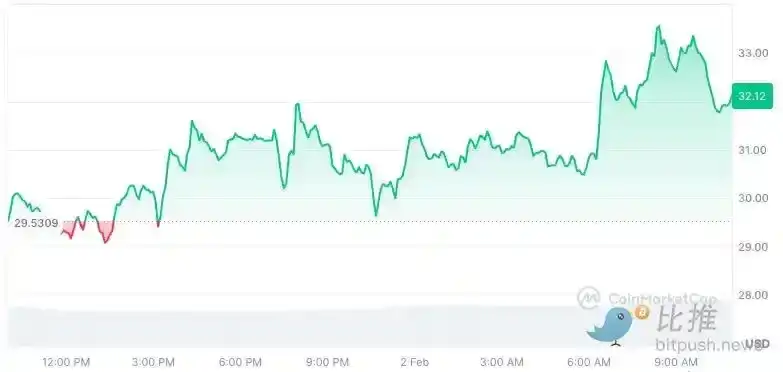
At a time when Polymarket dominates on-chain traffic and Kalshi, in partnership with Coinbase, captures the compliant market, Hyperliquid's entry is far from simple 'bandwagoning'. Instead, it leverages the absolute advantage of its native underlying performance to redefine the rules of the game.

What is Outcomes
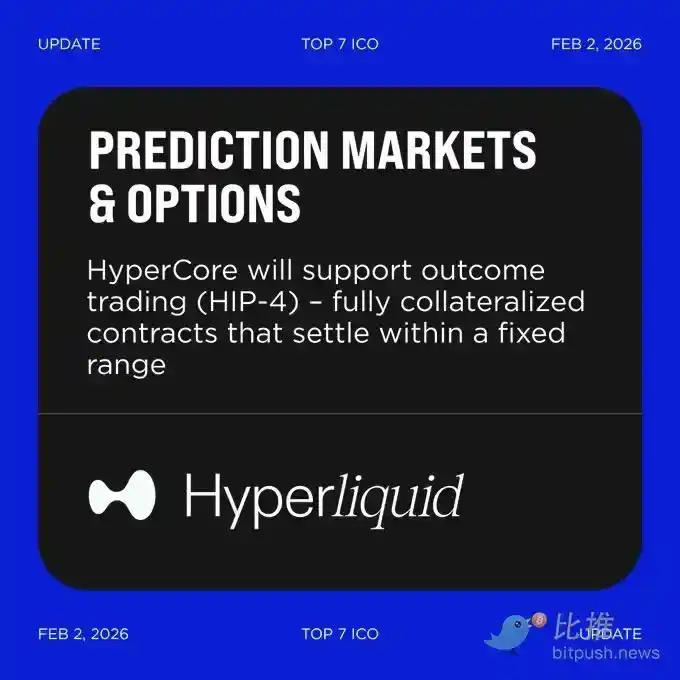
According to the official HIP-4 proposal, Outcomes (Result Contracts) are not a simple betting interface. Their design hinges on the following three core logics:

1. Full Collateralization, No Liquidation Risk

Unlike leveraged perpetual contracts, Outcomes adhere to the principle of 'you can only do as much as your money allows'. It uses full collateralization and settles within a fixed range. This means that no matter how the market fluctuates, as long as the settlement date hasn't arrived, a trader's position will not face forced liquidation, fundamentally removing the risk of being liquidated.

2. Non-linear Settlement, Greater Strategic Space

Outcomes introduces a non-linear settlement mechanism. For traders, this is equivalent to gaining a flexibility close to that of options. You can use it to build more complex hedging instruments, no longer limited to simple binary 'yes' or 'no' games, thereby opening up greater space for risk management and strategic combinations.

3. Native Integration, Liquidity Connectivity

Outcomes will be deeply integrated into HyperCore, Hyperliquid's underlying chain, and priced in its native stablecoin USDH. More importantly, it will share cross-margin with the platform's existing spot and perpetual contracts. This means users can seamlessly connect multiple trading strategies within a single margin account, truly achieving interoperability and reuse of liquidity.

Multi-Party Fragmentation: Who is the Final Form of the Prediction Market?

The current prediction market is at its '1995 browser war' moment, forming four distinct business paths:
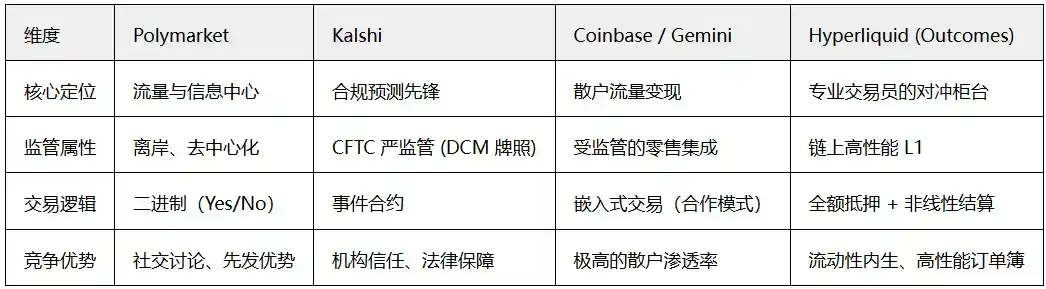
  • Polymarket sells 'opinions'; it's a barometer of social trends.
  • Kalshi sells 'compliance'; it attracts US domestic capital seeking to avoid legal risks.
  • Coinbase is about 'dimensionality reduction attack', turning the prediction market into a mass consumer product through an in-app feature.
  • Hyperliquid's logic is the most hardcore: it doesn't require you to click Yes or No on a webpage; it wants you to buy an Outcomes contract hedging 'non-farm payroll data exceeding expectations' while shorting BTC.

Right now, the community is most focused on the synergistic effect between HIP-3 (Permissionless Listing) and HIP-4 (Outcomes).

Under this architecture, Hyperliquid's evolution path is clear: first, official deployment of 'Canonical Markets' based on objective data sources, such as interest rates and macroeconomic indicators; followed by enabling permissionless deployment.
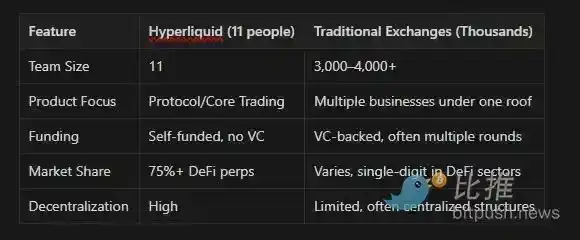
Behind this strategy is Hyperliquid's legendary team advantage. It's hard to imagine that this behemoth, with annualized revenue exceeding $1.1 billion and trading volume rivaling top-tier CEXs, is supported by a core team of only about 11 people. This 'special forces' team, composed of Harvard, MIT elites, and top quantitative hedge fund professionals, has created an astonishing efficiency of over $100 million in annualized revenue per capita. Precisely because the team is extremely lean with short decision-making paths, Hyperliquid can iterate rapidly.

A senior DeFi observer commented: 'Coinbase's entry validates the business model, but it is still centralized. Hyperliquid's Outcomes is challenging a proposition: the endgame of prediction markets does not lie in social media, but in financialization. When trading prediction outcomes becomes as smooth as buying and selling stocks, and can share margin with futures, the imagination space for on-chain finance truly opens up.'

Is HYPE Severely Undervalued?

As the crypto options market matures, the Open Interest (OI) in Hyperliquid's HIP-3 market has surged to $1 billion, and the platform's 24-hour trading volume has skyrocketed to $4.8 billion, hitting a new all-time high.
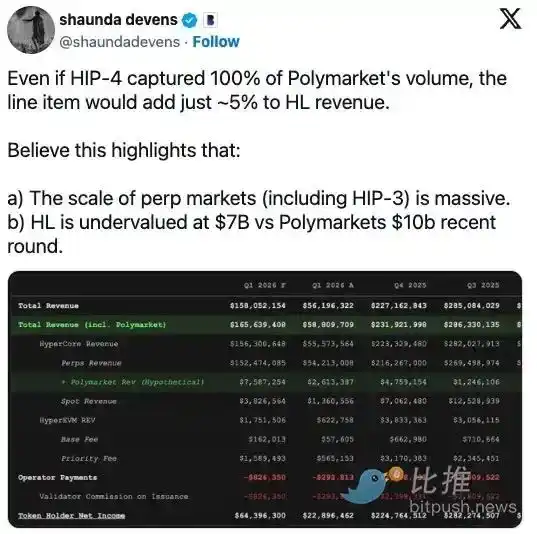
Regarding this move, Blockworks researcher Shaunda Devens believes it further supports Hyperliquid's valuation upside.

Devens pointed out that even if HIP-4 captured 100% of Polymarket's trading volume, its contribution to Hyperliquid's revenue would only be about 5%.

This data seems surprising at first glance, but the underlying logic is: the perpetual contracts market (including the long-tail assets brought by HIP-3) is extremely large. Devens believes that Hyperliquid's current valuation of approximately $7 billion is clearly in a state of significant undervaluation compared to Polymarket's latest round valuation of $10 billion (based on 2025 funding data). The launch of Outcomes is primarily about supplementing a key piece of its full-category financial matrix.

Despite the high market sentiment, it is important to note that Outcomes is currently still in the testnet phase, and a specific timeline for the mainnet launch has not been announced yet. However, with the explosion of the HyperEVM ecosystem, future mainstream service providers like Kalshi or Crypto.com could, in theory, migrate to run on the Hyperliquid chain using the HIP-4 protocol.

In summary, the prediction market is ushering in its best era. In the US, thanks to the advancement of regulatory clarity, the cooperation between Kalshi and Coinbase has already made prediction markets available in all 50 states; similarly strong growth momentum is also seen in the EU and Asia. For Hyperliquid, Outcomes is not a simple 'gambling game'; it is an indispensable piece of the puzzle in building the 'on-chain Wall Street'.

Original link

Domande pertinenti

QWhat is Hyperliquid's new feature called and what market is it targeting?

AHyperliquid's new feature is called 'Outcomes', and it is targeting the prediction market.

QWhat are the three core design principles of Hyperliquid's Outcomes feature?

AThe three core design principles are: 1. Full collateralization with no liquidation risk. 2. Non-linear settlement for greater strategic flexibility. 3. Native integration on HyperCore, sharing cross-margin with existing spot and perpetual contracts.

QHow did the announcement of Outcomes affect the price of the HYPE token?

AThe announcement caused the HYPE token to surge over 10% in 24 hours, pushing its price above $30.

QAccording to the article, how does Hyperliquid's approach to the prediction market differ from competitors like Polymarket and Kalshi?

AHyperliquid's approach is not a simple gambling interface; it leverages its native chain's performance to create a financialized product that integrates seamlessly with other derivatives, allowing for complex hedging strategies. This contrasts with Polymarket, which focuses on social sentiment, and Kalshi, which focuses on regulatory compliance.

QWhat was a key observation from Blockworks researcher Shaunda Devens regarding Hyperliquid's valuation after the Outcomes announcement?

AShaunda Devens observed that Hyperliquid's ~$7 billion valuation is significantly undervalued compared to Polymarket's latest $10 billion valuation, even if Outcomes captured 100% of Polymarket's volume, as the perpetuals market is vastly larger and is Hyperliquid's primary revenue driver.

Letture associate

In Conversation with Ray Dalio: We Are Currently in an AI Bubble, with 1% of My Portfolio in Bitcoin

Ray Dalio, founder of Bridgewater Associates, warns in an interview that the current AI boom shows classic bubble characteristics, which could lead to significant economic downturns as seen in past cycles like 1929 or 2000. He explains that speculative enthusiasm, fueled by debt and overvaluation, often precedes a crash when rising rates or taxation force asset sales, causing widespread losses and recession. Dalio also outlines his "Big Cycle" theory, describing an approximate 80-year pattern where widening wealth gaps, massive government deficits, and shifting geopolitical power (like China's rise) create internal conflict and global instability. He emphasizes that we are in a late-cycle, transitional phase where traditional powers like the US and UK face decline. For personal wealth protection, Dalio advises diversification beyond cash into assets like stocks, bonds, real estate, and particularly gold, which he prefers over Bitcoin. While he holds about 1% of his portfolio in Bitcoin as a non-printable hard asset, he views gold as more secure from technological or governmental threats. Regarding AI's impact, Dalio believes it will disproportionately benefit capital owners, worsening inequality by replacing both physical and cognitive labor. He suggests that human intuition and emotional intelligence, combined with AI, will be key for future workers. On taxation, Dalio argues that wealth taxes are impractical and risk triggering asset sell-offs, reducing productive investment. He points to the UK as a cautionary example of debt, low productivity, and political strife. Geopolitically, Dalio foresees a more regionalized world, with the US showing weakness in prolonged conflicts like with Iran, akin to past imperial declines. The ideal outcome, he suggests, is coexisting powerful blocs (e.g., Americas, China-Asia Pacific) without major war.

marsbit3 h fa

In Conversation with Ray Dalio: We Are Currently in an AI Bubble, with 1% of My Portfolio in Bitcoin

marsbit3 h fa

Daily 7.2 Trillion KRW: Foreign Capital's Record Net Buying on Friday! Wall Street Says Headwinds for Korean Stock Fund Flows Have Subsided

South Korean stock market sees a dramatic shift in fund flows. On July 31, foreign investors made a record net purchase of approximately KRW 7.2 trillion in KOSPI stocks, marking a fundamental reversal from the persistent large-scale net outflows seen in previous months. This contributed to a significant narrowing of foreign net selling in July to KRW 9.8 trillion, down sharply from KRW 48.4 trillion in June and KRW 44.5 trillion in May. Simultaneously, domestic institutional pressure eased. South Korean pension funds and asset managers turned to a net buying position in July, purchasing KRW 1.0 trillion worth of KOSPI shares, contrasting with net sales in May and June. Market volatility is expected to be dampened by new financial regulations. Effective July 31, the Financial Services Commission tightened access for retail investors to single-stock leveraged ETFs by raising the minimum cash deposit requirement. Trading volumes for these products subsequently dropped to about 50% of their monthly average. Citigroup Research maintains its year-end KOSPI target of 10,000 points. The firm cites several supportive factors: the substantial easing of headwinds from capital outflows, a robust fundamental outlook for the semiconductor sector, historically low market valuations, strong economic fundamentals, and the potential for policy support from financial authorities if needed.

marsbit3 h fa

Daily 7.2 Trillion KRW: Foreign Capital's Record Net Buying on Friday! Wall Street Says Headwinds for Korean Stock Fund Flows Have Subsided

marsbit3 h fa

Thanks to Dice Rolls, Bitcoin Keys Are Stored Offline, But Not Everyone Will Do It

The article discusses using dice rolls to generate secure Bitcoin wallet seeds, providing entropy independent of potentially flawed hardware random number generators. It explains that each fair dice roll offers about 2.585 bits of entropy, with around 50 rolls needed for a standard 12-word seed phrase and 99+ recommended for higher security. This method gained attention after a vulnerability was revealed in some Coldcard hardware wallets, where a faulty firmware RNG (dating back to 2021) compromised generated keys. The analysis notes that while a dice-generated main seed was safe from this specific flaw, other Coldcard functions (like creating paper wallets, backup keys, or passwords) could still be vulnerable if they used the defective RNG. The piece argues that while dice-based entropy is technically robust, the manual process is error-prone, tedious, and unrealistic for most new users, who might make mistakes in recording or inputting rolls. It concludes that while manual entropy generation should remain an option for advanced users, the long-term goal is to develop reliable, user-friendly hardware and software that securely generates randomness without requiring specialized knowledge. Coldcard users are advised to check their firmware version and replace any secondary secrets (like paper wallet keys) created with vulnerable devices, while also considering multi-signature setups with devices from different manufacturers for added security.

cryptonews.ru8 h fa

Thanks to Dice Rolls, Bitcoin Keys Are Stored Offline, But Not Everyone Will Do It

cryptonews.ru8 h fa

Trading

Spot
活动图片





