Predicting Market True and False Gambling Gods: Debunking the 8300x Miracle; Price Manipulation Nets $230,000

Odaily星球日报Pubblicato 2026-01-19Pubblicato ultima volta 2026-01-19

Introduzione

This article exposes two controversial cases on the prediction market platform Polymarket, highlighting issues of manipulation and deception. The first case involves a trader, ascetic, who claimed an 8,300x return—turning $12 into over $100,000 through 16 consecutive successful bets on Bitcoin's short-term volatility. However, he was accused by another trader, Moses, of operating a "Sybil farm"—using hundreds of accounts with small initial deposits to artificially create the illusion of a miraculous winning streak. Moses provided evidence of multiple accounts with similar trading patterns, suggesting the story was a fabricated marketing ploy. The second case details a more sophisticated manipulation: a trader known as a4385 exploited low liquidity during weekend trading to profit $233,000. He heavily bought "Yes" shares in a 15-minute XRP price prediction market, driving up the price of the shares. Then, just minutes before the market settled, he purchased $1 million worth of XRP on Binance, artificially inflating its price by 0.5% to ensure his Polymarket bet would win. After settlement, he quickly sold the XRP. This maneuver, with a minimal cost of around $6,200 in fees and slippage, effectively drained the liquidity from automated trading bots on Polymarket, one of which lost its entire annual profit of $160,000. The article concludes by warning users to be cautious and discerning, as not all spectacular gains are genuine, and platform rules can be exploited for manipu...

Original|Odaily Planet Daily(@OdailyChina)

Author|Wenser(@wenser 2010)

As a hot sector that has continued to rise since the beginning of the year, the prediction market is no stranger to wealth creation miracles.

But behind the miracles, is it a true spectacle achieved through careful timing and nimble maneuvering, or a false hype of artificial fraud and obfuscation? This requires onlookers to have a discerning eye. Recently, a Polymarket trader on X claimed to have achieved an "8300x miracle," betting from a $12 principal to over $100,000, but was quickly exposed for multi-account fraud and traffic炒作; another trader, through price manipulation of XRP, netted $230,000 in the "15-minute price prediction" section, executing a one-sided harvest against Polymarket's betting bots.

On the stage of betting for and against, some want to dance with lies, while others exploit rule loopholes for clever plunder. In the bet of right and wrong, there is no unbeatable strategy, only flexible tactics.

The 8300x Miracle from $12 to $100,000: Polymarket's Living Billboard VS Trader's Fraud Scheme

The story begins with a post "self-reporting a journey from a $12 principal to $100,000 in profit, achieving an 8300x return".

On January 16th, trader ascetic posted saying that through "all-in bets on short-term Bitcoin volatility", they doubled their principal 16 times consecutively, ultimately achieving the milestone of going from $12 to $100,000 in profit. Simultaneously, they emphasized that they "also specifically shared their betting strategy and the reasoning behind it" during the betting process.

Subsequently, they posted a link to their Polymarket account in the comments,直言 such wealth creation miracles can only happen on Polymarket (Odaily Planet Daily Note: Does it feel familiar? Platforms where traders previously used similar expressions include but are not limited to OpenSea, Blur, Pump.fun, Hyperliquid, Aster, etc.).

The comments section then上演 a "Polymarket community member's adrenaline-fueled狂欢", with countless people congratulating them,甚至 Polymarket Global Growth Lead LeGate commented: "Congrats bro! I think you deserve it! Congrats on the @PolymarketTrade badge!" (Odaily Planet Daily Note: This account is for the Polymarket active trader community.)

If you thought this would be a常规 "overnight wealth炫耀 post", then you might have underestimated the drama level of the situation.

Soon, the wind direction of this "Polymarket 8300x return miracle" event took a sharp turn for the worse.

From Betting Miracle to Fraud Scheme: 8300x Return Data Questioned

On January 16th itself, a trader named Moses, who自称 "ranked 515th in Polymarket trading for 2025", posted质疑 trader ascetic's account data, saying: "Did you ever wonder why his account balance was $3000 in the first post? The answer is simple: he operates a massive 'sybil farm'. He didn't start with $12, but with hundreds of accounts, each funded with $10 to $20. Once one account reached $2900, he started posting. Since then, he has made seven trades, all wins.

But note, he bets his entire stack every time. Real traders don't do this. He's just chasing clout, doing whatever it takes to get there.

Failing to get enough volume, he also seems to use other accounts to fake trade to get the price he wants.

Before blindly believing 'influencers', please do your own research. The attached image shows some of his failed sybil accounts that only made it to $1000 max."

Subsequently, Moses added in the comments that all accounts were created 7 months ago and consistently participated in random markets, all starting the same challenge on the same day 2 months ago. The entire "$10 to $100k" story is fake!

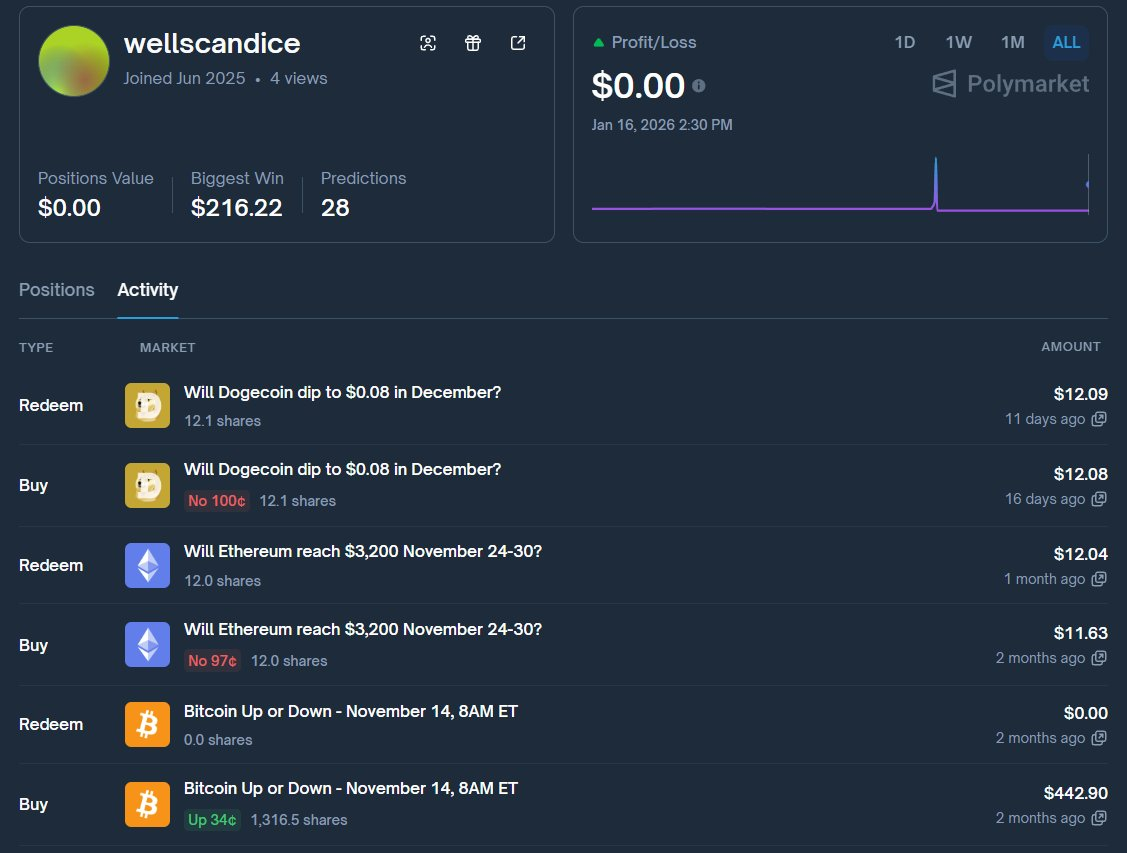
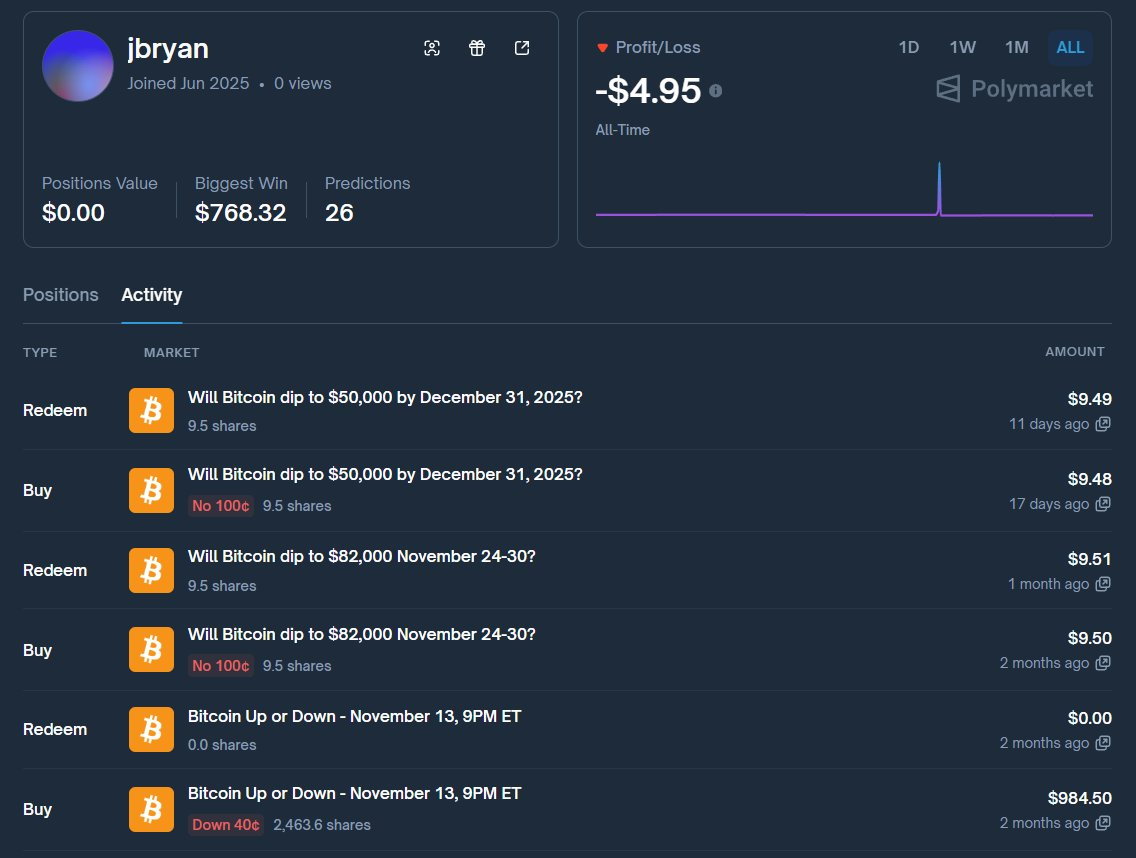
Not only that, he also posted screenshots and links to the corresponding sybil account homepages:

  • Account one: https://polymarket.com/@brockmatthew;
  • Account two: https://polymarket.com/@wellscandice;
  • Account three: https://polymarket.com/@jbryan.
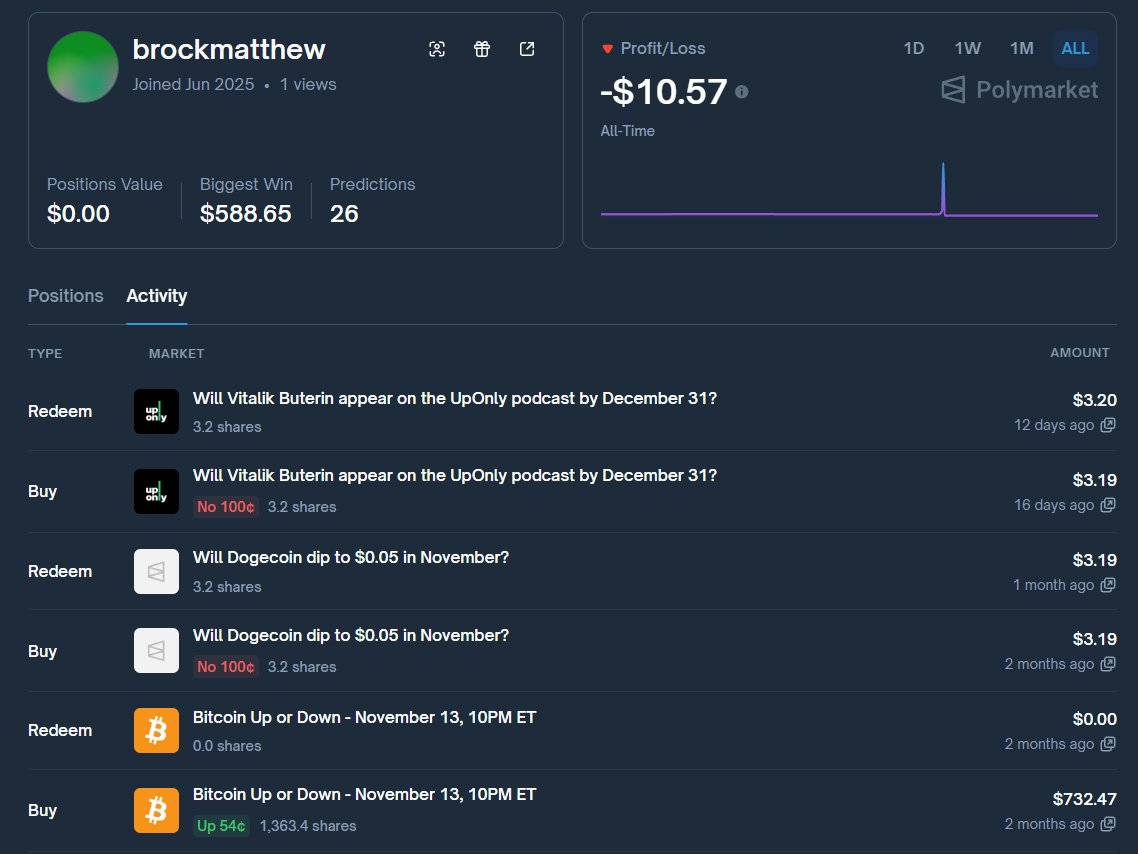
Although ascetic later responded in the comments that the wallets and accounts mentioned by Moses were unrelated to them, and some ZSC DAO (a Polymarket trader community) members also voiced support, calling Moses's actions a cyber attack, the association between the bot-like reply content on ascetic's previous tweet and their Polymarket account and numerous accounts with similar behavioral traces still greatly reduced the credibility of this "8300x return miracle".

Someone in the comments also mentioned it was hard to understand the reason for doing this, as "7 consecutive winning bets" itself is already impressive; but随后 someone pointed out this was still a game of "bot-style wide net".

Somewhat ironically, Moses's own bio also reads "The Road from $1 to $1M", whether it's a real record or a personal goal, we don't know.

Compared to the hard-to-judge ascetic, the following case of a trader who made $230,000 in profit through price manipulation in the XRP "15-minute price prediction market" might be more worthy of study by whale players.

Trader Uses Binance Spot to Counter-Harvest Prediction Market: $1M Principal Nets $230K Profit

On January 18th, Polymarket trader PredictTrader posted exposing a trader's操作 worthy of a "Wolf of Wall Street" drama—by harvesting liquidity from trading bots, he made $233,000 in just a few hours, and it hadn't even attracted大规模 market attention yet.

The timing chosen by this trader, a4385, was also extremely clever—it was Saturday evening, market liquidity was low, and Binance spot order book liquidity was also relatively thin.

In the "XRP Up/Down — Jan 17, 12:45-1:00 PM ET" market, he heavily bought "Yes" shares.

His counterparties were the more common "individual market makers" on Polymarket—various trading bots. (Odaily Planet Daily Note: Market making on Polymarket is relatively simple, with low entry barriers for individual developers, trading bots are very popular now). By 10 minutes into the event, XRP was down about 0.3% from the opening price, but he had pushed the "Yes" shares up to 70%. The trading bots saw a profit opportunity, unaware they were falling into the price trap set by this trader, and proceeded to sell him more "Yes" shares.

Ultimately, the trader bought $77,000 worth of "Yes" shares at an average price of 48%.

Then, just 2 minutes before the event settled, a wallet on Binance bought about $1 million worth of XRP spot, pushing its price up about 0.5%; seconds after the event settled, this $1 million spot was quickly sold off.

In other words, the cost of this price manipulation event was—approximately 0.25% one-way trade slippage + fees.

Using a Binance VIP Level 4 account (0.06%) (easy to obtain) and 0.25% two-way slippage, the total cost is approximately $6,200, the actual operating cost could be even lower. By repeating the same operation multiple times, exploiting the weekend liquidity loophole, this trader借此 emptied multiple bot wallets.

Some bots were shut down in time, while others weren't quick enough to react and lost all their funds—including @aleksandmoney, who lost their entire year's profit (about $160,000).

a4385 Polymarket account link: https://polymarket.com/profile/0x506bce138df20695c03cd5a59a937499fb00b0fe

At the end of the article, we hope that traders betting for and against, passionately battling on the prediction market, can distinguish fact from appearance. Sometimes, the truth is not always objective, while the standards and rules判定 by the platform are man-made.


Domande pertinenti

QWhat was the alleged 8300x return story on Polymarket, and what was the controversy surrounding it?

AA trader named ascetic claimed to have turned $12 into over $100,000 in profit through 16 consecutive successful bets on Bitcoin's short-term volatility, achieving an 8300x return. However, another trader, Moses, accused ascetic of running a 'Sybil farm' with hundreds of accounts, each starting with $10-$20, and only publicizing the one account that succeeded. Moses provided links to several accounts with similar creation dates and trading patterns to support the fraud allegation.

QHow did a trader allegedly manipulate the XRP price on Binance to profit on Polymarket?

AA trader, identified as a4385, manipulated the 'XRP Up/Down - 15-minute' market on Polymarket. They heavily bought 'Up' shares, pushing their price to 70% even though XRP was down 0.3%. Then, just two minutes before the market's resolution time, a wallet (likely controlled by them) bought ~$1 million of XRP spot on Binance, artificially pumping its price by ~0.5%. After the Polymarket market resolved in their favor, the XRP was quickly sold. The cost was minimal (estimated 0.25% slippage + fees), but the profit was $233,000, effectively draining liquidity from automated trading bots on Polymarket.

QWhat role did trading bots play in the XRP price manipulation scheme on Polymarket?

ATrading bots, which act as personal market makers on Polymarket, were the counterparties that sold the 'Up' shares to the manipulator, a4385. These bots, seeing a profitable opportunity to sell high-priced 'Up' shares against a falling XRP price, provided the liquidity that the manipulator needed. They failed to anticipate the upcoming artificial price pump on Binance and were consequently 'harvested' for their liquidity, with one bot, @aleksandmoney, reportedly losing its entire annual profit of ~$160,000.

QHow did the Polymarket community and officials initially react to the '8300x miracle' claim?

AInitially, the Polymarket community reacted with celebratory comments and congratulations. Polymarket's Global Head of Growth, LeGate, even congratulated the trader ascetic and awarded them a PolymarketTrade badge, seemingly endorsing the achievement as a legitimate success story for the platform before the fraud allegations surfaced.

QWhat is the core warning or lesson the article implies about prediction markets like Polymarket?

AThe article warns that not all spectacular gains are genuine. It highlights that these platforms can be susceptible to fraud, such as multi-account schemes (Sybil attacks), and sophisticated manipulation, where traders with significant capital can exploit market mechanics and liquidity providers (like bots) for profit. It advises participants to be discerning, conduct their own research, and understand that platform rules and judgments are ultimately man-made and can be gamed.

Letture associate

From Banning Doubao to Embracing Honor: Why Did WeChat Suddenly 'Change Its Face'?

The article explores the sudden shift in WeChat's strategy towards AI assistants from mobile phone manufacturers, transitioning from strict opposition to active collaboration. For over a year, WeChat fiercely resisted attempts by phone AI assistants (like ByteDance's Doubao in late 2025) to control its features via GUI automation ("simulated clicking"), citing security and data control concerns. This stance created a significant barrier for system-level AI integration. Now, Tencent has initiated A2A (Agent-to-Agent) partnerships with major phone brands like Honor, Xiaomi, OPPO, and vivo. This model allows a phone's system AI (e.g., Honor's YOYO) to parse a user's voice command and send a structured request directly to WeChat's own internal AI agent via secure APIs. WeChat then executes the action (e.g., sending a message) and returns the result. The article attributes Tencent's "change of face" to strategic pressure. While leading in social app usage, Tencent trails rivals like ByteDance and Alibaba in standalone AI app popularity. WeChat, with its vast mini-program ecosystem, is Tencent's key asset for an AI comeback. The upcoming WeChat AI agent aims to handle tasks like booking and payments within the app. However, phone system assistants remain the primary AI entry point for most users. The A2A collaboration allows Tencent to extend WeChat's AI reach to this crucial system layer while maintaining control over its core functions and data. For phone manufacturers, embracing A2A is a pragmatic move. The GUI route proved unviable due to WeChat's blocks. A2A offers a compliant path to integrate a vital service, enhancing their AI assistants' usefulness. It allows them to focus on developing their own AI ecosystems for other services while cooperating on WeChat access. The collaboration is framed as a mutual, strategic necessity: Tencent gains a distribution channel, and manufacturers gain a key functionality. The partnership relies on a "dual authorization" mechanism for security, requiring both user and app consent for each action. While questions about long-term data privacy practices remain, experts note A2A is more secure and compliant than GUI automation. Ultimately, this cooperation is seen as a tentative, calculated truce. Tencent's long-term goal is to make WeChat an AI-powered "service OS." Phone manufacturers aim to make their system AI the central user interface. Their paths may converge or clash in the future, but for now, the A2A deal represents the opening chapter in the battle for the AI-era user入口, driven by necessity and strategic calculus on both sides.

marsbit28 min fa

From Banning Doubao to Embracing Honor: Why Did WeChat Suddenly 'Change Its Face'?

marsbit28 min fa

On-Chain Figures on the Eve of Kickoff: 1.6 Billion Traded Before the World Cup Even Begins

"On-Chain Numbers on the Eve of the World Cup: $1.6 Billion Traded Before Kick-off" Analysis of on-chain markets before the 2026 FIFA World Cup reveals significant crypto integration into football. The most striking figure is the approximately **$1.6 billion** in total trading volume on the single "World Cup Winner" contract on the Polymarket prediction market platform, accumulated before a single match was played. This represents explosive growth for a sector whose annual volume surged from ~$16B in 2024 to ~$64B in 2025. The ecosystem is maturing beyond speculation. Key developments include: 1) **Infrastructure upgrades** like Polymarket's migration to native, regulated USDC stablecoin for settlements; 2) **Reliable data oracles**, such as Chainlink, being used to resolve real-world match outcomes on-chain; and 3) **Official recognition**, with FIFA appointing its first-ever "Prediction Markets" partner. Over 100 contracts now cover everything from the outright winner to individual match results and even non-sporting risks like venue relocation. This evolution marks a fundamental shift. While crypto firms are absent from FIFA's top-tier sponsor list, the technology has deeply penetrated the tournament's financial and predictive infrastructure through regulated stablecoin settlements, decentralized oracles, and new official partnership categories. The regulatory landscape remains complex and varies by jurisdiction, but on-chain markets for the World Cup are already a multi-billion-dollar reality.

marsbit1 h fa

On-Chain Figures on the Eve of Kickoff: 1.6 Billion Traded Before the World Cup Even Begins

marsbit1 h fa

From SpaceX's IPO to the Future of Crypto: Which Crypto Sectors Will Host the Trillion-Dollar Narrative?

From the SpaceX IPO, which targets a $750 billion raise at a $1.77 trillion valuation, we can extrapolate capital flow trends relevant to crypto. The focus shifts from speculative narratives to foundational infrastructure and real-world asset (RWA) integration. Key crypto sectors poised to benefit include: 1. **AI Infrastructure**: The narrative is moving from consumer-facing AI applications to underlying, scarce resources like compute power and decentralized GPU networks (e.g., TAO, RENDER, AKT, IO). These protocols are positioning as the essential "picks and shovels" providers for the AI economy. 2. **Real-World Assets (RWA)**: Beyond tokenized treasury bonds, RWA's future lies in on-chain equity and pre-IPO assets like SpaceX. This could democratize access to high-growth assets and reshape global capital flows, benefiting infrastructure projects like ONDO, LINK, and Plume that facilitate issuance, data, and liquidity. 3. **Core Financial Infrastructure**: Stablecoins, payment networks, and DePIN (Decentralized Physical Infrastructure Networks) are critical for settling the future on-chain economy. Their role expands from internal trading tools to foundational layers for global finance, AI systems, and real-world asset networks, leading to potential value reassessment. In summary, the next cycle may prioritize long-term infrastructure value—AI compute, asset tokenization networks, and settlement layers—over short-lived application hype, mirroring the broader market's shift towards funding the foundational systems of the future.

marsbit1 h fa

From SpaceX's IPO to the Future of Crypto: Which Crypto Sectors Will Host the Trillion-Dollar Narrative?

marsbit1 h fa

Trading

Spot
Futures

Articoli Popolari

Come comprare GODS

Benvenuto in HTX.com! Abbiamo reso l'acquisto di Gods Unchained (GODS) semplice e conveniente. Segui la nostra guida passo passo per intraprendere il tuo viaggio nel mondo delle criptovalute.Step 1: Crea il tuo Account HTXUsa la tua email o numero di telefono per registrarti il tuo account gratuito su HTX. Vivi un'esperienza facile e sblocca tutte le funzionalità,Crea il mio accountStep 2: Vai in Acquista crypto e seleziona il tuo metodo di pagamentoCarta di credito/debito: utilizza la tua Visa o Mastercard per acquistare immediatamente Gods UnchainedGODS.Bilancio: Usa i fondi dal bilancio del tuo account HTX per fare trading senza problemi.Terze parti: abbiamo aggiunto metodi di pagamento molto utilizzati come Google Pay e Apple Pay per maggiore comodità.P2P: Fai trading direttamente con altri utenti HTX.Over-the-Counter (OTC): Offriamo servizi su misura e tassi di cambio competitivi per i trader.Step 3: Conserva Gods Unchained (GODS)Dopo aver acquistato Gods Unchained (GODS), conserva nel tuo account HTX. In alternativa, puoi inviare tramite trasferimento blockchain o scambiare per altre criptovalute.Step 4: Scambia Gods Unchained (GODS)Scambia facilmente Gods Unchained (GODS) nel mercato spot di HTX. Accedi al tuo account, seleziona la tua coppia di trading, esegui le tue operazioni e monitora in tempo reale. Offriamo un'esperienza user-friendly sia per chi ha appena iniziato che per i trader più esperti.

156 Totale visualizzazioniPubblicato il 2024.12.13Aggiornato il 2026.06.02

Come comprare GODS

Discussioni

Benvenuto nella Community HTX. Qui puoi rimanere informato sugli ultimi sviluppi della piattaforma e accedere ad approfondimenti esperti sul mercato. Le opinioni degli utenti sul prezzo di GODS GODS sono presentate come di seguito.

活动图片