Powell's Reappointment Probability Soars to 98%, Is Trump's 'Firing Order' Just Empty Talk?

Odaily星球日报Pubblicato 2026-04-17Pubblicato ultima volta 2026-04-17

Introduzione

Powell's likelihood of remaining as Fed Chair surges to 98%, as Trump's threat to fire him appears increasingly unenforceable. The key issue is the Senate confirmation of Trump's nominee, Kevin Warsh, scheduled for a hearing on April 21. Opposition from Republican Senator Thom Tillis, who insists on delaying the vote until a Justice Department investigation into Powell (regarding Fed building renovation costs) is concluded, threatens to stall the process. With limited Senate working days before Powell's term ends on May 15, Warsh’s confirmation is unlikely to proceed in time. If no successor is confirmed, Powell will continue as interim Chair, a scenario supported by precedent and the Federal Reserve Act. Trump has threatened to fire Powell if he doesn’t step down, but legal authority to do so is weak—dismissal requires “for cause” justification, not policy disagreements. The ongoing investigation has so far yielded no evidence of wrongdoing by Powell, making a court challenge likely to fail. Market participants, however, may prefer Warsh, who is perceived as more open to rate cuts and crypto-friendly policies.

Original | Odaily Planet Daily (@OdailyChina)

Author | Golem (@web3_golem)
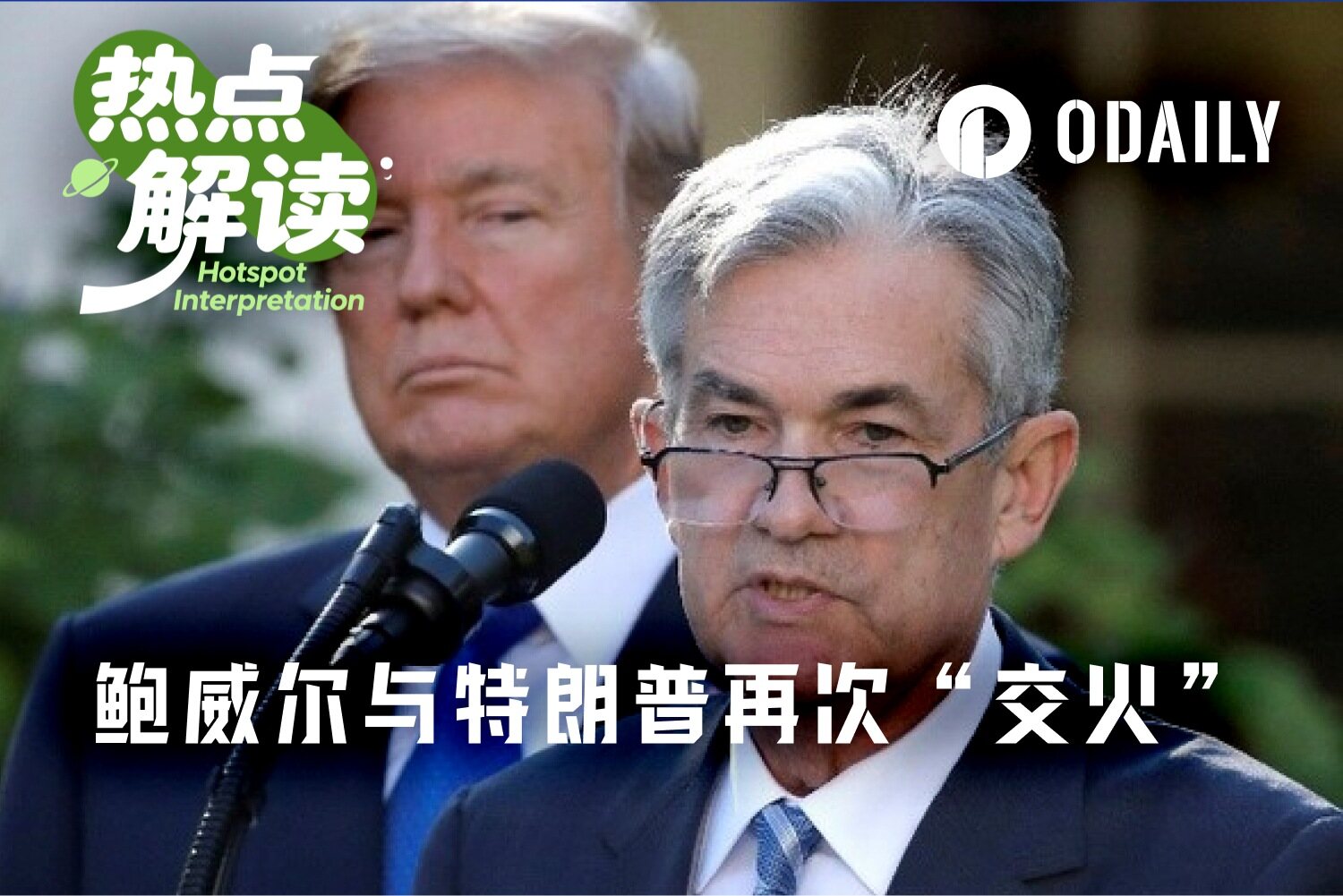
Trump is now truly facing both internal and external troubles: externally entangled in an ongoing struggle with Iran, and internally engaged in an intensifying "palace intrigue" with Federal Reserve Chairman Jerome Powell.

The two have long been at odds. Powell has repeatedly failed to follow Trump's wishes for interest rate cuts, and Trump has repeatedly stated his intention to fire Powell. Originally, if Trump could just endure a little longer, this problem would resolve itself: Powell's term as Fed Chair expires on May 15, 2026. Although he could remain on the Board of Governors until 2028, as long as Trump's favored Kevin Warsh took over, the new chair would hold the power, and an era of compliant rate cuts seemed imminent.

However, an unexpected twist has occurred. Monitoring by Odaily Seer Channel shows that the probability of Powell stepping down as Fed Chair after his term expires has dropped to 2% on Polymarket, indicating that Powell is very likely to continue serving as interim Fed Chair after May 15.

As early as March 19, Powell stated that if his successor is not confirmed before his term ends (May 15), he will continue to serve as Fed Chair. He further indicated that he would not leave the Fed Board of Governors as long as the Justice Department's investigation into him remains ongoing (Odaily Note: This investigation concerns whether Powell lied to Congress about the Fed's $2.5 billion building renovation project).

Therefore, whether Trump can get rid of Powell depends crucially on whether the Senate approves Kevin Warsh as the successor. Although prediction markets have priced in the outcome, the real answer will not be revealed until April 21 (next Tuesday).

Key Juncture: Whether Warsh's Fed Nomination Can Secure Senate Confirmation on April 21

Kevin Warsh is Trump's nominee for the next Fed Chair, but his eventual appointment is subject to review by the US Senate, which has the power to reject the nomination. Warsh will first appear at a hearing before the Senate Banking Committee on April 21, and the market is concerned that Warsh might not even pass the committee's confirmation.

The central figure obstructing Warsh's appointment is Thom Tillis, a Republican from North Carolina and a member of the Banking Committee. His reason is that the Justice Department's investigation into Powell is not yet concluded; he has publicly stated that he will block Warsh nomination from proceeding to a full Senate vote until the Justice Department ends its investigation. Thom Tillis has this influence because, although Republicans hold a 13-11 majority on the Senate Banking Committee, if Thom Tillis votes against it, Warsh's nomination could stall.

The Justice Department's investigation into Powell dates back to July 2025, when Trump visited the Fed building renovation site and publicly questioned its budget合理性. Consequently, in January 2026, the Justice Department formally launched an investigation into Powell regarding the cost of the Fed building renovation. This investigation was originally a political maneuver by Trump aimed at tarnishing Powell's public image and increasing pressure on the Fed.

Perhaps Trump didn't anticipate the backlash. However, Trump also does not intend to terminate the investigation into Powell to clear the path for Warsh's appointment. In an April 15 interview with Fox Business, he stated that while Thom Tillis's opposition would delay Warsh's confirmation, he did not plan to end the investigation, bluntly asking, "Don't you think we need to find out what happened there?"

Stepping back, even without this investigative hurdle, Warsh might struggle to secure the 51 Senate votes needed for confirmation. Under the current geopolitical and economic conditions, Warsh is likely to face questions about Fed independence and interest rate policy during his hearing. If energy and commodity bottlenecks persist due to war, the Fed's focus should be on whether to raise rates, not cut them.

This forces Warsh to choose his stance: either consistently support Trump, which would lower his confirmation chances, or defend the Fed's current wait-and-see stance, thereby angering the President.

Regardless of Warsh's choice, the window is narrow: The hearing is scheduled for April 21, meaning the Senate has only 24 days left before Powell's term ends to confirm Warsh's nomination and hold a vote; of these 24 days, the Senate is only scheduled to be in session for 13 days.

The Trump-Powell Stalemate

Therefore, based on this analysis, if Warsh encounters obstacles at the April 21 hearing, Powell is highly likely to continue serving as interim Fed Chair after his term expires on May 15, continuing to oppose Trump.

There is precedent for an incumbent chair continuing to lead the Fed as "interim chair" due to the successor's confirmation process being incomplete. For example, during President Clinton's administration, then-Fed Chair Alan Greenspan continued to lead the Fed for over three months as interim chair after his term expired while his successor's confirmation was pending; Powell himself served as interim chair for about three months in 2022 while awaiting Senate confirmation for his second term.

This mechanism also has a basis in US law. The Federal Reserve Act, the law governing the Fed, states that members of the Board of Governors shall continue to serve until their successors are appointed.

Faced with this situation, Trump is not willing to sit idly by. In his April 15 Fox Business interview, he stated that if Powell does not step down on time, he will fire him, and also will not abandon the investigation into him.

However, this might also be just an empty threat. Because Trump has not revealed what strategy he would use to fire Powell. Some conservatives believe Trump has the right to appoint one of his own nominated Fed governors—for example, Mester, Bowman, or Waller—to act in Warsh's stead before his confirmation, rather than having Powell do so, citing a memo drafted during the Carter administration which suggests the President can designate an acting chair if his nominee is not confirmed in time.

But the Fed's attitude towards this memo is unknown. Furthermore, this memo ultimately cannot serve as legal basis, so Trump appointing someone other than Powell as interim chair basically lacks legal foundation.

If Trump tries to fire Powell through normal procedures, the success rate is also low. US law states that Trump does not need Congressional confirmation to fire Powell, but he also cannot fire him directly without reason; it must be "for cause," meaning there must be legal grounds, not simply policy disagreements. Whether the reason for dismissal is justified would ultimately be decided by the courts.

Under the current circumstances, the only justifiable reason Trump has for firing Powell would be if Powell lied or was corrupt regarding the Fed's $2.5 billion building renovation project. But according to a March 25 report by The Washington Post, a senior aide to US Justice Department official Jeannie Rhee admitted during a closed-door hearing this month that the Justice Department, in its criminal investigation into Fed Chair Powell regarding the renovation costs, has not found evidence of any wrongdoing.

In other words, the investigation into Powell has not made substantial progress. Therefore, if Trump were to actually fire Powell, the latter would certainly appeal and challenge the dismissal, and with insufficient evidence, the court ruling would most likely side with Powell.

However, for capital market investors, a delay in Warsh's appointment and Powell retaining control of the Fed for several more months is not necessarily good news. Compared to Powell, who consistently preaches "patience," the market clearly prefers Warsh, who, upon taking office, might signal more rate cuts. Additionally, Warsh's own demonstrated crypto-friendly stance could more easily bring new imagination space to the crypto market.


Crypto di tendenza

Domande pertinenti

QWhat is the probability of Jerome Powell remaining as Fed Chair after May 15th, according to the prediction market?

AAccording to the Polymarket, the probability of Jerome Powell remaining as Fed Chair after his term expires has surged to 98%.

QWho is the key Republican senator potentially blocking Kevin Warsh's confirmation, and what is his reason?

AThe key Republican senator is Thom Tillis. His reason for potentially blocking the nomination is that he will not allow the nomination to proceed to a full Senate vote until the Justice Department's investigation into Jerome Powell is concluded.

QWhat is the legal basis that could allow Jerome Powell to stay on as 'interim Chair' after his term expires?

AThe legal basis is the Federal Reserve Act, which states that a member of the Board of Governors may continue to serve until a successor is appointed and confirmed.

QWhat reason would President Trump need to legally fire Jerome Powell, and does he currently have sufficient evidence for it?

APresident Trump would need to fire Jerome Powell 'for cause,' meaning a legal reason such as proven misconduct, not just policy disagreements. The article states that the Justice Department's investigation has not yet found evidence of any wrongdoing, so sufficient evidence currently does not appear to exist.

QWhy might the market prefer Kevin Warsh over Jerome Powell as Fed Chair, according to the article?

AThe market might prefer Kevin Warsh because he is perceived as being more likely to signal interest rate cuts, and he has shown a crypto-friendly stance which could bring new imagination space to the crypto market.

Letture associate

Annual Salary of Millions Competing for Electricians, Meta Rushes to Open Its Own Technical School

The AI boom is facing an unexpected bottleneck: a severe shortage of skilled construction workers and electricians. As tech giants like Meta, OpenAI, and Alphabet race to build massive data centers—such as OpenAI's $16 billion "Stargate" project—they are hitting a critical labor wall. The U.S. needs an estimated 130,000 more electricians, 240,000 construction workers, and 150,000 supervisors by 2030 for AI infrastructure alone, but tens of thousands of electrician jobs go unfilled each year. While AI companies offer high premiums, with electricians earning up to $280,000 annually, worker scarcity still causes massive losses—delays on a single project can cost $14.2 million per month. The complexity of building AI data centers, which require immense power (equivalent to powering hundreds of thousands of homes), sophisticated electrical systems, and advanced liquid cooling solutions, demands highly skilled technicians who are in short supply. To combat this, companies are investing heavily in training. Meta has committed $115 million to a free training school offering tuition, housing, and stipends, targeting 5,000 new workers. OpenAI is partnering with unions to secure skilled labor. These efforts are paying off, with a significant rise in Gen Z interest in trade schools over college. However, the power demands are staggering. AI data centers are driving a rapid surge in electricity consumption, projected to account for up to 12% of U.S. power use by 2028 and raising costs for consumers. Furthermore, the construction boom is project-based, leading to a potential future glut of trained workers once building peaks, which could depress wages industry-wide. The race for AI supremacy now depends as much on skilled hands as on advanced chips.

marsbit56 min fa

Annual Salary of Millions Competing for Electricians, Meta Rushes to Open Its Own Technical School

marsbit56 min fa

OpenAI No Longer Sells Its Most Expensive Model for Profit

OpenAI is shifting its business strategy away from promoting its most expensive, flagship models for every task. Recent price cuts—80% for GPT-5.6 Luna and 20% for Terra—signal a deeper change: the company now actively advises users that many tasks don't require the most powerful model. Instead, OpenAI recommends a tiered approach: use the high-end GPT-5.6 Sol for complex planning and analysis, then delegate execution to cheaper models like Luna. This mirrors moves by Anthropic, which recently launched Claude Opus 5 at half the price of its top model, Fable 5. Both companies are de-emphasizing flagship models as primary revenue drivers, using them instead for brand prestige and technological showcases. The industry is entering a "mass-market" phase, similar to automotive, where high-volume, cost-effective models handle daily operations and drive scale. OpenAI's price reductions are partly enabled by AI models themselves optimizing underlying code and infrastructure, creating a self-reinforcing cycle of efficiency gains and cost reduction. Competition is shifting from "who is smartest" to "who offers the best value." The goal is no longer selling individual models but fostering widespread API adoption and ecosystem lock-in. By making AI calls cheap and ubiquitous, companies like OpenAI aim to become the indispensable, utility-like infrastructure powering automated workflows—the "water and electricity" of software, quietly embedded everywhere.

marsbit56 min fa

OpenAI No Longer Sells Its Most Expensive Model for Profit

marsbit56 min fa

Will the Fed Definitely Raise Interest Rates in September? How Will Crypto and U.S. Stocks Withstand the Pressure?

The market's expectation for a September Fed rate hike surged dramatically in early August, jumping from under 50% to over 80% within a week. This shift followed a contentious July FOMC meeting, where a 9-3 vote to hold rates revealed growing dissent from hawkish members advocating for an immediate hike to combat persistent inflation. The primary catalyst for this repricing is rising oil prices, driven by renewed geopolitical tensions around the Strait of Hormuz, which threaten global supply. Energy costs directly influence inflation metrics, making the upcoming July CPI report (due August 12th) a critical data point. If it shows inflation reaccelerating, the probability of a September hike will solidify. For Bitcoin and crypto assets, this is typically bearish news. Bitcoin continues to behave as a high-beta, liquidity-sensitive risk asset. A rate hike raises the opportunity cost of holding non-yielding assets and could drive capital toward money markets, pressuring crypto prices in the short term. However, historical patterns suggest that if a hike is perceived as the end of a tightening cycle rather than the start, any negative price impact may be brief. U.S. stocks, particularly crypto-linked equities like Coinbase and growth-oriented tech stocks, are also vulnerable. Higher rates increase discount rates in valuation models, putting pressure on high-multiple companies. This coincides with a pivotal tech earnings season where investor focus has shifted from massive AI capital expenditure to tangible revenue and cash flow generation. Companies with negative cash flow and weak growth narratives could face heightened volatility if borrowing costs rise in September. In summary, a September Fed hike has evolved into a mainstream market scenario. Key factors to watch are oil prices, the July CPI report, and Fed communications, which will determine the final decision and its impact on volatile crypto and equity markets.

marsbit1 h fa

Will the Fed Definitely Raise Interest Rates in September? How Will Crypto and U.S. Stocks Withstand the Pressure?

marsbit1 h fa

Trading

Spot

Articoli Popolari

Come comprare ORDER

Benvenuto in HTX.com! Abbiamo reso l'acquisto di Orderly (ORDER) semplice e conveniente. Segui la nostra guida passo passo per intraprendere il tuo viaggio nel mondo delle criptovalute.Step 1: Crea il tuo Account HTXUsa la tua email o numero di telefono per registrarti il tuo account gratuito su HTX. Vivi un'esperienza facile e sblocca tutte le funzionalità,Crea il mio accountStep 2: Vai in Acquista crypto e seleziona il tuo metodo di pagamentoCarta di credito/debito: utilizza la tua Visa o Mastercard per acquistare immediatamente OrderlyORDER.Bilancio: Usa i fondi dal bilancio del tuo account HTX per fare trading senza problemi.Terze parti: abbiamo aggiunto metodi di pagamento molto utilizzati come Google Pay e Apple Pay per maggiore comodità.P2P: Fai trading direttamente con altri utenti HTX.Over-the-Counter (OTC): Offriamo servizi su misura e tassi di cambio competitivi per i trader.Step 3: Conserva Orderly (ORDER)Dopo aver acquistato Orderly (ORDER), conserva nel tuo account HTX. In alternativa, puoi inviare tramite trasferimento blockchain o scambiare per altre criptovalute.Step 4: Scambia Orderly (ORDER)Scambia facilmente Orderly (ORDER) nel mercato spot di HTX. Accedi al tuo account, seleziona la tua coppia di trading, esegui le tue operazioni e monitora in tempo reale. Offriamo un'esperienza user-friendly sia per chi ha appena iniziato che per i trader più esperti.

280 Totale visualizzazioniPubblicato il 2024.12.10Aggiornato il 2026.06.02

Come comprare ORDER

Discussioni

Benvenuto nella Community HTX. Qui puoi rimanere informato sugli ultimi sviluppi della piattaforma e accedere ad approfondimenti esperti sul mercato. Le opinioni degli utenti sul prezzo di ORDER ORDER sono presentate come di seguito.

活动图片











