Post a Tweet for $5 Million? The Price Tag for a President's Endorsement of a Meme Coin Exposed

比推Pubblicato 2026-03-17Pubblicato ultima volta 2026-03-17

Introduzione

Argentine President Javier Milei is accused of accepting a $5 million bribe to promote the meme token LIBRA on his X (formerly Twitter) account, according to a report by local media El Destape. The allegation is based on evidence recovered from the phone of a crypto lobbyist, Mauricio Novelli, who represented KIP Protocol, the entity behind LIBRA. The scandal erupted after Milei posted a tweet on February 15, 2025, endorsing LIBRA as a project aimed at supporting Argentine entrepreneurs. The token's market cap surged to $4.56 billion within 30 minutes, but it collapsed after insiders executed a "rug pull," cashing out over $100 million. Milei later deleted the tweet, claiming he was misled and that the post was intended to support private enterprise. Investigators uncovered a purported agreement between Milei and Hayden Davis, the alleged mastermind behind the scheme. The deal involved a $5 million payment—$1.5 million upfront, another $1.5 million after Milei publicly endorsed Davis as an advisor, and a final $2 million for a blockchain consulting contract. Phone records also showed frequent communication between Novelli and Milei’s office around the time of the tweet. Despite initial investigations by anti-corruption offices and Congress, no conclusive action was taken. The report suggests Milei was aware of the token’s speculative nature but proceeded for financial gain. Davis defended the scheme in an interview, arguing that meme token trading is a “casino” where such ...

Author: Eric, Foresight News

Original Title: How Much Does It Cost for a President to Endorse a Meme Coin? Milei: $5 Million


On March 17, Beijing time, Argentine local media El Destape broke an exclusive bombshell: information recovered from the phone of a cryptocurrency lobbyist in Argentina revealed that Argentine President Milei posted a tweet promoting LIBRA a year ago because he accepted a $5 million bribe, and the mastermind was none other than Hayden Davis, as previously speculated by the outside world.

Opposition lawmakers in Argentina who pushed for the investigation called this an "explosive scandal" and demanded further investigation. However, as of the time of writing, neither Milei nor the presidential office has responded.

Promoting Meme Coin Backfires, Blames "Political Struggle"

On February 15, 2025, Argentine President Milei promoted a Meme token named LIBRA on X, with the caption "Free Argentina is growing!!! This private project will be committed to promoting Argentina's economic growth and providing funding for Argentine small businesses and startup projects. The world wants to invest in Argentina."
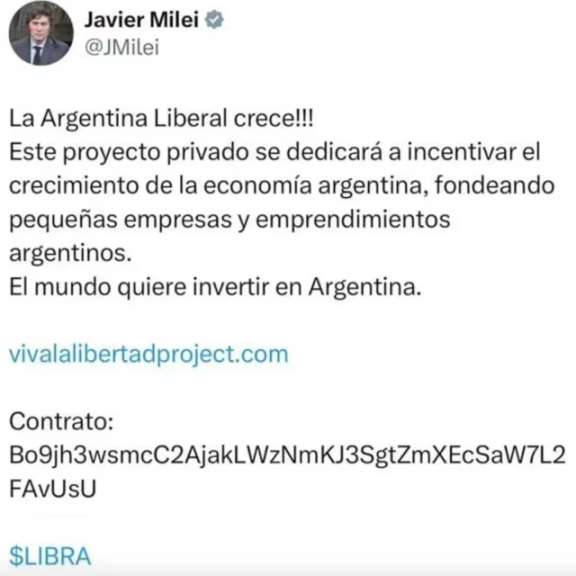
At that time, the hype around the Meme tokens of the US Trump couple had not yet subsided, and the new "presidential concept coin" once again ignited market enthusiasm. The FDV of the LIBRA token soared to a maximum of $4.56 billion within 30 minutes of its launch.

This project, which claimed it would invest token proceeds in Argentine entrepreneurs and education, saw a large number of rat warehouses withdraw liquidity and sell tokens after Milei helped the token price take off, successfully cashing out over $100 million and leaving within an hour or two. At noon Beijing time that day, Milei deleted the tweet and stated that his previous action was merely to support private enterprises and was not related to them, and that after understanding the situation, he decided not to spread the message further.

After the tweet was deleted, the price of LIBRA headed straight to zero without looking back. The entire event started in the early morning Beijing time and was over before the afternoon even arrived.

Even someone as abstract as Trump only dared to issue Meme coins before taking office, but Milei publicly helped promote a Rug project while in office. This kind of "not even pretending" blatant corruption was met with indiscriminate criticism. As the torrent of verbal and written attacks fell, Milei was forced to respond, but these responses seemed more like excuses.

The Argentine presidential office first stated that Milei met with Mauricio Novelli, the representative of KIP Protocol (the entity behind LIBRA) in Argentina, in October 2024. At that time, this representative said that a project named Viva la Libertad would be launched in the future to provide financing support for Argentine private enterprises. Milei's retweet after KIP Protocol launched the LIBRA token was merely to support Argentine entrepreneurs, and he himself was not aware of the details.

In other words, Milei believed LIBRA was a project to help Argentine entrepreneurs, and the retweet was well-intentioned.

Later, Milei himself stated again on a television program that his actions were in good faith, hoping to support any project that could improve the financing situation for technology entrepreneurs, but he was "deceived" because he did not understand the project's situation. Furthermore, Milei shamelessly stated that the vast majority of the deceived investors were Americans and Chinese, and he had not wronged his own citizens.

Finally, Milei even stated that the smear campaign against him was politically motivated and vowed to pursue the matter.

This flimsy explanation was obviously unconvincing: Why would a national president promote a private company without investigation?

Took the Money, But Didn't Fully Deliver

After this national-level scandal occurred, both the Argentine Anti-Corruption Office and Congress launched investigations. The Anti-Corruption Office believed that Milei's action was personal and did not violate public ethics regulations; the congressional investigation committee accused Milei of providing "key cooperation" in the LIBRA incident and recommended that Congress assess whether it constituted misconduct.

However, these investigation results did not reveal details, and the outside world was unclear about what exactly happened.

El Destape's爆料 revealed a key piece of evidence, shedding light on the gray transaction between LIBRA's issuer and the president.

According to the report, investigators recovered an agreement between H (confirmed to be Hayden Davis) and Milei from the phone of Mauricio Novelli, who was referred to by the Argentine presidential office as the "representative of KIP Protocol in Argentina" but was actually a cryptocurrency lobbyist.
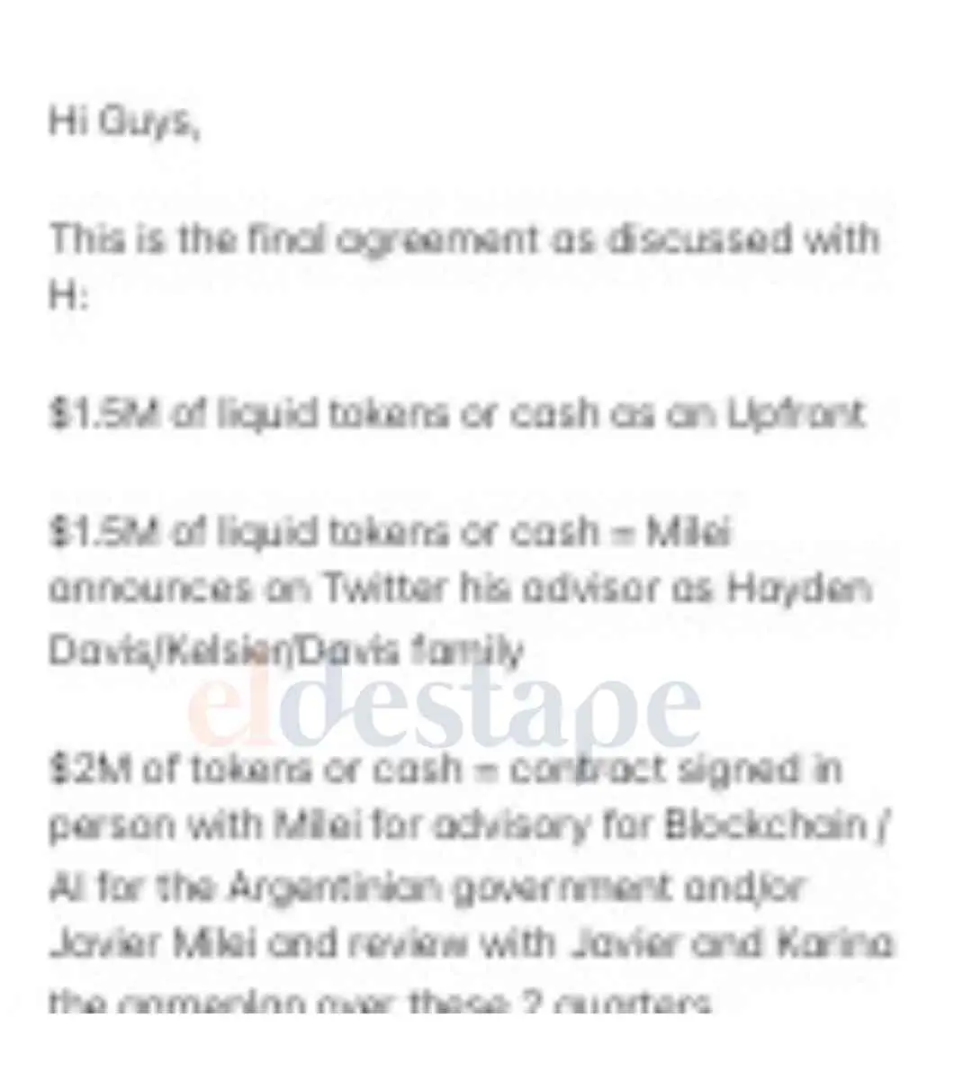
The agreement content shows that Hayden Davis would first pay Milei $1.5 million in liquid tokens or cash as an advance payment. After Milei announced on X that Hayden Davis/Kelsier/Davis family were his advisors, another $1.5 million in liquid tokens or cash would be paid. As for the final $2 million, it required Milei to sign a blockchain/artificial intelligence consulting contract.

The creation date of this file was just three days before Milei posted the promotional LIBRA tweet, and the file came from an expert report by the Argentine General Directorate of Technical Support for Criminal Investigations, but it only appeared in a folder of an attachment.

The secrets found on the phone were far more than just this file; they even included materials related to Milei teaching a cryptocurrency course at a school, which also proved that Milei's claim a year ago that he did not understand cryptocurrency was a pure lie.

In addition, the investigation report also exposed密集的通话记录 (dense call records) between Mauricio Novelli and Milei, as well as Milei's sister (who serves as Secretary General of the Argentine Presidential Office) from a few minutes before to a few hours after Milei promoted the token. Although there was no specific call content, the timing吻合 (coincidence)恰好证明 (just proves) that LIBRA was a premeditated financial scam organized with the involvement of the president.

Judging from Milei's tweet, the cooperation between the two parties may have only reached the first step. Before the tweet announcing that Hayden Davis was his advisor could be sent, the LIBRA incident spiraled out of control, forcing Milei to quickly clarify and distance himself. No wonder Hayden Davis said in an interview with crypto blogger Coffeezilla that Milei was originally supposed to post more interactive tweets, but for some reason the cooperation suddenly stopped.

Bottomless "Open Robbery"

In fact, after the LIBRA incident, some people inferred through on-chain information that Hayden Davis and his Kelsier Ventures were the masterminds behind the incident, and also uncovered that the token MELANIA launched by Trump's wife was also manipulated by him.

El Destape reported that on January 30, 2025, Hayden Davis met with Milei and Milei's sister at the Argentine presidential palace and signed a contract with Milei, making Davis an advisor to the Argentine government in the blockchain field. This contract was also found on Novelli's phone but was concealed by prosecutor Eduardo Taiano and not made known to the relevant parties.

After this agreement was reached, a bank account associated with Davis transferred $1 million to an account with an unconfirmed owner.

So far, we roughly know the whole story:

In October 2024, Mauricio Novelli introduced KIP Protocol (actually controlled by Hayden Davis) to Argentine President Milei, claiming that a project named Viva la Libertad would be launched to provide financing support for Argentine private enterprises, thereby getting closer to Milei.

At the end of January 2025, Hayden Davis, through the introduction of Mauricio Novelli, contacted Argentine President Milei and successfully became the blockchain advisor to the Argentine government. Afterwards, Hayden Davis, through Mauricio Novelli, reached an agreement with Milei: Hayden Davis would pay Milei a total of $5 million in exchange for Milei promoting the Viva la Libertad project and its issued LIBRA token on his personal X account.

Between October 2024 and the end of January 2025, Hayden Davis and Milei may have had more or less contact through Mauricio Novelli and discussed how to promote LIBRA. Milei was probably well aware that this was a pure scam project using cryptocurrency, but the reason he agreed was probably, as Hayden Davis said in an interview, their series of plans would not let this token quickly "rug pull.

But unexpectedly, after Milei posted the tweet, the rat warehouses couldn't wait to cash out over $100 million, quickly triggering a large amount of critical public opinion. Seeing the situation turning bad, Milei chose to cut losses rather than continue the cooperation. As public opinion further发酵 (fermented), the originally win-win situation turned into Milei being left alone in the lurch, while Hayden Davis cashed out and left.

The most terrifying thing about this incident is that Hayden Davis never considered it fraud. In an interview with Coffeezilla, he stated, "In the meme market, this is not illegal. This is what happens in every trade. These are the rules here. People know this, agree to this, and make money from this. If you're going to blame this, I think, for the vast majority of retail traders betting on meme tokens, especially those who get in early, this is the rules of the game in this market. This is not the capital market; this is a casino."

The development process of the industry is never afraid of speculators participating. What it fears is that speculators truly believe the industry is simply a casino for speculation.

This perhaps explains some of the chaos in the Web3 industry in the past two or three years: when schemers don't think they are scheming, they naturally lose all bottom lines. Eventually, projects no longer compare in the simple sense of good or bad, but only in who has the more clever means of "robbing."


Twitter:https://twitter.com/BitpushNewsCN

Bitpush TG Discussion Group:https://t.me/BitPushCommunity

Bitpush TG Subscription: https://t.me/bitpush

Original link:https://www.bitpush.news/articles/7620466

Crypto di tendenza

Domande pertinenti

QWhat was the alleged bribe amount that Argentine President Javier Milei received to promote the LIBRA meme coin on Twitter?

AArgentine President Javier Milei allegedly received a bribe of $5 million to promote the LIBRA meme coin on Twitter.

QWho was identified as the mastermind behind the LIBRA meme coin promotion scandal involving President Milei?

AHayden Davis was identified as the mastermind behind the LIBRA meme coin promotion scandal involving President Milei.

QWhat was the fully diluted valuation (FDV) of the LIBRA token shortly after its promotion by President Milei?

AThe fully diluted valuation (FDV) of the LIBRA token surged to a peak of $4.56 billion within 30 minutes after its promotion by President Milei.

QHow did President Milei respond to the backlash after promoting the LIBRA meme coin?

APresident Milei deleted the promotional tweet, claimed he was deceived and acted in good faith to support Argentine entrepreneurs, and alleged that the criticism was politically motivated.

QWhat evidence was recovered from the phone of cryptocurrency lobbyist Mauricio Novelli that implicated President Milei?

AEvidence recovered from Mauricio Novelli's phone included a agreement detailing a $5 million payment plan to President Milei for promoting the LIBRA token, documents related to Milei's cryptocurrency lectures, and records of密集的通话记录 between Novelli, Milei, and his sister around the time of the promotion.

Letture associate

The "Impossible Triad" Is Fundamentally a Pseudo-Problem

The article argues that blockchain's fundamental limitation is not the scalability trilemma (decentralization, scalability, security), which has been largely solved, but the lack of **privacy** and, until recently, clear **legitimacy**. Blockchain is described as a slow, expensive, globally shared computer whose core value is censorship resistance and verifiability. While ideal for native digital assets like money (e.g., stablecoins), its default transparency acts as a **tax**, exposing all transactions and enabling MEV extraction, which deters serious institutional capital. Simultaneously, its permissionless nature created regulatory ambiguity. The piece contends that **privacy** is the missing critical feature. It rejects the false choice between total transparency and complete anonymity. Modern cryptography (like zero-knowledge proofs) enables **compliant privacy**: users can prove facts (solvency, KYC status, compliance) without revealing the underlying sensitive data (specific holdings, identities). This preserves auditability for regulators and eliminates the leak of financial information. With recent regulatory progress (e.g., the GENIUS Act) addressing legitimacy, adding default, provably compliant privacy becomes a pure upgrade. It transforms blockchain from a costly, public ledger into a confidential settlement layer, finally bridging the gap to mainstream institutional and individual adoption of on-chain finance.

链捕手2 h fa

The "Impossible Triad" Is Fundamentally a Pseudo-Problem

链捕手2 h fa

Optical Chips: Collective Capacity Expansion

The global optical chip industry is experiencing a massive wave of expansion driven by surging AI data center demand. Major players across the US, Japan, Europe, and China are aggressively investing to ramp up production capacity. In the US, Coherent is expanding its 6-inch Indium Phosphide (InP) semiconductor fab in Texas, supported by CHIPS Act funding and a $2 billion strategic investment from NVIDIA. Lumentum is building a new factory for InP optical devices, and Nokia is scaling its advanced photonic chip packaging and testing capabilities. NVIDIA's investments aim to secure future supply of critical lasers and optical interconnect products for AI infrastructure. Japan's JX Advanced Metals, a leading InP substrate supplier, plans a multi-billion yen investment to increase its capacity 7-10 times, strengthening its grip on the crucial upstream materials market. In Europe, IQE and Tower Semiconductor settled a patent dispute and signed a multi-year InP epitaxial wafer supply agreement, highlighting that next-generation silicon photonics platforms will integrate high-performance InP components. STMicroelectronics and Sivers Semiconductors are also expanding silicon photonics production and partnerships. China is rapidly building out its domestic supply chain. Dongshan Precision's subsidiary, Source Photonics, announced a $12 billion project to expand optical chip and module production. Companies like Sanan Optoelectronics and Yunnan Germanium are scaling up InP chip manufacturing and substrate production, moving towards vertical integration from materials to modules. While debate continues around the exact future architecture—whether CPO (Co-Packaged Optics), NPO, or pluggables will dominate—analysts like Morgan Stanley argue the underlying driver is unchangeable: the explosive growth in bandwidth demand. This will inevitably increase the volume of optical engines, lasers, and related content per GPU, regardless of the final technical path. The competition for "more light" in the AI era has intensified into a global, full-chain capacity race.

marsbit5 h fa

Optical Chips: Collective Capacity Expansion

marsbit5 h fa

Stablecoins Finally Find Real Yield: An In-Depth Look at On-Chain Reinsurance Re | A Conversation with Re Founder Karan Saroya

Stablecoin Real Yield Found: A Deep Dive into On-Chain Reinsurance with Re's Karan Saroya As stablecoin supply exceeds $170 billion, the search for sustainable, non-speculative yield intensifies. Re, an on-chain reinsurance platform, provides an answer: connecting stablecoin capital to the trillion-dollar traditional reinsurance market. Re operates as a regulated reinsurer, accepting stablecoin deposits as collateral to back US insurance companies. These insurers pay premiums, generating yield that flows back to on-chain depositors. Currently supporting 35 insurers and underwriting $500 million, Re projects scaling to over $1 billion soon. Key insights from a Bankless podcast with founder Karan Saroya and investor Avichal of Electric Capital: 1. **Uncorrelated, Real-World Yield:** Re offers stablecoin holders access to reinsurance returns (targeting 12-14%+), an asset class entirely separate from crypto or equity markets. 2. **Operational Efficiency via Smart Contracts:** Re replaces traditional, labor-intensive capital fundraising with smart contracts, allowing a ~12-person team to compete with industry giants. 3. **Regulatory Leverage:** For every $1 of collateral, regulations allow backing $5-7 in written premiums. This leverage amplifies returns from the underlying risk-free rate. 4. **DeFi Integration:** Depositors receive receipt tokens, which can be used in protocols like Morpho for "looping," potentially pushing yields to 18-20%+. 5. **The "DeFi Mullet" Model:** A compliant front-end (regulated reinsurer) paired with a decentralized back-end (smart contracts, DeFi capital markets). 6. **RE Governance Token:** Modeled on Lloyd's of London, the token governs the central capital pool's allocation, counterparty acceptance, and parameters. 7. **Real Economic Impact:** Capital funds real-world productivity (factories, clinics, businesses) via insurance, moving beyond crypto's internal loops. The discussion highlights a pivotal moment: DeFi's supply-side infrastructure is now met by real demand for productive yield, potentially kickstarting a flywheel where vast on-chain stablecoin capital seeks these real-world returns.

链捕手6 h fa

Stablecoins Finally Find Real Yield: An In-Depth Look at On-Chain Reinsurance Re | A Conversation with Re Founder Karan Saroya

链捕手6 h fa

1996 or 1999? Walsh's First Test is 'How to View AI'

"1996 or 1999? Wall's First Big Test Is 'How to View AI'" Federal Reserve Chairman Wall's initial challenge is not whether to raise or cut rates, but a more fundamental judgment: what kind of boom is the current AI boom? This will determine the Fed's policy path and define his legacy. Economics is split between two opposing views, according to reporter Nick Timiraos. One sees imminent productivity gains that will increase supply and cool inflation, allowing the Fed to hold steady. The other argues that while productivity benefits are distant, demand shocks are here now, and waiting for data confirmation risks missing the intervention window, forcing sharper rate hikes later. Wall has signaled a leaning toward the first view, echoing 1996-era Alan Greenspan, who embraced strong, productivity-driven growth without fear of inflation. However, Wall faces a different macro environment than Greenspan did, with tariff pressures, expanding fiscal deficits, and diminishing globalization benefits, which could force more significant inflation pressures even if AI benefits materialize. Wall's logic, expressed before taking office, is that AI-driven productivity gains won't show in official data for years. If the Fed waits for confirmation, it might mistakenly tighten policy and choke off the very growth that could suppress inflation. This argues for using forward-looking narratives over lagging data. Chicago Fed President Austan Goolsbee presents a key counter-argument. He distinguishes between expected and unexpected productivity booms. A widely anticipated boom, like the current AI wave, can cause people to spend future wealth gains in advance, overheating the economy before productivity actually rises, thus requiring preemptive rate hikes. He cites rising costs for AI data centers as evidence of such overheating. Fed Governor Christopher Waller offers a rebuttal to Goolsbee, noting the "expected spending" mechanism only works if people can borrow against future income, which many households cannot do due to borrowing constraints. Wall also faces a paradox related to his desire to reduce the Fed's use of "forward guidance" (pre-announcing policy moves). This practice was established in 1999 when Greenspan began signaling hikes to avoid market shocks. If the economy follows a less optimistic path, Wall may be forced to choose between using the guidance he wants to abolish or risking market volatility by staying silent. The ultimate question defining Wall's first major test remains: Is this 1996 or 1999?

marsbit7 h fa

1996 or 1999? Walsh's First Test is 'How to View AI'

marsbit7 h fa

Trading

Spot
Futures

Articoli Popolari

Cosa è MEME 2.0

Memecoin 2.0: L'Ascesa di $MEME 2.0 nel Mondo delle Criptovalute Introduzione Nel panorama in continua evoluzione delle criptovalute, è emerso un nuovo contendente. Memecoin 2.0, simboleggiato come $MEME 2.0, porta il concetto di meme coin a un livello emozionante. Come prodotto derivato dal Memecoin originale, questo progetto ha catturato l'attenzione della comunità crypto spostando il focus da incentivi finanziari tipici a un'esperienza coinvolgente e divertente. Operando sulla blockchain di Ethereum, Memecoin 2.0 ridefinisce audacemente l'impegno della comunità nella sfera crypto. Che cos'è Memecoin 2.0, $MEME 2.0? Alla base, Memecoin 2.0 è un progetto di criptovaluta che dà priorità allo spirito di comunità e al divertimento associato alla cultura meme. A differenza delle criptovalute convenzionali, che si concentrano su casi d'uso pratici e benefici tangibili, Memecoin 2.0 si distingue abbracciando il lato più leggero della moneta digitale. Il progetto esiste senza promesse di utilità, una roadmap strutturata o ritorni finanziari, concentrandosi invece sulla creazione di una comunità vibrante incentrata sui meme e sul divertimento condiviso. Facendo così, attinge alla crescente tendenza della cultura meme nello spazio online, rendendola un giocatore unico nel mondo degli asset digitali. Creatore di Memecoin 2.0, $MEME 2.0 Nonostante ricerche approfondite sulle origini di Memecoin 2.0, l'identità esplicita del suo creatore rimane sconosciuta. Questa anonimità non è rara nella comunità crypto, dove molti progetti sono guidati da individui o gruppi che preferiscono rimanere dietro le quinte. La mancanza di informazioni pubblicamente disponibili sul creatore potrebbe essere vista come una mossa strategica, mettendo in evidenza l'impegno della comunità piuttosto che la notorietà individuale all'interno dello spazio. Investitori di Memecoin 2.0, $MEME 2.0 Le informazioni riguardanti gli investitori o il supporto finanziario per Memecoin 2.0 sono scarse. Questa assenza di dettagli potrebbe suggerire che il progetto sia autofinanziato o che il suo focus sulla comunità piuttosto che sulle strutture d'investimento tradizionali abbia attratto un tipo diverso di sostenitore. Poiché il mondo delle meme coin coinvolge tipicamente un maggior coinvolgimento di base piuttosto che investimenti istituzionali, questo approccio si allinea con l'etica dei progetti guidati dalla comunità. Come funziona Memecoin 2.0, $MEME 2.0? Memecoin 2.0 opera interamente sulla blockchain di Ethereum, capitalizzando le sue robuste caratteristiche di sicurezza e scalabilità. Sfruttando i punti di forza di Ethereum, Memecoin 2.0 può offrire un ambiente sicuro per le interazioni degli utenti garantendo che le transazioni siano sia efficienti che convenienti. Uno degli attributi unici di Memecoin 2.0 risiede nella sua struttura guidata dalla comunità. Il valore e la popolarità del token $MEME 2.0 derivano dalla partecipazione attiva dei suoi utenti, piuttosto che dalla utilità intrinseca. Questo design rinforza il focus del progetto sull'aspetto dell'intrattenimento delle criptovalute, implicando che la risata e l'impegno della comunità siano le vere monete che guidano il suo successo. Inoltre, il progetto si inserisce all'interno dell'ecosistema più ampio delle meme coin, dove il valore di ciascuna meme coin oscilla in base alla cultura, alle tendenze e all'impegno della comunità piuttosto che ai principi economici tradizionali. Cronologia di Memecoin 2.0, $MEME 2.0 Per comprendere meglio l'evoluzione e le pietre miliari di Memecoin 2.0, ecco una cronologia che evidenzia eventi significativi nella sua storia: 2024: L'inizio di Memecoin 2.0 è riconosciuto come un ramo del Memecoin originale, affermandosi all'interno del contesto fiorente delle meme coin mentre opera sulla blockchain di Ethereum. 13 luglio 2024: Memecoin 2.0 si posiziona ufficialmente come una meme coin incentrata sulla comunità sulla rete Ethereum, enfatizzando il suo approccio centrato sull'intrattenimento che invita gli utenti a impegnarsi e partecipare alla sua crescita. Punti Chiave su Memecoin 2.0, $MEME 2.0 Diverse caratteristiche critiche definiscono Memecoin 2.0: Approccio Centrico alla Comunità: La missione principale di Memecoin 2.0 è creare un'esperienza comunitaria divertente e coinvolgente, capitalizzando il piacere collettivo derivante dalla cultura memetica. Costruita su Ethereum: Operare sulla blockchain di Ethereum fornisce al progetto un'infrastruttura essenziale che garantisce sicurezza e scalabilità. Mancanza di Utilità o Roadmap: In una marcata deviazione dalle criptovalute tradizionali, Memecoin 2.0 non promette alcuna caratteristica utilitaria o ritorni finanziari, riaffermando il suo impegno per il coinvolgimento della comunità e l'impegno sociale. Focus sulla Cultura Memetica: Abbracciando gli aspetti umoristici e culturali del fenomeno meme, Memecoin 2.0 offre una piattaforma per gli utenti per interagire con la crypto offline e online. Ulteriore Contesto: L'Importanza delle Meme Coin Le meme coin sono emerse come una classe distinta di criptovaluta, spesso guidata dall'umorismo e da un approccio spensierato al trading. Queste monete generalmente mancano di significative utilità o roadmap di sviluppo, attirando gli utenti con la promessa di divertimento, interazione comunitaria e rilevanza culturale. Nel panorama del più ampio ecosistema crypto, le meme coin rianimano l'importanza dell'impegno della comunità, opponendosi ad approcci esclusivamente orientati al profitto. Progetti come Memecoin 2.0 danno il via a un'era in cui l'intrattenimento può armonizzarsi con le aspirazioni finanziarie, trasformando la blockchain in un parco giochi per la creatività e l'interazione sociale. Conclusione Memecoin 2.0, o $MEME 2.0, incarna una nuova ondata di criptovaluta che dà priorità all'impegno della comunità rispetto a rigidi strutture finanziarie. Con un focus sull'umorismo e l'interazione sociale, capitalizza sulla fascinazione circondante la cultura meme. Operando sulla blockchain di Ethereum, Memecoin 2.0 sfrutta le capacità della tecnologia mantenendo fermo il suo impegno per il valore ricreativo della valuta digitale. Mentre lo spazio delle criptovalute continua a evolversi, Memecoin 2.0 serve come testimonianza della nozione che il futuro degli asset digitali potrebbe ben dipendere da esperienze condivise, risate e solidi legami comunitari. Nel mondo imprevedibile delle crypto, forse la gioia può essere altrettanto preziosa quanto il guadagno finanziario tradizionale.

94 Totale visualizzazioniPubblicato il 2024.04.04Aggiornato il 2024.12.03

Cosa è MEME 2.0

Come comprare MEME

Benvenuto in HTX.com! Abbiamo reso l'acquisto di Memeland (MEME) semplice e conveniente. Segui la nostra guida passo passo per intraprendere il tuo viaggio nel mondo delle criptovalute.Step 1: Crea il tuo Account HTXUsa la tua email o numero di telefono per registrarti il tuo account gratuito su HTX. Vivi un'esperienza facile e sblocca tutte le funzionalità,Crea il mio accountStep 2: Vai in Acquista crypto e seleziona il tuo metodo di pagamentoCarta di credito/debito: utilizza la tua Visa o Mastercard per acquistare immediatamente MemelandMEME.Bilancio: Usa i fondi dal bilancio del tuo account HTX per fare trading senza problemi.Terze parti: abbiamo aggiunto metodi di pagamento molto utilizzati come Google Pay e Apple Pay per maggiore comodità.P2P: Fai trading direttamente con altri utenti HTX.Over-the-Counter (OTC): Offriamo servizi su misura e tassi di cambio competitivi per i trader.Step 3: Conserva Memeland (MEME)Dopo aver acquistato Memeland (MEME), conserva nel tuo account HTX. In alternativa, puoi inviare tramite trasferimento blockchain o scambiare per altre criptovalute.Step 4: Scambia Memeland (MEME)Scambia facilmente Memeland (MEME) nel mercato spot di HTX. Accedi al tuo account, seleziona la tua coppia di trading, esegui le tue operazioni e monitora in tempo reale. Offriamo un'esperienza user-friendly sia per chi ha appena iniziato che per i trader più esperti.

300 Totale visualizzazioniPubblicato il 2024.12.12Aggiornato il 2026.06.02

Come comprare MEME

Discussioni

Benvenuto nella Community HTX. Qui puoi rimanere informato sugli ultimi sviluppi della piattaforma e accedere ad approfondimenti esperti sul mercato. Le opinioni degli utenti sul prezzo di MEME MEME sono presentate come di seguito.

活动图片