POLY's Appearance Hints Are Getting Denser, How Far Away Is the Polymarket Airdrop?

Odaily星球日报Pubblicato 2026-05-19Pubblicato ultima volta 2026-05-19

Introduzione

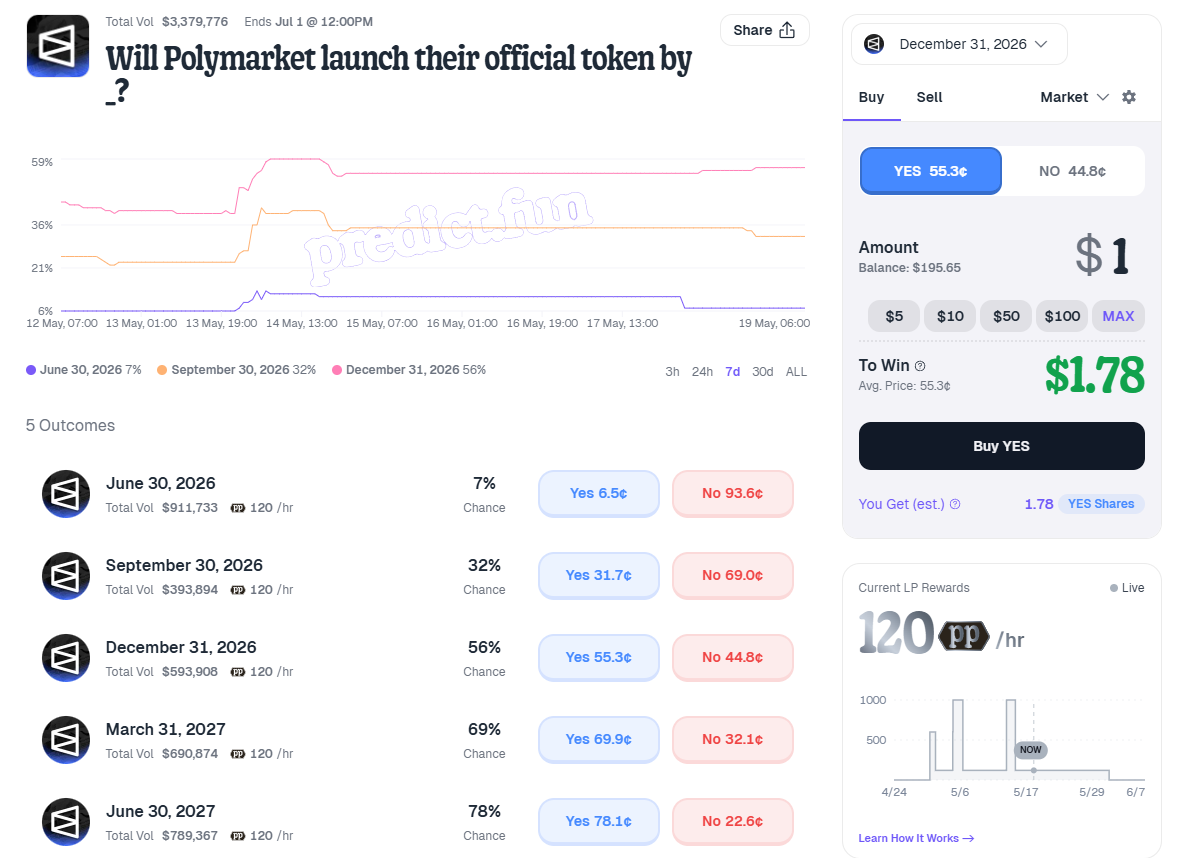
**POLY Debut Hints Grow More Frequent: How Far is the Polymarket Airdrop?** Recent continuous hints from Polymarket team members regarding the POLY token have sparked widespread analysis within airdrop communities about its launch timeline and potential scale. According to predict.fun data, the probability of "Polymarket launching its official token before year-end 2025" currently stands at 56%. Hints about POLY began in October 2024. CEO Shayne Coplan's social media post mentioning $POLY alongside major cryptocurrencies first fueled speculation. This was followed by Growth Lead William LeGate discussing "prospective airdrop farmers," and CMO Matthew Modabber explicitly confirming that "Polymarket will have a token, and there will be an airdrop." The momentum continued into 2025. In April, major crypto data platforms CoinGecko and CoinMarketCap created placeholder pages for POLY, further solidifying expectations. May saw discussions shift towards token utility and airdrop criteria. A team member's "Soon" reply to a question about staking POLY for fee reductions, and a leaked internal screenshot showing an "Airdrop" tab, significantly increased anticipation. LeGate also outlined potential airdrop qualifiers, mentioning badges for employees, high-volume/high-profit traders, and ecosystem builders. He suggested that linking a Polymarket account to X (Twitter), sharing trades and market insights, and actively engaging with the community might constitute part of the eligibilit...

Original | Odaily Planet Daily (@OdailyChina)

Author | Asher (@Asher_0210)

Recently, due to continuous hints from Polymarket's official team members regarding POLY token-related content, major airdrop farming communities have analyzed the timing and scale of a potential POLY airdrop from various angles. According to data from predict.fun, the probability of the event "Polymarket will launch its official token before the end of this year" is currently reported at 56%; there is even a 7% probability that "Polymarket will launch its official token before Q2 this year."
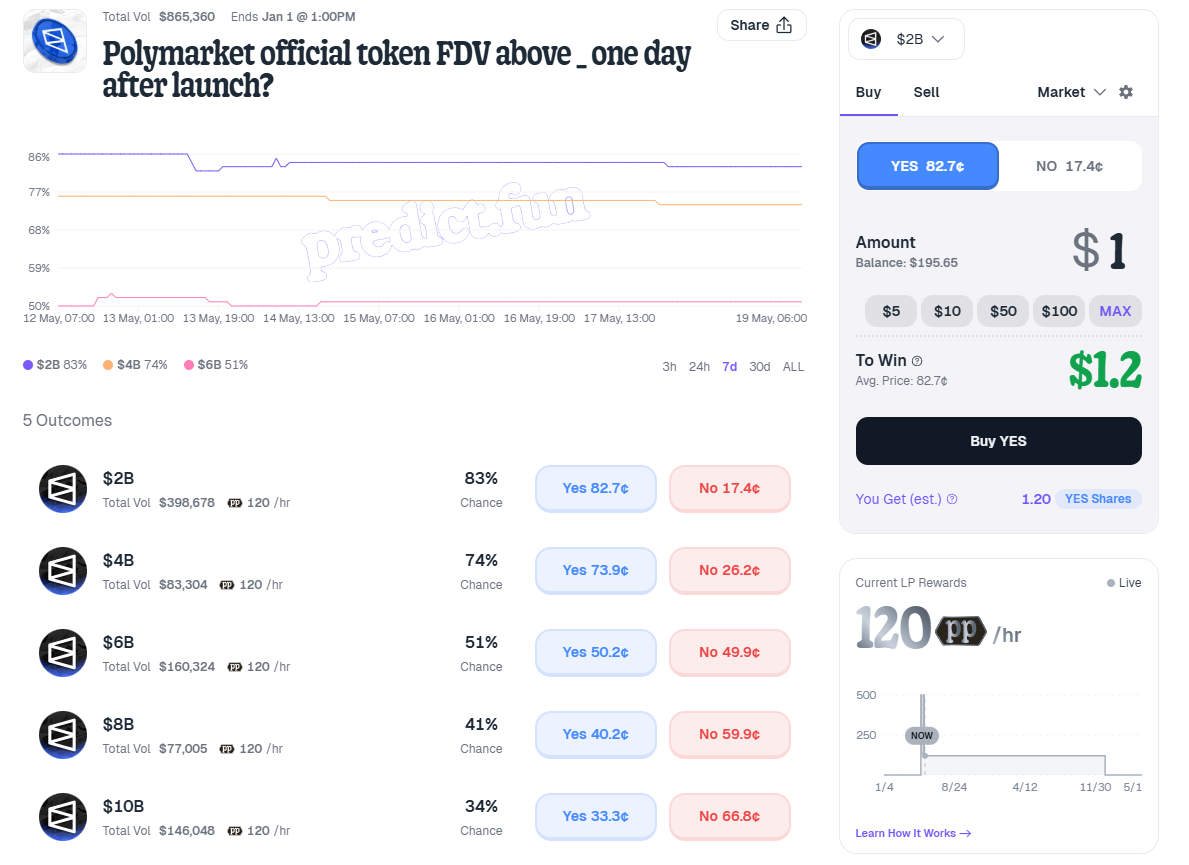
Furthermore, regarding market cap, the probability of the event "Polymarket's FDV exceeds $6 billion one day after launch" is currently reported at 51%; there is a 34% probability that "Polymarket's FDV exceeds $10 billion one day after launch."
Timeline of Polymarket's Official Token Hinting

October 2025: Initial Hints and Official Confirmation of the POLY Token

Signals from the Polymarket official team about the POLY token can be traced back to October last year.

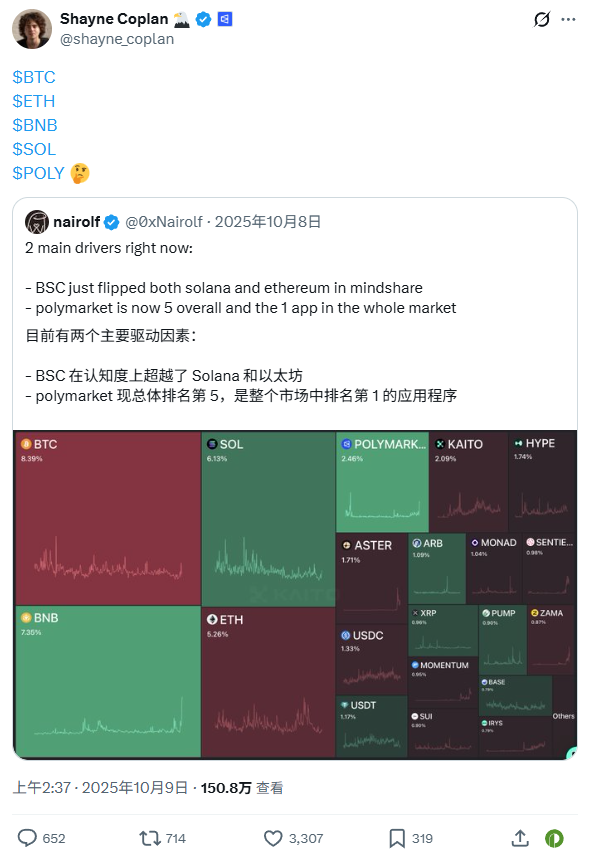
On October 8, 2025, Polymarket CEO Shayne Coplan posted on platform X, listing POLY alongside BTC, ETH, BNB, SOL, sparking community speculation about a Polymarket token launch. Although this was not an official token announcement, for the market, the founder personally writing $POLY was sensitive enough. After that, community discussion about a Polymarket token launch began to noticeably heat up.
Subsequently, the airdrop expectation was further brought into public discussion by official team members. On October 23, 2025, Polymarket Growth Lead William LeGate mentioned "prospective airdrop farmers" in a podcast or related discussion. While not an official rules clarification, this acknowledged the existence of user behavior and expectations surrounding a potential Polymarket airdrop in the market.

What further solidified the POLY token expectation was on October 24, 2025. Polymarket CMO Matthew Modabber explicitly stated in a podcast, "Polymarket will have a token, and there will be an airdrop." This statement became a key turning point for Polymarket's token expectation, shifting from community speculation to official confirmation.

After entering November, the focus of official discussions began to shift from whether there would be an airdrop to what kind of behavior would NOT qualify for an airdrop. On November 11, 2025, William LeGate explicitly stated in response to Sybil farming, "I can tell you for sure that these Sybil accounts will not get airdrop allocations. They are wasting their time."

April This Year: Major Price Tracking Platforms Launch POLY Preview Pages

Entering April this year, the POLY token expectation extended to major crypto price-tracking websites.

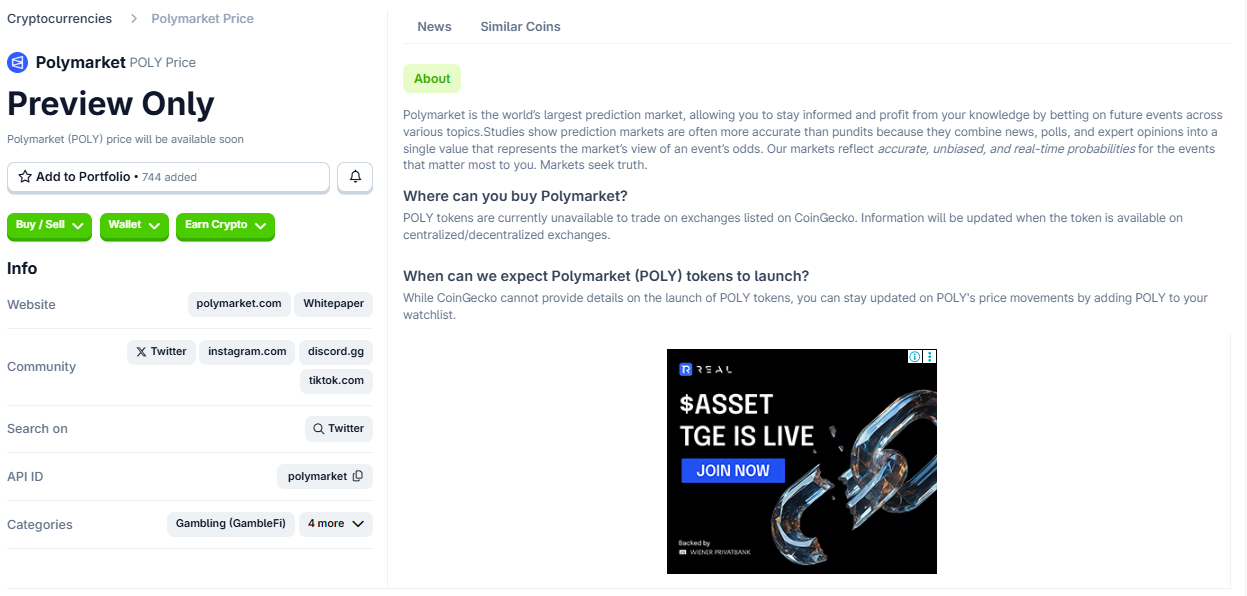
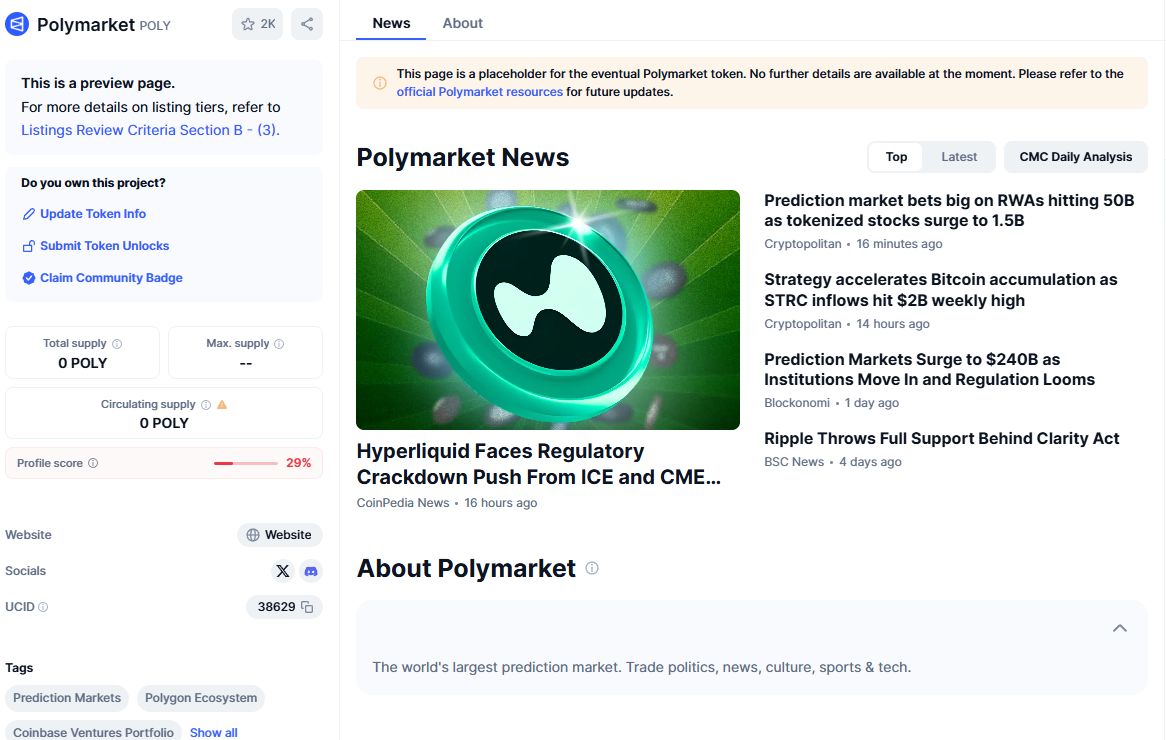
Currently, preview pages for Polymarket (POLY) have appeared on both CoinGecko and CoinMarketCap. While these pages do not equate to the formal token launch and do not represent an announced TGE date by Polymarket, the fact that external price-tracking platforms are reserving space for $POLY further reinforces the community's expectation for a Polymarket token launch.
May This Year: POLY Token Moves from Airdrop Expectation to Product Hinting

After entering May, discussions about the POLY token have progressed further towards specific functionalities and airdrop eligibility.

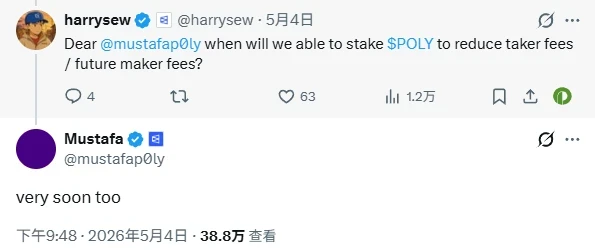
On the evening of May 4, Polymarket official team member Mustafa responded to a question about the POLY token during a community interaction. A user asked when it would be possible to stake POLY to reduce taker fees or potentially future maker fees. Mustafa replied: "Soon." The community quickly interpreted this official response as an indication that Polymarket is preparing for the token's launch.
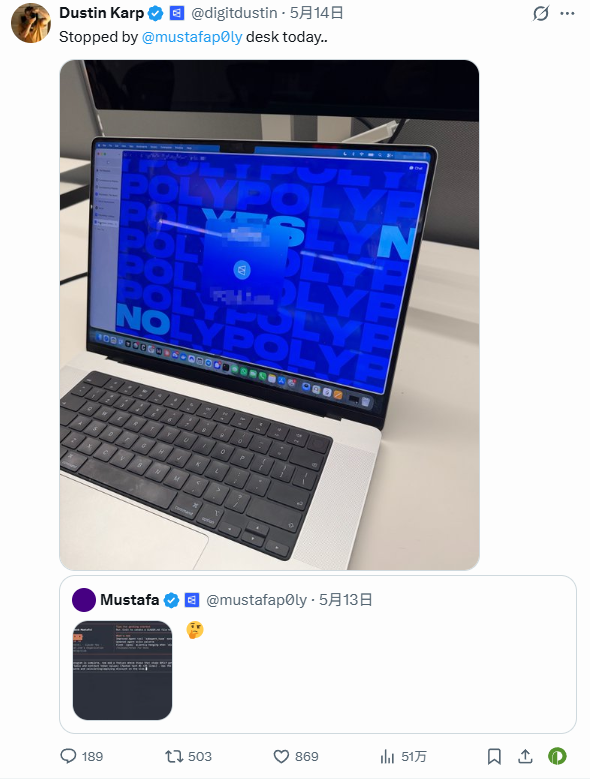
On May 13, more clues around the POLY token emerged. Polymarket Product Lead Dustin Karp posted a photo of a workstation, saying he passed by Mustafa's desk. The photo appeared to show an internal page related to the POLY token airdrop. Upon zooming in, the community spotted an "Airdrop" label, further increasing expectations for the POLY token airdrop.
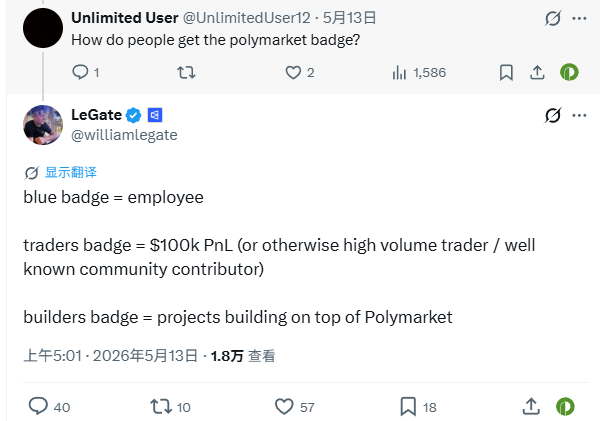
Subsequently, Polymarket Growth Lead LeGate also responded in a community discussion regarding official badges. LeGate replied that blue badges represent Polymarket employees; Traders badges are mainly for traders with cumulative profits reaching $100,000, or other high-volume users (in other tweet replies he mentioned transaction volume exceeding $10 million, adding that if users are active traders on Polymarket, profit amounts and transaction volumes could be slightly adjusted), and notable community contributors; Builders badges are for projects developing and building based on the Polymarket ecosystem.
Badges may not be the sole criterion for receiving an airdrop. The community inquired whether X content contributions would be rewarded with POLY tokens. LeGate replied that connecting an X account to a Polymarket account is only one-third of the conditions. Additionally, users should perhaps also put their Polymarket profile link in their X bio, actively share their trades, profit records, and market views on X, and engage with the community.
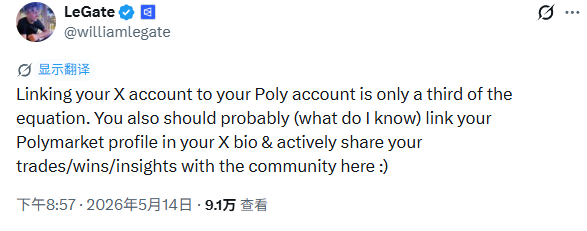
Although this reply did not explicitly confirm whether "jaw farming" (creating content for potential airdrops) would actually yield an airdrop, major communities are relatively optimistic and are actively posting Polymarket-related content on X to vie for potential token airdrops.

Personal Strategy

For me, having been deeply involved in prediction markets throughout the first half of this year, I still lean towards Polymarket not launching its token before the World Cup.

The reason is simple: Polymarket's more important task right now might not be launching a token immediately, but first refining the trading experience and infrastructure. Whether it's the continuous optimization of the V2 version or even changing chains, the essence is to prepare for high-traffic, high-frequency trading scenarios like the World Cup. For Polymarket, if the platform experience is unstable during the World Cup, launching a token beforehand might not effectively capture new users and trading volume.

Therefore, recent trading has primarily been hedging: placing orders for points on predict.fun, and then hedging the acquired positions on Polymarket. At the same time, I participate in various events on Polymarket with the goal of making profits. Additionally, I will bind my personal X account information on Polymarket and post Polymarket-related content on X, hoping that future token launches might allocate a portion of airdrops to "jaw-farming users."


Domande pertinenti

QWhat are the key pieces of evidence from Polymarket officials that have fueled speculation about a POLY token airdrop?

AThe evidence includes: CEO Shayne Coplan mentioning $POLY alongside major cryptocurrencies in Oct 2025; CMO Matthew Modabber explicitly confirming 'Polymarket will have a token, and there will be an airdrop' in late Oct 2025; Growth Lead William LeGate discussing 'prospective airdrop farmers'; internal screenshots from May 2026 showing 'Airdrop' labels; and LeGate outlining potential airdrop criteria like linking X accounts and active community participation.

QAccording to the prediction market data in the article, what is the perceived likelihood and potential valuation of a POLY token launch?

AAccording to predict.fun data: There is a 56% probability that Polymarket will launch its official token before the end of the year. There is a 34% probability that its Fully Diluted Valuation (FDV) will exceed $10 billion one day after launch, and a 51% probability it will exceed $6 billion.

QWhat specific user behaviors does the article suggest might *not* qualify for a potential POLY airdrop, based on official hints?

ABased on comments from Growth Lead William LeGate, Sybil farming (creating fake accounts to farm airdrops) will not qualify for an airdrop allocation. He stated such accounts are 'just wasting their time.'

QWhat are the three types of official badges mentioned by Polymarket's team, and what do they represent?

AThe three badge types are: 1) Blue Badge: Represents Polymarket employees. 2) Traders Badge: For users with cumulative profits of $100,000+, very high trading volume (hinted at over $10 million), or notable community contributors. 3) Builders Badge: For projects building on or developing within the Polymarket ecosystem.

QWhat is the author's personal prediction regarding the timing of the POLY token launch, and what is their reasoning?

AThe author predicts Polymarket will NOT launch the token before the FIFA World Cup. The reasoning is that Polymarket's priority is likely perfecting the trading experience and infrastructure (like V2 optimizations) to handle the high traffic and transaction volume expected during the World Cup. A stable platform is seen as more critical than an immediate token launch to capitalize on that event.

Letture associate

Who Funds the Agents?

**Summary: Who Funds AI Agents?** OpenAI recently shut down a feature allowing AI agents to shop for users, highlighting the challenge of creating a secure and regulated environment for agent-driven transactions. While payment infrastructure exists, a crucial governance layer—defining spending limits, fraud detection, tax handling, and return policies—is largely missing. The potential is enormous: AI agents already processed $73M across 176M transactions last year, with McKinsey forecasting this could grow to $3-5T in global consumer commerce by 2030. The core competition isn't just about processing payments, which can be very cheap (especially with crypto-based settlement), but about controlling the rules that govern agent spending. Key players like Stripe and Coinbase are racing to dominate this governance layer. Stripe's acquisition of wallet provider Privy allows it to set spending policies, identity checks, and human-in-the-loop approvals directly at the wallet level. Similarly, Coinbase's stack, including its x402 protocol and AgentKit, embeds governance rules. This vertical integration across settlement, wallet, and governance layers is becoming the dominant strategy. Control over the governance layer is where significant future value lies. If agents handle trillions in transactions, even a small fee for managing compliance, fraud prevention, and policy enforcement could generate billions in annual revenue. The companies that successfully integrate across the payment stack will capture value from idle agent balances, transaction fees, and governance services, positioning themselves as the foundational banks of the AI agent economy.

marsbit20 min fa

Who Funds the Agents?

marsbit20 min fa

A Nation Blocks Chips, a Giant Buys a Nuclear Power Plant: Why It's Time to Seriously Consider DeAI

**Title: Great Powers Blockade Chips, Giants Buy Nuclear Plants: Why It's Time to Seriously Consider DeAI** In May 2026, the US closed loopholes for Chinese firms to acquire advanced NVIDIA chips via overseas subsidiaries. That same month, Kenya halted a $1B geothermal data center project involving Microsoft, fearing its immense energy consumption. Meanwhile, Huawei announced mass production of its Ascend AI chip. These disparate events underscore a new reality: the competition for computing power ("compute") has escalated beyond the tech industry, becoming a geopolitical and infrastructural battleground. A new era of oligopoly is forming, with control over the AI stack—from GPU chips (NVIDIA) and cloud platforms (AWS, Azure, Google Cloud) to foundational models (OpenAI, Anthropic)—concentrating in a few Western "AI Octopus" corporations. This centralization creates systemic risks: pricing power and platform lock-in for users, infrastructure fragility, and a widening "compute divide" that threatens to marginalize nations without independent AI capacity. An "AI Iron Curtain" is deepening through export controls. In response, some nations like Saudi Arabia and the UAE are investing heavily to buy compute power, aiming to transition from oil to AI economies. The EU seeks to triple its compute capacity by 2030 to reduce dependency. However, the spending gap is vast, with four US tech giants alone planning ~$750B in AI capex for 2026. The race is increasingly constrained by energy, with AI tasks consuming up to 1000x more power than web searches, pushing firms to even acquire nuclear plants. This landscape is fueling interest in Decentralized AI (DeAI). It proposes a third way: using open protocols to coordinate a global network of idle GPUs, independent developers, and data centers, creating an AI infrastructure without a single controlling entity. Leveraging blockchain and cryptographic verification, DeAI aims to break market concentration, disperse energy demands, reduce geopolitical dependencies, and enhance transparency. While still nascent in performance and stability, DeAI's core promise is not immediate superiority but providing a crucial alternative architecture to resist monopoly, censorship, and centralized power. As specialized AI hardware costs fall and open-source models flourish, the window to build this foundation is open. The very existence of such competition serves as a vital check against the inevitable abuse of concentrated power.

marsbit1 h fa

A Nation Blocks Chips, a Giant Buys a Nuclear Power Plant: Why It's Time to Seriously Consider DeAI

marsbit1 h fa

Trading

Spot
Futures
活动图片




