Polymarket Sues Massachusetts Over Prediction Market Regulation – SUBBD Token Takes Advantage

bitcoinistPubblicato 2026-02-10Pubblicato ultima volta 2026-02-10

Introduzione

Polymarket, the world's largest prediction market, is suing the Commonwealth of Massachusetts after receiving a cease-and-desist order from the state's Attorney General, who accused it of operating an unlicensed gambling platform. The company argues its markets are financial derivatives under the jurisdiction of the Commodity Futures Trading Commission (CFTC), not gambling subject to state laws. This lawsuit represents a critical test for the crypto industry's ability to operate under a single federal framework rather than fragmented state regulations. Amid this regulatory battle, the SUBBD Token is capitalizing on the demand for decentralized platforms. It aims to disrupt the $85 billion creator economy by merging Web3 financial sovereignty with AI tools, offering lower fees and censorship-resistant monetization for content creators. The project has already raised $1.47 million in its presale and offers a 20% APY staking reward, positioning itself as a utility-driven alternative in a market seeking alternatives to centralized control.

Trusted Editorial content, reviewed by leading industry experts and seasoned editors. Ad Disclosure

Quick Facts:

  • ➡️ Polymarket is suing Massachusetts to establish that prediction markets are federally regulated derivatives, not state-regulated gambling.
  • ➡️ The lawsuit represents a critical test for the crypto industry’s ability to operate under federal oversight rather than fragmented state laws.
  • ➡️ SUBBD Token leverages similar decentralized principles to disrupt the $85B creator economy, offering AI tools and lower fees than Web2 competitors.
  • ➡️ The conflict highlights a broader market trend toward platforms that offer user sovereignty and resistance to centralized censorship.

The battle for decentralized information markets just hit a breaking point.

Polymarket, the world’s largest prediction platform, has officially filed a lawsuit against the Commonwealth of Massachusetts. This legal maneuver serves as a sharp counter-offensive to the Cease and Desist order issued by the state’s Attorney General, who accused the platform of running an unlicensed gambling operation.

Polymarket’s argument hangs on a single hook: federal preemption. The company contends its markets are financial derivatives under the jurisdiction of the Commodity Futures Trading Commission (CFTC), not games of chance subject to state-level gambling laws.

That distinction isn’t just legalese, it’s survival. If prediction markets are classified merely as gambling, they face a fractured nightmare of 50 different state regulators. If they’re derivatives? They face a single federal framework.

This lawsuit follows the precedent set by Kalshi, a regulated competitor that recently scored a massive win against the CFTC, emboldening platforms to challenge regulatory overreach.

But this isn’t just about election betting or sports outcomes. The conflict highlights the friction between decentralized protocols and legacy frameworks that struggle to categorize Web3 innovation. The market’s reaction? Telling.

Rather than fleeing, liquidity in decentralized sectors has deepened. Investors are hunting for sovereignty and utility outside the reach of arbitrary restrictions.

While prediction markets fight for the right to trade truth, SUBBD Token ($SUBBD) is using this sentiment to disrupt the $85 billion creator economy. As users look for platforms that guarantee ownership and freedom from censorship, SUBBD is capitalizing on the shift toward decentralized monetization.

Explore the SUBBD Token ecosystem.

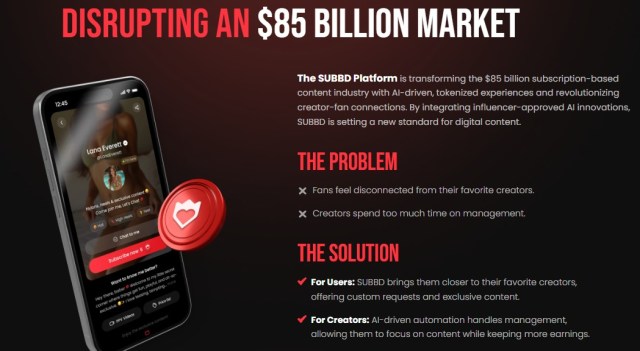
Disrupting The $85B Content Economy With AI And Web3

While the Polymarket case highlights the struggle for permissionless trading, the content creation industry faces a parallel crisis: centralization.

Right now, Web2 giants strangle the landscape, extracting up to 70% of creator earnings through fees and maintaining absolute authority over who can monetize. Sound familiar?

This centralized control creates a fragile ecosystem where influencers face arbitrary bans, demonetization, and payment processor restrictions. SUBBD Token has emerged to fix these inefficiencies by merging Web3 financial sovereignty with advanced AI tooling.

The project’s architecture is built to return value to the user (a concept foreign to most legacy platforms). By utilizing the Ethereum blockchain, SUBBD eliminates the intermediaries that typically siphon revenue, offering a transparent payment infrastructure that supports creators, fans, and even AI-driven influencers.

The platform integrates proprietary AI models directly into the ecosystem, offering features like AI Personal Assistants for automated interactions and AI Voice Cloning. Why does that matter? It lets creators scale their output without the burnout associated with traditional streaming.
From a market perspective, the utility here goes beyond simple tokenization. The platform introduces governance mechanisms that allow token holders to vote on feature rollouts and creator curation, fostering a community-owned ecosystem rather than a corporate dictatorship.

For investors watching the regulatory squeeze on platforms like Polymarket, SUBBD represents a tangible application of decentralized tech, solving a clear operational problem rather than relying on purely speculative trading. The integration of ‘HoneyHive’ membership tiers and token-gated exclusive content further aligns the token’s velocity with platform growth.

Read more about $SUBBD here.

SUBBD Presale Momentum Signals Demand For Decentralized Monetization

You can see the hunger for utility-driven crypto assets in the project’s early numbers. According to official presale data, SUBBD Token has already raised $1.47M, indicating strong capital inflows despite the broader market’s regulatory uncertainty.

The token’s current price of $0.057495 offers a vital entry point for investors looking to capitalize on the intersection of AI and the creator economy before the platform fully launches.

Financial incentives play a major role in this early accumulation phase. The protocol offers a robust staking mechanism, providing a fixed 20% APY for the first year to users who lock their tokens. This strategy is designed to reduce circulating supply volatility during the project’s initial expansion phase.

Plus, stakers unlock platform-specific benefits, including exclusive livestreams, daily behind-the-scenes drops, and XP multipliers that enhance their standing within the ecosystem.

Smart money seems to be betting on the convergence of two high-growth narratives: the explosion of AI tools and the necessity of censorship-resistant payments. While the Polymarket lawsuit dominates the headlines regarding regulatory jurisdiction, projects like SUBBD Token are building the infrastructure that renders traditional gatekeepers obsolete.

By offering a solution that combines lower fees, AI utility, and staking yields, the project positions itself as a hedge against the centralization risks currently plaguing both the prediction and content markets.

Buy your $SUBBD tokens here.

This article is for informational purposes only and doesn’t constitute financial advice. Cryptocurrencies are volatile assets; always conduct your own research before investing. The regulatory landscape is evolving and may impact project viability.

Editorial Process for bitcoinist is centered on delivering thoroughly researched, accurate, and unbiased content. We uphold strict sourcing standards, and each page undergoes diligent review by our team of top technology experts and seasoned editors. This process ensures the integrity, relevance, and value of our content for our readers.

patrubogdan

Follow

Full Profile

Related Posts

Binance Dominates Trump’s USD1 Supply as Bitcoin Hyper Breaks Records

Cathie Wood’s Ark Invest Buys More Bullish Assets Just Days After Last Purchase, While LiquidChain Turns Heads

Bitcoin Hyper Could Conquer 2026 if Bitcoin Regains Lost Ground

Tether Pushes for $1 Despite Market Crash, While Maxi Doge Reaches New Heights

Ethereum Holds Strong Above $2K, While $LIQUID Starts Turning Heads: Price Analysis & Outlook

Convicted FTX CEO SBF Cries ‘Biden Lawfare’ In Trump Pardon Pitch

Domande pertinenti

QWhat is the core legal argument Polymarket is using in its lawsuit against Massachusetts?

APolymarket argues that its prediction markets are financial derivatives under the jurisdiction of the Commodity Futures Trading Commission (CFTC), not state-regulated gambling, and are therefore subject to federal preemption.

QHow does the SUBBD Token aim to disrupt the creator economy?

ASUBBD Token aims to disrupt the $85 billion creator economy by merging Web3 financial sovereignty with AI tools, eliminating high fees from Web2 intermediaries, and offering a transparent, censorship-resistant payment infrastructure for creators and fans.

QWhat precedent did the prediction market platform Kalshi set that is relevant to Polymarket's case?

AKalshi, a regulated prediction market competitor, recently scored a significant win against the CFTC, which emboldened other platforms like Polymarket to challenge regulatory overreach and assert that they operate under federal oversight.

QWhat financial incentive does the SUBBD Token offer to early investors during its presale?

AThe SUBBD Token offers a fixed 20% APY for the first year to users who stake their tokens, along with platform-specific benefits like exclusive content and XP multipliers, to encourage early adoption and reduce supply volatility.

QWhat two major market trends does the SUBBD Token capitalize on, according to the article?

AThe SUBBD Token capitalizes on the convergence of two high-growth narratives: the explosion of AI tools and the necessity for censorship-resistant, decentralized payment systems in the creator economy.

Letture associate

The "Impossible Triad" Is Fundamentally a Pseudo-Problem

The article argues that blockchain's fundamental limitation is not the scalability trilemma (decentralization, scalability, security), which has been largely solved, but the lack of **privacy** and, until recently, clear **legitimacy**. Blockchain is described as a slow, expensive, globally shared computer whose core value is censorship resistance and verifiability. While ideal for native digital assets like money (e.g., stablecoins), its default transparency acts as a **tax**, exposing all transactions and enabling MEV extraction, which deters serious institutional capital. Simultaneously, its permissionless nature created regulatory ambiguity. The piece contends that **privacy** is the missing critical feature. It rejects the false choice between total transparency and complete anonymity. Modern cryptography (like zero-knowledge proofs) enables **compliant privacy**: users can prove facts (solvency, KYC status, compliance) without revealing the underlying sensitive data (specific holdings, identities). This preserves auditability for regulators and eliminates the leak of financial information. With recent regulatory progress (e.g., the GENIUS Act) addressing legitimacy, adding default, provably compliant privacy becomes a pure upgrade. It transforms blockchain from a costly, public ledger into a confidential settlement layer, finally bridging the gap to mainstream institutional and individual adoption of on-chain finance.

链捕手9 h fa

The "Impossible Triad" Is Fundamentally a Pseudo-Problem

链捕手9 h fa

Optical Chips: Collective Capacity Expansion

The global optical chip industry is experiencing a massive wave of expansion driven by surging AI data center demand. Major players across the US, Japan, Europe, and China are aggressively investing to ramp up production capacity. In the US, Coherent is expanding its 6-inch Indium Phosphide (InP) semiconductor fab in Texas, supported by CHIPS Act funding and a $2 billion strategic investment from NVIDIA. Lumentum is building a new factory for InP optical devices, and Nokia is scaling its advanced photonic chip packaging and testing capabilities. NVIDIA's investments aim to secure future supply of critical lasers and optical interconnect products for AI infrastructure. Japan's JX Advanced Metals, a leading InP substrate supplier, plans a multi-billion yen investment to increase its capacity 7-10 times, strengthening its grip on the crucial upstream materials market. In Europe, IQE and Tower Semiconductor settled a patent dispute and signed a multi-year InP epitaxial wafer supply agreement, highlighting that next-generation silicon photonics platforms will integrate high-performance InP components. STMicroelectronics and Sivers Semiconductors are also expanding silicon photonics production and partnerships. China is rapidly building out its domestic supply chain. Dongshan Precision's subsidiary, Source Photonics, announced a $12 billion project to expand optical chip and module production. Companies like Sanan Optoelectronics and Yunnan Germanium are scaling up InP chip manufacturing and substrate production, moving towards vertical integration from materials to modules. While debate continues around the exact future architecture—whether CPO (Co-Packaged Optics), NPO, or pluggables will dominate—analysts like Morgan Stanley argue the underlying driver is unchangeable: the explosive growth in bandwidth demand. This will inevitably increase the volume of optical engines, lasers, and related content per GPU, regardless of the final technical path. The competition for "more light" in the AI era has intensified into a global, full-chain capacity race.

marsbit11 h fa

Optical Chips: Collective Capacity Expansion

marsbit11 h fa

Stablecoins Finally Find Real Yield: An In-Depth Look at On-Chain Reinsurance Re | A Conversation with Re Founder Karan Saroya

Stablecoin Real Yield Found: A Deep Dive into On-Chain Reinsurance with Re's Karan Saroya As stablecoin supply exceeds $170 billion, the search for sustainable, non-speculative yield intensifies. Re, an on-chain reinsurance platform, provides an answer: connecting stablecoin capital to the trillion-dollar traditional reinsurance market. Re operates as a regulated reinsurer, accepting stablecoin deposits as collateral to back US insurance companies. These insurers pay premiums, generating yield that flows back to on-chain depositors. Currently supporting 35 insurers and underwriting $500 million, Re projects scaling to over $1 billion soon. Key insights from a Bankless podcast with founder Karan Saroya and investor Avichal of Electric Capital: 1. **Uncorrelated, Real-World Yield:** Re offers stablecoin holders access to reinsurance returns (targeting 12-14%+), an asset class entirely separate from crypto or equity markets. 2. **Operational Efficiency via Smart Contracts:** Re replaces traditional, labor-intensive capital fundraising with smart contracts, allowing a ~12-person team to compete with industry giants. 3. **Regulatory Leverage:** For every $1 of collateral, regulations allow backing $5-7 in written premiums. This leverage amplifies returns from the underlying risk-free rate. 4. **DeFi Integration:** Depositors receive receipt tokens, which can be used in protocols like Morpho for "looping," potentially pushing yields to 18-20%+. 5. **The "DeFi Mullet" Model:** A compliant front-end (regulated reinsurer) paired with a decentralized back-end (smart contracts, DeFi capital markets). 6. **RE Governance Token:** Modeled on Lloyd's of London, the token governs the central capital pool's allocation, counterparty acceptance, and parameters. 7. **Real Economic Impact:** Capital funds real-world productivity (factories, clinics, businesses) via insurance, moving beyond crypto's internal loops. The discussion highlights a pivotal moment: DeFi's supply-side infrastructure is now met by real demand for productive yield, potentially kickstarting a flywheel where vast on-chain stablecoin capital seeks these real-world returns.

链捕手12 h fa

Stablecoins Finally Find Real Yield: An In-Depth Look at On-Chain Reinsurance Re | A Conversation with Re Founder Karan Saroya

链捕手12 h fa

1996 or 1999? Walsh's First Test is 'How to View AI'

"1996 or 1999? Wall's First Big Test Is 'How to View AI'" Federal Reserve Chairman Wall's initial challenge is not whether to raise or cut rates, but a more fundamental judgment: what kind of boom is the current AI boom? This will determine the Fed's policy path and define his legacy. Economics is split between two opposing views, according to reporter Nick Timiraos. One sees imminent productivity gains that will increase supply and cool inflation, allowing the Fed to hold steady. The other argues that while productivity benefits are distant, demand shocks are here now, and waiting for data confirmation risks missing the intervention window, forcing sharper rate hikes later. Wall has signaled a leaning toward the first view, echoing 1996-era Alan Greenspan, who embraced strong, productivity-driven growth without fear of inflation. However, Wall faces a different macro environment than Greenspan did, with tariff pressures, expanding fiscal deficits, and diminishing globalization benefits, which could force more significant inflation pressures even if AI benefits materialize. Wall's logic, expressed before taking office, is that AI-driven productivity gains won't show in official data for years. If the Fed waits for confirmation, it might mistakenly tighten policy and choke off the very growth that could suppress inflation. This argues for using forward-looking narratives over lagging data. Chicago Fed President Austan Goolsbee presents a key counter-argument. He distinguishes between expected and unexpected productivity booms. A widely anticipated boom, like the current AI wave, can cause people to spend future wealth gains in advance, overheating the economy before productivity actually rises, thus requiring preemptive rate hikes. He cites rising costs for AI data centers as evidence of such overheating. Fed Governor Christopher Waller offers a rebuttal to Goolsbee, noting the "expected spending" mechanism only works if people can borrow against future income, which many households cannot do due to borrowing constraints. Wall also faces a paradox related to his desire to reduce the Fed's use of "forward guidance" (pre-announcing policy moves). This practice was established in 1999 when Greenspan began signaling hikes to avoid market shocks. If the economy follows a less optimistic path, Wall may be forced to choose between using the guidance he wants to abolish or risking market volatility by staying silent. The ultimate question defining Wall's first major test remains: Is this 1996 or 1999?

marsbit13 h fa

1996 or 1999? Walsh's First Test is 'How to View AI'

marsbit13 h fa

Trading

Spot
Futures
活动图片