Polymarket bets surge on Lighter airdrop as Hyperliquid lists LIT

cointelegraphPubblicato 2025-12-23Pubblicato ultima volta 2025-12-23

Introduzione

Lighter, a perpetual decentralized exchange (perp DEX) and rival to Hyperliquid, is generating significant airdrop speculation. A core contributor announced the platform is finalizing its token generation event (TGE), including removing Sybil and wash-trading points from its Season 2 rewards program. Hype intensified when Hyperliquid listed the yet-to-launch LIT token. Lighter opened an airdrop allocation form, allowing users to direct tokens to additional wallets, with submissions accepted until Friday. The transfer of 250 million LIT tokens (25% of supply) further fueled expectations. On prediction market Polymarket, the odds of an airdrop occurring by December 31st have surged to 86%, with $9.5 million in betting volume. Lighter recently raised $68 million in a round led by Founders Fund and Ribbit Capital.

Lighter, a perpetual decentralized exchange (perp DEX) and a major rival to Hyperliquid, is fueling airdrop speculation as Polymarket traders bet on a token launch before year’s end.

Sebas, also known as Babastianj, a core contributor to the Lighter DEX, announced on the project’s Discord channel Monday that the platform is finalizing key processes ahead of the highly anticipated token generation event (TGE).

“We’re in the final stretch of Season 2 and are running data science to remove Sybil, self-trading, and wash-trading points,” he said, adding that all slashed and removed points are planned to be redistributed to the community.

The announcement has fueled growing optimism over Lighter’s airdrop, further amplified with Hyperliquid’s listing of the yet-to-launch Lighter token against USDC (USDC) on Monday.

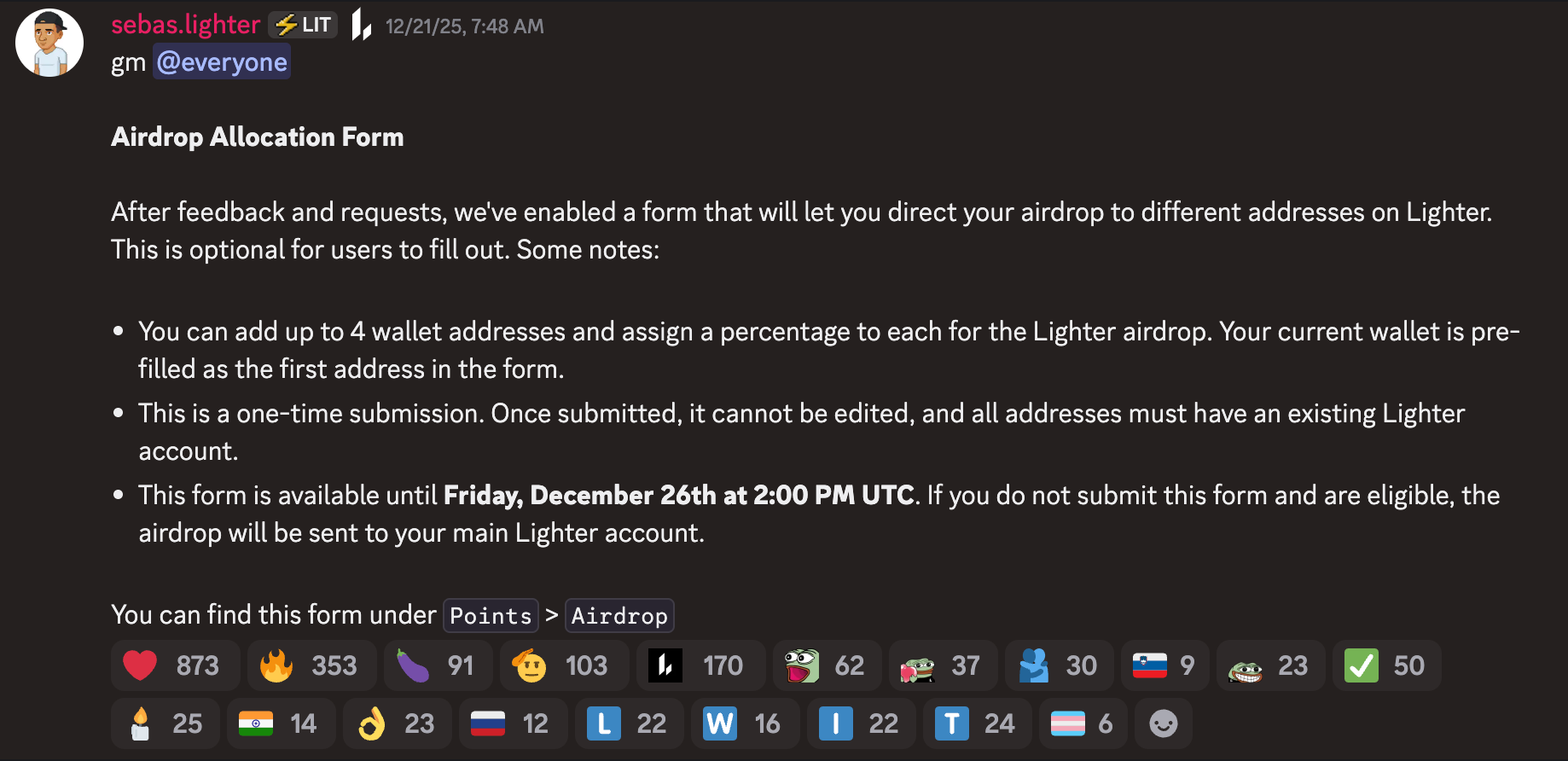
Lighter’s airdrop allocation form open until Friday

Lighter launched an airdrop allocation form on Sunday, allowing users to direct their tokens to up to four additional wallets.

The optional form lets users allocate different token amounts to each wallet, with submissions accepted through Friday.

“If you do not submit this form and are eligible, the airdrop will be sent to your main Lighter account,” Sebas said on Discord.
Source: Discord

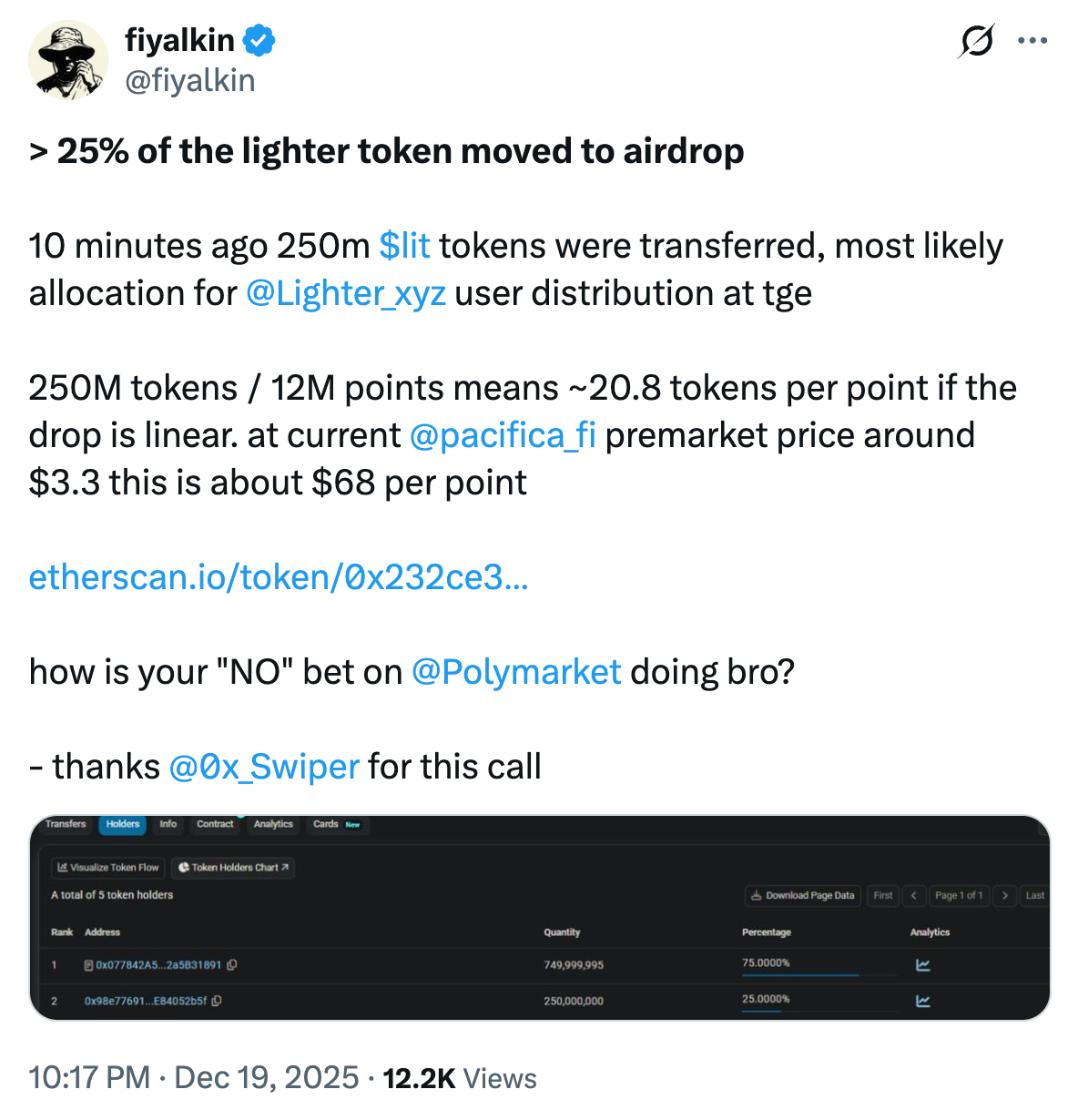
Lighter transferred 250 million LIT tokens — representing 25% of the total supply — on Friday, sparking community speculation that the move signaled an upcoming user airdrop ahead of the TGE, expected by Dec. 31.
Source: Fiyalkin

According to Lighter, its Season 1 points program ended with the final private beta distribution on Sept. 30, while Season 2 points are distributed every Friday.

Related: Hyperliquid says ex-employee responsible for HYPE token shorting

The points are earned by running organic trading strategies via user interface and application programming interface.

Polymarket odds on Lighter airdrop at 86%

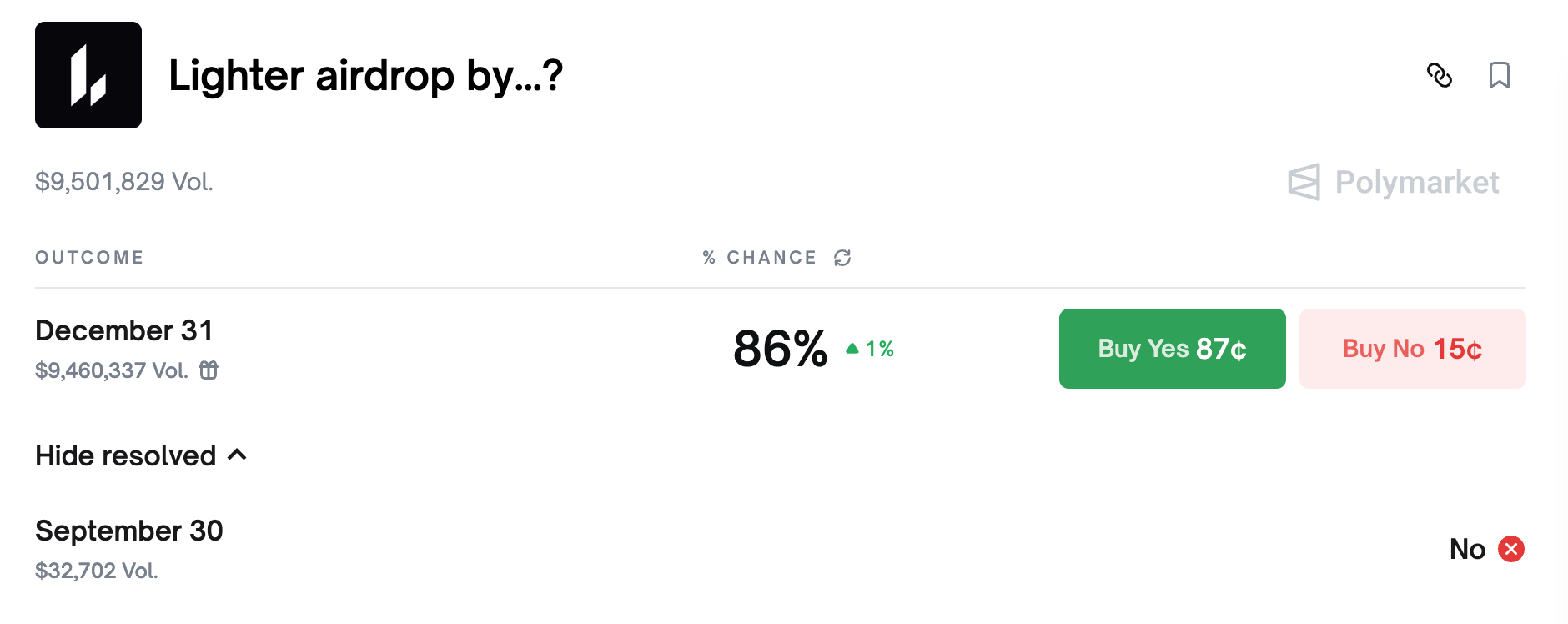
Amid rising community anticipation, the odds that Lighter’s airdrop will occur before the end of the year have been climbing on the prediction market Polymarket, with $9.5 million in volume backing bets that it will take place by Dec. 31.

At least 86% of traders have positioned their predictions on a “yes” scenario.

Onchain analyst Andrew 10 GWEI previously suggested that the airdrop would happen by the end of December, using an alleged insider bet proof on Polymarket.
Source: Polymarket

The news follows Lighter’s $68 million fundraising round announced in November, led by Peter Thiel’s Founders Fund and fintech investor Ribbit Capital, shortly after the platform launched its public mainnet in October.

Related: Coinbase opens Solana DEX access as CeFi and DeFi converge

Founded in 2022 by tech entrepreneur Vladimir Novakovski, Lighter has emerged as a key competitor in the perpetual decentralized exchange market, ranking as the second-largest perp DEX after Hyperliquid at the time of publication, according to DefiLlama data.

In mid-December, major US cryptocurrency exchange Coinbase added Lighter to its listing roadmap, signaling a potential future listing of the token, which has yet to be generated.

Domande pertinenti

QWhat is the current probability on Polymarket that Lighter's airdrop will occur before the end of the year?

AThe current probability on Polymarket is 86%, with $9.5 million in volume backing bets that the airdrop will take place by December 31st.

QWhat action did Hyperliquid take that amplified the speculation around Lighter's token?

AHyperliquid listed the yet-to-launch Lighter token (LIT) against USDC on Monday, which amplified the growing optimism over the airdrop.

QWhat is the purpose of the airdrop allocation form that Lighter launched, and until when is it open?

AThe optional airdrop allocation form allows eligible users to direct their tokens to up to four additional wallets, with different amounts for each. Submissions are accepted through Friday.

QWhat percentage of the total LIT token supply was transferred recently, and what did this action spark in the community?

ALighter transferred 250 million LIT tokens, representing 25% of the total supply. This sparked community speculation that it signaled an upcoming user airdrop ahead of the Token Generation Event (TGE).

QWho led Lighter's recent $68 million fundraising round?

AThe $68 million fundraising round was led by Peter Thiel's Founders Fund and fintech investor Ribbit Capital.

Letture associate

Lowering Expectations for BTC's Next Bull Market

The author, Alex Xu, explains his decision to significantly reduce his Bitcoin holdings (from full to ~30% of his portfolio) during the current bull cycle, citing a lowered long-term outlook for BTC's price appreciation in the next cycle. He outlines six key reasons for this reduced expectation: 1. **Diminished Growth Drivers:** The narrative of exponential user adoption has largely played out with institutional ETF adoption. The next major growth phase—adoption by sovereign national reserves or central banks—seems unlikely in the near future. 2. **Personal Opportunity Cost:** More attractive investment opportunities have emerged in other assets, such as undervalued companies. 3. **Industry-Wide Contraction:** The broader crypto industry is struggling, with most Web3 business models (SocialFi, GameFi, DePIN) failing. This overall萧条 (depression) reduces the fundamental demand and consensus for Bitcoin. 4. **Strain on Major Buyer:** MicroStrategy, a major corporate buyer of BTC, faces rising financing expenses for its debt, which could slow its purchasing rate and create significant marginal pressure on the market. 5. **Increased Competition from Gold:** The emergence of "tokenized gold" has closed the functional gap (portability, divisibility) between physical gold and Bitcoin, offering a strong competitor in the non-sovereign store-of-value space. 6. **Security Budget Concerns:** The block reward halving continues to exacerbate the long-standing issue of funding Bitcoin's network security, with new fee source explorations like Ordinals and L2s largely failing. The author's decision to hold a significant (though reduced) position reflects a cautious, not bearish, outlook. He remains open to increasing his exposure if the fundamental reasons for his skepticism change or if new positive catalysts emerge.

marsbit12 min fa

Lowering Expectations for BTC's Next Bull Market

marsbit12 min fa

Can Iran 'Control' the Strait of Hormuz?

Iran has announced a comprehensive plan to assert control over the strategic Strait of Hormuz, a critical global oil shipping chokepoint. The proposed measures include requiring all vessels to obtain Iranian permission for passage, imposing fees for security, environmental protection, and navigation management—preferably paid in Iranian rials—and absolutely banning Israeli ships. Vessels from countries deemed hostile by Iran’s top security bodies may also be barred. Analysts suggest Iran’s motives are multifaceted: increasing pressure on the U.S. and Israel by leveraging control over oil transit to influence global prices and inflation; creating a new revenue stream, potentially exceeding $7.7 billion annually, to counter Western sanctions and support postwar reconstruction; and using transit permissions as bargaining chips in future negotiations, notably with the U.S. However, the plan faces significant practical and diplomatic challenges. Enforcing comprehensive interception and fee collection in the busy waterway, patrolled by international military forces, would be difficult. The U.S. has already countering with a blockade of Iranian ports and threats to intercept any ship paying fees, potentially strangling Iran’s oil exports and fee revenue. Broad international opposition, led by European and Gulf states, and legal controversies further complicate implementation. The proposal may ultimately serve more as a negotiating tactic than a feasible policy, with its execution remaining highly uncertain.

marsbit1 h fa

Can Iran 'Control' the Strait of Hormuz?

marsbit1 h fa

Trading

Spot
Futures
活动图片





