Polygon deploys Madhugiri hard fork, aims for 33% throughput boost

cointelegraphPubblicato 2025-12-09Pubblicato ultima volta 2025-12-09

Introduzione

Polygon has deployed the Madhugiri hard fork, targeting a 33% increase in network throughput and reducing block consensus time to one second. The upgrade includes support for three Fusaka Ethereum Improvement Proposals (EIP-7823, EIP-7825, EIP-7883), which improve efficiency and security by limiting gas consumption for heavy mathematical operations. It also introduces a new transaction type for Ethereum-Polygon bridge traffic and adds flexibility for future upgrades. This enhancement aims to better support high-frequency use cases like stablecoins and real-world asset (RWA) tokenization. The hard fork follows the recent Heimdall 2.0 upgrade, which significantly reduced finality times, despite a brief disruption in September due to a bug that was later resolved.

Blockchain network Polygon has rolled out its latest protocol upgrade, known as the Madhugiri hard fork, which aims to achieve a 33% increase in network throughput and reduce block consensus time to one second.

Polygon core developer Krishang Shah said on X that the update includes support for three Fusaka Ethereum Improvement Proposals, specifically EIP-7823, EIP-7825 and EIP-7883. These EIPs make heavy mathematical operations more efficient and secure by limiting the amount of gas they consume.

They also prevent single transactions from consuming excessive computing power, helping the network run more smoothly and predictably.

The upgrade introduces a new transaction type for Ethereum to Polygon bridge traffic and adds a built-in flexibility feature for future upgrades. Polygon previously said that the update makes throughput increases as easy as “flipping a few switches.”

“We are also decreasing the consensus time to 1 second, so blocks can now be announced in 1 second if ready, instead of waiting the full 2 seconds,” Shah wrote.
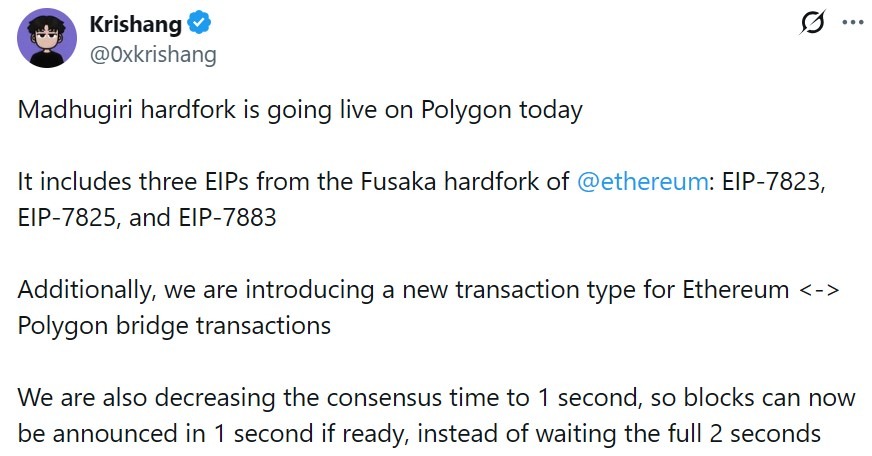
Source: Krishang Shah

New update reinforces Polygon for stablecoins and RWAs

With Madhugiri now live, Polygon aims to reinforce its infrastructure while materially improving its performance. These are prerequisites for high-frequency and high-trust use cases, such as real-world asset (RWA) tokenization and stablecoins.

Aishwary Gupta, the global head of payments and RWAs at Polygon Labs, previously forecasted a “stablecoin supercycle.”

Gupta said there will be a surge of “at least 100,000 stablecoins” in the next five years. However, he said this would not only be about minting tokens and must have a corresponding utility like yield.

Gupta also advocated for more transparency and accountability in the RWA sector. He previously argued that RWA numbers are meaningless if the assets cannot be audited, settled or traded.

“When transparency and accountability are established, RWAs will reach even greater heights, unlocking trillions in institutional capital,” he wrote.

Related: Polygon co-founder mulls resurrecting MATIC a year after POL rebrand

Hard fork follows major Heimdall upgrade

The upgrade comes on the heels of rapid prior improvements. On July 10, Polygon deployed Heimdall 2.0, dubbed by Polygon Foundation CEO Sandeep Nailwal as the network’s “most technically complex” hard fork since its launch.

The update reduced transaction finality times from one to two minutes to roughly five seconds.

However, on Sept. 10, the network experienced a significant disruption when a bug caused finality delays of 10 to 15 minutes, affecting validator sync, remote procedure call services and third-party tooling. Despite this, the team assured the community that blocks were still running.

On Sept. 11, the Polygon Foundation announced that the consensus and finality functions had been restored through a hard fork. With the update, nodes were no longer stuck, while checkpoints and milestones were finalized as expected.

Magazine: Ethereum’s Fusaka fork explained for dummies: What the hell is PeerDAS?
Letture associate

20 Billion Valuation, Alibaba and Tencent Competing to Invest, Whose Money Will Liang Wenfeng Take?

DeepSeek, an AI startup founded by Liang Wenfeng, is reportedly in talks with Alibaba and Tencent for an external funding round that could value the company at over $20 billion. This marks a significant shift, as DeepSeek had previously relied solely on funding from its parent company,幻方量化 (Huanfang Quantitative), and had resisted external investment. The potential valuation would place DeepSeek among the top-tier AI model companies in China, comparable to competitors like MoonDark (valued at ~$18 billion) and ahead of recently listed firms like MiniMax and Zhipu. The funding—which could range from $600 million (for a 3% stake) to $2 billion (for 10%)—is seen as a move to secure resources for model development, retain talent, and support infrastructure needs, particularly as competition in inference models and AI agents intensifies. Both Alibaba and Tencent are eager to invest, not only for financial returns but also to integrate DeepSeek into their broader AI ecosystems. However, DeepSeek’s leadership is cautious about maintaining independence and may prefer financial investors over strategic ones to avoid being locked into a specific tech ecosystem. Alternative options, such as state-backed funds, offer longer-term capital and policy support but may come with slower decision-making and potential constraints on global expansion. With competing AI firms accelerating their IPO plans, DeepSeek’s window for securing optimal terms may be narrowing. The final decision will reflect a trade-off between capital, resources, and strategic independence.

marsbit41 min fa

20 Billion Valuation, Alibaba and Tencent Competing to Invest, Whose Money Will Liang Wenfeng Take?

marsbit41 min fa

After Losing 97% of Its Market Value, iQiyi Attempts to Use AI to Forcefully Extend Its Lifespan

After losing 97% of its market value since its 2018 peak, iQiyi is aggressively pivoting to AI in a desperate attempt to survive. At its 2026 World Conference, CEO Gong Yu announced an "AI Artist Library" with over 100 virtual performers and a new AIGC platform, "NaDou Pro," promising faster production and lower costs. This shift comes as the company faces severe financial distress: its market cap sits near delisting thresholds at $1.36 billion, with significant losses, declining membership revenue, and depleted cash flow. The AI strategy has sparked controversy. Top actors have issued legal threats against unauthorized digital replicas, while in Hengdian, over 134,000 background actors are seeing their already scarce job opportunities vanish as AI replaces them for background roles. iQiyi's move represents a fundamental shift from being a high-cost content buyer to a landlord" to becoming a "platform capitalist" that transfers production risk to creators. This contrasts with competitors like Douyin (TikTok's Chinese counterpart), which is investing heavily in *real* actor-led short dramas, betting that authentic human connection retains users better than AI-generated content. The article draws a parallel to the 1920s transition to "talkies," which made cinema musicians obsolete but ultimately enriched the art form. In contrast, iQiyi's AI drive is framed not as an artistic evolution but as a cost-cutting measure that could degrade storytelling, replacing genuine human emotion with algorithmically calculated stimulation and potentially numbing audiences' capacity for empathy. The core question remains: can a company focused solely on financial survival preserve the art of storytelling?

marsbit44 min fa

After Losing 97% of Its Market Value, iQiyi Attempts to Use AI to Forcefully Extend Its Lifespan

marsbit44 min fa

Only a 50% Chance of Passing This Year, Can the CLARITY Bill Succeed Before the Midterm Elections?

The CLARITY Act, which passed the House in July 2025 with strong bipartisan support (294-134), faces a critical juncture in the Senate. The Senate Banking Committee is expected to hold a markup soon, but key issues remain unresolved, including stablecoin yield provisions, DeFi regulations, and securing full Republican committee support. Other contentious points involve the Blockchain Regulatory Certainty Act (BRCA), ethics amendments for government officials, and SEC-related matters. The legislative calendar is tight, with limited time before the midterm elections. If the committee markup is delayed beyond mid-May, the chances of passage in 2026 drop significantly. Senator Cynthia Lummis has warned that failure this year could delay comprehensive crypto market structure legislation until 2030 or later. Galaxy estimates the probability of the CLARITY Act becoming law in 2026 is only about 50%. The bill provides crucial regulatory clarity by defining jurisdictional boundaries between the SEC and CFTC, establishing a path for decentralization, and bringing digital commodity intermediaries under federal regulation. Its passage is seen as vital before potential power shifts in the next Congress, which could bring less favorable leadership to key committees. The timeline is compressed, and the bill must compete for floor time with other priorities like Iran authorization and DHS appropriations. Key hurdles include finalizing the stablecoin yield compromise text, addressing law enforcement concerns about BRCA, and navigating political dynamics around SEC nominations. The outcome of the Banking Committee markup and the level of bipartisan support will be critical indicators of its future success.

marsbit1 h fa

Only a 50% Chance of Passing This Year, Can the CLARITY Bill Succeed Before the Midterm Elections?

marsbit1 h fa

Trading

Spot
Futures
活动图片