Policy Pilot First: Central Bank Explores Direct 'Money Distribution', Digital Yuan Users Already Benefiting

比推Pubblicato 2026-01-21Pubblicato ultima volta 2026-01-21

Introduzione

China's digital yuan (e-CNY) has entered a significant upgrade phase, transitioning from a non-interest-bearing digital cash (M0) to an interest-bearing asset classified as M1. As of January 1, 2026, users holding funds in verified tier 1-3 digital yuan wallets can earn interest at the current demand deposit rate of 0.05% per annum, paid quarterly. This move, a world-first for a central bank digital currency (CBDC), aims to boost user adoption by providing a tangible benefit for holding the digital currency, which had previously struggled to compete with established payment platforms like Alipay and WeChat Pay despite extensive pilot programs and government subsidies. A key structural change is the shift away from the 100% reserve requirement for commercial banks. Banks can now use a portion of the e-CNY deposits for lending and developing financial products, transforming the digital yuan from a cost center into a potential profit source and incentivizing them to promote it more actively. In contrast, non-bank payment institutions must still maintain 100% reserves. Beyond payments, the digital yuan is positioning itself as a programmable financial infrastructure. Its smart contract capability, though using a restricted Turing-complete design for security, enables complex applications like controlled fund disbursement for pre-paid services, family budgeting, and government subsidies. It also supports offline transactions via NFC. A major strategic focus is cross-border payme...

Author: Nancy, PANews

Original Title: While Wall Street Still Debates, Digital Yuan Already 'Distributes Money' to Users


Historically, in financial customer acquisition battles, 'distributing money to users' has always been the simplest and most effective weapon.

Over a decade ago, products like Yu'ebao used visible, calculable yields to pry open the cognitive boundaries of ordinary people towards financial products, also launching a frontal assault on traditional finance.

A similar game is playing out again across the ocean. These days, Wall Street elites and crypto-native giants are arguing fiercely over market structure bills related to stablecoin yields. One side attempts to defend the high walls of traditional finance through regulation, while the other tries to compete for the market with real money.

Shifting focus back to China, the digital yuan is undergoing a critical upgrade. As is well known, after several years of pilot programs, red envelope incentives, scenario promotions, and policy pushes have been deployed in turn, but the digital yuan has consistently struggled to become commonplace in every household.

As the digital yuan enters version 2.0 this year, it begins to possess interest-bearing capabilities, giving users, for the first time, an intuitive and practical reason to hold it: earning interest on holdings. Simultaneously, the digital yuan also transitions from being classified as M0 to M1, charting a longer-term path through smart contracts to become an underlying digital payment infrastructure.

Entering the Interest-Bearing Era, Upgrading to a 'Yield-Bearing Stablecoin'

If judged solely by scale, the progress of the digital yuan hasn't been slow.

After a decade of R&D exploration and pilot promotion, the digital yuan has reached a considerable size. As of the end of November 2025, it had cumulatively processed 3.48 billion transactions, with a transaction value of 167 trillion yuan; 230 million personal wallets and 18.84 million corporate wallets were opened, with pilot coverage extending to 26 regions across 17 provinces (autonomous regions, municipalities).

From infrastructure construction and technical verification to payment scenario implementation, the digital yuan has completed the phased goal of moving from usable to practical. This progress benefits both from the continuous improvement of underlying technology and strong policy-level promotion, creating usage opportunities for the digital yuan through methods like red envelope subsidies and consumption rebates.

But is the digital yuan truly common in daily life? The answer is unfortunately not optimistic.

Placed within the larger payment system, the contrast is particularly stark. In the third quarter of 2025 alone, Chinese non-bank payment institutions handled online payment business volume amounting to 85.28 trillion yuan, with 338.019 billion transactions. Not to mention, commercial payment networks formed by platforms like Alipay and WeChat Pay have long penetrated high-frequency scenarios such as daily necessities, clothing, housing, and transportation. Whether in terms of transaction scale, user stickiness, or fund settlement capacity, they far surpass what the digital yuan currently offers.

For most ordinary users and businesses, the digital yuan is just renminbi in a different guise; its essence remains funds sitting idle in an account, not earning interest. There is no difference from the user's perspective compared to balances in WeChat or Alipay wallets, so users naturally lack the motivation to change long-established usage habits.

This situation finally saw a turning point on January 1, 2026, when the digital yuan officially upgraded to a 'yield-bearing stablecoin'.

According to the latest policy, users can download the digital yuan App from official app stores and have funds in Tier 1, Tier 2, and Tier 3 real-name wallets accrue interest based on the listed demand deposit interest rate. The current annual interest rate is 0.05%, with interest settlement dates on March 20, June 20, September 20, and December 20 each year; it is important to note that anonymous wallets (Tier 4 wallets) opened solely with mobile number verification do not accrue interest for now.

This means users now have a channel for their short-term idle funds to appreciate, with automatic interest calculation and zero operational cost. Although this interest rate is not high, it provides a reason for users to retain funds and gives the digital yuan a competitive advantage compared to traditional financial products.

In the crypto world, stablecoin yield is not new, often achieved through DeFi, staking, or shadow interest rates. However, these mechanisms also come with challenges such as smart contract vulnerabilities, depegging risks, and regulatory uncertainty.

In contrast, the yield of the digital yuan is established within a safe and controllable framework under central bank supervision, ensuring fund stability and security. The digital yuan is included in the deposit insurance scope, enjoying the same safety guarantees as ordinary deposits, with coverage for compensation up to a limit of 500,000 yuan. This safety structure, backed by national credit, is fundamentally different from the crypto world's reliance on code and consensus mechanisms.

With this latest upgrade of the digital yuan, China has become the first economy globally to pay interest on a central bank digital currency.

Bidding Farewell to 100% Reserves, Banks Finally Have Motivation

Besides insufficient motivation on the user side, bank participation and incentive were also major challenges in promoting the digital yuan.

Initially, the digital yuan was positioned as M0 (digital cash). This design limited its application scenarios and could not generate yield for users. More importantly, it adopted a 100% reserve requirement system. This meant that commercial banks could not utilize the digital yuan deposited by users for fund utilization or lending; every unit of digital yuan received by banks had to be fully surrendered to the central bank and frozen in central bank accounts.

Consequently, banks not only failed to generate income from these funds but also bore significant operational costs for wallet opening, scenario expansion, anti-money laundering, customer service, etc. Therefore, banks lacked sufficient motivation to actively promote the digital yuan.

"The traditional account system has little room for innovation left. After the digital yuan is positioned as M1, it is becoming a piece of financial infrastructure, giving market institutions more space," according to a bank insider cited by Caixin Net.

The situation changed as the digital yuan gradually ascended to an M1 form.

In the new M1 model, the digital yuan balance in customers' real-name bank wallets becomes a liability of the commercial banks. Banks only need to deposit a portion of the funds with the central bank according to the statutory reserve requirement ratio; the remaining funds can be used for independently developing value-added services, such as launching exclusive wealth management products for digital yuan.

This institutional adjustment provides banks with more profit potential, incentivizing their active participation in building the digital yuan ecosystem. It also transforms banks from cost centers into profit centers, thereby enhancing their motivation to promote the digital yuan.

Currently, banks including Industrial and Commercial Bank of China (ICBC), Agricultural Bank of China (ABC), Bank of China (BOC), China Construction Bank (CCB), Bank of Communications, China Postal Savings Bank, and China Merchants Bank all provide digital wallet services.

It is important to note that non-bank payment institutions (such as Alipay and WeChat Pay) still need to maintain 100% reserves and cannot enjoy the relatively flexible fund operation space like banks.

Shedding the Payment Label, Smart Contracts Become New Financial Infrastructure

The digital yuan is gradually shedding its label as a 'payment substitute' and transforming towards a stickier digital financial infrastructure.

Unlike WeChat and Alipay, which are essentially payment tools storing traditional currency, the digital yuan is itself a form of money, used like electronic cash. Also, the digital yuan is not built on a blockchain but based on a newly designed account system. However, programmability based on smart contracts is its core competitive advantage, enabling it to be embedded into more complex performance and regulatory scenarios.
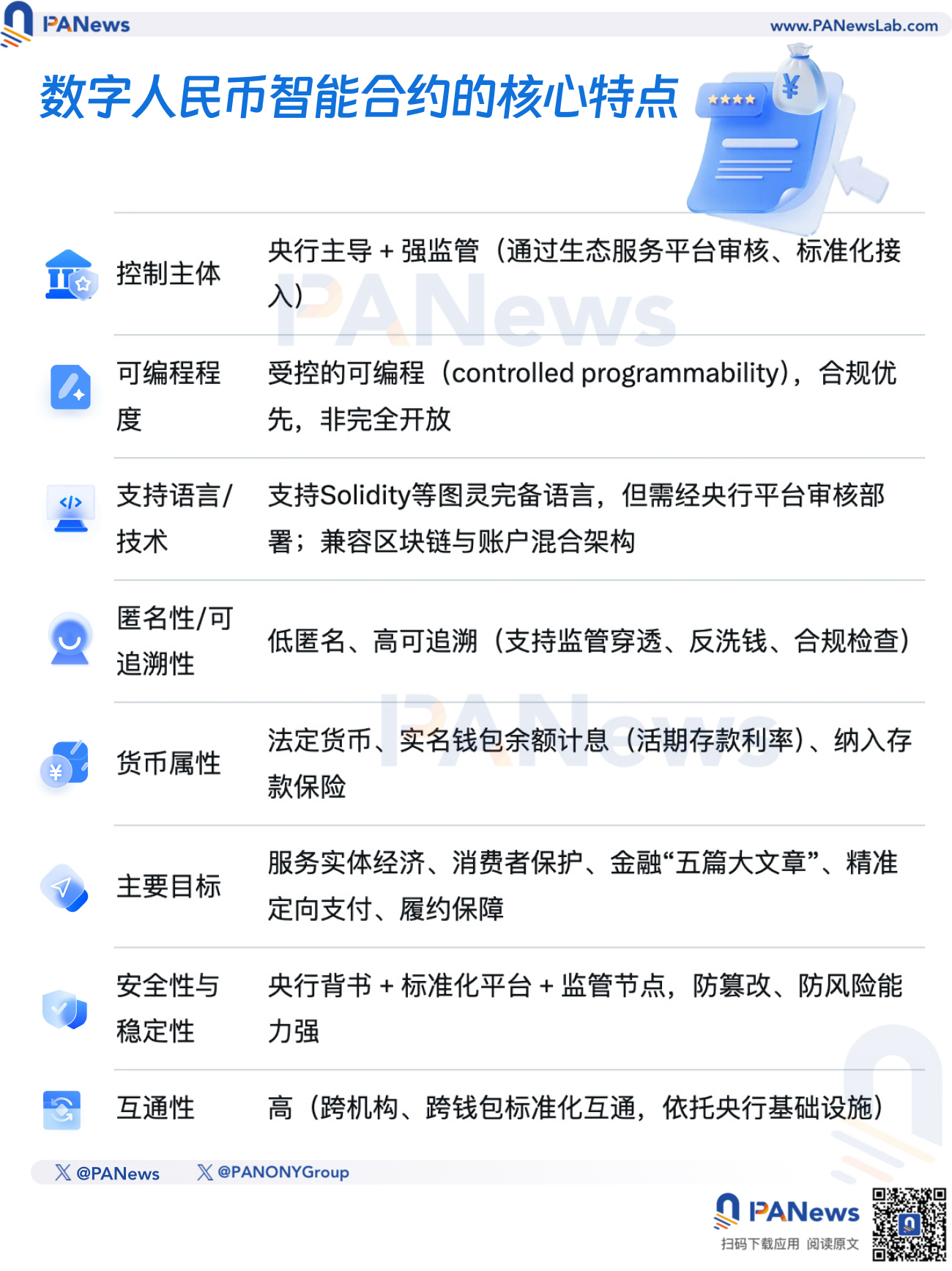
For example, in the pre-paid field, the digital yuan can achieve fund management modes like 'thawing in installments, paying per use'; in family and campus scenarios, parents can restrict children's accounts to specific consumption ranges; in government subsidy areas, the use of funds can also be precisely controlled.

In terms of technical implementation, according to disclosures by Caixin Net, the digital yuan adopts a restricted Turing-complete design, only supporting templated scripts permitted by the central bank. This design, while limiting certain functions, effectively ensures system security and controllability. Compared to the fully Turing-complete smart contracts of the crypto world, this design of the digital yuan avoids common risks like vulnerabilities, attacks, and governance failures in smart contracts. It is worth mentioning that the development of digital yuan smart contracts supports multiple programming languages, including fully Turing-complete languages compatible with Ethereum like Solidity. Therefore, development potential is not limited.

Furthermore, the digital yuan has demonstrated payment resilience. Its dual-offline payment function allows both payer and payee to complete transactions via手机NFC (Near Field Communication) in a no-network environment. This capability is irreplaceable in emergency scenarios and special environments. In contrast, in crypto systems, whether Bitcoin or stablecoin payments, they almost all rely on continuous internet connection to complete ledger synchronization and final settlement.
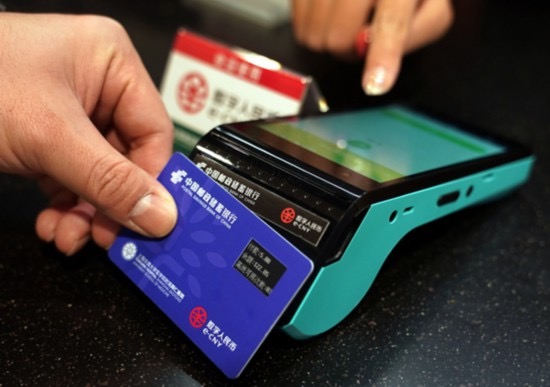
To bridge the 'digital divide' and adapt to the usage habits of different groups such as the elderly, students, and overseas visitors to China, the digital yuan also offers various forms of hard wallets, including IC cards, wearable devices (e.g., watches), SIM cards, and mobile terminals. This is fundamentally different from crypto hard wallets, which are primarily used for 'cold storage' of private keys as a defense against hacking attacks; digital yuan hard wallets focus more on the inclusivity of high-frequency payments. However, currently limited by the cost of deploying merchant acceptance terminals and the willingness to upgrade, the actual usage scope of digital yuan hard wallets remains limited, and their practical penetration effect still requires further observation.

Currently, the digital yuan is accelerating its evolution into a full-scenario currency. Its applications have broken through the retail sphere, forming replicable and promotable application models in areas like wholesale payments, public services, social governance, and even cross-border settlement, covering both online and offline scenarios. It is expected to further become an indispensable infrastructure in the digital economy.

Cross-border payment, in particular, is an important direction after its upgrade, supporting three-level transfers for countries, merchants, and individuals. As stablecoins rapidly penetrate the global cross-border payment field, the digital yuan is accelerating its 'going global' journey, becoming an important driving force for the internationalization of the renminbi. Through cross-border payments, the digital yuan can not only improve payment efficiency and reduce costs but also secure a place in the global payment system. For example, when overseas tourists consume in China, they don't need to exchange foreign currency; they can simply use the digital yuan App to scan a code and complete payment in their local currency at the real-time exchange rate. Currently, cross-border transfers conducted via mBridge have cumulatively exceeded $55 billion, with 95% settled using digital yuan.

In summary, for the digital yuan to truly complete the leap from a policy tool to a mass-market product, the real test may have just begun. But its path and potential are clearer than ever before.


Twitter:https://twitter.com/BitpushNewsCN

Bitpush TG Discussion Group:https://t.me/BitPushCommunity

Bitpush TG Subscription: https://t.me/bitpush

Original Link:https://www.bitpush.news/articles/7604656

Domande pertinenti

QWhat is the major upgrade that digital yuan (e-CNY) underwent on January 1, 2026, and how does it benefit users?

AThe major upgrade is that digital yuan transitioned to an 'interest-bearing stablecoin.' Users with verified (Class I, II, and III) wallets can now earn interest on their holdings at the current demand deposit rate of 0.05% per annum, paid quarterly. This provides users with a reason to hold digital yuan as their short-term idle funds can now generate yield automatically and with zero operational cost.

QHow did the initial M0 (digital cash) positioning of the digital yuan limit its adoption by commercial banks, and how has the shift to M1 changed this?

AInitially, as M0, the digital yuan operated on a 100% reserve system. This meant commercial banks had to deposit 100% of the digital yuan they received with the central bank, freezing those funds. Banks could not use them for lending or other profitable activities, making the system a cost center with little incentive for promotion. The shift to M1 reclassifies the funds in user wallets as a liability of the commercial banks. Now, banks only need to deposit a portion (the required reserve ratio) with the central bank and can use the remaining funds to develop profitable services, such as exclusive wealth management products, turning digital yuan into a potential profit center and incentivizing banks to promote it.

QWhat is a key technological advantage of the digital yuan's smart contracts compared to those in the crypto world, according to the article?

AA key technological advantage is its security and controllability. The digital yuan uses a 'restricted Turing-complete' design, which only supports templated scripts permitted by the central bank. This design, while still supporting languages like Solidity, effectively avoids common risks found in fully Turing-complete smart contracts in the crypto world, such as vulnerabilities, attacks, and governance failures, ensuring system safety and control.

QBesides retail payments, in which other significant area is the digital yuan expanding its application, and what is a specific example provided?

AThe digital yuan is expanding significantly into cross-border payments. A specific example is the mBridge project, through which cross-border transfers have cumulatively exceeded $55 billion, with 95% of these settlements conducted using the digital yuan. This facilitates more efficient and lower-cost international transactions and serves as a key driver for the internationalization of the renminbi.

QHow does the security backing for the digital yuan's value differ from that of crypto-based stablecoins?

AThe value of the digital yuan is backed by the full faith and credit of the Chinese state. It is included within the deposit insurance system, guaranteeing compensation of up to 500,000 yuan per account in case of bank failure. This state-backed security framework is fundamentally different from crypto stablecoins, which rely on code, algorithmic mechanisms, or collateral reserves that are subject to smart contract risks, de-pegging events, and regulatory uncertainty.

Letture associate

Trading

Spot
Futures

Articoli Popolari

Cosa è $BANK

Banca AI: Un Passo Rivoluzionario nel Futuro della Banca Introduzione In un'era caratterizzata da rapidi progressi tecnologici, Banca AI si trova all'incrocio tra intelligenza artificiale (AI) e servizi bancari. Questo progetto innovativo mira a ridefinire il panorama finanziario, migliorando l'efficienza operativa, le misure di sicurezza e le esperienze dei clienti attraverso il potere dell'AI. Mentre ci impegniamo in questa esplorazione di Banca AI, esamineremo cosa comporta il progetto, le sue dinamiche operative, il suo contesto storico e i traguardi significativi. Cos'è Banca AI? Alla sua essenza, Banca AI rappresenta un'iniziativa trasformativa volta a integrare l'intelligenza artificiale in varie operazioni bancarie. Questo progetto sfrutta le capacità dell'AI per automatizzare processi, migliorare i protocolli di gestione del rischio e potenziare l'interazione con i clienti attraverso servizi personalizzati. Gli obiettivi principali di Banca AI includono: Automazione delle Funzioni Bancarie: Sfruttando le tecnologie AI, Banca AI mira ad automatizzare compiti di routine, riducendo il carico sulle risorse umane e aumentando l'efficienza. Miglioramento della Gestione del Rischio: Il progetto utilizza algoritmi AI per prevedere e identificare i rischi, rafforzando così le misure di sicurezza contro le frodi e altre minacce. Personalizzazione dei Servizi Bancari: Banca AI si concentra sull'offrire prodotti e servizi finanziari su misura analizzando i dati e i comportamenti dei clienti. Miglioramento dell'Esperienza del Cliente: L'implementazione di soluzioni guidate dall'AI, come chatbot e assistenti virtuali, mira a fornire agli utenti interazioni più umane, rivoluzionando il modo in cui i clienti si relazionano con le banche. Con questi obiettivi, Banca AI si posiziona come un attore cruciale nel rendere la banca più efficiente, sicura e centrata sull'utente. Chi è il Creatore di Banca AI? I dettagli riguardanti il creatore di Banca AI rimangono sconosciuti. Pertanto, non è stata identificata alcuna persona o organizzazione specifica nelle informazioni disponibili. L'anonimato che circonda la nascita del progetto solleva domande, ma non sminuisce la sua ambiziosa visione e obiettivi. Chi sono gli Investitori di Banca AI? Simile al creatore del progetto, informazioni specifiche riguardo gli investitori o le organizzazioni di supporto di Banca AI non sono state divulgate. Senza queste informazioni, è difficile delineare il sostegno finanziario e istituzionale che potrebbe spingere il progetto in avanti. Tuttavia, l'importanza di avere una solida base di investimento è fondamentale per sostenere lo sviluppo in un campo così innovativo. Come Funziona Banca AI? Banca AI opera su più fronti innovativi, concentrandosi su fattori unici che la differenziano dai framework bancari tradizionali. Di seguito sono riportate le caratteristiche operative chiave: Automazione: Applicando algoritmi di machine learning, Banca AI automatizza vari processi manuali all'interno delle banche. Ciò si traduce in una riduzione dei costi operativi e consente ai lavoratori umani di reindirizzare i propri sforzi verso attività più strategiche. Gestione Avanzata del Rischio: L'integrazione dell'AI nelle pratiche di gestione del rischio fornisce alle banche strumenti per prevedere con precisione potenziali minacce come le frodi, garantendo che le informazioni e i beni dei clienti rimangano al sicuro. Raccomandazioni Finanziarie Personalizzate: Attraverso l'apprendimento continuo dalle interazioni con i clienti, i sistemi AI sviluppano una comprensione sfumata delle esigenze degli utenti, consentendo loro di offrire consigli su misura per le decisioni finanziarie. Interazioni Migliorate con i Clienti: Utilizzando chatbot e assistenti virtuali alimentati dall'AI, Banca AI consente un'esperienza cliente più coinvolgente, permettendo agli utenti di risolvere rapidamente le loro richieste, riducendo così i tempi di attesa e migliorando i livelli di soddisfazione. Tutte queste caratteristiche operative posizionano Banca AI come un pioniere nel settore bancario, stabilendo nuovi standard per la fornitura di servizi e l'eccellenza operativa. Timeline di Banca AI Comprendere la traiettoria di Banca AI richiede uno sguardo al suo contesto storico. Di seguito è riportata una timeline che evidenzia traguardi e sviluppi importanti: Inizio 2010: La concettualizzazione dell'integrazione dell'AI nei servizi bancari ha cominciato a guadagnare attenzione mentre le istituzioni bancarie riconoscevano i potenziali benefici. 2018: Si è verificato un aumento significativo nell'implementazione delle tecnologie AI quando le banche hanno iniziato a utilizzare strumenti AI come i chatbot per servizi clienti di base e sistemi di gestione del rischio per migliorare la sicurezza. 2023: La sofisticazione dell'AI ha continuato ad avanzare, con l'introduzione dell'AI generativa per compiti più complessi come l'elaborazione di documenti e l'analisi degli investimenti in tempo reale. Quest'anno ha segnato un significativo salto nelle capacità offerte alle banche dalla tecnologia AI. 2024-Stato Attuale: A partire da quest'anno, Banca AI è su una traiettoria ascendente, con ricerche e sviluppi in corso pronti a migliorare ulteriormente le capacità nelle operazioni bancarie. L'esplorazione continua delle applicazioni AI suggerisce sviluppi entusiasmanti in arrivo. Punti Chiave su Banca AI Integrazione dell'AI nella Banca: Banca AI si concentra sull'adozione dell'intelligenza artificiale per snellire i processi bancari e migliorare le esperienze degli utenti. Focus su Automazione e Gestione del Rischio: Il progetto enfatizza fortemente queste aree, mirando a spostare il carico di compiti di routine mentre migliora le strutture di sicurezza attraverso analisi predittive. Soluzioni Bancarie Personalizzate: Sfruttando i dati dei clienti, Banca AI consente servizi bancari su misura che si adattano alle esigenze individuali degli utenti. Impegno per lo Sviluppo: Banca AI rimane impegnata in sforzi di ricerca e sviluppo continuativi, garantendo la sua adattabilità e rilevanza continua man mano che la tecnologia continua a evolversi. Conclusione In sintesi, Banca AI rappresenta un passo cruciale in avanti nell'industria bancaria, sfruttando l'intelligenza artificiale per rimodellare i paradigmi operativi, migliorare la sicurezza e promuovere la soddisfazione del cliente. Nonostante le lacune nelle informazioni riguardo il creatore e gli investitori, gli obiettivi chiari e i meccanismi funzionali di Banca AI forniscono una solida base per la sua continua evoluzione. Mentre la tecnologia AI continua ad avanzare e fondersi con il settore bancario, Banca AI è ben posizionata per avere un impatto significativo sul futuro dei servizi finanziari, migliorando il modo in cui comprendiamo e interagiamo con la banca.

107 Totale visualizzazioniPubblicato il 2024.04.06Aggiornato il 2024.12.03

Cosa è $BANK

Come comprare BANK

Benvenuto in HTX.com! Abbiamo reso l'acquisto di Lorenzo Protocol (BANK) semplice e conveniente. Segui la nostra guida passo passo per intraprendere il tuo viaggio nel mondo delle criptovalute.Step 1: Crea il tuo Account HTXUsa la tua email o numero di telefono per registrarti il tuo account gratuito su HTX. Vivi un'esperienza facile e sblocca tutte le funzionalità,Crea il mio accountStep 2: Vai in Acquista crypto e seleziona il tuo metodo di pagamentoCarta di credito/debito: utilizza la tua Visa o Mastercard per acquistare immediatamente Lorenzo ProtocolBANK.Bilancio: Usa i fondi dal bilancio del tuo account HTX per fare trading senza problemi.Terze parti: abbiamo aggiunto metodi di pagamento molto utilizzati come Google Pay e Apple Pay per maggiore comodità.P2P: Fai trading direttamente con altri utenti HTX.Over-the-Counter (OTC): Offriamo servizi su misura e tassi di cambio competitivi per i trader.Step 3: Conserva Lorenzo Protocol (BANK)Dopo aver acquistato Lorenzo Protocol (BANK), conserva nel tuo account HTX. In alternativa, puoi inviare tramite trasferimento blockchain o scambiare per altre criptovalute.Step 4: Scambia Lorenzo Protocol (BANK)Scambia facilmente Lorenzo Protocol (BANK) nel mercato spot di HTX. Accedi al tuo account, seleziona la tua coppia di trading, esegui le tue operazioni e monitora in tempo reale. Offriamo un'esperienza user-friendly sia per chi ha appena iniziato che per i trader più esperti.

669 Totale visualizzazioniPubblicato il 2025.05.09Aggiornato il 2025.05.09

Come comprare BANK

Discussioni

Benvenuto nella Community HTX. Qui puoi rimanere informato sugli ultimi sviluppi della piattaforma e accedere ad approfondimenti esperti sul mercato. Le opinioni degli utenti sul prezzo di BANK BANK sono presentate come di seguito.

活动图片














