Plummeting Token Price, Whales Dumping and Exiting: The Aave Governance Battle Exposes DeFi's Governance Dilemma

marsbitPubblicato 2025-12-23Pubblicato ultima volta 2025-12-23

Introduzione

The article details a major governance crisis within Aave, a leading DeFi lending protocol, sparked in December 2025. The conflict began when Aave Labs, the development team, switched the front-end service provider for its official website and redirected an estimated $10 million in annual fees from user transactions to its own controlled address instead of the community DAO treasury. This move was perceived by the Aave community as a "hidden privatization" of brand assets and a breach of trust. It raised a fundamental question: who ultimately controls a DeFi protocol—the founding team that builds the code and brand, or the token holders governing the DAO? Tensions escalated with the submission of an aggressive "poison pill" governance proposal demanding Aave Labs transfer all intellectual property, trademarks, and equity to the DAO. A more constructive counter-proposal, "Phase 1 - Ownership," sought to reclaim control of critical assets like domains and social media accounts for the DAO. Amid the internal strife, the AAVE token price fell over 25%, and a major whale investor sold their holdings at a significant loss, signaling eroding confidence. Aave Labs further angered the community by unilaterally advancing a snapshot vote during the Christmas holiday, a move criticized for violating procedural norms. Despite the turmoil, Aave's core protocol remained robust with $34 billion in assets. The SEC's decision to close its investigation without action was seen as a tacit en...

Author: Jae, PANews

When DeFi's governance benchmark collides with real-world commercial interests, a brutal game determining "who is the master" is unfolding within the leading lending protocol, Aave.

As a leader in the DeFi market, Aave not only manages approximately $34 billion in assets but is also regarded as a model of on-chain governance. In December 2025, however, Aave found itself in the most severe crisis of confidence in its eight-year history.

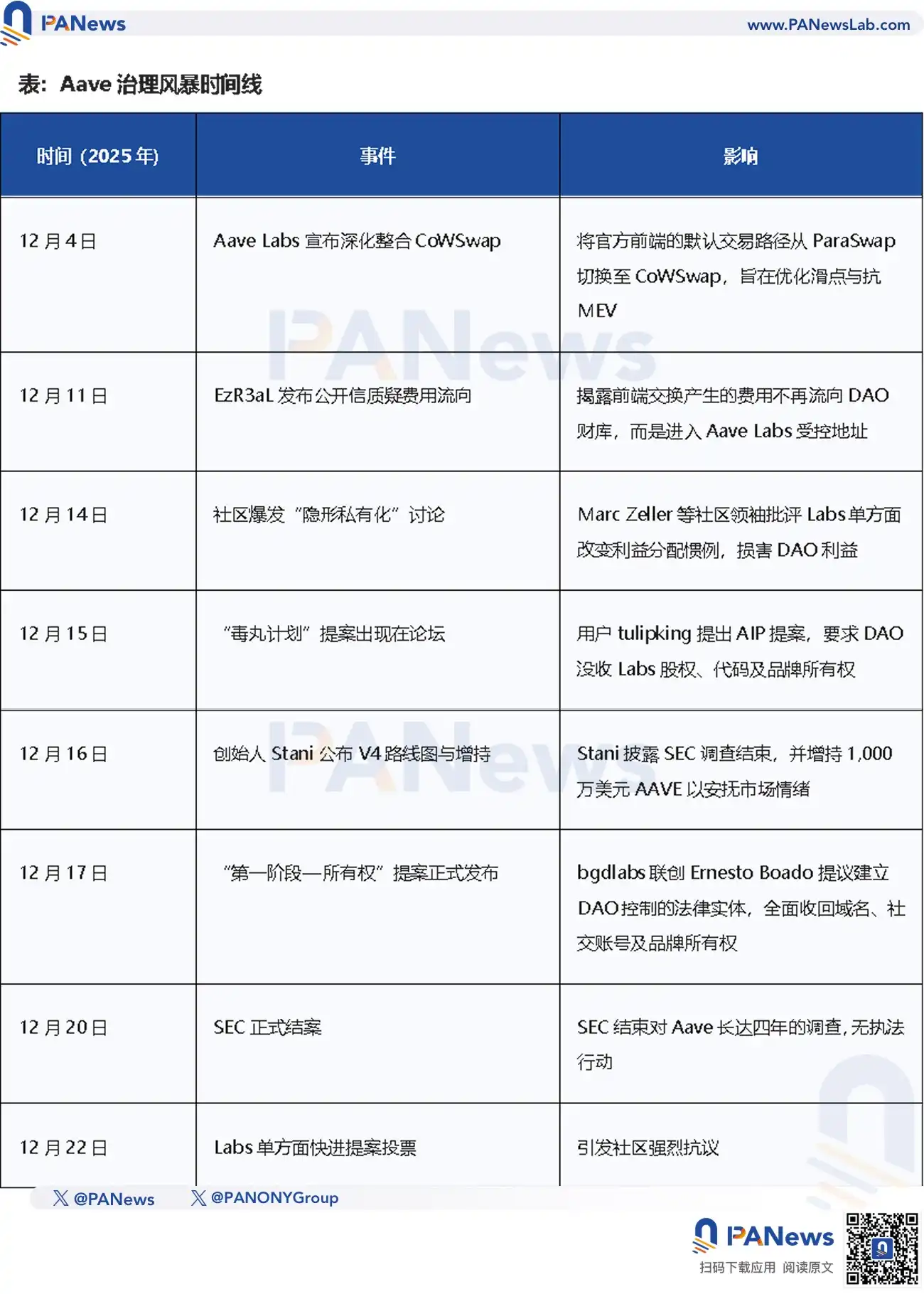
This controversy did not arise by chance. The initial trigger was a seemingly insignificant front-end fee allocation, but it unexpectedly set off a domino effect. Catalyzed layer by layer through a series of key events, it ultimately pushed the lending giant Aave into the spotlight.
This is more than just a dispute over profit distribution; it has torn open a gap, exposing the most fundamental and sensitive conflict in the DeFi space: under the narrative, who has the final say—the founding team, who controls the code and the brand, or the DAO community, which holds the governance tokens?

This is not just a crisis for Aave; this event poses an urgent question to the entire DeFi market: as protocols mature, how can the commercial incentives for development teams be balanced with the governance rights of token holders?

$10 Million "Vanish," Aave Labs Accused of Depriving Community Rights

The source of Aave's internal governance war began with an update at the technical optimization level.

On December 4, 2025, Aave Labs announced that it was switching the asset swap service provider on its official frontend (app.aave.com) from ParaSwap to CoWSwap, citing better prices and MEV protection.

However, the ensuing financial changes were not fully disclosed in the announcement. Community representative EzR3aL discovered through on-chain data tracking that the fees generated by user transactions, after the change, no longer flowed to the DAO's public treasury but were instead transferred to an address controlled by Labs. Based on historical data estimates, this missing annualized revenue would amount to $10 million.
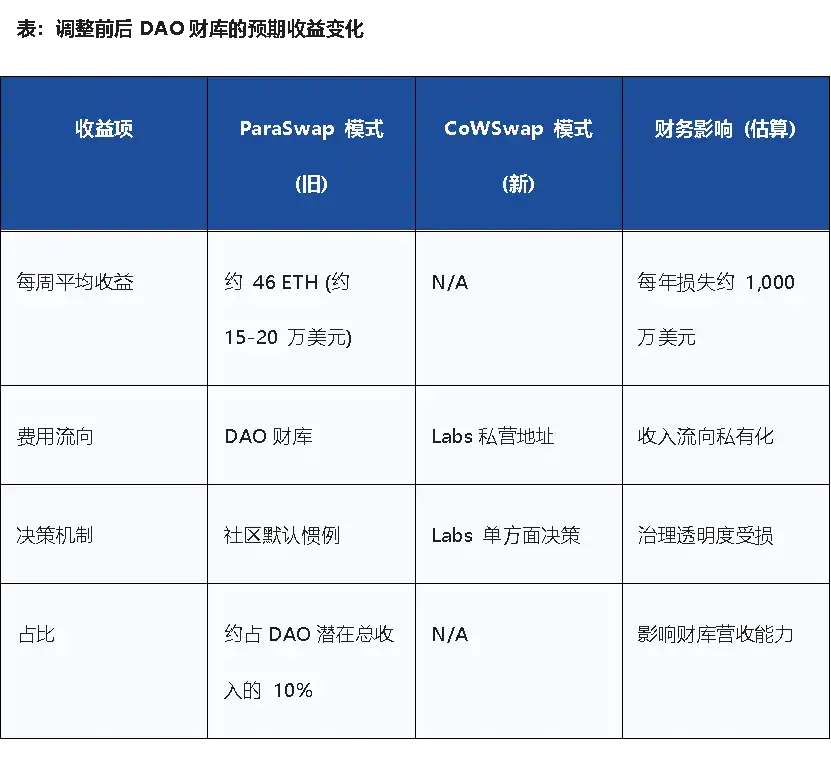
Aave community leader Marc Zeller pointed out: This is an invisible privatization of brand assets. Labs is using the technology and brand value developed with DAO funding to profit itself, breaking a long-standing trust agreement.

Aave founder Stani Kulechov, however, argued: This is a distinction between the protocol and the product. He explained that the Aave protocol, built by smart contracts, belongs to the DAO, while the commercial rights to the frontend product app.aave.com, which requires high operating and maintenance costs, should belong to the builders, Labs. The fees previously flowing to the DAO were merely "voluntary donations." This view challenges the traditional DeFi community belief that tokens should capture all economic value generated by the protocol's ecosystem.

To the community, Stani's logic is tantamount to a deprivation of sovereignty. The frontend, as the most important user entry point and traffic gate, if its revenue can be unilaterally intercepted by Labs, will similar revenue interception occur in future projects like Aave V4, the GHO stablecoin, and Horizon RWA? In this scenario, the value capture promise carried by the governance token AAVE risks becoming an empty promise.

Related reading: Annual Loss of Tens of Millions in Revenue Sparks Governance Controversy, Aave Labs Accused of "Stabbing the DAO in the Back"

Internal Conflict Heats Up, DAO Proposal Seeks to Reclaim Brand Ownership

When gentle negotiations failed to reach an agreement, radical factions within the community began adopting extreme博弈 strategies. On December 15, a governance proposal named the "Poison Pill Plan" was put forward by user tulipking, making three highly aggressive demands:

  1. Forced Asset Transfer: Require Labs to unconditionally transfer all code repositories, intellectual property (IP), and trademarks to the DAO, or face legal action.
  2. Equity Confiscation and Subsidiary Status: Advocate that the DAO should obtain 100% of Labs' equity, turning the originally independent company into a wholly-owned subsidiary of the DAO, with founders and employees becoming employees of the DAO.
  3. Recovery of Past Profits: Recover all historical frontend revenue generated from the use of the Aave brand from Labs and return it to the treasury.

This bombshell was temporarily shelved due to procedural issues, but its deterrent intent was achieved, demonstrating that the community has the ability and willingness to use governance votes to reversely吞并 a development team that refuses to cooperate.

Under the shadow of the extreme proposal, Aave's former CTO Ernesto Boado proposed a more constructive proposal, "Phase 1 - Ownership," sounding the horn for the sovereignty recovery operation: reclaim domains like aave.com; reclaim control of official social media accounts like X and Discord; reclaim control of the GitHub code repository.
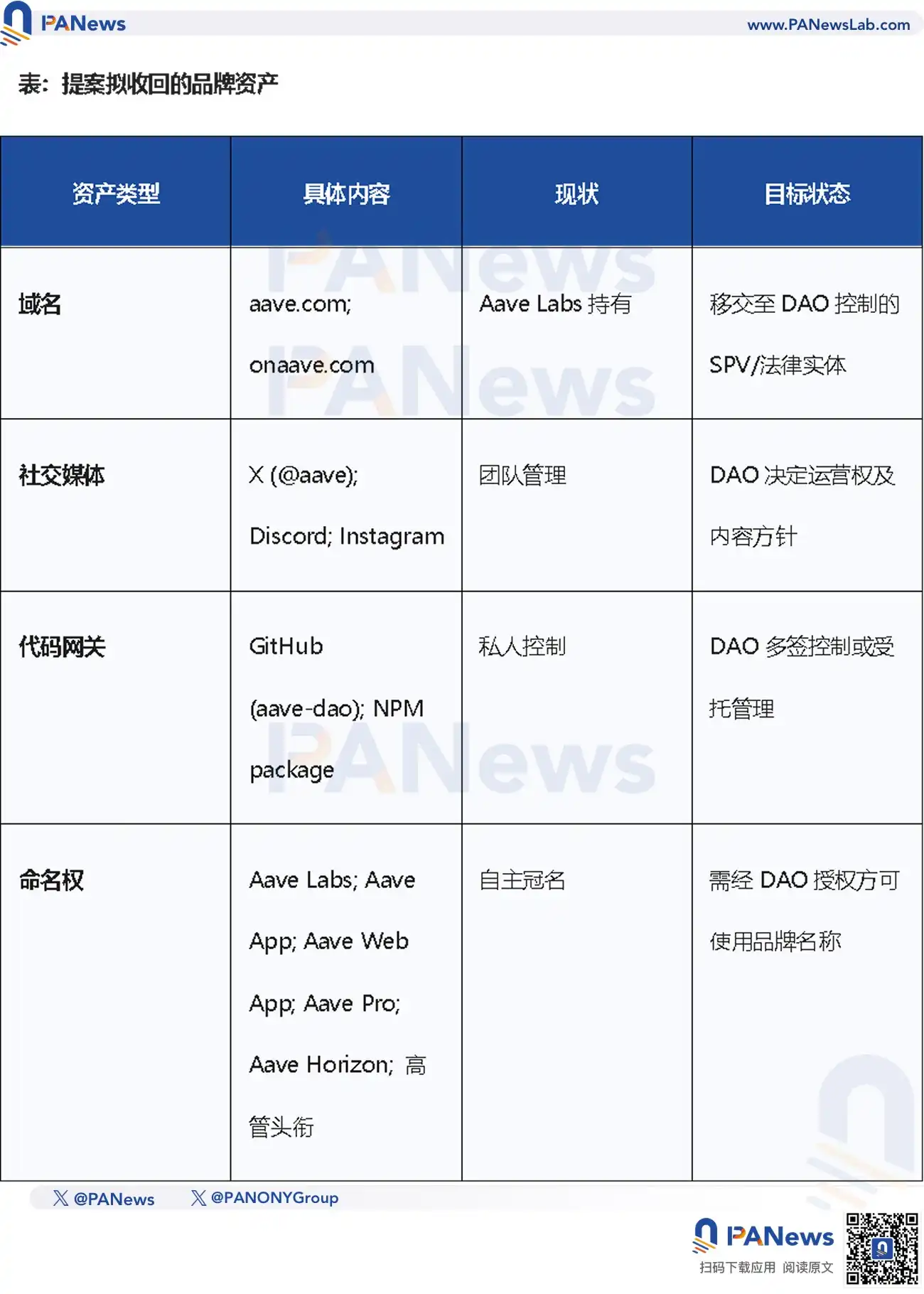
Boado stated bluntly, True decentralization must include the decentralization of "soft assets." He proposed establishing a legal entity controlled by the DAO to hold these brand assets, thereby gaining recourse rights within traditional legal jurisdictions. This marks the DAO's attempt to evolve from a loose on-chain voting organization into a "digital sovereign entity" with actual legal definition and assets.

Token Price Falls, Whales Cut Losses and Exit, Labs Unilaterally Advances Vote Sparking Discontent

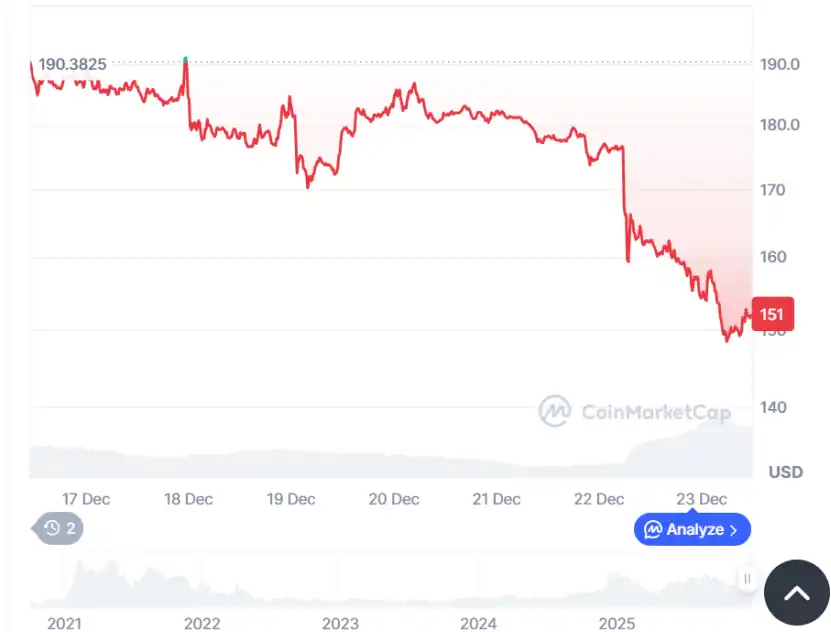
When governance is bogged down in internal strife, the secondary market votes with its feet. Although the protocol's locked $34 billion in assets showed no significant fluctuations, the price of the AAVE token, directly related to the interests of holders, fell continuously by over 25% in two weeks.

On December 22, the second-largest AAVE holder cut its losses and exited. It had accumulated 230,000 AAVE tokens at an average price of around $223 but liquidated its position at approximately $165 amid the governance chaos, resulting in an estimated paper loss of $13.45 million. The whale's departure is a negative statement on Aave's current governance chaos and a deep skepticism about its future value capture ability: if revenue can be easily stripped away, the token's past valuation model will also become invalid.
Adding insult to injury, Labs unilaterally advanced the proposal to the Snapshot voting stage without the original author Boado's consent, causing strong protests from the community. Multiple representatives criticized this move as violating normal governance procedures.

Crypto KOL 0xTodd pointed out two problems: 1) The voting date was set for December 23-26, during the Christmas holiday period when many users are on vacation, potentially leading to reduced voting participation; 2) Currently, Boado's proposal is still in the discussion phase. Typically, a discussion post requires 3-6 months of repeated communication and optimization before entering the voting stage.

But Stani replied that the new ARFC proposal vote fully complies with the governance framework, and voting is the best way to solve the problem and the ultimate form of governance. This shows a divergence between the DAO's focus on procedural correctness and Labs' focus on result-oriented efficiency.

On the other hand, absolute procedural correctness could also stifle efficiency. If the development team's commercial returns are completely剥夺, Labs' motivation to promote the protocol's V4 upgrade will significantly decrease. If the brand is managed by the DAO, and it encounters legal disputes, the lack of a directly responsible person could lead to difficulties in rapid response, potentially resulting in the brand being directly seized by regulators.

As of now,赞成票仅占3%,呈现一边倒的局势. The community may enter the "proposal—vote" process again,甚至恶化为一个死循环. In fact, Aave has already wasted a significant amount of time while stuck in this governance deadlock.

However, this crisis of confidence is likely only a阶段性 problem, and a necessary "rite of passage" for Aave as a DeFi leader.

Many seasoned DAO participants stated that even a governance benchmark like Aave is濒临分裂, perhaps the DAO governance model itself is not feasible. But the fact that such a transparent, intense, and evenly matched debate can occur within Aave itself proves its extremely high degree of decentralized governance. This collective correction ability is precisely the value of decentralized governance.

A more critical turning point came from external regulation. On December 20, the U.S. SEC ended a four-year investigation without taking any enforcement action against Aave. This was widely interpreted as regulatory默许 for highly decentralized governance models like Aave's.

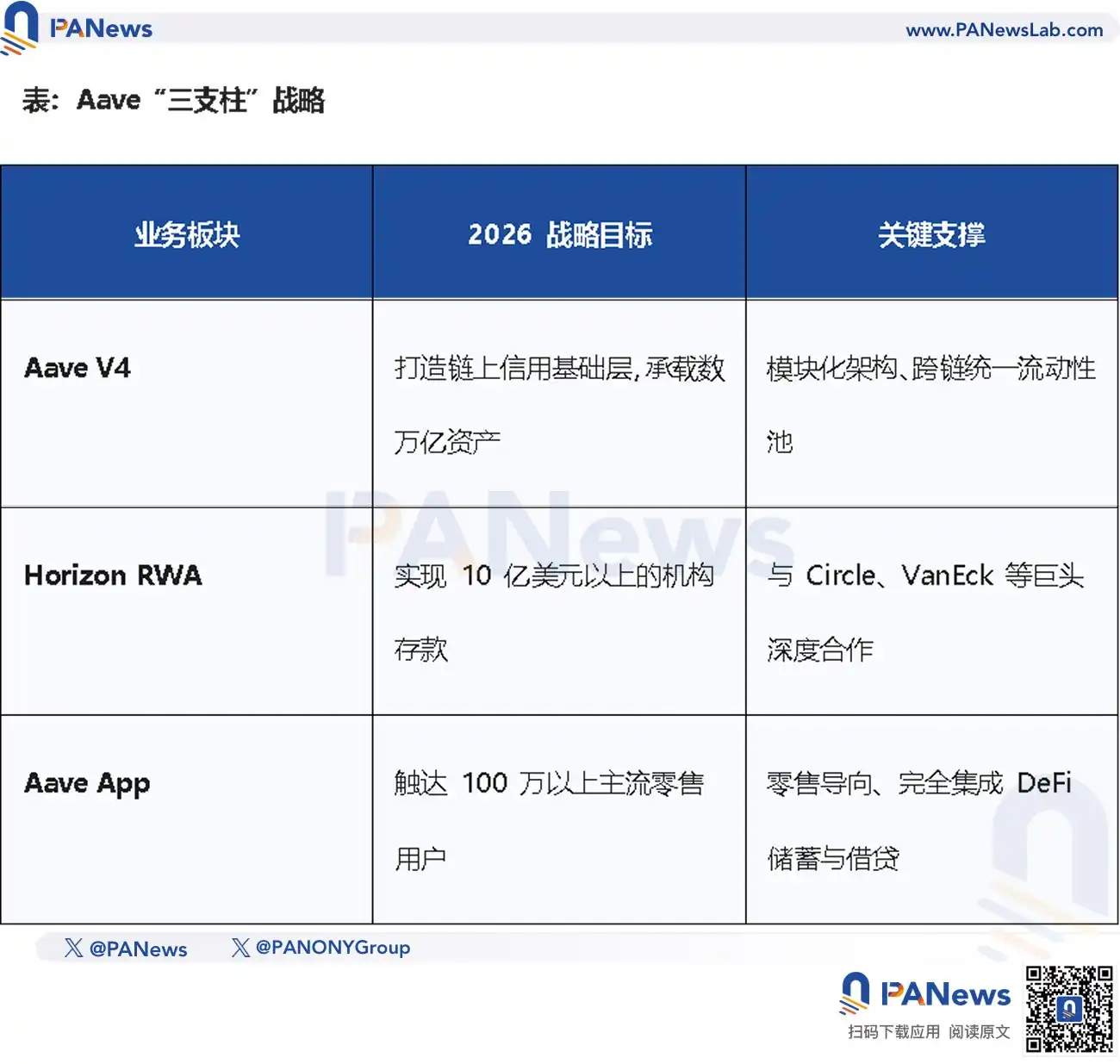
Amid the storm, Aave's fundamentals remain highly resilient. Founder Stani not only continued to respond to质疑, personally increasing his holdings by a total of $15 million in AAVE (suffering over $2 million in paper losses), but also announced a "Three Pillars" strategy to rebuild community consensus and trust. However, Stani's move was also questioned by the community, seen as an attempt to increase his own voting power. Even so, simply increasing Labs' influence in governance is still a temporary solution, not a fundamental cure.
Governance Evolution, Hybrid Organization May Become Path to Restructuring Interests

As the风波 evolves, a path of governance evolution may emerge: Aave might transform from a single on-chain protocol into a "hybrid organization."

Returning to the content of the latest proposal itself, the model proposed by Boado essentially redefines the relationship between the two parties in three aspects.

  1. DAO Owns Sovereignty: Not only owns the smart contracts, but also the brand, domains, trademarks, and user distribution channels;
  2. Labs as a Professional Service Provider: Labs no longer profits as an "owner," but as a top-tier service provider authorized by the DAO. The fees Labs charges on the frontend should be based on DAO authorization and may need to determine a sharing ratio with the DAO to cover development costs and feed back into the token's value;
  3. Contractual Governance: All profit distribution is no longer based on "voluntary donations" but on on-chain service agreements.

In fact, this controversy is highly similar to the 2023 incident where Uniswap Labs charging frontend fees caused community dissatisfaction. Ultimately, Uniswap reached an agreement with the community by defining Labs' commercialization rights and the decentralization of the protocol layer.

Aave may go a step further. It attempts to solve the problem of "who is the brand owner" at its legal root through the "Phase 1 - Ownership" proposal. If the proposal passes in the future, any commercialization move by Labs must receive DAO approval at the procedural level, which would fundamentally end the possibility of "invisible privatization."

Aave's dilemma is a universal contradiction faced by all decentralized protocols. Does the market want an efficient but potentially centralized "product," or a decentralized but potentially inefficient "protocol"? This not only concerns the permission boundaries of governance tokens but also determines the evolution direction of DeFi.

Currently, this $30+ billion DeFi experiment is at a crossroads, and its future direction will be slowly revealed through each on-chain vote.

Domande pertinenti

QWhat was the initial event that triggered the governance crisis within Aave?

AThe crisis began when Aave Labs switched the asset swap provider on its official frontend from ParaSwap to CoWSwap on December 4, 2025, and it was subsequently discovered that the associated fees were being redirected to an address controlled by Labs instead of the community DAO, amounting to an estimated $10 million in lost annual revenue for the DAO.

QWhat is the core philosophical conflict exposed by this incident in the DeFi space?

AThe incident exposed the fundamental conflict over who has ultimate authority in a decentralized protocol: the founding team that controls the code and brand, or the DAO community that holds the governance tokens. It questions the balance between a development team's commercial incentives and the governance rights of token holders.

QWhat drastic action did a community member propose in the 'Poison Pill' governance proposal?

AThe 'Poison Pill' proposal demanded that Aave Labs unconditionally transfer all code repositories, intellectual property, and trademarks to the DAO; that the DAO acquire 100% of Labs' equity, effectively making it a subsidiary; and that Labs return all historical frontend revenue generated from using the Aave brand to the community treasury.

QHow did the market react to the internal conflict, as evidenced by the actions of a major token holder?

AThe market reacted negatively, with the AAVE token price falling over 25% in two weeks. A major whale, the second-largest holder, sold their entire position of 230,000 AAVE at a significant loss of approximately $13.45 million, signaling a loss of confidence in the protocol's governance and future value-capture ability.

QWhat potential new organizational structure is suggested as a solution to resolve the conflict between Aave Labs and the DAO?

AA potential solution is the evolution into a 'hybrid organization' model. This would involve the DAO holding sovereignty over all assets (including brand, domains, and trademarks), Aave Labs operating as a professional service provider authorized by the DAO with a clear revenue-sharing agreement, and all relationships being governed by on-chain service agreements rather than voluntary donations.

Letture associate

Has Hook Summer Truly Arrived? sato, Lo0p, FLOOD Ignite the New Uniswap v4 Narrative

With the broader market showing signs of recovery, a new wave of interest has emerged around Ethereum-based meme coins. Following ASTEROID, tokens like sato, sat1, Lo0p, and FLOOD, built upon the Uniswap v4 Hook protocol, are capturing market attention. Their market capitalizations range from millions to tens of millions of dollars, injecting much-needed focused liquidity into a market lacking narratives. This article explores whether this trend signifies an incoming "Hook Summer" and its potential impact on UNI's price. Hooks are essentially plug-in smart contracts for Uniswap v4 liquidity pools, allowing developers to inject custom logic at key points in a pool's lifecycle (like initialization, adding/removing liquidity, swaps). This transforms the AMM into programmable building blocks. Key highlighted projects include: * **sato**: Peaked over $38M market cap. It utilizes a v4 curve for minting/burning; buying locks ETH as reserve to mint new tokens, while selling redeems ETH from the reserve and burns tokens. * **sat1**: Market cap briefly exceeded $10M, promoted as an "optimized sato," but later declined significantly. * **Lo0p**: Reached nearly $6.6M. It's a lending AMM protocol where buying LO0P tokens locks them as collateral, allowing users to borrow ETH from the pool reserve at 40% LTV, aiming to improve capital efficiency for idle ETH in LPs. * **FLOOD**: Peaked near $6M. Its mechanism directs asset reserves from buys into Aave v3 to generate yield, with fees and interest retained in the pool to potentially influence the token's price long-term. In the long term, the development of the Hook ecosystem can attract users and liquidity to Uniswap v4, benefiting UNI's fundamentals—especially combined with the recent activation of the protocol fee switch, where a portion of fees is used to burn UNI. However, in the short term, these Hook-based tokens are unlikely to directly drive significant UNI price appreciation. Their impact is moderated by factors like token sustainability, price volatility, and broader market and regulatory conditions. Currently, Uniswap v4's TVL ($595M) still trails behind v2 and v3, indicating adoption and growth will take time. The article concludes that while the Hook ecosystem provides long-term "nourishment" for UNI, its short-term role is more of a "catalyst" than a "booster." Readers are cautioned that these are early-stage experimental tokens and may carry unknown risks.

Odaily星球日报4 min fa

Has Hook Summer Truly Arrived? sato, Lo0p, FLOOD Ignite the New Uniswap v4 Narrative

Odaily星球日报4 min fa

Interview with Michael Saylor: I Did Say I Would Sell Bitcoin, But Never a Net Sale

Interview with Michael Saylor: I Said We'd Sell Bitcoin, But Never Be a Net Seller In a recent podcast, MicroStrategy Executive Chairman Michael Saylor clarified the company's stance on potentially selling Bitcoin. Following MicroStrategy's earnings call statement about being prepared to sell BTC to fund dividends for its STRC (Strategic) credit product, Saylor emphasized the distinction between selling and being a "net seller." Saylor explained the core business model: MicroStrategy sells credit instruments like STRC and uses the proceeds to buy Bitcoin, which is viewed as "digital capital" expected to appreciate around 30-40% annually. A portion of these capital gains can then be used to pay the dividends on the credit products. He stressed that even if the company sells some Bitcoin for dividends, it simultaneously buys much more with new credit issuance. For example, after raising $3.2 billion from STRC sales in April, the dividend obligation was only $80-90 million, making the company a net buyer. The clarification aims to counter market narratives questioning the value of Bitcoin on MicroStrategy's balance sheet if it were never sold, and to dismiss claims of a "Ponzi scheme." Saylor reiterated his personal philosophy for investors: "Don't be a net seller of bitcoin" and ensure your Bitcoin holdings increase each year. Saylor also discussed Bitcoin's role as the foundation for "digital credit," noting that STRC has become the largest and most liquid preferred stock issue in the U.S., offering high risk-adjusted returns (Sharpe ratio). He highlighted Bitcoin's deep liquidity, stating that even large purchases by MicroStrategy do not move the market significantly, which is driven by macro factors, geopolitical tensions, and capital flows from ETFs and credit products. Finally, Saylor reflected on his early inspiration from sci-fi books, which motivated his path to MIT, and maintained his fundamental thesis on Bitcoin remains unchanged: it is superior digital capital enabling superior digital credit.

链捕手8 min fa

Interview with Michael Saylor: I Did Say I Would Sell Bitcoin, But Never a Net Sale

链捕手8 min fa

Beaten SK Hynix Employees in China: Year-end Bonus Less Than 5% of Korean Staff's

"SK Hynix Chinese Staff Hit Hard: Bonuses Less Than 5% of Korean Counterparts" Driven by the AI boom, South Korea's SK Hynix is experiencing record performance, with media reports predicting massive year-end bonuses for its employees, making them highly desirable in the matchmaking market. However, this prosperity starkly contrasts with the situation for the company's Chinese employees. According to reports, SK Hynix operates under a rule allocating 10% of operating profit for employee bonuses. While projections suggest Korean employees could receive bonuses reaching millions of RMB, a Chinese employee with over a decade of technical experience revealed the disparity: "If they get 3 million, Chinese staff get less than 5% of that." After adjustments based on KPI ratings, this employee's highest bonus was slightly over 100,000 RMB. Bonuses are paid annually in Korea but semi-annually in China. During the industry downturn in 2023-2024, Chinese employees received no bonus at all. The gap extends beyond bonuses. Recruitment posts for SK Hynix's Chinese factories (in Wuxi, Dalian, Chongqing) show engineer monthly salaries ranging from 10,000 to 35,000 RMB, with a 13th-month salary promised. Chinese employees also receive standard benefits like annual leave but lack stock incentives, which are reportedly unavailable to them. Furthermore, management positions in China are predominantly held by Korean personnel, though industry observers note a gradual increase in local middle managers over time. SK Hynix has confirmed the 10% bonus rule but cautioned that specific future bonus amounts remain unpredictable. The company forecasts strong demand for HBM and other high-value enterprise products for the next 2-3 years, driven by AI infrastructure investment. This focus on business-to-business markets may continue to constrain supply for consumer products, potentially prolonging price increases for components like memory.

链捕手22 min fa

Beaten SK Hynix Employees in China: Year-end Bonus Less Than 5% of Korean Staff's

链捕手22 min fa

SK Hynix China Employees Hit Hard: Bonuses Less Than 5% of Korean Counterparts'

"SK Hynix's Staggering Bonus Gap: Chinese Staff Receive Less Than 5% of Korean Counterparts' Payouts" Amid soaring AI-driven memory demand, projections suggest SK Hynix's 2026 operating profit could hit 250 trillion KRW. Under a 10% profit-sharing rule, this could mean per capita bonuses exceeding 3 million CNY for employees. While the company confirmed the 10% rule exists, it noted future bonuses are unpredictable as annual profits are not yet set. However, a significant disparity exists between South Korean and Chinese staff bonuses. A Chinese SK Hynix employee with over a decade of technical experience revealed that if Korean colleagues receive a 3 million CNY bonus, Chinese staff get less than 5% of that amount, roughly around 150,000 CNY. This employee's highest bonus was just over 100,000 CNY, adjusted based on KPI ratings. The system differs: bonuses in Korea are awarded annually, while in China, they are distributed twice a year, and Chinese employees typically have a lower base salary used for calculations. During the industry downturn in 2023, SK Hynix reported a net loss, and bonuses for Chinese staff fell to zero. Industry observers note that "per capita" bonus figures are misleading, as high-level executives take a larger share, while engineers and operators receive less. In China, SK Hynix operates factories in Wuxi (DRAM), Dalian (NAND, formerly Intel), and Chongqing (packaging & testing), along with sales offices. Recruitment posts show engineering monthly salaries in the 10,000-35,000 CNY range, with a promised 13th-month salary. Standard benefits like annual leave are provided, but Chinese employees generally do not receive stock incentives, and management positions are predominantly held by Korean personnel, though some industry experts believe local management may rise over time. Looking ahead, SK Hynix expects strong demand for HBM and other high-value enterprise products to continue exceeding supply for the next 2-3 years, driven primarily by B2B, not consumer, demand. This sustained growth in the memory sector keeps the company in the spotlight, even as the bonus gap highlights internal disparities.

marsbit42 min fa

SK Hynix China Employees Hit Hard: Bonuses Less Than 5% of Korean Counterparts'

marsbit42 min fa

Trading

Spot
Futures

Articoli Popolari

Cosa è $S$

Comprendere SPERO: Una Panoramica Completa Introduzione a SPERO Mentre il panorama dell'innovazione continua a evolversi, l'emergere delle tecnologie web3 e dei progetti di criptovaluta gioca un ruolo fondamentale nel plasmare il futuro digitale. Un progetto che ha attirato l'attenzione in questo campo dinamico è SPERO, denotato come SPERO,$$s$. Questo articolo mira a raccogliere e presentare informazioni dettagliate su SPERO, per aiutare gli appassionati e gli investitori a comprendere le sue basi, obiettivi e innovazioni nei domini web3 e crypto. Che cos'è SPERO,$$s$? SPERO,$$s$ è un progetto unico all'interno dello spazio crypto che cerca di sfruttare i principi della decentralizzazione e della tecnologia blockchain per creare un ecosistema che promuove l'impegno, l'utilità e l'inclusione finanziaria. Il progetto è progettato per facilitare interazioni peer-to-peer in modi nuovi, fornendo agli utenti soluzioni e servizi finanziari innovativi. Al suo interno, SPERO,$$s$ mira a responsabilizzare gli individui fornendo strumenti e piattaforme che migliorano l'esperienza dell'utente nello spazio delle criptovalute. Questo include la possibilità di metodi di transazione più flessibili, la promozione di iniziative guidate dalla comunità e la creazione di percorsi per opportunità finanziarie attraverso applicazioni decentralizzate (dApps). La visione sottostante di SPERO,$$s$ ruota attorno all'inclusività, cercando di colmare le lacune all'interno della finanza tradizionale mentre sfrutta i vantaggi della tecnologia blockchain. Chi è il Creatore di SPERO,$$s$? L'identità del creatore di SPERO,$$s$ rimane piuttosto oscura, poiché ci sono risorse pubblicamente disponibili limitate che forniscono informazioni dettagliate sul suo fondatore o fondatori. Questa mancanza di trasparenza può derivare dall'impegno del progetto per la decentralizzazione—un ethos che molti progetti web3 condividono, dando priorità ai contributi collettivi rispetto al riconoscimento individuale. Centrando le discussioni attorno alla comunità e ai suoi obiettivi collettivi, SPERO,$$s$ incarna l'essenza dell'empowerment senza mettere in evidenza individui specifici. Pertanto, comprendere l'etica e la missione di SPERO rimane più importante che identificare un creatore singolo. Chi sono gli Investitori di SPERO,$$s$? SPERO,$$s$ è supportato da una varietà di investitori che vanno dai capitalisti di rischio agli investitori angelici dedicati a promuovere l'innovazione nel settore crypto. Il focus di questi investitori generalmente si allinea con la missione di SPERO—dando priorità a progetti che promettono avanzamenti tecnologici sociali, inclusività finanziaria e governance decentralizzata. Queste fondazioni di investitori sono tipicamente interessate a progetti che non solo offrono prodotti innovativi, ma contribuiscono anche positivamente alla comunità blockchain e ai suoi ecosistemi. Il supporto di questi investitori rafforza SPERO,$$s$ come un concorrente degno di nota nel dominio in rapida evoluzione dei progetti crypto. Come Funziona SPERO,$$s$? SPERO,$$s$ impiega un framework multifunzionale che lo distingue dai progetti di criptovaluta convenzionali. Ecco alcune delle caratteristiche chiave che sottolineano la sua unicità e innovazione: Governance Decentralizzata: SPERO,$$s$ integra modelli di governance decentralizzati, responsabilizzando gli utenti a partecipare attivamente ai processi decisionali riguardanti il futuro del progetto. Questo approccio favorisce un senso di proprietà e responsabilità tra i membri della comunità. Utilità del Token: SPERO,$$s$ utilizza il proprio token di criptovaluta, progettato per servire varie funzioni all'interno dell'ecosistema. Questi token abilitano transazioni, premi e la facilitazione dei servizi offerti sulla piattaforma, migliorando l'impegno e l'utilità complessivi. Architettura Stratificata: L'architettura tecnica di SPERO,$$s$ supporta la modularità e la scalabilità, consentendo un'integrazione fluida di funzionalità e applicazioni aggiuntive man mano che il progetto evolve. Questa adattabilità è fondamentale per mantenere la rilevanza nel panorama crypto in continua evoluzione. Coinvolgimento della Comunità: Il progetto enfatizza iniziative guidate dalla comunità, impiegando meccanismi che incentivano la collaborazione e il feedback. Nutrendo una comunità forte, SPERO,$$s$ può affrontare meglio le esigenze degli utenti e adattarsi alle tendenze di mercato. Focus sull'Inclusione: Offrendo basse commissioni di transazione e interfacce user-friendly, SPERO,$$s$ mira ad attrarre una base utenti diversificata, inclusi individui che potrebbero non aver precedentemente interagito nello spazio crypto. Questo impegno per l'inclusione si allinea con la sua missione generale di empowerment attraverso l'accessibilità. Cronologia di SPERO,$$s$ Comprendere la storia di un progetto fornisce preziose intuizioni sulla sua traiettoria di sviluppo e sui traguardi. Di seguito è riportata una cronologia suggerita che mappa eventi significativi nell'evoluzione di SPERO,$$s$: Fase di Concettualizzazione e Ideazione: Le idee iniziali che formano la base di SPERO,$$s$ sono state concepite, allineandosi strettamente con i principi di decentralizzazione e focus sulla comunità all'interno dell'industria blockchain. Lancio del Whitepaper del Progetto: Dopo la fase concettuale, è stato rilasciato un whitepaper completo che dettaglia la visione, gli obiettivi e l'infrastruttura tecnologica di SPERO,$$s$ per suscitare interesse e feedback dalla comunità. Costruzione della Comunità e Prime Interazioni: Sono stati effettuati sforzi attivi di outreach per costruire una comunità di early adopters e potenziali investitori, facilitando discussioni attorno agli obiettivi del progetto e ottenendo supporto. Evento di Generazione del Token: SPERO,$$s$ ha condotto un evento di generazione del token (TGE) per distribuire i propri token nativi ai primi sostenitori e stabilire una liquidità iniziale all'interno dell'ecosistema. Lancio della Prima dApp: La prima applicazione decentralizzata (dApp) associata a SPERO,$$s$ è stata attivata, consentendo agli utenti di interagire con le funzionalità principali della piattaforma. Sviluppo Continuo e Partnership: Aggiornamenti e miglioramenti continui alle offerte del progetto, inclusi partnership strategiche con altri attori nello spazio blockchain, hanno plasmato SPERO,$$s$ in un concorrente competitivo e in evoluzione nel mercato crypto. Conclusione SPERO,$$s$ rappresenta una testimonianza del potenziale del web3 e delle criptovalute di rivoluzionare i sistemi finanziari e responsabilizzare gli individui. Con un impegno per la governance decentralizzata, il coinvolgimento della comunità e funzionalità progettate in modo innovativo, apre la strada verso un panorama finanziario più inclusivo. Come per qualsiasi investimento nello spazio crypto in rapida evoluzione, si incoraggiano potenziali investitori e utenti a ricercare approfonditamente e a impegnarsi in modo riflessivo con gli sviluppi in corso all'interno di SPERO,$$s$. Il progetto mostra lo spirito innovativo dell'industria crypto, invitando a ulteriori esplorazioni delle sue innumerevoli possibilità. Mentre il percorso di SPERO,$$s$ è ancora in fase di sviluppo, i suoi principi fondamentali potrebbero effettivamente influenzare il futuro di come interagiamo con la tecnologia, la finanza e tra di noi in ecosistemi digitali interconnessi.

75 Totale visualizzazioniPubblicato il 2024.12.17Aggiornato il 2024.12.17

Cosa è $S$

Cosa è AGENT S

Agent S: Il Futuro dell'Interazione Autonoma in Web3 Introduzione Nel panorama in continua evoluzione di Web3 e criptovalute, le innovazioni stanno costantemente ridefinendo il modo in cui gli individui interagiscono con le piattaforme digitali. Uno di questi progetti pionieristici, Agent S, promette di rivoluzionare l'interazione uomo-computer attraverso il suo framework agentico aperto. Aprendo la strada a interazioni autonome, Agent S mira a semplificare compiti complessi, offrendo applicazioni trasformative nell'intelligenza artificiale (AI). Questa esplorazione dettagliata approfondirà le complessità del progetto, le sue caratteristiche uniche e le implicazioni per il dominio delle criptovalute. Cos'è Agent S? Agent S si presenta come un innovativo framework agentico aperto, progettato specificamente per affrontare tre sfide fondamentali nell'automazione dei compiti informatici: Acquisizione di Conoscenze Specifiche del Dominio: Il framework apprende in modo intelligente da varie fonti di conoscenza esterne ed esperienze interne. Questo approccio duale gli consente di costruire un ricco repository di conoscenze specifiche del dominio, migliorando le sue prestazioni nell'esecuzione dei compiti. Pianificazione su Lungo Orizzonte di Compiti: Agent S impiega una pianificazione gerarchica potenziata dall'esperienza, un approccio strategico che facilita la suddivisione e l'esecuzione efficiente di compiti complessi. Questa caratteristica migliora significativamente la sua capacità di gestire più sottocompiti in modo efficiente ed efficace. Gestione di Interfacce Dinamiche e Non Uniformi: Il progetto introduce l'Interfaccia Agente-Computer (ACI), una soluzione innovativa che migliora l'interazione tra agenti e utenti. Utilizzando Modelli Linguistici Multimodali di Grandi Dimensioni (MLLM), Agent S può navigare e manipolare senza sforzo diverse interfacce grafiche utente. Attraverso queste caratteristiche pionieristiche, Agent S fornisce un framework robusto che affronta le complessità coinvolte nell'automazione dell'interazione umana con le macchine, preparando il terreno per innumerevoli applicazioni nell'AI e oltre. Chi è il Creatore di Agent S? Sebbene il concetto di Agent S sia fondamentalmente innovativo, informazioni specifiche sul suo creatore rimangono elusive. Il creatore è attualmente sconosciuto, il che evidenzia sia la fase embrionale del progetto sia la scelta strategica di mantenere i membri fondatori sotto anonimato. Indipendentemente dall'anonimato, l'attenzione rimane sulle capacità e sul potenziale del framework. Chi sono gli Investitori di Agent S? Poiché Agent S è relativamente nuovo nell'ecosistema crittografico, informazioni dettagliate riguardanti i suoi investitori e sostenitori finanziari non sono documentate esplicitamente. La mancanza di approfondimenti pubblicamente disponibili sulle fondazioni di investimento o sulle organizzazioni che supportano il progetto solleva interrogativi sulla sua struttura di finanziamento e sulla roadmap di sviluppo. Comprendere il supporto è cruciale per valutare la sostenibilità del progetto e il suo potenziale impatto sul mercato. Come Funziona Agent S? Al centro di Agent S si trova una tecnologia all'avanguardia che gli consente di funzionare efficacemente in contesti diversi. Il suo modello operativo è costruito attorno a diverse caratteristiche chiave: Interazione Uomo-Computer Simile a Quella Umana: Il framework offre una pianificazione AI avanzata, cercando di rendere le interazioni con i computer più intuitive. Mimando il comportamento umano nell'esecuzione dei compiti, promette di elevare le esperienze degli utenti. Memoria Narrativa: Utilizzata per sfruttare esperienze di alto livello, Agent S utilizza la memoria narrativa per tenere traccia delle storie dei compiti, migliorando così i suoi processi decisionali. Memoria Episodica: Questa caratteristica fornisce agli utenti una guida passo-passo, consentendo al framework di offrire supporto contestuale mentre i compiti si sviluppano. Supporto per OpenACI: Con la capacità di funzionare localmente, Agent S consente agli utenti di mantenere il controllo sulle proprie interazioni e flussi di lavoro, allineandosi con l'etica decentralizzata di Web3. Facile Integrazione con API Esterne: La sua versatilità e compatibilità con varie piattaforme AI garantiscono che Agent S possa adattarsi senza problemi agli ecosistemi tecnologici esistenti, rendendolo una scelta attraente per sviluppatori e organizzazioni. Queste funzionalità contribuiscono collettivamente alla posizione unica di Agent S all'interno dello spazio crittografico, poiché automatizza compiti complessi e multi-fase con un intervento umano minimo. Man mano che il progetto evolve, le sue potenziali applicazioni in Web3 potrebbero ridefinire il modo in cui si svolgono le interazioni digitali. Cronologia di Agent S Lo sviluppo e le tappe di Agent S possono essere riassunti in una cronologia che evidenzia i suoi eventi significativi: 27 Settembre 2024: Il concetto di Agent S è stato lanciato in un documento di ricerca completo intitolato “Un Framework Agentico Aperto che Usa i Computer Come un Umano”, mostrando le basi per il progetto. 10 Ottobre 2024: Il documento di ricerca è stato reso pubblicamente disponibile su arXiv, offrendo un'esplorazione approfondita del framework e della sua valutazione delle prestazioni basata sul benchmark OSWorld. 12 Ottobre 2024: È stata rilasciata una presentazione video, fornendo un'idea visiva delle capacità e delle caratteristiche di Agent S, coinvolgendo ulteriormente potenziali utenti e investitori. Questi indicatori nella cronologia non solo illustrano i progressi di Agent S, ma indicano anche il suo impegno per la trasparenza e il coinvolgimento della comunità. Punti Chiave su Agent S Man mano che il framework Agent S continua a evolversi, diversi attributi chiave si distinguono, sottolineando la sua natura innovativa e il potenziale: Framework Innovativo: Progettato per fornire un uso intuitivo dei computer simile all'interazione umana, Agent S porta un approccio nuovo all'automazione dei compiti. Interazione Autonoma: La capacità di interagire autonomamente con i computer attraverso GUI segna un passo avanti verso soluzioni informatiche più intelligenti ed efficienti. Automazione di Compiti Complessi: Con la sua metodologia robusta, può automatizzare compiti complessi e multi-fase, rendendo i processi più veloci e meno soggetti a errori. Miglioramento Continuo: I meccanismi di apprendimento consentono ad Agent S di migliorare dalle esperienze passate, migliorando continuamente le sue prestazioni e la sua efficacia. Versatilità: La sua adattabilità attraverso diversi ambienti operativi come OSWorld e WindowsAgentArena garantisce che possa servire un'ampia gamma di applicazioni. Man mano che Agent S si posiziona nel panorama di Web3 e delle criptovalute, il suo potenziale per migliorare le capacità di interazione e automatizzare i processi segna un significativo avanzamento nelle tecnologie AI. Attraverso il suo framework innovativo, Agent S esemplifica il futuro delle interazioni digitali, promettendo un'esperienza più fluida ed efficiente per gli utenti in vari settori. Conclusione Agent S rappresenta un audace passo avanti nell'unione tra AI e Web3, con la capacità di ridefinire il modo in cui interagiamo con la tecnologia. Sebbene sia ancora nelle sue fasi iniziali, le possibilità per la sua applicazione sono vaste e coinvolgenti. Attraverso il suo framework completo che affronta sfide critiche, Agent S mira a portare le interazioni autonome al centro dell'esperienza digitale. Man mano che ci addentriamo nei regni delle criptovalute e della decentralizzazione, progetti come Agent S giocheranno senza dubbio un ruolo cruciale nel plasmare il futuro della tecnologia e della collaborazione uomo-computer.

502 Totale visualizzazioniPubblicato il 2025.01.14Aggiornato il 2025.01.14

Cosa è AGENT S

Come comprare S

Benvenuto in HTX.com! Abbiamo reso l'acquisto di Sonic (S) semplice e conveniente. Segui la nostra guida passo passo per intraprendere il tuo viaggio nel mondo delle criptovalute.Step 1: Crea il tuo Account HTXUsa la tua email o numero di telefono per registrarti il tuo account gratuito su HTX. Vivi un'esperienza facile e sblocca tutte le funzionalità,Crea il mio accountStep 2: Vai in Acquista crypto e seleziona il tuo metodo di pagamentoCarta di credito/debito: utilizza la tua Visa o Mastercard per acquistare immediatamente SonicS.Bilancio: Usa i fondi dal bilancio del tuo account HTX per fare trading senza problemi.Terze parti: abbiamo aggiunto metodi di pagamento molto utilizzati come Google Pay e Apple Pay per maggiore comodità.P2P: Fai trading direttamente con altri utenti HTX.Over-the-Counter (OTC): Offriamo servizi su misura e tassi di cambio competitivi per i trader.Step 3: Conserva Sonic (S)Dopo aver acquistato Sonic (S), conserva nel tuo account HTX. In alternativa, puoi inviare tramite trasferimento blockchain o scambiare per altre criptovalute.Step 4: Scambia Sonic (S)Scambia facilmente Sonic (S) nel mercato spot di HTX. Accedi al tuo account, seleziona la tua coppia di trading, esegui le tue operazioni e monitora in tempo reale. Offriamo un'esperienza user-friendly sia per chi ha appena iniziato che per i trader più esperti.

916 Totale visualizzazioniPubblicato il 2025.01.15Aggiornato il 2025.03.21

Come comprare S

Discussioni

Benvenuto nella Community HTX. Qui puoi rimanere informato sugli ultimi sviluppi della piattaforma e accedere ad approfondimenti esperti sul mercato. Le opinioni degli utenti sul prezzo di S S sono presentate come di seguito.

活动图片