PIPPIN falls hard after $0.90 peak – Can bulls take back control?

ambcryptoPubblicato 2026-03-24Pubblicato ultima volta 2026-03-24

Introduzione

PIPPIN's price experienced a sharp decline from its peak of $0.90, falling to around $0.0915, driven by aggressive selling pressure and long liquidations. Open Interest dropped by 40%, indicating a significant exit of speculative capital and a fragile market structure. However, the token has recently stabilized between $0.082 and $0.10, with RSI recovering from oversold levels and trading volume declining—suggesting seller exhaustion. A break above the $0.113 resistance could signal a short-term bullish reversal, potentially pushing the price toward $0.15.

Pippin’s [PIPPIN] price action reflects classic memecoin expansion followed by rapid unwinding, as momentum shifts from hype to distribution.

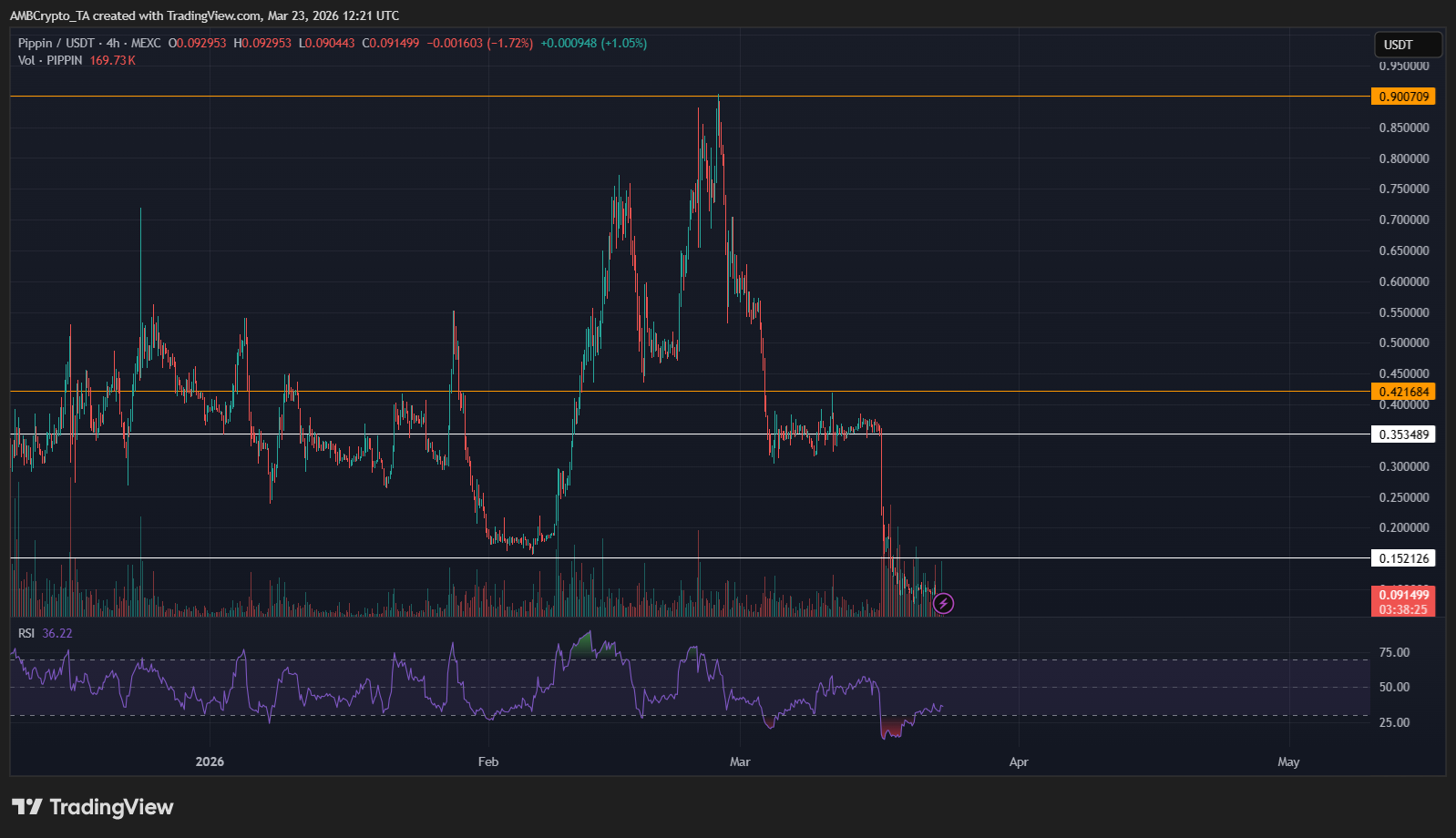
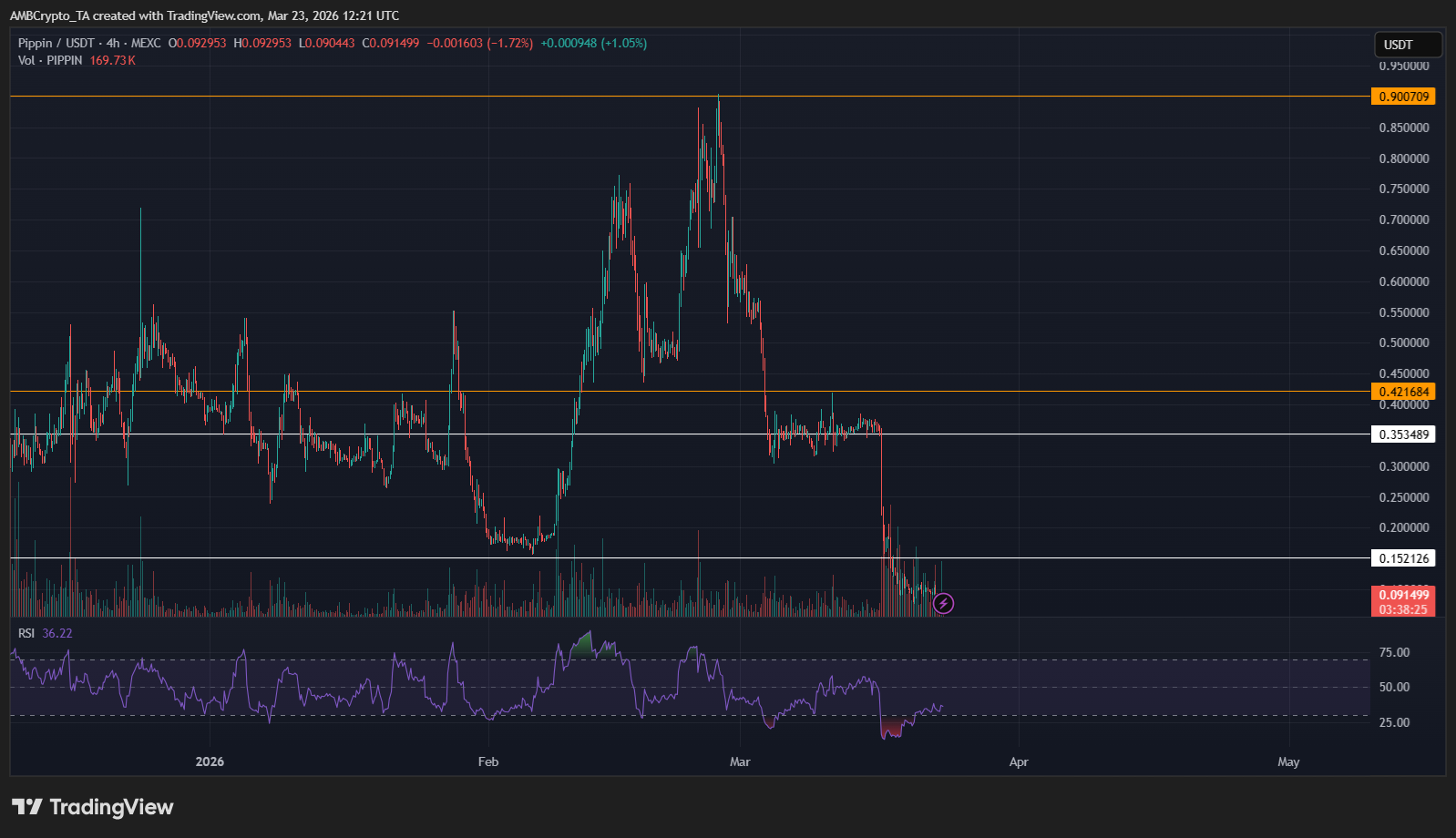
The rally from $0.20–$0.30 into the $0.90 peak shows aggressive speculative inflows, likely driven by social momentum and short-term positioning.

As the price approached $0.90, selling pressure intensified, leading to a sharp drop toward $0.15, which marked the first major profit-taking phase. This move weakened the structure, as buyers failed to sustain higher levels, allowing momentum to fade.
Source: TradingView

Price then consolidated briefly before breaking below $0.15, accelerating downside toward $0.0915, now acting as immediate support. RSI near 36 confirms bearish momentum, yet it is not fully oversold, which leaves room for further downside.

This decline reflects liquidity exit and fading demand, as speculative capital rotates out quickly. If $0.0915 fails, price may extend toward $0.05–$0.07, reinforcing a fragile, sentiment-driven structure.

Long liquidations accelerate as PIPPIN’s structure weakens

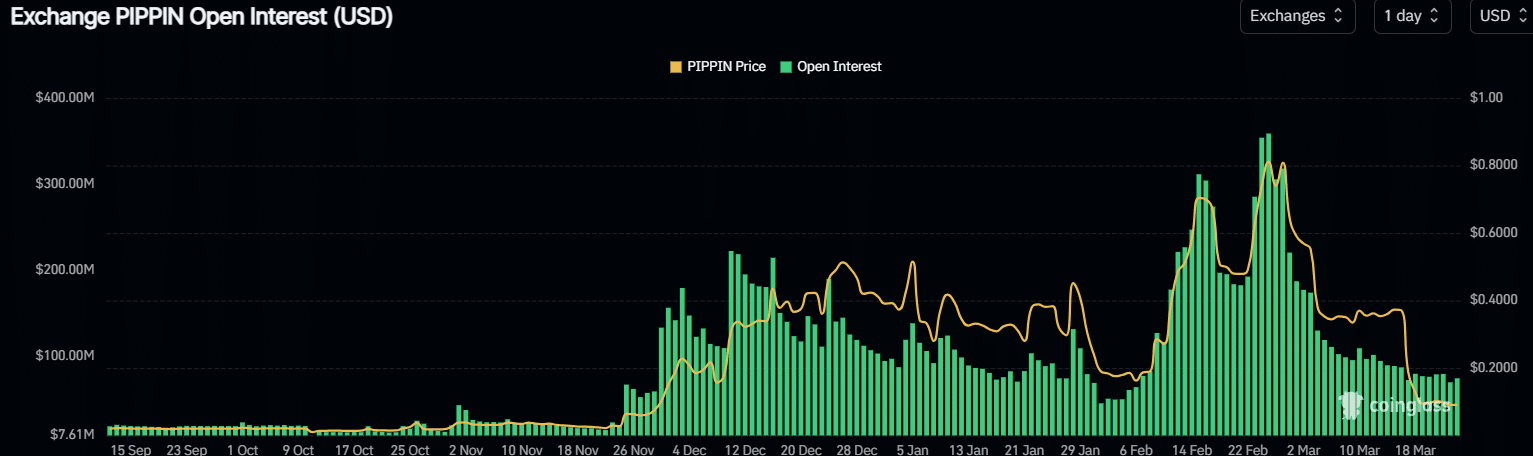
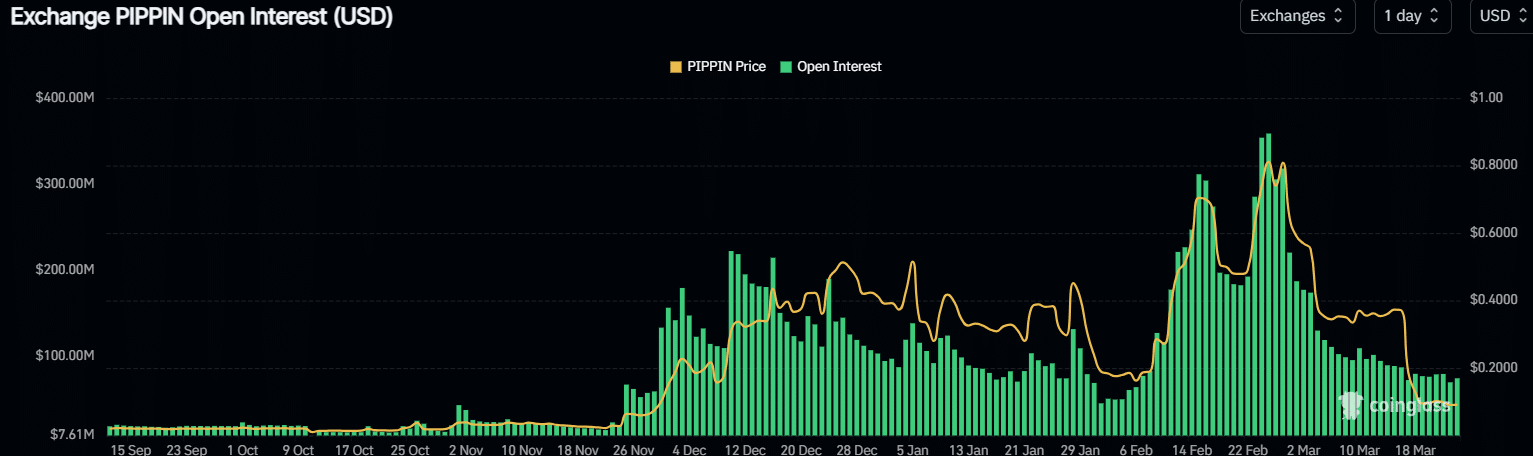
As price breaks below $0.15 and accelerates toward $0.0915, derivatives positioning confirms that the decline is driven by forced unwinding rather than fresh bearish bets.

Open Interest contracted to 74.14 million, dropping 12% in 24 hours and nearly 40% across major venues, which shows traders are closing positions instead of adding exposure.
Source: CoinGlass

This shift reflects a long unwind phase, where overleveraged participants exit as losses mount, amplifying downside pressure. At the same time, Funding Rates remained positive near 0.05%, which revealed that some longs still held positions, expecting a rebound despite weakening structure.

As liquidations increased, long-side wipes dominated, contributing to cascading sell pressure and reinforcing the breakdown. This imbalance highlights a fragile market, where liquidity thins as participants retreat.

With conviction fading and capital exiting, the structure becomes hollow, meaning price lacks strong support. Until Open Interest stabilizes and funding normalizes, the market remains vulnerable to further downside or sharp volatility spikes.

Short-term strength builds as PIPPIN finds a floor

After the sharp breakdown, price began stabilizing between $0.082 and $0.10, forming a clear short-term floor. As lower lows disappeared, buyers gradually absorbed remaining sell pressure, shifting structure from decline to accumulation.

The RSI recovered from oversold levels below 20 to around 50.6, signaling improving momentum as buying strength starts matching selling pressure. This transition suggests that short-term control is slowly rotating back toward bulls.
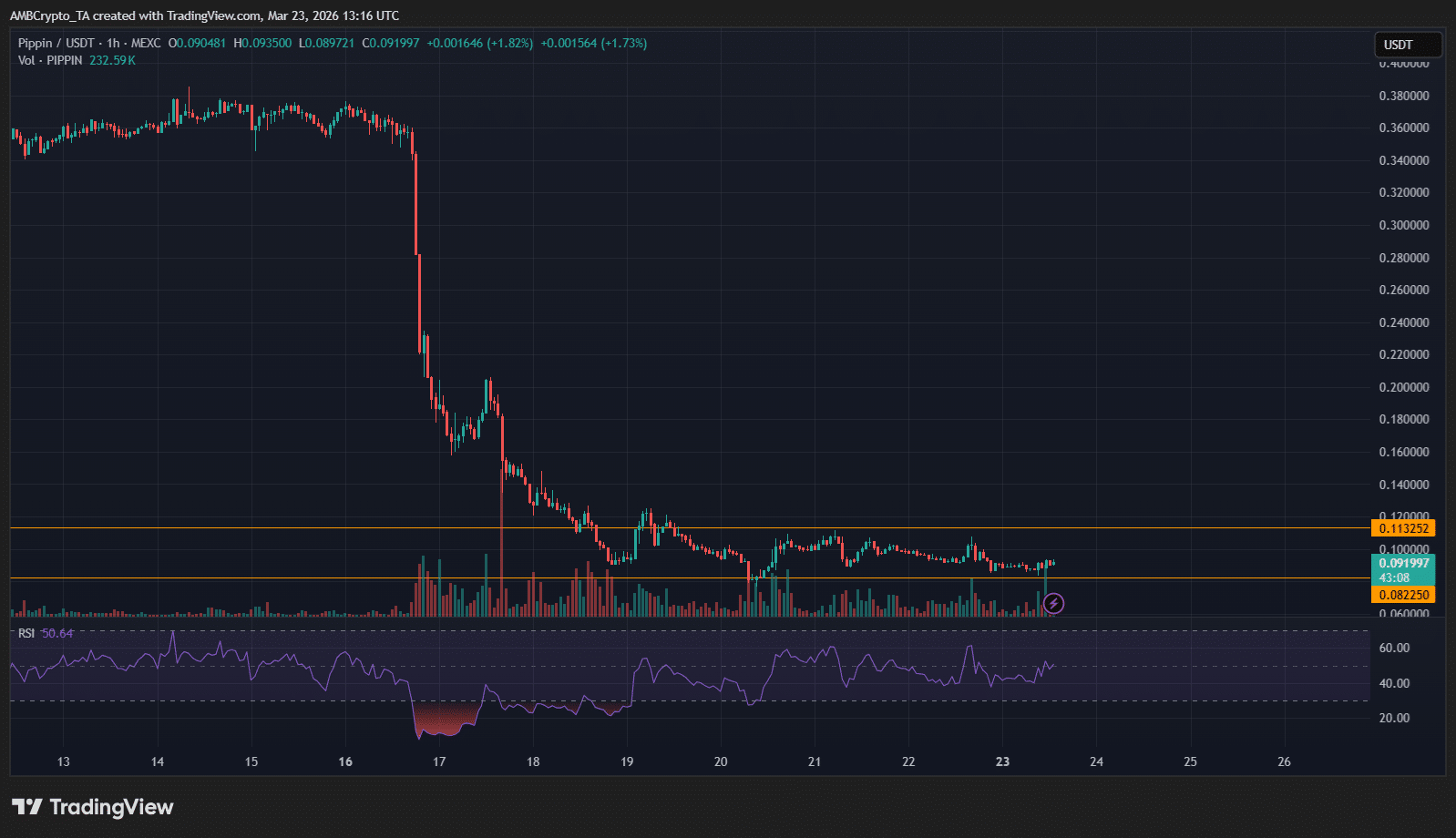
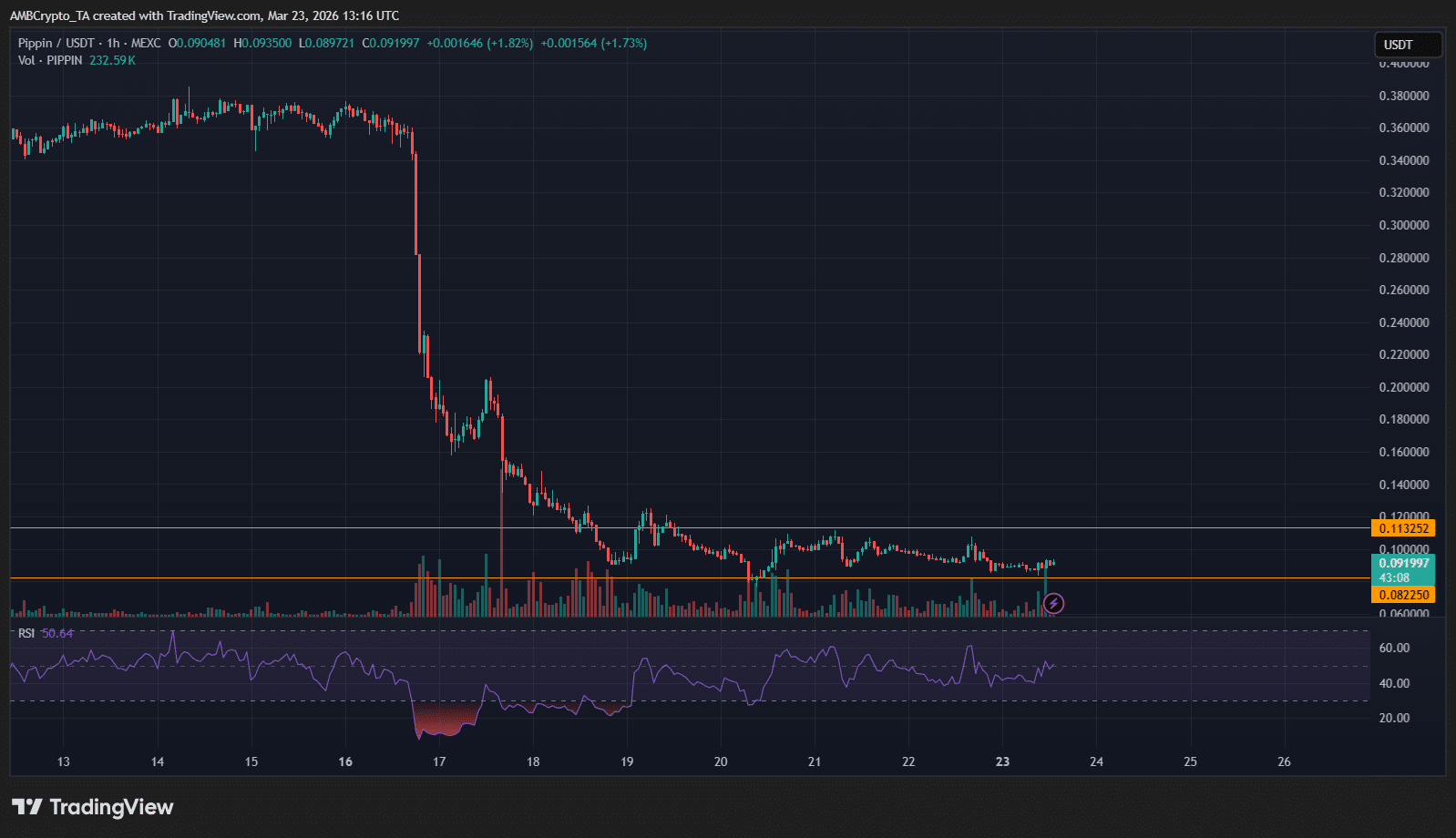
Source: TradingView

At the same time, volume declines noticeably compared to the crash on the 17th of March, indicating seller exhaustion as aggressive dumping fades. With fewer sellers, smaller buy orders can now influence price more effectively.

Price tightens below the $0.113 resistance, creating a compression range. If this level breaks, momentum could accelerate toward $0.15, confirming a short-term reversal structure.


Final Summary

  • PIPPIN’s collapse from $0.90 to $0.0915, driven by long liquidations and a 40% Open Interest drop signals liquidity exit and fragile structure.
  • PIPPIN stabilization between $0.082 and $0.10 with RSI recovery and declining volume suggests seller exhaustion, positioning for short-term rebound if $0.113 breaks.


Domande pertinenti

QWhat was the peak price of PIPPIN and what does its subsequent drop to $0.0915 indicate?

APIPPIN reached a peak price of $0.90. The subsequent sharp drop to $0.0915 indicates a classic memecoin pattern of rapid unwinding, driven by profit-taking, long liquidations, and a significant exit of speculative capital, revealing a fragile market structure.

QHow did Open Interest and Funding Rates change during PIPPIN's decline, and what does this suggest about market sentiment?

AOpen Interest contracted by 12% in 24 hours and nearly 40% across major venues, indicating traders were closing positions rather than adding new exposure. Despite this, Funding Rates remained slightly positive at 0.05%, suggesting some longs were still holding, hoping for a rebound, but the overall sentiment was weak with capital exiting.

QWhat key support level is PIPPIN currently testing, and what is the significance of a break below it?

APIPPIN is testing immediate support at $0.0915. A break below this level could lead to a further decline toward the $0.05–$0.07 range, reinforcing the fragile, sentiment-driven nature of its market structure.

QWhat signs suggest that PIPPIN might be forming a short-term bottom and a potential rebound?

ASigns of a short-term bottom include price stabilization between $0.082 and $0.10, the RSI recovering from oversold levels (20) to around 50.6, and a noticeable decline in trading volume indicating seller exhaustion. A break above the $0.113 resistance could confirm a short-term reversal.

QWhat was the primary driver behind the cascading sell pressure during PIPPIN's price crash?

AThe cascading sell pressure was primarily driven by long liquidations, where overleveraged participants were forced to exit their positions as losses mounted. This created a cycle of amplified downside pressure and contributed to the rapid breakdown in price.

Letture associate

Anthropic's IPO Launch: Commercial Miracle or Valuation Bubble?

Anthropic has confidentially filed for an IPO, led by Morgan Stanley and Goldman Sachs, potentially going public by October. Following its latest $650 billion funding round, its pre-IPO valuation stands at $965 billion, with projections reaching up to $2 trillion at listing, which would make it the highest-valued private company ever. The article, written by Fu Sheng, addresses skepticism that this represents an AI bubble akin to the 2000 dot-com crash. It argues the current situation differs fundamentally. Unlike the internet bubble era, which relied on speculative narratives with little revenue, Anthropic's valuation is backed by unprecedented, measurable financial performance. Key data points include: * **Revenue Growth:** ARR skyrocketed from $10 billion in early 2025 to $470 billion by May 2026, targeting $100 billion by year-end—a growth curve unmatched in business history. * **Profitability:** It achieved operating profitability in Q2 2026 with an estimated $5.6 billion profit. * **Efficiency:** With ~3,000 employees and ~$470 billion ARR, its revenue per employee exceeds $10 million. Products like Claude Code, launched less than a year ago, already generate $25 billion in annualized revenue. * **Enterprise Adoption:** It boasts a strong enterprise client base, with 8 of the Fortune 10 and over 1,000 large firms spending over $1 million annually on Claude. The valuation is framed using a traditional SaaS model (e.g., a 10x Price-to-Sales multiple on $100 billion revenue). The author contends the core question for analysts has shifted from "How big could this be?" to "How much is it earning and will earn next quarter?" The discussion extends beyond Anthropic to a broader paradigm shift: the transition from a "carbon-based" to a "silicon-based" economy. Companies are increasingly prioritizing investment in compute and AI capabilities over human resources, as these directly scale productivity and competitive advantage. Anthropic's IPO is thus positioned not just as a corporate milestone, but as a price anchor for this new economic era.

链捕手1 h fa

Anthropic's IPO Launch: Commercial Miracle or Valuation Bubble?

链捕手1 h fa

Near Returns to the AI Stage: Transformation into a Public Chain Due to 'Payroll Difficulties,' Agent and Privacy Emerge as New Growth Narratives

NEAR Returns to AI Origins: From Payroll Struggles to Blockchain, Now Focusing on AI Agents and Privacy NEAR Protocol's journey began not with grand blockchain ambitions, but from a practical hurdle: its AI startup founders, including Transformer paper co-author Illia Polosukhin, couldn't efficiently pay international developers in 2017. This led them to pivot and build a high-performance, scalable blockchain. After years navigating various crypto narratives like sharding and cross-chain interoperability, NEAR is now leveraging its AI roots to re-enter the AI arena. A key driver is its "NEAR Intents" layer, which abstracts complex cross-chain transactions. Users simply state their goal (e.g., swap BTC for ETH), and a solver network finds the optimal route. This system has processed over $20B in cross-chain volume, generating significant fee revenue. A major growth area is private transactions via "Confidential Intents/Swaps," which hide trade details until settlement to protect against MEV and front-running. Remarkably, private swaps recently accounted for over 40% of NEAR's transaction volume, highlighting strong demand but also potential regulatory scrutiny. With its AI-founder pedigree, NEAR is positioning itself at the intersection of blockchain, AI agents, and privacy, aiming to become infrastructure for the emerging agent economy while navigating the challenges of its rapid adoption.

marsbit4 h fa

Near Returns to the AI Stage: Transformation into a Public Chain Due to 'Payroll Difficulties,' Agent and Privacy Emerge as New Growth Narratives

marsbit4 h fa

Trading

Spot
Futures

Articoli Popolari

Come comprare PIPPIN

Benvenuto in HTX.com! Abbiamo reso l'acquisto di pippin (PIPPIN) semplice e conveniente. Segui la nostra guida passo passo per intraprendere il tuo viaggio nel mondo delle criptovalute.Step 1: Crea il tuo Account HTXUsa la tua email o numero di telefono per registrarti il tuo account gratuito su HTX. Vivi un'esperienza facile e sblocca tutte le funzionalità,Crea il mio accountStep 2: Vai in Acquista crypto e seleziona il tuo metodo di pagamentoCarta di credito/debito: utilizza la tua Visa o Mastercard per acquistare immediatamente pippinPIPPIN.Bilancio: Usa i fondi dal bilancio del tuo account HTX per fare trading senza problemi.Terze parti: abbiamo aggiunto metodi di pagamento molto utilizzati come Google Pay e Apple Pay per maggiore comodità.P2P: Fai trading direttamente con altri utenti HTX.Over-the-Counter (OTC): Offriamo servizi su misura e tassi di cambio competitivi per i trader.Step 3: Conserva pippin (PIPPIN)Dopo aver acquistato pippin (PIPPIN), conserva nel tuo account HTX. In alternativa, puoi inviare tramite trasferimento blockchain o scambiare per altre criptovalute.Step 4: Scambia pippin (PIPPIN)Scambia facilmente pippin (PIPPIN) nel mercato spot di HTX. Accedi al tuo account, seleziona la tua coppia di trading, esegui le tue operazioni e monitora in tempo reale. Offriamo un'esperienza user-friendly sia per chi ha appena iniziato che per i trader più esperti.

414 Totale visualizzazioniPubblicato il 2025.01.11Aggiornato il 2026.06.02

Come comprare PIPPIN

Discussioni

Benvenuto nella Community HTX. Qui puoi rimanere informato sugli ultimi sviluppi della piattaforma e accedere ad approfondimenti esperti sul mercato. Le opinioni degli utenti sul prezzo di PIPPIN PIPPIN sono presentate come di seguito.

活动图片