PIPPIN crashes 49% after $560K transfer to exchanges triggers sell-off

ambcryptoPubblicato 2026-03-17Pubblicato ultima volta 2026-03-17

Introduzione

PIPPIN experienced a sharp 49% price decline, falling from the $0.35–$0.40 range to around $0.19. On-chain data indicates that two wallets transferred approximately $560,000 worth of PIPPIN to Gate.io just minutes before the sell-off began. The rapid price drop triggered a cascade of long liquidations, flipping the funding rate deeply negative to -0.8. The move underscores how exchange inflows and derivatives activity can rapidly shift sentiment in low-liquidity markets. While the market is now short-dominated, the extreme positioning could also set the stage for a short-term rebound if buying interest returns.

PIPPIN recorded a sharp 49% decline over the latest trading session, with on-chain data suggesting that exchange inflows may have preceded the move.

The drop pushed the token from the $0.35–$0.40 range to around $0.19, marking one of its steepest single-session losses in recent weeks.

Data from Bubblemaps showed that two wallets transferred roughly $560k in PIPPIN to deposit addresses. These addresses then routed the tokens to Gate.io at around 8:00 UTC, just minutes before the price breakdown began.

Wallet transfers preceded the sell-off

According to Bubblemaps, the transfers occurred within minutes of each other, with both wallets sending funds to exchange-linked deposit addresses shortly before the decline.

While the data does not confirm intent, the timing suggests that tokens were moved to exchanges ahead of increased selling pressure.

In crypto markets, such inflows are often monitored as potential indicators of distribution, particularly when followed by sharp price movements.

Price breakdown triggers liquidation cascade

The price chart showed a clear loss of structure before the drop accelerated. After failing to hold the $0.30 consolidation level, PIPPIN broke lower with strong momentum, accompanied by a visible spike in trading volume.
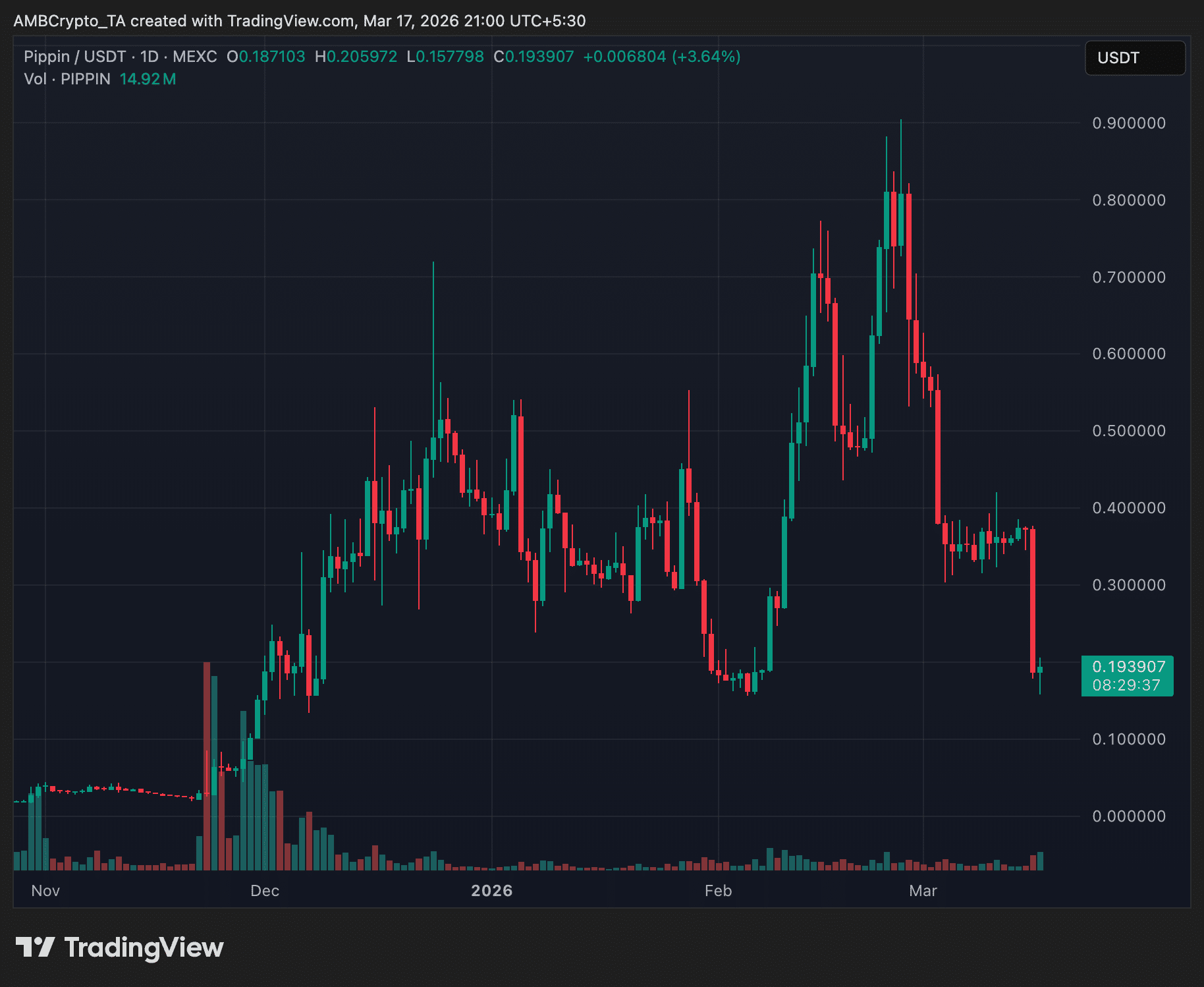
Source: TradingView

The move accelerated losses, wiping out recent gains and pushing the token back toward levels last seen in its trading range. The speed of the decline pointed to forced selling and cascading liquidations, rather than gradual profit-taking.

Funding flips as longs get wiped

Derivatives data reinforced the liquidation narrative. The OI-weighted funding rate flipped deeply negative following the drop. As of this writing, the funding rate was -0.8, an improvement from –1.5 in the previous trading session.

This indicates that long positions were aggressively closed or liquidated during the move.
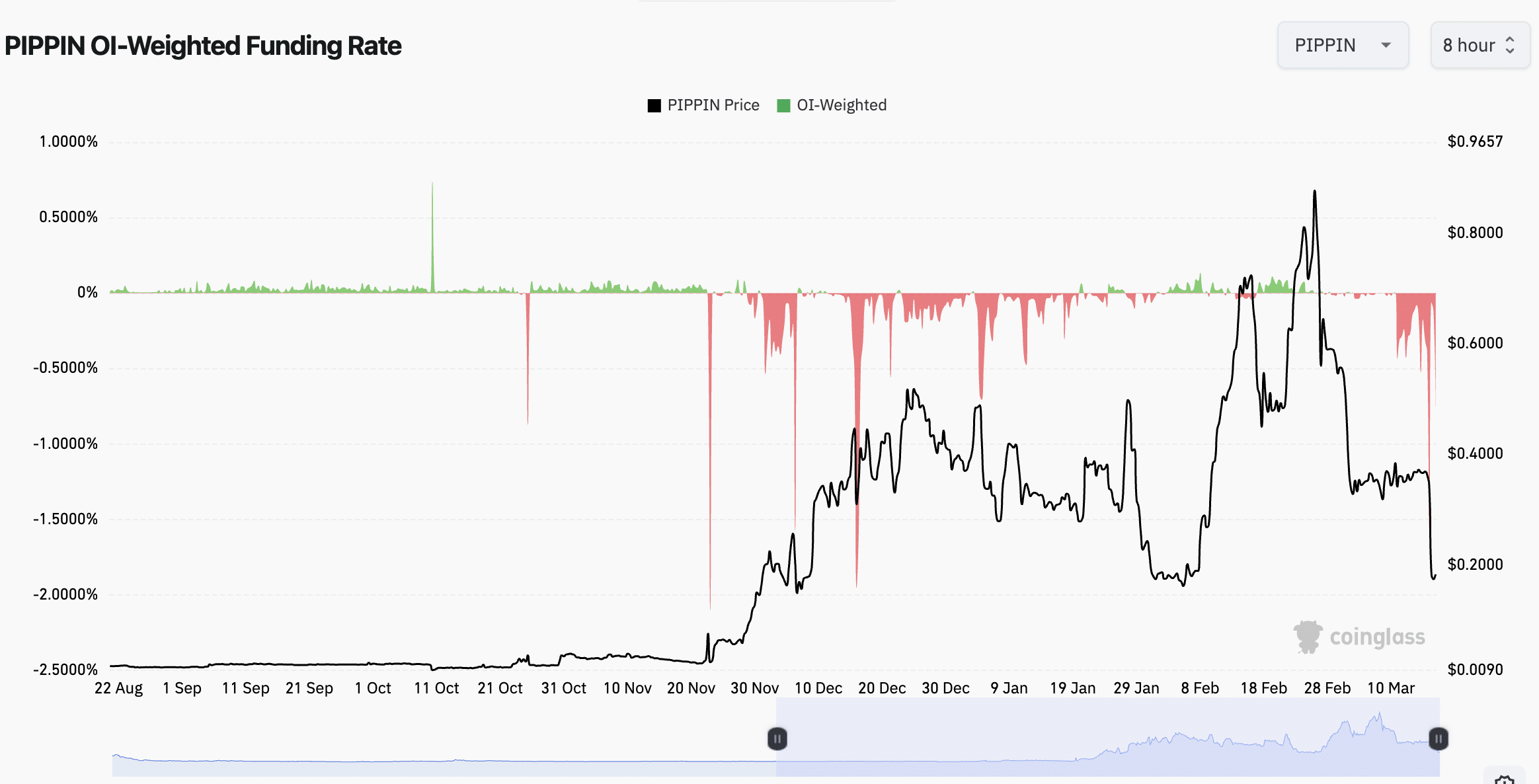
Source: Coinglass

Earlier in the cycle, funding had remained relatively stable or slightly positive, suggesting that the market was positioned for upside. The sudden reversal highlights a shift from crowded longs to short dominance, a typical pattern following a long squeeze.

What next for PIPPIN?

With funding now negative and price significantly lower, the market faces a split outlook.

On one hand, continued weakness could follow if the exchange inflows reflect a broader distribution. On the other hand, crowded short positioning may create conditions for a short-term rebound if buying interest returns.

For now, PIPPIN’s price action appears to be driven by a combination of on-chain flows, spot selling pressure, and derivatives liquidations, with the latest move underscoring how quickly sentiment can shift in low-liquidity environments.


Final Summary

  • PIPPIN’s 49% drop followed $560k in token transfers to exchanges, with timing suggesting inflows may have preceded the sell-off.
  • The move triggered long liquidations and flipped funding negative, leaving the market tilted toward shorts in the near term.

Crypto di tendenza

Domande pertinenti

QWhat was the percentage decline in PIPPIN's price and what event preceded it according to on-chain data?

APIPPIN recorded a sharp 49% decline, with on-chain data suggesting that $560k in token transfers to exchanges preceded the sell-off.

QWhich exchange received the tokens from the two wallets, and what was the approximate timing of these transfers?

AThe tokens were routed to Gate.io at around 8:00 UTC, just minutes before the price breakdown began.

QWhat key price level did PIPPIN fail to hold before the drop accelerated?

APIPPIN failed to hold the $0.30 consolidation level before breaking lower with strong momentum.

QHow did the funding rate change following the price drop, and what does this indicate?

AThe OI-weighted funding rate flipped deeply negative to -0.8, indicating that long positions were aggressively closed or liquidated during the move.
QWhat are the two potential outlooks for PIPPIN's market following this event?

AThe outlook is split: continued weakness could follow if the exchange inflows reflect broader distribution, or crowded short positioning may create conditions for a short-term rebound if buying interest returns.

Letture associate

Unlocking $100 Million in Liquidity? Pump.fun's New Policy Tests the 5-Minute Pump Technique

Pump.fun, a popular meme coin launchpad, has introduced a new standard mechanism called BOOST. It aims to address a significant capital efficiency issue: when a newly launched token graduates from its initial bonding curve to a liquidity pool (LP), roughly 20% of its liquidity becomes permanently locked as "dead liquidity," estimated to waste over $100 million annually. Instead of locking these funds permanently, BOOST repurposes them. Upon a token's migration, approximately 20% of the settlement funds (e.g., 17.6 SOL or ~$2516 USDC) are used to buy back the token on the open market over a 5-minute period via a Time-Weighted Average Price (TWAP) mechanism. All purchased tokens are immediately burned. This creates a brief, systematic buy pressure immediately after migration, potentially generating a short-term price surge ("pump") while permanently reducing the token's circulating supply. The goal is to enhance the immediate post-launch trading experience, potentially increasing trader retention and sustainable protocol revenue, which funds ongoing token buybacks. However, concerns exist that this artificial 5-minute boost could lower the barrier for launching low-quality tokens and lead to steeper price crashes once the buy pressure stops, if followed by large sell-offs. The feature automatically applies to tokens migrating after July 21, 2024, but not to previously migrated tokens or those launched via the Mayhem AI Agent lab.

marsbit3 min fa

Unlocking $100 Million in Liquidity? Pump.fun's New Policy Tests the 5-Minute Pump Technique

marsbit3 min fa

Podcast Notes | Conversation with GSR Asset Management Head: To Determine if This Crypto Rally is Real, Just Watch the Lending Rates on Aave

Podcast Summary: Dialogue with GSR's Head of Asset Management: To Determine if This Crypto Rally is Real, Just Check Lending Rates on Aave Andy Baehr, Managing Director of Asset Management at GSR, discusses the current crypto market, characterizing it as stuck in a state of "ambivalence" with short-lived, unsustainable rallies. He outlines a simple framework: the market moves between "ambivalence" and "conviction" (sustained upward momentum). Currently, every rally resembles a single-stage rocket booster that quickly fizzles out. Baehr identifies three key signals to watch: 1) DeFi lending rates, 2) the potential passage of the CLARITY Act, and 3) the market forming a consensus on the "Fed hawkish peak." He emphasizes that the most immediate indicator for the sustainability of the recent CPI-triggered rally is the USDC borrowing rate on Aave, currently around 3.75%—close to U.S. Treasury yields. The absence of a credit spread indicates low leverage demand and a lack of market energy. He explains that a healthy, sustained rally requires layered buying pressure. Last year's rally progressed from an ETH short squeeze to crypto-native trader influx and finally to ETF inflows. Currently, this structure is missing. Other potential structural buyers like Digital Asset Treasury (DAT) companies are absent, and ETF flows have proven transient. Baehr notes that while small-cap crypto tokens outperformed large caps in Q2—a potential sign of capitation in major assets—capital is also flowing to more exciting opportunities like AI stocks and tech IPOs, leaving crypto sidelined. Regarding DeFi, he highlights that platforms like Aave provide a clear, real-time signal of leverage demand through their supply/demand-driven interest rates. A significant, sustained rate increase would signal genuine market conviction. He also observes the quiet emergence of fixed-income-like products and vaults in DeFi. On regulation, the probability of the CLARITY Act passing before the August 7th deadline has dropped linearly from 75% to below 40% on Polymarket. Baehr suggests its passage would be treated as a bullish surprise, a potent driver for price movement. However, political hurdles, including ethical clause debates and disclosures about the First Family's crypto profits, remain significant obstacles. Ultimately, the market awaits clarity on the Fed's terminal rate under Chair Warsh. Until the "Fed Solstice"—the point where the market collectively understands the peak of hawkish policy—sustained conviction will be difficult to achieve.

marsbit34 min fa

Podcast Notes | Conversation with GSR Asset Management Head: To Determine if This Crypto Rally is Real, Just Watch the Lending Rates on Aave

marsbit34 min fa

Trading

Spot

Articoli Popolari

Come comprare PIPPIN

Benvenuto in HTX.com! Abbiamo reso l'acquisto di pippin (PIPPIN) semplice e conveniente. Segui la nostra guida passo passo per intraprendere il tuo viaggio nel mondo delle criptovalute.Step 1: Crea il tuo Account HTXUsa la tua email o numero di telefono per registrarti il tuo account gratuito su HTX. Vivi un'esperienza facile e sblocca tutte le funzionalità,Crea il mio accountStep 2: Vai in Acquista crypto e seleziona il tuo metodo di pagamentoCarta di credito/debito: utilizza la tua Visa o Mastercard per acquistare immediatamente pippinPIPPIN.Bilancio: Usa i fondi dal bilancio del tuo account HTX per fare trading senza problemi.Terze parti: abbiamo aggiunto metodi di pagamento molto utilizzati come Google Pay e Apple Pay per maggiore comodità.P2P: Fai trading direttamente con altri utenti HTX.Over-the-Counter (OTC): Offriamo servizi su misura e tassi di cambio competitivi per i trader.Step 3: Conserva pippin (PIPPIN)Dopo aver acquistato pippin (PIPPIN), conserva nel tuo account HTX. In alternativa, puoi inviare tramite trasferimento blockchain o scambiare per altre criptovalute.Step 4: Scambia pippin (PIPPIN)Scambia facilmente pippin (PIPPIN) nel mercato spot di HTX. Accedi al tuo account, seleziona la tua coppia di trading, esegui le tue operazioni e monitora in tempo reale. Offriamo un'esperienza user-friendly sia per chi ha appena iniziato che per i trader più esperti.

442 Totale visualizzazioniPubblicato il 2025.01.11Aggiornato il 2026.06.02

Come comprare PIPPIN

Discussioni

Benvenuto nella Community HTX. Qui puoi rimanere informato sugli ultimi sviluppi della piattaforma e accedere ad approfondimenti esperti sul mercato. Le opinioni degli utenti sul prezzo di PIPPIN PIPPIN sono presentate come di seguito.

活动图片