PIPPIN crashes 44%: How $3.03M liquidations forced a market reset

ambcryptoPubblicato 2026-04-05Pubblicato ultima volta 2026-04-05

Introduzione

PIPPIN experienced a severe market crash, plummeting over 44% from nearly $0.80 to around $0.035, driven by a liquidation cascade that forced approximately $3.03 million in positions to close—$2.30 million of which were long positions. This sharp decline reflected a shift from expansion to exhaustion, wiping out speculative momentum and triggering a market reset. The price structure weakened, showing lower highs and fading demand throughout March. Currently, PIPPIN is stabilizing near the $0.03–$0.037 support zone, with RSI indicating oversold conditions at 27.9, suggesting reduced selling pressure. The market remains fragile; holding this support could lead to a relief bounce toward $0.15, but failure may result in further downside, extending the reset phase.

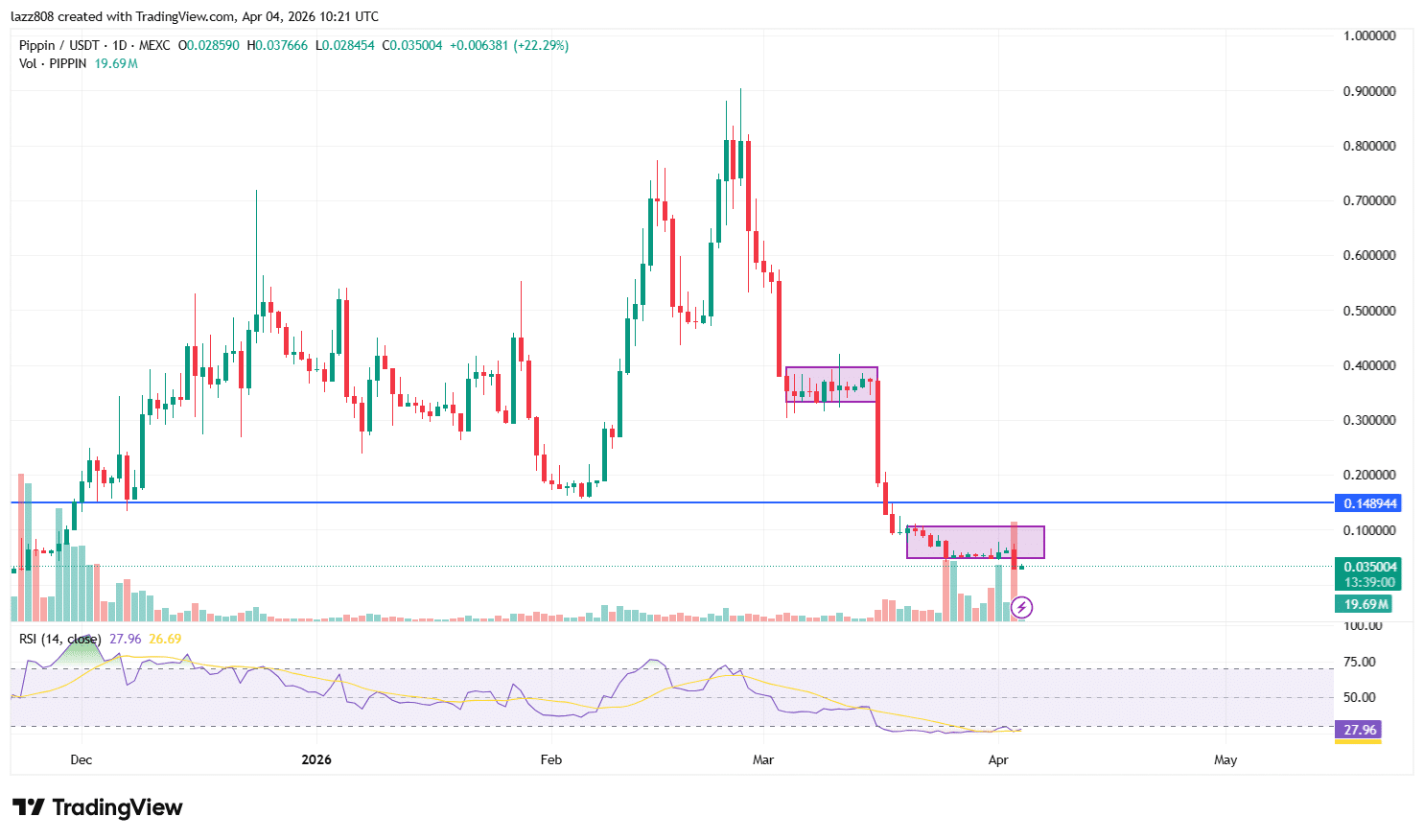
Pippin’s [PIPPIN] market shifted from expansion into exhaustion, as a sharp drop from near $0.80 toward $0.035 signaled a clear liquidity flush. This move exceeded 44% on rising volume, which shows forced exits as speculative momentum unwinds.

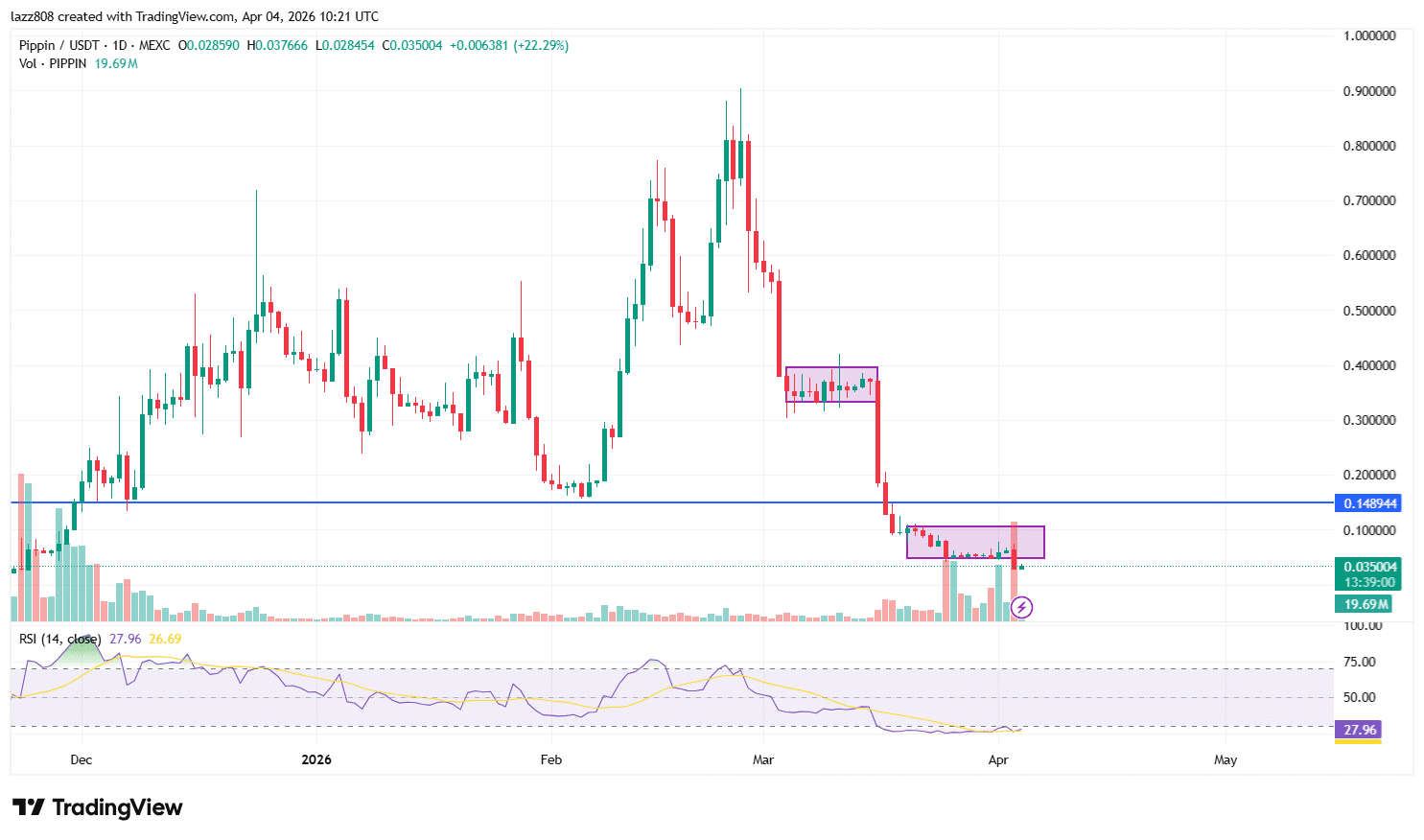
As this unfolded, the price structure weakened into lower highs through March, reflecting fading demand. Earlier, a similar consolidation formed around $0.35–$0.40, where the price paused before breaking down sharply. That setup showed how trapped liquidity often builds before a forced move lower.
Source: PIPPIN/USDT on TradingView

Now, the same pattern reappears near $0.035, where price compresses after the drop. This happens because sellers exhaust support while buyers cautiously step in. At press time, RSI was nearing 27.9, signaling oversold conditions, suggesting selling pressure begins to fade.

This creates a fragile balance, where compression reflects indecision. If buyers absorb supply, a relief bounce may follow; however, failure to hold support could trigger another liquidation wave.
Liquidation cascade drives PIPPIN’s breakdown

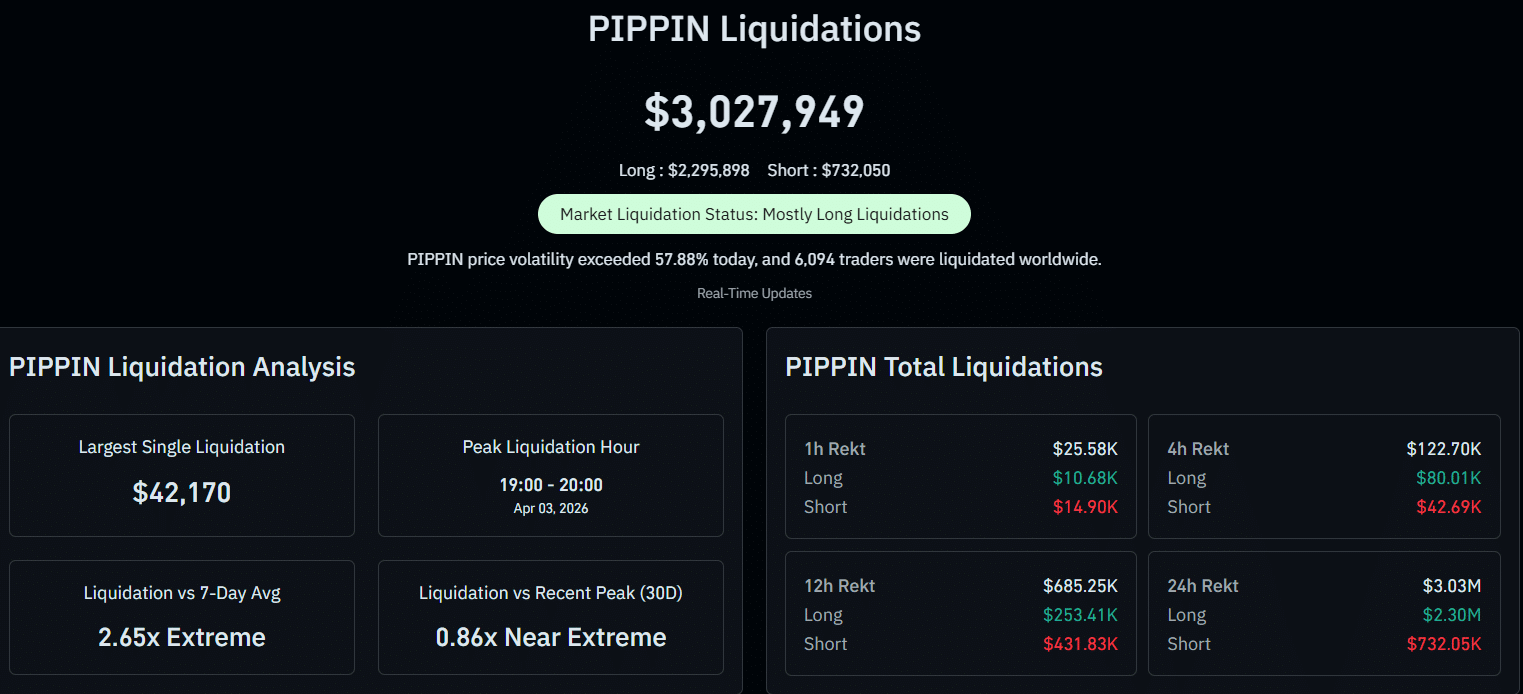
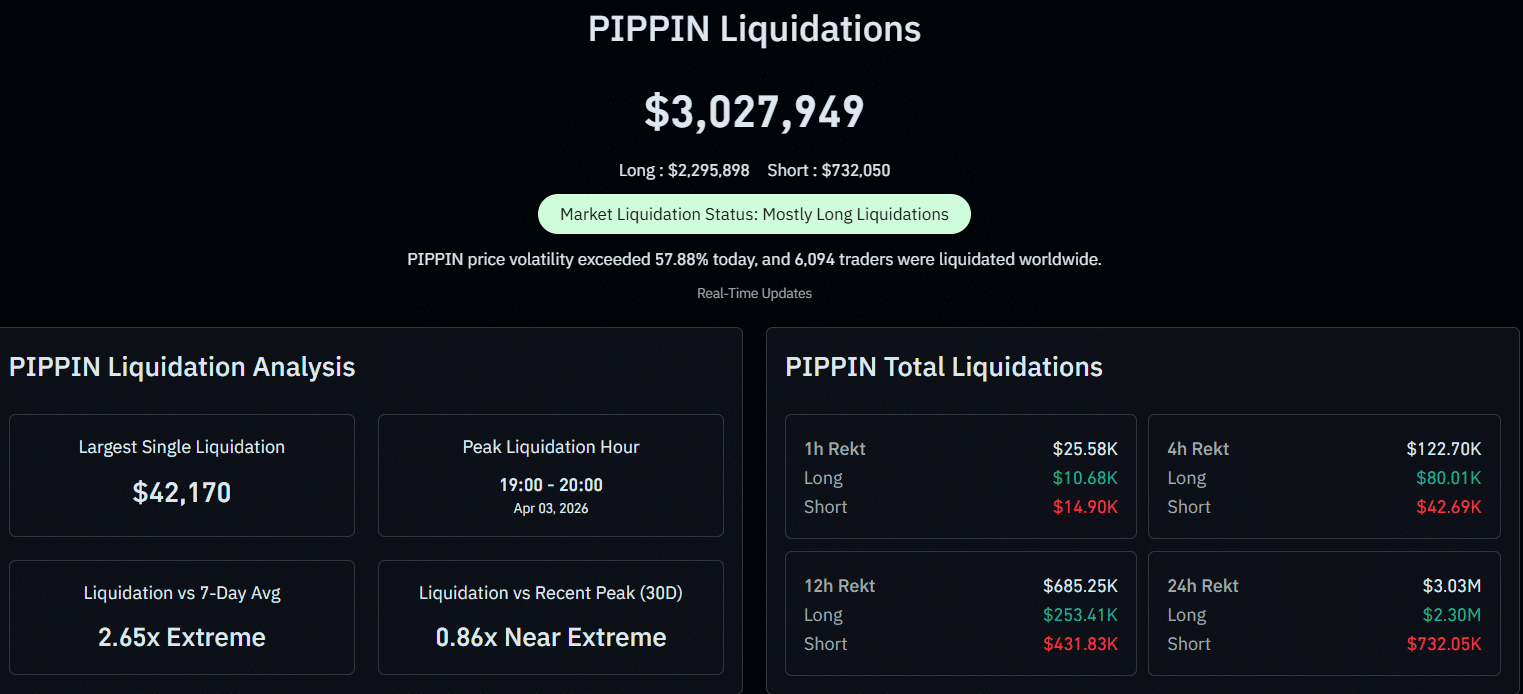
Liquidations took control of the move and accelerated PIPPIN’s breakdown, turning a weak structure into a rapid unwind. As prices dropped, about $3.03 million in positions were liquidated, with $2.30 million in longs, showing buyers were overexposed.

Source: CoinGlass

As support gives way, exchanges force long positions to close, putting immediate sell pressure on the market. This selling lowers prices, which prompts additional liquidations, resulting in a cascading effect.

However, prices then stabilized between $0.03 and $0.035, where the cascade slowed. This move resets the market, as forced exits remove weak hands, leaving recovery to fresh buyers.

PIPPIN tests key support as recovery hinges on...

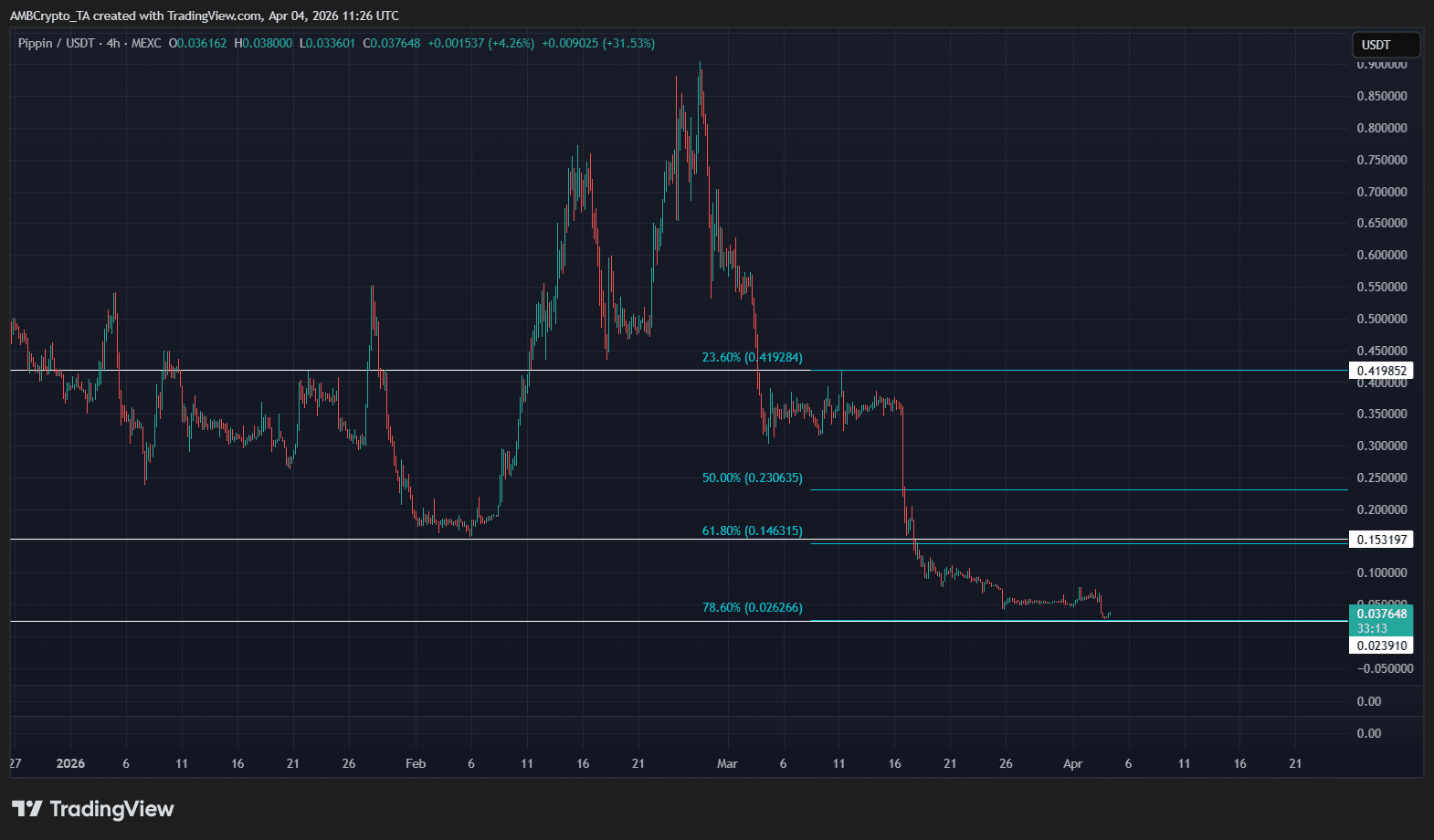
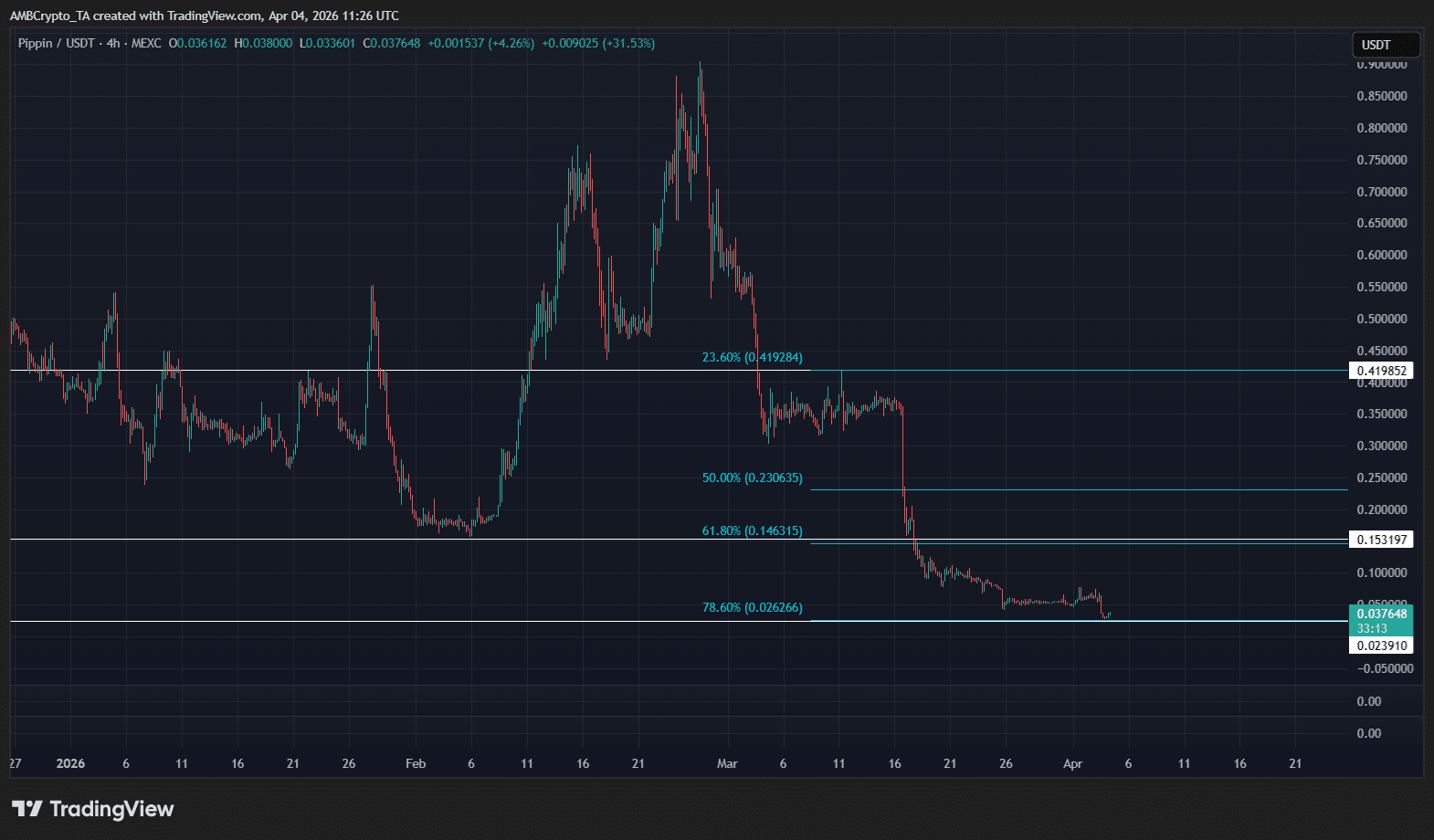
PIPPIN’s structure now reflects a market trying to stabilize after a sharp breakdown, where price holds near $0.037 following a decisive loss of $0.153 and $0.230. This shift shows momentum has flipped, as earlier buyers exit and new demand struggles to take control.

The move pushes price toward the 78.6% retracement near $0.026, a zone where deep corrections often slow as selling begins to exhaust. This happens because most weak hands have already exited, leaving fewer forced sellers in the market.

Source: PIPPIN/USDT on TradingView

However, the inability to reclaim $0.153 shows confidence remains low, which limits sustained upside. Buyers hesitate, as the trend still points downward.

This creates a fragile balance, where holding $0.026–$0.037 could support a relief bounce toward $0.15. That move would signal early recovery, yet failure to hold this zone may trigger another drop, extending the reset phase.


Final Summary

  • PIPPIN resets after a sharp drop and liquidation cascade, with price stabilizing near $0.03–$0.037 as selling pressure fades.
  • PIPPIN now depends on demand, where holding support enables a bounce, while failure risks further downside.

Crypto di tendenza

Domande pertinenti

QWhat was the primary driver behind PIPPIN's sharp price drop of over 44%?

AA liquidation cascade, where about $3.03 million in positions were forced to close, accelerated the breakdown. This included $2.30 million in long liquidations, indicating overexposed buyers were forced to exit.

QAt what price level did PIPPIN show signs of stabilization after the crash?

AThe price stabilized between $0.03 and $0.035, where the liquidation cascade slowed and the market began to reset as weak hands were flushed out.

QWhat does the RSI value of 27.9 indicate about PIPPIN's market condition at press time?

AAn RSI of 27.9 signals oversold conditions, suggesting that selling pressure was beginning to fade.

QWhich key retracement level is mentioned as a potential zone where deep corrections often slow down?

AThe 78.6% retracement level near $0.026 is highlighted as a zone where selling pressure may exhaust and corrections often slow.

QWhat are the two possible scenarios for PIPPIN's price action mentioned in the final summary?

AIf buyers absorb supply and hold support, a relief bounce toward $0.15 may occur. However, failure to hold the $0.026–$0.037 support zone could trigger another drop and extend the reset phase.

Letture associate

Will the Fed Definitely Raise Interest Rates in September? How Will Crypto and U.S. Stocks Withstand the Pressure?

The market's expectation for a September Fed rate hike surged dramatically in early August, jumping from under 50% to over 80% within a week. This shift followed a contentious July FOMC meeting, where a 9-3 vote to hold rates revealed growing dissent from hawkish members advocating for an immediate hike to combat persistent inflation. The primary catalyst for this repricing is rising oil prices, driven by renewed geopolitical tensions around the Strait of Hormuz, which threaten global supply. Energy costs directly influence inflation metrics, making the upcoming July CPI report (due August 12th) a critical data point. If it shows inflation reaccelerating, the probability of a September hike will solidify. For Bitcoin and crypto assets, this is typically bearish news. Bitcoin continues to behave as a high-beta, liquidity-sensitive risk asset. A rate hike raises the opportunity cost of holding non-yielding assets and could drive capital toward money markets, pressuring crypto prices in the short term. However, historical patterns suggest that if a hike is perceived as the end of a tightening cycle rather than the start, any negative price impact may be brief. U.S. stocks, particularly crypto-linked equities like Coinbase and growth-oriented tech stocks, are also vulnerable. Higher rates increase discount rates in valuation models, putting pressure on high-multiple companies. This coincides with a pivotal tech earnings season where investor focus has shifted from massive AI capital expenditure to tangible revenue and cash flow generation. Companies with negative cash flow and weak growth narratives could face heightened volatility if borrowing costs rise in September. In summary, a September Fed hike has evolved into a mainstream market scenario. Key factors to watch are oil prices, the July CPI report, and Fed communications, which will determine the final decision and its impact on volatile crypto and equity markets.

marsbit3 min fa

Will the Fed Definitely Raise Interest Rates in September? How Will Crypto and U.S. Stocks Withstand the Pressure?

marsbit3 min fa

A 'Overlooked' Market Event: Joint US-Japan-South Korea Intervention, Rare US Treasury Involvement, and Bessent's Quiet 'Market Rescue'?

Summary: The United States, Japan, and South Korea executed their largest coordinated foreign exchange intervention in nearly 30 years. The action targeted depreciation pressure on the Japanese yen and South Korean won. This move is seen as a significant effort by the US to stabilize the financial markets of its key allies and prevent the spillover of risks. Key details: * Japan reportedly intervened on July 30 using approximately 8.45 trillion yen (about $52.8 billion). South Korean authorities also intervened that day, selling dollars to support the won. * Notably, the US Treasury Department intervened directly in yen markets for the first time in roughly 30 years. The New York Fed, reportedly acting on behalf of the Treasury, sold euros to buy yen via Goldman Sachs and Morgan Stanley on July 31. Analysts view the use of the euro-yen pair as a way to alleviate yen pressure without adding selling pressure to the US dollar. * Prior to the action, the New York Fed conducted "rate checks" on both USD/JPY and EUR/JPY, a newer signaling tool that falls between verbal and physical intervention. The intervention is interpreted as going beyond traditional currency stabilization. Analysts, such as Michael Hartnett of Bank of America, suggest it resembles a "Price Keeping Operation" for the AI era. The core US objectives are perceived to be: 1. Preventing rapid yen depreciation from triggering a sharp rise in Japanese government bond yields. 2. Containing financial stress from spreading across Asian markets like South Korea and Japan. 3. Reducing the risk of disorderly capital flows impacting the US bond market. This coordinated action underscores the importance of Japan and South Korea as critical partners in the US semiconductor and AI supply chain. Stabilizing their financial markets is seen as vital to mitigating risks to the broader tech industry and the US market itself. The intervention coincides with market pressures, including the KOSDAQ index hitting a low since October 2022. While seen as a move to control volatility, some analysts caution it may not fundamentally reverse existing market trends.

marsbit7 min fa

A 'Overlooked' Market Event: Joint US-Japan-South Korea Intervention, Rare US Treasury Involvement, and Bessent's Quiet 'Market Rescue'?

marsbit7 min fa

Will the Federal Reserve Definitely Raise Interest Rates in September? How Will Cryptocurrencies and US Stocks Bear the Pressure?

In early August 2024, market expectations for a September Federal Reserve rate hike surged dramatically, from below 50% to over 80%, driven by renewed inflation concerns. This shift followed a contentious July FOMC meeting where a 9-3 vote to hold rates revealed a growing hawkish faction advocating for an immediate hike, citing prolonged above-target inflation. The key catalyst is escalating conflict near the Strait of Hormuz, which has pushed oil prices up approximately 20% in July, threatening to reignite inflation. The next critical data point is the July CPI report on August 12th; a hot reading could solidify hike expectations. For crypto assets, particularly Bitcoin, this represents near-term pressure. Bitcoin continues to exhibit high-beta, risk-on characteristics, making it sensitive to tightening liquidity and higher opportunity costs. However, historical precedent suggests that if a hike is perceived as the cycle's end rather than its start, the negative impact may be brief, with markets quickly pivoting to anticipate future rate cuts. U.S. stocks, especially crypto-linked equities like Coinbase and high-valuation tech stocks, face amplified volatility. Higher rates increase discount rates in valuation models, pressuring growth stocks. This coincides with a pivotal tech earnings season where investor focus has shifted from massive AI capital expenditures to demonstrable revenue and cash flow generation. Companies with negative cash flows and weak growth narratives could see severe pressure if a September hike materializes, as financing costs would rise. Key indicators to watch include oil prices, upcoming inflation data, and Fed commentary at events like the Jackson Hole symposium.

Odaily星球日报7 min fa

Will the Federal Reserve Definitely Raise Interest Rates in September? How Will Cryptocurrencies and US Stocks Bear the Pressure?

Odaily星球日报7 min fa

Trading

Spot

Articoli Popolari

Come comprare PIPPIN

Benvenuto in HTX.com! Abbiamo reso l'acquisto di pippin (PIPPIN) semplice e conveniente. Segui la nostra guida passo passo per intraprendere il tuo viaggio nel mondo delle criptovalute.Step 1: Crea il tuo Account HTXUsa la tua email o numero di telefono per registrarti il tuo account gratuito su HTX. Vivi un'esperienza facile e sblocca tutte le funzionalità,Crea il mio accountStep 2: Vai in Acquista crypto e seleziona il tuo metodo di pagamentoCarta di credito/debito: utilizza la tua Visa o Mastercard per acquistare immediatamente pippinPIPPIN.Bilancio: Usa i fondi dal bilancio del tuo account HTX per fare trading senza problemi.Terze parti: abbiamo aggiunto metodi di pagamento molto utilizzati come Google Pay e Apple Pay per maggiore comodità.P2P: Fai trading direttamente con altri utenti HTX.Over-the-Counter (OTC): Offriamo servizi su misura e tassi di cambio competitivi per i trader.Step 3: Conserva pippin (PIPPIN)Dopo aver acquistato pippin (PIPPIN), conserva nel tuo account HTX. In alternativa, puoi inviare tramite trasferimento blockchain o scambiare per altre criptovalute.Step 4: Scambia pippin (PIPPIN)Scambia facilmente pippin (PIPPIN) nel mercato spot di HTX. Accedi al tuo account, seleziona la tua coppia di trading, esegui le tue operazioni e monitora in tempo reale. Offriamo un'esperienza user-friendly sia per chi ha appena iniziato che per i trader più esperti.

449 Totale visualizzazioniPubblicato il 2025.01.11Aggiornato il 2026.06.02

Come comprare PIPPIN

Discussioni

Benvenuto nella Community HTX. Qui puoi rimanere informato sugli ultimi sviluppi della piattaforma e accedere ad approfondimenti esperti sul mercato. Le opinioni degli utenti sul prezzo di PIPPIN PIPPIN sono presentate come di seguito.

活动图片