Pi Network Temporarily Halts Wallet Payment Requests Amid Rising Scams

TheNewsCryptoPubblicato 2025-12-31Pubblicato ultima volta 2025-12-31

Introduzione

Pi Network has temporarily disabled its wallet payment request feature due to widespread scams. Scammers were impersonating official accounts and targeting high-balance wallets, tricking users into approving fraudulent requests, resulting in irreversible losses. Over a million PI tokens have been stolen this year, with one wallet receiving more than 838,000 tokens. The Pi Core Team clarified that the issue stems from user approval, not a system vulnerability, and emphasized that this is a common risk across crypto wallets. The token’s value dropped 10% following the incident but has since shown slight recovery. Recent updates include standardized KYC and testnet DEX improvements to enhance security and liquidity.

The Pi network, which is the mobile-first Cryptocurrency and web3 blockchain, recently posted a tweet on DEC 30 that the team has warned that scammers are exploiting the Payment request feature to steal Pi tokens from users’ balances. In the Pi network, the wallet balances are publicly visible, and the attackers are targeting the high-balance wallets and sending the payment request to the wallet as an impersonation of official Pi accounts or community moderators.
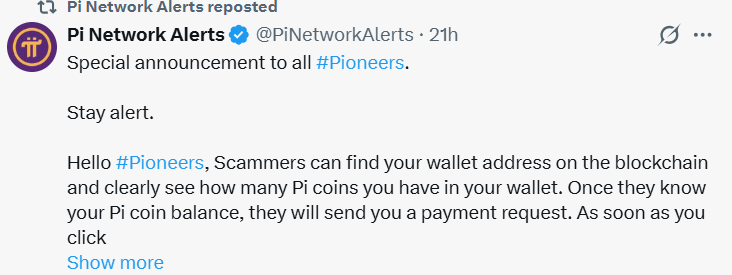
Once the user approves the payment request, the Tokens will be instantly transferred to the scammers’ account and will be gone forever. No reversal or recovery will be done. The Community reports indicate the scams are widespread, and one scammer’s wallet has received more than 838,000 PI tokens. Overall, more than a million PI tokens have been lost throughout the year. This created a panic situation among the users, and even the experienced users were tricked because the request looked legitimate.

Pi Core Team Denies System Vulnerability, Addresses Market and User Impact

After this incident happened, many users called it a wallet flaw, but the Core team clarified that the problem is from the human approval, not the protocol Flaw. They say that the wallet never sends funds on its own, and the transfer only happens after the user’s approval. This behavior exists in all major Crypto wallets. So to stop this scam, the PI network has disabled all payment requests network-wide. This stops the scams instantly and prevents further user losses. This makes the PI token safe, and it was the fastest way to contain the damage.

The token is currently trading at $0.204 with a market cap of 1.7 billion. The Token has dropped to 10% due to this issue. Recently, the token has updated its ecosystem by adding Standardized KYC to cut the verification backlogs by 50% and speed up mainnet migration for millions of users. Another update is from the testnet DEX, which makes the trading safer and easier by using Pi as the main trading Pair and improving the liquidity. This makes the token regain its momentum, and it has increased by 0.7% in 24 hours.

Highlighted Crypto News:

XDC Network Momentum Test: Will It Break Resistance or Slip Back to Lows?

TagsAltcoinCryptocurrencyPi Network

Domande pertinenti

QWhy did the Pi Network temporarily halt wallet payment requests?

AThe Pi Network temporarily halted wallet payment requests to stop scammers who were exploiting the feature to steal Pi tokens by impersonating official accounts, preventing further user losses.

QHow were the scammers able to steal Pi tokens from users?

AScammers targeted high-balance wallets, sent payment requests while impersonating official Pi accounts or community moderators, and stole tokens once users approved these deceptive transactions.

QWhat was the Pi Core Team's response to the incident being called a 'wallet flaw'?

AThe Pi Core Team clarified that the issue was due to human approval of fraudulent requests, not a protocol flaw, emphasizing that transfers only occur after user authorization, similar to other crypto wallets.

QHow much Pi token value was reported lost due to these scams?

ACommunity reports indicated that over a million Pi tokens were lost throughout the year, with one scammer's wallet receiving more than 838,000 Pi tokens.

QWhat recent updates has the Pi Network implemented to improve its ecosystem?

AThe Pi Network recently added Standardized KYC to reduce verification backlogs by 50% and introduced updates to the testnet DEX, using Pi as the main trading pair to enhance safety and liquidity.

Letture associate

Within Strategy's Framework, STRC's Dividend Yield Remains at 12% as Share Price Stays Below Par Value

Michael Saylor, Executive Chairman of Strategy (MSTR), confirmed that the dividend rate for its STRC perpetual preferred shares will remain at 12.00% through August 2026. The rate has increased from 9% at its July 2025 launch to the current high via a "ratchet" mechanism, which permanently raises the rate by 0.5% whenever the share price falls below $95. This mechanism is intended to push the price back toward its $100 par value and support Strategy's "at-the-market" (ATM) program for issuing new shares to fund Bitcoin purchases. However, the mechanism has not worked as intended. STRC shares closed at $89.46 on July 31, remaining about 10-11% below par value despite the record-high dividend. Competition from rival Strive's higher-yielding SATA securities has pressured demand. The persistent discount has forced Strategy to suspend new STRC issuances via its ATM program, limiting this funding channel for Bitcoin acquisitions. STRC's struggles reflect Bitcoin's own volatility, as the preferred shares historically move in tandem. Analysts have warned the ratchet structure carries long-term, one-way risk. A law firm is investigating Strategy's ability to maintain dividend payments if Bitcoin's price stays low. Retail investors own roughly 83% of outstanding STRC shares, a group seen as prone to panic selling during downturns. In response, Strategy has established financial reserves, including a liquidity cushion covering about 26 months of dividend/interest obligations, and a $2 billion share buyback program alongside a Bitcoin monetization framework, though the company emphasized it is not obligated to sell any Bitcoin.

cryptonews.ru5 min fa

Within Strategy's Framework, STRC's Dividend Yield Remains at 12% as Share Price Stays Below Par Value

cryptonews.ru5 min fa

Analyst: Bitcoin's Price Will Drop to $60k in August, Then Rebound to $70k

Financial analyst Andrey Poroshin has provided a new forecast for Bitcoin's price dynamics in August. Poroshin, an analyst at the Bitbanker exchange, expects the cryptocurrency market to experience a downturn this month, with prices retesting the $60,000 level due to a lack of supportive macroeconomic catalysts. He noted that the recent US Federal Reserve decision to hold interest rates did not significantly impact the market, while inflation remains above the 2% target. Poroshin stated that Bitcoin is ending July under pressure from moderate volatility and a lack of new macroeconomic stimuli, leading to continued market caution. According to his base scenario, Bitcoin will drop to a range of $60,000 to $62,000 before recovering to $70,000. He pointed out that even $70,000 remains below the cost of mining in the US, which has prompted some miners to shift towards AI data center operations. Poroshin cited the winding down of BitMEX's operations as a potential catalyst for a price rebound, suggesting the exit of weaker players often coincides with market reversals and reduced short-term selling pressure. He believes Bitcoin is currently less susceptible to geopolitical shocks, such as the Iran-US conflict, and does not expect significant market changes in August related to the pending CLARITY Act. Looking ahead, Poroshin forecasts that September will bring more active price fluctuations driven by potential Fed rate decisions and possible discussions or approval of the CLARITY Act.

cryptonews.ru6 min fa

Analyst: Bitcoin's Price Will Drop to $60k in August, Then Rebound to $70k

cryptonews.ru6 min fa

Trading

Spot
活动图片





