Phoenix Finance In-Depth Analysis: From "Asset Encapsulation" to "Native Finance", Reconstructing the Yield Logic of RWA

marsbitPubblicato 2026-01-21Pubblicato ultima volta 2026-01-21

Introduzione

Phoenix Finance is not merely an asset encapsulation protocol but a comprehensive native financial system for Real World Assets (RWA). It addresses the current fragmentation and inefficiency of the $170 billion RWA market on-chain, where assets remain siloed and disconnected from high-speed DeFi activities. Phoenix introduces a unified settlement layer (PUSD) and an intelligent yield engine to transform static real-world cash flows into composable DeFi products. Key challenges in the RWA space include liquidity fragmentation (e.g., tokenized bonds on Ethereum cannot circulate on Solana), idle capital, and mismatched yield cycles (RWA pays periodically, while DeFi demands block-level compounding). Phoenix bridges this gap with its Intelligent Execution Layer. The product suite includes: - PUSD: A cross-chain native stablecoin enabling frictionless transfers without traditional bridges. - yPUSD: A base yield layer offering automated compounding returns from fragmented RWA repayments. - PYN: Fixed-term NFT notes (7–181 days) that provide alpha returns by matching specific RWA maturity cycles. Core mechanisms powering Phoenix: 1. Teleporter: A unified credit protocol enabling native minting of PUSD on any chain by mapping cross-chain collateral, eliminating fragmentation. 2. Dynamic Reserve Stack (80/15/5): - 80% liquidity layer (USDC/USDT, short-term Treasuries) for instant redemptions. - 15% yield layer (high-grade private credit/structured RWA) for returns. - 5% b...

Phoenix is not just an asset encapsulation protocol, but a complete RWA native financial system. Facing the current situation where 170 billion dollars of RWA assets on-chain are fragmented, dormant, and disconnected from the high-speed flow of DeFi,Phoenix introduces a solution consisting of a unified settlement layer (PUSD) and an intelligent yield engine, aiming to transform static real-world cash flows into composable DeFi protocols.

I. Why Do We Need Phoenix?

"We completed the on-chain migration of assets, but we missed the on-chain migration of financial logic."

2025 stablecoin trading volume has exceeded 33 trillion dollars, far surpassing traditional payment giants like Visa. However, theRWA(Real World Asset) track remains stuck in the初级 "asset mapping" mode. Although government bonds and credit have been successfully tokenized, the market still faces severe structural mismatches:

Liquidity Fragmentation: Tokenized bonds on Ethereum cannot circulate on Solana.

Capital Passively Idle: Static tokens lie idle in wallets, unable to participate in the high-frequency closed loop of DeFi.

Yield Cycle Mismatch: Real-world assets pay yields monthly or quarterly, while DeFi pursues block-level compound growth.

Phoenix Finance is committed to bridging this gap. We not only bring assets on-chain but also build an intelligent execution layer (Intelligent Execution Layer) to orchestrate these assets.

II. Product Matrix: The Financial Refinery
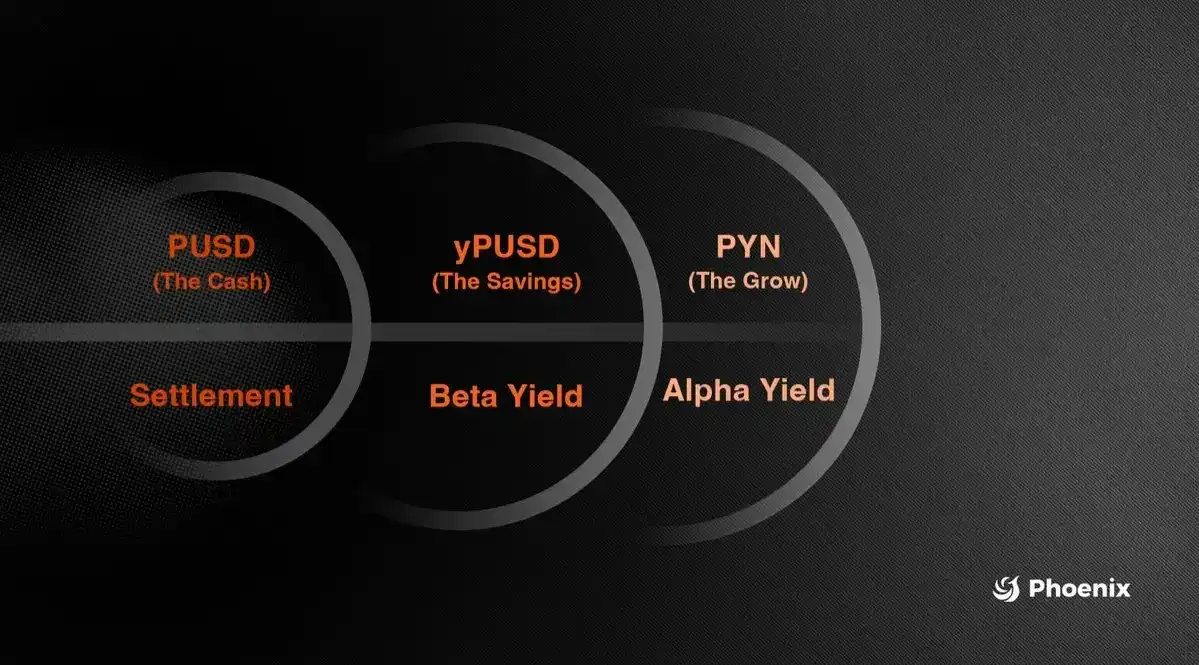
Phoenix plays the role of a"refinery", refining raw, non-standardized real-world yields - into DeFi-friendly standardized products:

PUSD(Settlement Layer): A unified cross-chain stablecoin. Without traditional bridges,PUSD enables inter-chain"instant transmission", with zero-friction circulation.

yPUSD(Base Yield Layer): Provides Beta yield, delivered through an auto-compounding exchange rate. The system smooths fragmented RWA repayments into a continuous yield curve; users gain value simply by holding,无需 manually claiming rewards.

PYN(Structured Yield Layer): Fixed-term NFT notes (7/31/89/181 days). Users lock liquidity to match specific RWA maturities (e.g., structured credit cycles), thereby earning an Alpha premium. This is equivalent to crypto-native principal tokens backed by real-world cash flows.

III. Core Engine: Mechanisms and Logic

1. Teleporter Mechanism (Teleporter): Unified Credit and Native Minting Traditional cross-chain bridges often rely on high-risk"lock-mint" models.Phoenix Teleporter operates as a unified credit protocol,它 maps users' collateral and credit status across chains, allowing for the direct native minting (Native Minting) of PUSD on the target chain. This means PUSD is a native asset on any chain, achieving zero fragmentation.

2. Dynamic Layered Reserve Stack (The Reserve Stack 80/15/5) Solvency is binary—either solvent or in default. To ensure the former, we employ a dynamic layering mechanism:

Liquidity Layer (80%): Composed of USDC/USDT and short-term U.S. Treasuries, ensuring users' ability to exit with rigid兑付 capability at any time.

Yield Layer (15%): Composed of high-rated private credit and structured RWA, serving as the core yield engine of the system.

Buffer Layer (5%): Protocol revenue acts as a"first-loss (First-loss)" layer,优先 absorbing risks before volatility is transmitted to users.

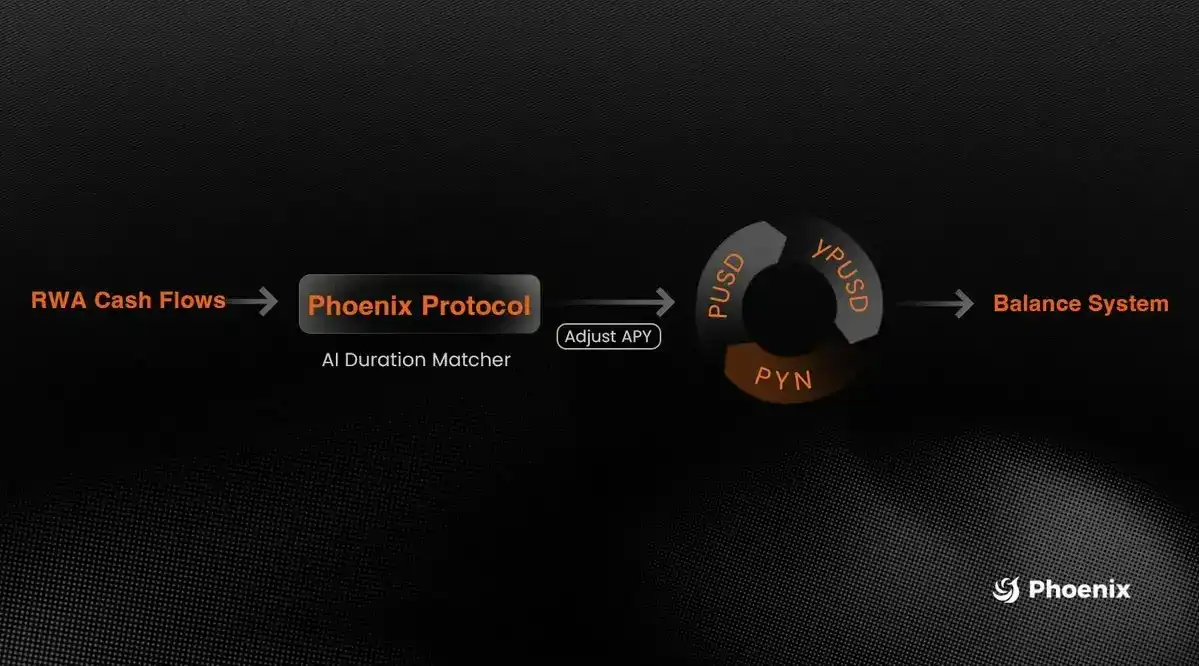
3.AI Controller (AI as Controller) Phoenix's AI is not used for price speculation but serves as a"cycle adapter" and"risk sentinel". When the system detects a mismatch between on-chain liquidity demand and off-chain asset maturity dates (e.g., rigid quarterly interest payments for RWA), theAI dynamically adjusts the APY for specific-term PYN (e.g., 89 day notes). This incentivizes users through market mechanisms to lock capital, precisely balancing the资产负债表.

IV. Transparency and Security Defenses

From Trust to Verification:

Proof of Reserve (Proof of Reserve): Real-time on-chain feeds of all underlying asset data.

Phoenix Hunters(Liquidation Network): An active defense network composed of whitelisted Keepers. When collateral value falls below the threshold,Hunters automatically bid at approximately 95% of the value, instantly clearing bad debt without waiting for lengthy governance processes.

Rejecting Black Boxes: Every bit of yPUSD yield comes from verifiable on-chain sources or audited SPVs.

RWA should not become a museum of assets.Phoenix is transforming it into a highly efficient on-chain economy.


Domande pertinenti

QWhat is the core problem that Phoenix Finance aims to solve in the RWA market?

APhoenix Finance aims to solve the structural mismatch in the RWA market, where $170 billion in on-chain RWA assets are fragmented, static, and disconnected from the high-speed circulation of DeFi. This includes issues like liquidity fragmentation across different blockchains, passive capital sitting idle in wallets, and a mismatch between the periodic yield payments of real-world assets and the block-by-block compound growth demanded by DeFi.

QWhat are the three main components of Phoenix's product matrix, and what role does each play?

AThe three main components are: 1) PUSD: A unified cross-chain stablecoin that acts as the settlement layer, enabling frictionless, 'instant transmission' across chains without traditional bridges. 2) yPUSD: The base yield layer that provides Beta returns through an auto-compounding exchange rate, converting fragmented RWA repayments into a continuous yield curve. 3) PYN: The structured yield layer, which are fixed-term NFT notes (7/31/89/181 days) that allow users to lock liquidity to match specific RWA maturity dates and earn Alpha premiums.

QHow does the 'Teleporter' mechanism differ from a traditional cross-chain bridge?

AUnlike traditional cross-chain bridges that rely on a high-risk 'lock-mint' model, the Teleporter acts as a unified credit protocol. It maps a user's collateral and credit status across different chains, allowing for the direct native minting of PUSD on the target chain. This means PUSD is a native asset on every chain, achieving zero fragmentation.

QDescribe the purpose and composition of the 'Dynamic Layered Reserve (80/15/5)'.

AThe Dynamic Layered Reserve Stack is designed to ensure solvency. It consists of: 1) Liquidity Layer (80%): Composed of USDC/USDT and short-term U.S. Treasury bonds to ensure rigid redemption capability for users. 2) Yield Layer (15%): Composed of high-grade private credit and structured RWA, serving as the system's core yield engine. 3) Buffer Layer (5%): Composed of protocol revenue, which acts as a 'first-loss' layer to absorb risks before they are passed on to users.

QWhat is the role of AI within the Phoenix system, and what specific problem does it address?

AThe AI acts as a 'cycle adapter' and 'risk sentinel,' not for price speculation. Its primary role is to detect and manage the mismatch between on-chain liquidity demand and the rigid payment schedules of off-chain RWA assets (e.g., quarterly interest payments). When a mismatch is detected, the AI dynamically adjusts the APY for specific PYN durations to incentivize users to lock their capital, thereby precisely balancing the system's资产负债表.

Letture associate

Anthropic Cries Wolf: Is the AGI Threat Real, or Just an IPO Story?

Anthropic has published an article titled "When AI builds itself," discussing the emerging concept of "recursive self-improvement," where AI begins to actively participate in designing, training, testing, and optimizing its own subsequent versions. The company presents internal data showing that by May 2026, over 80% of code merged into its codebase was written by Claude, its AI model. Claude's capabilities have expanded to handling complex, open-ended engineering tasks, achieving a 76% success rate in such areas, and even contributing to research processes, such as optimizing code performance and conducting AI safety experiments. Anthropic outlines an evolution from human-driven development to AI-assisted workflows, culminating in the current stage where AI agents can autonomously write, run, and delegate code. The company cautions that the path toward a "closed loop," where AI continuously improves itself, is becoming visible. It calls for coordinated global mechanisms to potentially slow or pause frontier AI development to allow safety research and societal structures to catch up. However, the timing of this warning coincides with Anthropic's preparations for an IPO, framing the narrative not just as a safety concern but also as a demonstration of Claude's advanced capabilities and its integral role in accelerating Anthropic's own R&D—creating a potential "flywheel" effect for competitive advantage. This contrasts with OpenAI's recent, more policy-oriented discussion of the same risks, highlighting the competitive dynamics in the AI industry as companies position themselves in both the technological and regulatory landscape.

marsbit45 min fa

Anthropic Cries Wolf: Is the AGI Threat Real, or Just an IPO Story?

marsbit45 min fa

BIT Research: ETF Purchases Have Slowed, Strategy (MicroStrategy) Has Slowed, What Else Can Drive Bitcoin's Rise?

Market Refocus on Inflation and Rate Expectations Weighs on Bitcoin Currently, the market is in a phase of macro-repricing dominated by inflation and interest rate expectations. Bitcoin, which previously benefited from easy liquidity and low inflation, is seeing its core bullish drivers weaken. These drivers were market expectations for interest rate cuts and strong inflows from Bitcoin ETFs and institutions like MicroStrategy (referred to as "Strategy" in the text). The logic has shifted. Recent high inflation data (e.g., CPI hitting 3.8% in a May 2026 report) has caused the market to sharply reduce its rate cut expectations for 2025 and even price in potential hikes. This is a key constraint for Bitcoin, as it lacks cash flows and is highly sensitive to rate expectations. Concurrently, institutional capital flows have slowed significantly. Following the hot CPI data, Bitcoin ETFs saw accelerated outflows, with around $4.3 billion leaving over a period. MicroStrategy's ability to keep adding substantial Bitcoin to its balance sheet is also diminishing. Together, ETF and MicroStrategy holdings total roughly $110 billion, but their momentum as growth engines is cooling. In summary, Bitcoin's current pressure stems not from its own fundamentals but from a changing macro environment. As long as inflation stays elevated, Bitcoin is likely to remain in a consolidating phase. However, historically, inflation eventually peaks. Once it recedes and rate cut expectations rebuild, institutional capital could return, potentially fueling a new and more robust recovery phase for Bitcoin.

marsbit52 min fa

BIT Research: ETF Purchases Have Slowed, Strategy (MicroStrategy) Has Slowed, What Else Can Drive Bitcoin's Rise?

marsbit52 min fa

Earning 1000 Trillion in Half a Year, 'Pocketing' 20 Million per Capita: This Round of Wealth Creation in the Korean Stock Market is Unprecedented in Scale

The South Korean stock market is experiencing an unprecedented wealth surge in 2026, with household equity and fund asset values soaring by over 1,000 trillion KRW (~$730bn) year-to-date. This translates to an average per capita wealth increase of roughly 20 million KRW, fueled by a historic 109% rally in the KOSPI index. The boom is driven by three converging forces: an AI-driven semiconductor supercycle boosting giants like Samsung and SK Hynix; the government's "Value-Up" market reforms addressing long-standing corporate governance issues; and aggressive real estate regulations that have locked capital within financial markets, preventing profits from flowing back into property. This has triggered a wealth effect, boosting high-end consumption significantly. However, the gains are highly concentrated. The two semiconductor behemoths account for over half the index's value, but retail investors own relatively low stakes in them, systematically missing the biggest rallies. Wealth and consumption benefits are skewed towards luxury goods and imported cars, bypassing mainstream retail. Further risks stem from excessive leverage, with high trading volume in leveraged ETFs, and a market sentiment heavily reliant on the AI sector's fortunes and speculative rumors. While this cycle marks a potential shift from real estate to equities as a primary wealth generator for Koreans, its sustainability, amid structural imbalances and leverage, remains a critical test.

marsbit58 min fa

Earning 1000 Trillion in Half a Year, 'Pocketing' 20 Million per Capita: This Round of Wealth Creation in the Korean Stock Market is Unprecedented in Scale

marsbit58 min fa

Trading

Spot
Futures

Articoli Popolari

Come comprare F

Benvenuto in HTX.com! Abbiamo reso l'acquisto di Synfutures (F) semplice e conveniente. Segui la nostra guida passo passo per intraprendere il tuo viaggio nel mondo delle criptovalute.Step 1: Crea il tuo Account HTXUsa la tua email o numero di telefono per registrarti il tuo account gratuito su HTX. Vivi un'esperienza facile e sblocca tutte le funzionalità,Crea il mio accountStep 2: Vai in Acquista crypto e seleziona il tuo metodo di pagamentoCarta di credito/debito: utilizza la tua Visa o Mastercard per acquistare immediatamente SynfuturesF.Bilancio: Usa i fondi dal bilancio del tuo account HTX per fare trading senza problemi.Terze parti: abbiamo aggiunto metodi di pagamento molto utilizzati come Google Pay e Apple Pay per maggiore comodità.P2P: Fai trading direttamente con altri utenti HTX.Over-the-Counter (OTC): Offriamo servizi su misura e tassi di cambio competitivi per i trader.Step 3: Conserva Synfutures (F)Dopo aver acquistato Synfutures (F), conserva nel tuo account HTX. In alternativa, puoi inviare tramite trasferimento blockchain o scambiare per altre criptovalute.Step 4: Scambia Synfutures (F)Scambia facilmente Synfutures (F) nel mercato spot di HTX. Accedi al tuo account, seleziona la tua coppia di trading, esegui le tue operazioni e monitora in tempo reale. Offriamo un'esperienza user-friendly sia per chi ha appena iniziato che per i trader più esperti.

282 Totale visualizzazioniPubblicato il 2024.12.21Aggiornato il 2026.06.02

Come comprare F

Discussioni

Benvenuto nella Community HTX. Qui puoi rimanere informato sugli ultimi sviluppi della piattaforma e accedere ad approfondimenti esperti sul mercato. Le opinioni degli utenti sul prezzo di F F sono presentate come di seguito.

活动图片