Philippines’ fastest growing digital bank rolls out crypto services

cointelegraphPubblicato 2025-12-08Pubblicato ultima volta 2025-12-08

Introduzione

Philippines digital bank GoTyme, with 6.5 million customers, has introduced cryptocurrency services through a partnership with U.S. fintech firm Alpaca. Users can now buy and store 11 cryptocurrencies—including Bitcoin (BTC), Ether (ETH), Solana (SOL), and Polkadot (DOT)—via auto-conversion from Philippine pesos to USD within the GoTyme app. The service emphasizes simplicity and accessibility rather than advanced trading features. Launched in 2022 as a joint venture between Singapore’s Tyme Group and the Philippines’ Gokongwei Group, GoTyme allows new users to set up an account and debit card in under five minutes. The bank is planning expansion into Vietnam and Indonesia and is prioritizing customer growth over profitability until at least 2027. The Philippines ranks ninth globally in crypto adoption.

Philippines digital bank GoTyme, which has 6.5 million customers, has rolled out crypto services in the Philippines following a partnership with US fintech firm Alpaca.

A total of 11 crypto assets can now be bought and stored in GoTyme’s banking app via an auto conversion from the Philippine peso to USD, including Bitcoin (BTC), Ether (ETH), Solana (SOL), Polkadot (DOT) and a host of other altcoins.

It is unclear if the firm will offer more sophisticated trading services in the future; however, the focus appears to be on simplicity and ease of access.

“Our product focuses on simplicity and reliability, designed for people who want to buy crypto confidently without complicated technical analysis or managing multiple apps,” said GoTyme CEO Nate Clarke.
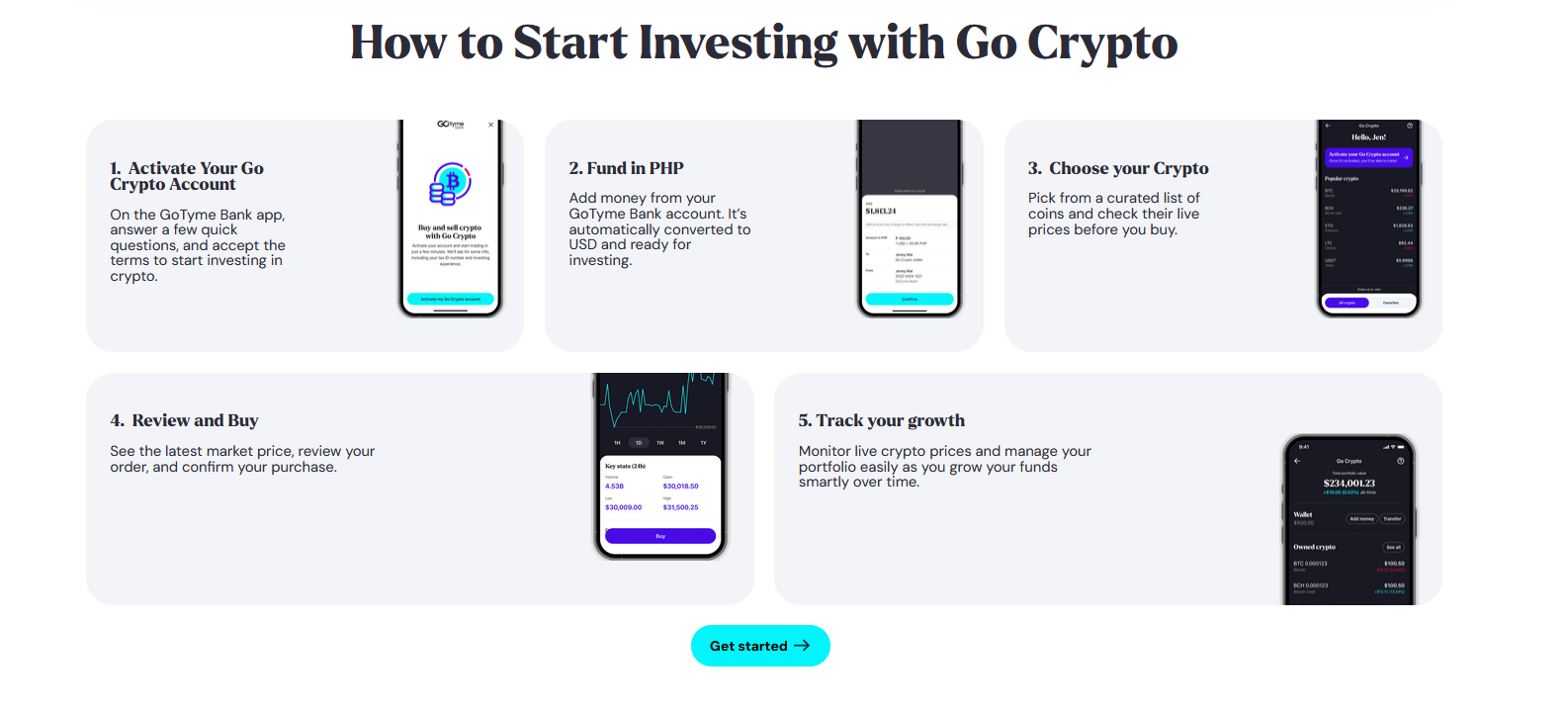
Process of buying crypto in the app. Source: GoTyme

GoTyme was launched in October 2022, with Nikkei Asia reporting in September that the bank has built up a client base of over 6.5 million people in the Philippines to date.

The digital bank was formed via a partnership between Singapore-based unicorn Tyme Group and Filipino conglomerate Gokongwei Group.

According to GoTyme’s website, the app is designed to enable users to set up a bank account and debit card within 5 minutes, suggesting users could have easy access to crypto.

GoTyme eyes growth in South East Asia

With plans to expand into Vietnam and Indonesia, the firm is looking to capture market share in the rapidly growing digital banking sector in Southeast Asia.

Related: French banking giant BPCE to launch in-app crypto trading: Report

In a recent article from the Digital Banker, Clarke stated that the bank is focused on scaling rapidly and won’t be eyeing profitability until 2027.

“We are very much still in a growth phase. We are not optimising for profitability at the moment. What matters to us is building a growing and engaged customer base,” Clarke said.

The Philippines is no lightweight in terms of crypto adoption, ranking ninth on Chainalysis’ 2025 Global Crypto Adoption Index Top 20, with the government weighing up a bill to create a strategic reserve with 10,000 BTC this year.

Magazine: Justin Sun’s SUI-farming sins, PEPE’s wild run, 3AC’s oyster philosophy: Asia Express


Letture associate

From MSTR to STRC+: Where Is the Limit of the Strategy Universe?

From MSTR to STRC+: The Evolution and Limits of the Strategy Universe This article examines the transformation of Strategy (formerly MicroStrategy) from a simple "Bitcoin treasury" company into a complex financial engineering firm building a BTC-backed credit system. **Core Thesis:** Strategy's true significance lies not just in its massive BTC holdings (~844k BTC), but in its attempt to transform this static reserve into a multi-layered credit curve within traditional capital markets and, subsequently, into on-chain yield infrastructure. **The MSTR Flywheel:** The initial model was a reflexive loop: BTC price rises → MSTR stock rises → company raises capital (debt/equity) at a premium → buys more BTC → increases per-share BTC exposure → MSTR premium grows. This "amplified Bitcoin" equity (MSTR) thrives on bullish momentum but is vulnerable to tightening premiums and rising funding costs. **Building the Credit Curve:** Strategy's innovation is slicing its single BTC balance sheet into different risk/return profiles via specialized securities: * **MSTR:** High-volatility equity layer absorbing full BTC upside/downside. * **STRC:** Key product. A perpetual preferred stock designed as "short duration high yield credit," offering ~11.5% floating monthly dividends. It attracts fixed-income investors seeking yield without direct BTC exposure, funding Strategy's operations. * **STRD/STRK/STRF:** Other preferred/share classes with varying durations, conversion rights, and fixed dividends. **Risks of the STRC Model:** STRC's high yield is not risk-free. Its stability depends on: 1) Sufficient BTC asset coverage, 2) Strategy's continued ability to pay dividends, and 3) Market faith in the MSTR/STRC funding flywheel. Stress points include deep BTC price declines eroding the asset buffer, rising dividend costs if STRC trades below par, and a broken flywheel if MSTR's premium (mNAV) falls persistently. **On-Chain Expansion: STRC+:** Projects like **Saturn** and **Apyx** aim to package STRC's (and other DAT preferred stock) cash flows into on-chain stablecoin yield (e.g., sUSDat, apyUSD). They offer DeFi a new yield source distinct from trading fees or incentives—cash dividends from traditional securities. However, this introduces compounded risks: off-chain custody, issuer credit risk, BTC volatility, and protocol execution risk. **Conclusion: The Ultimate Boundary** Strategy's endgame is not infinite BTC accumulation. It is the market's long-term acceptance of a new credit system where BTC serves as collateral for tradable securities whose cash flows can power on-chain financial applications. Its "universe" expands if this BTC-native credit curve gains legitimacy, but contracts if these instruments are repriced purely as high-risk, yield-bearing credit assets without stablecoin mythology.

marsbit4 min fa

From MSTR to STRC+: Where Is the Limit of the Strategy Universe?

marsbit4 min fa

Founder of Baixing.com: My Fourteen Claude Code Usage Experiences

Founder of Baixing.com Shares 14 Personal Tips for Using Claude Code The author outlines his personal, non-universal strategies for maximizing Claude Code. Key points include: focusing deeply on one primary tool (Claude Code) rather than constant comparison; mastering essential shortcuts for the editor and command line; utilizing voice input like HoldSpeak; starting projects with a structured PROJECT.md file; defaulting to Claude agents for most tasks; and leveraging integrations with GitHub and Cloudflare for build, deployment, and infrastructure. He emphasizes a clear separation between human and machine work: manually maintain a core CLAUDE.md file, and understand AI-generated content by asking the AI, not reading its raw code. Efficient communication involves dragging files (screenshots, audio, documents) directly into the interface. For knowledge management, he recommends a centralized, Git-synced memory system based on ~/.claude/CLAUDE.md to ensure permanence and avoid scattered project memories. Other practices include writing and continuously refining "Skills," using the expensive but reliable ultracode for complex dynamic workflows, and employing Git documentation as handoff points between agents. The overarching philosophy is to treat Claude Code like a horse (or a person) with its own pathfinding abilities—setting goals and boundaries rather than micromanaging every turn.

链捕手12 min fa

Founder of Baixing.com: My Fourteen Claude Code Usage Experiences

链捕手12 min fa

Gary Yang: Agent Economy and AI Submicroeconomics

**Title:** Agent Economy and AI Sub-Microeconomics - Gary Yang **Summary:** Following the AI singularity, the pace of evolution has accelerated rapidly, creating new generational disparities in technological advancement globally. While many regions are still grappling with single-agent bottlenecks, Silicon Valley has moved ahead into the next dimension: the Agent Economy and A2A ecosystems. The article outlines six key areas of this emerging paradigm: 1. **AI Payment Competition & H2A Bottlenecks:** A fierce battle for AI Agent payment protocol standards is underway (e.g., MPP, x402). However, most current efforts remain Human-to-Agent (H2A), essentially grafting AI onto traditional human-centric commerce, which creates a non-AI-native bottleneck. The true potential lies in Agent-to-Agent (A2A) autonomous economies. 2. **Agent Economy & the Inevitable A2A Trend:** The Agent Economy is defined by autonomous AI Agents creating, exchanging, and capitalizing value as independent economic actors. The A2A ecosystem describes their interactions. This represents the next major investment frontier, akin to the early days of e-commerce or DeFi, but with faster iteration and an AI-native, efficiency-first perspective that often diverges from human needs. 3. **AI Protocol vs. Crypto Protocol:** AI Protocols are the foundational rules for Agent interaction in an open network (communication, discovery, collaboration), akin to the governance and economic laws of the AI world. Currently, they focus on communication and weak boundaries, unlike Crypto Protocols which emphasize asset rights and clear ownership. While they appear different due to political-economic factors and legacy system constraints, their eventual convergence into a unified Digital Protocol system is seen as inevitable, driven by first principles. 4. **AI Agent Sub-Microeconomics & Biological Analogy:** AI Agent economics differ fundamentally from human economics: higher frequency/lower value transactions, energy/value direct correlation, efficiency-driven (not emotional) decisions, task-oriented (not consumption-oriented) behavior, and near-zero organizational/communication costs. A powerful analogy frames the Agent economy as a biological system: the LLM is the nucleus, the Agent harness is the cytoplasm, the Agent itself is a cell, its communication protocol is the cell membrane, and external tools (Skills, Prompts) are the extracellular environment. 5. **The Inevitability of AIFi & FinChip:** AIFi (AI Finance) represents the financial system where AI-native value within the Agent economy is tokenized and exchanged. Unlike TradFi/DeFi where value resides *in* finance, in AIFi, value originates *in* AI, and finance becomes its form. This shift is enabled by Agents taking over value discovery. FinChip (Financial Chip) is introduced as a key infrastructure—a fusion of AI autonomy and crypto smart contracts—forming intelligent financial assets to power the future A2A economy. 6. **AI-Native as a Paradigm Shift:** Adopting AI is not akin to "Internet+". It requires AI-Native thinking—designing systems based on first principles, the shortest energy-value path, and maximum efficiency. This abstract, counter-intuitive logic poses a significant, ongoing challenge for all practitioners, as effective, generalized upgrade methodologies will be slow to emerge in this rapidly evolving landscape.

链捕手53 min fa

Gary Yang: Agent Economy and AI Submicroeconomics

链捕手53 min fa

From 'The Big Short' to San Francisco: The Revelry and Dizziness Within the AI Bubble

From "The Big Short" to San Francisco: The Frenzy and Dizziness in the AI Bubble The article captures the intense, frenetic atmosphere in San Francisco, the epicenter of the current AI boom. Drawing a parallel to the "smell of money" from *The Big Short*, the author observes a city gripped by a singular status game centered entirely on AI and technology. This manifests in a palpable, caffeine-fueled anxiety ("people are shaking"), rampant comparison using vanity metrics like funding rounds, and pervasive "Big Bubble Behavior." The piece explores the city's stark contrasts: its dystopian streets versus beautiful vistas, and the disconnect between the doomsday concerns of some AI researchers and the optimistic, growth-focused "GTM" teams. It critiques the obsession with "math genius" founders as the new ticket to outsized returns, akin to scouting sports prodigies. Referencing economic historian Carlota Perez's "frenzy phase" and Karl Polanyi's "double movement," the author frames the boom as a period where financial speculation detaches from fundamentals, with society potentially becoming subordinate to a new economic force driven by "geniuses in data centers." Ultimately, while acknowledging the unprecedented wealth creation and party-like energy, the article concludes with cautionary advice: when the music is playing, you should dance, but don't get drunk. The core reminder is to stay grounded, avoid distorted judgment, and maintain perspective amidst the euphoria.

marsbit54 min fa

From 'The Big Short' to San Francisco: The Revelry and Dizziness Within the AI Bubble

marsbit54 min fa

Trading

Spot
Futures

Articoli Popolari

Cosa è $BANK

Banca AI: Un Passo Rivoluzionario nel Futuro della Banca Introduzione In un'era caratterizzata da rapidi progressi tecnologici, Banca AI si trova all'incrocio tra intelligenza artificiale (AI) e servizi bancari. Questo progetto innovativo mira a ridefinire il panorama finanziario, migliorando l'efficienza operativa, le misure di sicurezza e le esperienze dei clienti attraverso il potere dell'AI. Mentre ci impegniamo in questa esplorazione di Banca AI, esamineremo cosa comporta il progetto, le sue dinamiche operative, il suo contesto storico e i traguardi significativi. Cos'è Banca AI? Alla sua essenza, Banca AI rappresenta un'iniziativa trasformativa volta a integrare l'intelligenza artificiale in varie operazioni bancarie. Questo progetto sfrutta le capacità dell'AI per automatizzare processi, migliorare i protocolli di gestione del rischio e potenziare l'interazione con i clienti attraverso servizi personalizzati. Gli obiettivi principali di Banca AI includono: Automazione delle Funzioni Bancarie: Sfruttando le tecnologie AI, Banca AI mira ad automatizzare compiti di routine, riducendo il carico sulle risorse umane e aumentando l'efficienza. Miglioramento della Gestione del Rischio: Il progetto utilizza algoritmi AI per prevedere e identificare i rischi, rafforzando così le misure di sicurezza contro le frodi e altre minacce. Personalizzazione dei Servizi Bancari: Banca AI si concentra sull'offrire prodotti e servizi finanziari su misura analizzando i dati e i comportamenti dei clienti. Miglioramento dell'Esperienza del Cliente: L'implementazione di soluzioni guidate dall'AI, come chatbot e assistenti virtuali, mira a fornire agli utenti interazioni più umane, rivoluzionando il modo in cui i clienti si relazionano con le banche. Con questi obiettivi, Banca AI si posiziona come un attore cruciale nel rendere la banca più efficiente, sicura e centrata sull'utente. Chi è il Creatore di Banca AI? I dettagli riguardanti il creatore di Banca AI rimangono sconosciuti. Pertanto, non è stata identificata alcuna persona o organizzazione specifica nelle informazioni disponibili. L'anonimato che circonda la nascita del progetto solleva domande, ma non sminuisce la sua ambiziosa visione e obiettivi. Chi sono gli Investitori di Banca AI? Simile al creatore del progetto, informazioni specifiche riguardo gli investitori o le organizzazioni di supporto di Banca AI non sono state divulgate. Senza queste informazioni, è difficile delineare il sostegno finanziario e istituzionale che potrebbe spingere il progetto in avanti. Tuttavia, l'importanza di avere una solida base di investimento è fondamentale per sostenere lo sviluppo in un campo così innovativo. Come Funziona Banca AI? Banca AI opera su più fronti innovativi, concentrandosi su fattori unici che la differenziano dai framework bancari tradizionali. Di seguito sono riportate le caratteristiche operative chiave: Automazione: Applicando algoritmi di machine learning, Banca AI automatizza vari processi manuali all'interno delle banche. Ciò si traduce in una riduzione dei costi operativi e consente ai lavoratori umani di reindirizzare i propri sforzi verso attività più strategiche. Gestione Avanzata del Rischio: L'integrazione dell'AI nelle pratiche di gestione del rischio fornisce alle banche strumenti per prevedere con precisione potenziali minacce come le frodi, garantendo che le informazioni e i beni dei clienti rimangano al sicuro. Raccomandazioni Finanziarie Personalizzate: Attraverso l'apprendimento continuo dalle interazioni con i clienti, i sistemi AI sviluppano una comprensione sfumata delle esigenze degli utenti, consentendo loro di offrire consigli su misura per le decisioni finanziarie. Interazioni Migliorate con i Clienti: Utilizzando chatbot e assistenti virtuali alimentati dall'AI, Banca AI consente un'esperienza cliente più coinvolgente, permettendo agli utenti di risolvere rapidamente le loro richieste, riducendo così i tempi di attesa e migliorando i livelli di soddisfazione. Tutte queste caratteristiche operative posizionano Banca AI come un pioniere nel settore bancario, stabilendo nuovi standard per la fornitura di servizi e l'eccellenza operativa. Timeline di Banca AI Comprendere la traiettoria di Banca AI richiede uno sguardo al suo contesto storico. Di seguito è riportata una timeline che evidenzia traguardi e sviluppi importanti: Inizio 2010: La concettualizzazione dell'integrazione dell'AI nei servizi bancari ha cominciato a guadagnare attenzione mentre le istituzioni bancarie riconoscevano i potenziali benefici. 2018: Si è verificato un aumento significativo nell'implementazione delle tecnologie AI quando le banche hanno iniziato a utilizzare strumenti AI come i chatbot per servizi clienti di base e sistemi di gestione del rischio per migliorare la sicurezza. 2023: La sofisticazione dell'AI ha continuato ad avanzare, con l'introduzione dell'AI generativa per compiti più complessi come l'elaborazione di documenti e l'analisi degli investimenti in tempo reale. Quest'anno ha segnato un significativo salto nelle capacità offerte alle banche dalla tecnologia AI. 2024-Stato Attuale: A partire da quest'anno, Banca AI è su una traiettoria ascendente, con ricerche e sviluppi in corso pronti a migliorare ulteriormente le capacità nelle operazioni bancarie. L'esplorazione continua delle applicazioni AI suggerisce sviluppi entusiasmanti in arrivo. Punti Chiave su Banca AI Integrazione dell'AI nella Banca: Banca AI si concentra sull'adozione dell'intelligenza artificiale per snellire i processi bancari e migliorare le esperienze degli utenti. Focus su Automazione e Gestione del Rischio: Il progetto enfatizza fortemente queste aree, mirando a spostare il carico di compiti di routine mentre migliora le strutture di sicurezza attraverso analisi predittive. Soluzioni Bancarie Personalizzate: Sfruttando i dati dei clienti, Banca AI consente servizi bancari su misura che si adattano alle esigenze individuali degli utenti. Impegno per lo Sviluppo: Banca AI rimane impegnata in sforzi di ricerca e sviluppo continuativi, garantendo la sua adattabilità e rilevanza continua man mano che la tecnologia continua a evolversi. Conclusione In sintesi, Banca AI rappresenta un passo cruciale in avanti nell'industria bancaria, sfruttando l'intelligenza artificiale per rimodellare i paradigmi operativi, migliorare la sicurezza e promuovere la soddisfazione del cliente. Nonostante le lacune nelle informazioni riguardo il creatore e gli investitori, gli obiettivi chiari e i meccanismi funzionali di Banca AI forniscono una solida base per la sua continua evoluzione. Mentre la tecnologia AI continua ad avanzare e fondersi con il settore bancario, Banca AI è ben posizionata per avere un impatto significativo sul futuro dei servizi finanziari, migliorando il modo in cui comprendiamo e interagiamo con la banca.

107 Totale visualizzazioniPubblicato il 2024.04.06Aggiornato il 2024.12.03

Cosa è $BANK

Come comprare BANK

Benvenuto in HTX.com! Abbiamo reso l'acquisto di Lorenzo Protocol (BANK) semplice e conveniente. Segui la nostra guida passo passo per intraprendere il tuo viaggio nel mondo delle criptovalute.Step 1: Crea il tuo Account HTXUsa la tua email o numero di telefono per registrarti il tuo account gratuito su HTX. Vivi un'esperienza facile e sblocca tutte le funzionalità,Crea il mio accountStep 2: Vai in Acquista crypto e seleziona il tuo metodo di pagamentoCarta di credito/debito: utilizza la tua Visa o Mastercard per acquistare immediatamente Lorenzo ProtocolBANK.Bilancio: Usa i fondi dal bilancio del tuo account HTX per fare trading senza problemi.Terze parti: abbiamo aggiunto metodi di pagamento molto utilizzati come Google Pay e Apple Pay per maggiore comodità.P2P: Fai trading direttamente con altri utenti HTX.Over-the-Counter (OTC): Offriamo servizi su misura e tassi di cambio competitivi per i trader.Step 3: Conserva Lorenzo Protocol (BANK)Dopo aver acquistato Lorenzo Protocol (BANK), conserva nel tuo account HTX. In alternativa, puoi inviare tramite trasferimento blockchain o scambiare per altre criptovalute.Step 4: Scambia Lorenzo Protocol (BANK)Scambia facilmente Lorenzo Protocol (BANK) nel mercato spot di HTX. Accedi al tuo account, seleziona la tua coppia di trading, esegui le tue operazioni e monitora in tempo reale. Offriamo un'esperienza user-friendly sia per chi ha appena iniziato che per i trader più esperti.

687 Totale visualizzazioniPubblicato il 2025.05.09Aggiornato il 2026.06.02

Come comprare BANK

Discussioni

Benvenuto nella Community HTX. Qui puoi rimanere informato sugli ultimi sviluppi della piattaforma e accedere ad approfondimenti esperti sul mercato. Le opinioni degli utenti sul prezzo di BANK BANK sono presentate come di seguito.

活动图片