Perspective: Tokens on alt.fun are double-layered leverage

marsbitPubblicato 2026-05-18Pubblicato ultima volta 2026-05-18

Introduzione

**Title:** Tokens on alt.fun are Double-Layered Leverage **Summary:** Tokens on alt.fun (like ALT) are not simple 5x leveraged bets on HYPE. Instead, they represent a **double layer of leverage**. The core mechanism involves HyperSwap V2 pools. After "graduation," these tokens are paired not with USDC, but with **HYPE5L**—a 5x long leverage token (LT) issued by BounceTech that tracks HYPE. Therefore, an alt.fun token's price in USDC is determined by multiplying two independent factors: 1. **AMM Exchange Rate:** The pool's ratio between the alt token and HYPE5L, driven by trading activity on alt.fun. 2. **LT Net Asset Value (NAV):** HYPE5L's value, which moves at approximately 5x the daily return of HYPE. This creates a compounding effect: * If HYPE rises 1%, HYPE5L's NAV rises ~5%. Profit-taking HYPE5L holders may then buy alt tokens, increasing demand and pushing the AMM exchange rate higher. The alt token's total gain thus exceeds 5%, potentially reaching 8-15%. * Conversely, if HYPE falls, losses are amplified beyond 5x due to combined NAV decline and AMM selling pressure. During crashes, large sell orders may fail due to non-atomic redemption paths, potentially trapping later sellers. In contrast, platforms like pump.fun pair tokens with stable assets like SOL, applying only the AMM amplifier to a 1x underlying asset. Alt.fun's use of a pre-leveraged quote asset (HYPE5L) fundamentally shifts the risk profile, creating a **second-order product with floating, of...

Author:798.eth

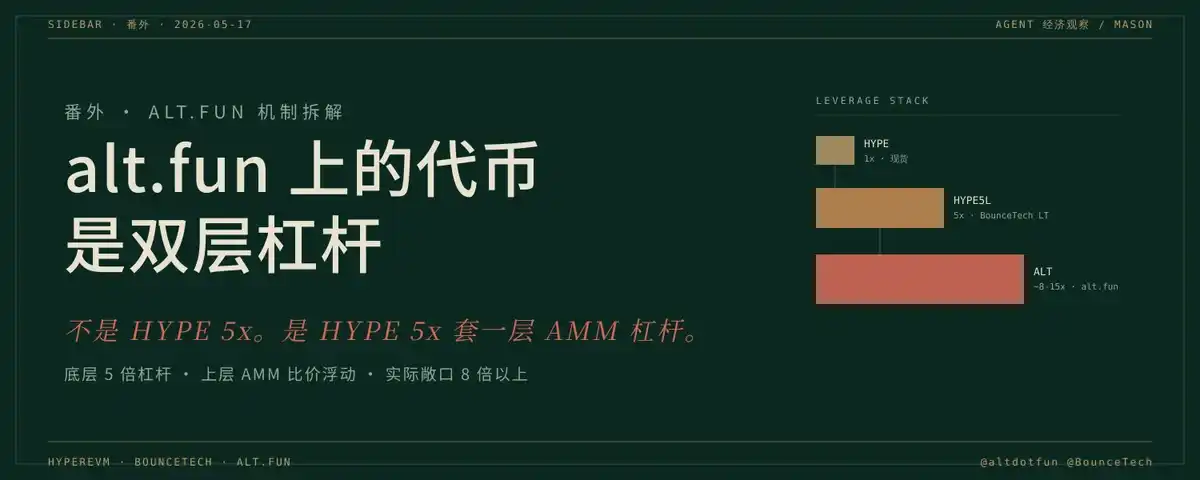
The alt tokens on alt.fun are not 5x leverage on HYPE. They are 5x leverage on HYPE with an additional layer of AMM leverage stacked on top.

This isn't obvious intuitively. You'll understand after reviewing the mechanism. First, let's look at current data for reference.

HYPE spot price is 42.84 USDC.

HYPE5L (the HYPE 5x long leverage token LT issued by BounceTech) has a current NAV of 0.870 USDC, which is a 13% decay from its issue price of 1 USDC.

In the HyperSwap V2 pool for the alt.fun flagship token ALT, there are 18.58 million ALT tokens and 129,400 HYPE5L tokens. 1 ALT equals 0.00697 HYPE5L. Converted to USDC price, that's 0.00606. The USDC price of ALT is the product of two things.

Note: After graduation, the pool contains no USDC; the paired asset is HYPE5L LT. This is the starting point for all understanding.

ALT's USDC price = The exchange rate of ALT to HYPE5L in the pool multiplied by HYPE5L's current NAV.

The first factor is the AMM price ratio. The fewer ALT and more HYPE5L in the pool, the higher the ratio, meaning ALT is more expensive. The opposite makes it cheaper. This factor is determined by buy/sell pressure and is unrelated to the HYPE price.

The second factor is the LT's Net Asset Value. When HYPE rises 1%, HYPE5L's NAV rises approximately 5%, and vice versa. This factor is determined by BounceTech's actual perp position on Hyperliquid and is unrelated to trading activity on alt.fun.

These two factors are independent. Multiply them together to get ALT's final USDC price.

Why this constitutes double-layered leverage.

HYPE rises 1%.

The second layer (LT) amplifies it to 5%. HYPE5L NAV rises 5%.

The first layer (AMM) will amplify further. When HYPE5L rises, holders who are making money may go to alt.fun to buy more alt tokens (leveraged exposure plus alt narrative exposure). This buying increases HYPE5L in the pool and decreases ALT, causing the AMM price ratio to rise. The same 1% HYPE increase is amplified once more in the AMM layer.

Ultimately, ALT's USDC price increase will likely be between 8% and 15%, depending on AMM pool depth and buying intensity. But it will always be greater than 5%.

The same logic applies in reverse when the price falls. If HYPE falls 1%, HYPE5L falls 5%, alt holders see amplified losses, and some start selling ALT for HYPE5L to redeem. Selling pressure pushes down the AMM price ratio, likely causing ALT's USDC price to fall between 8% and 15%.

When falling, there's also an asymmetric effect. The alt.fun docs themselves warn that large sell orders may revert due to the path not being atomic (the path from alt to HYPE5L to USDC redemption; if the order is large, the LT redemption on BounceTech's side can't handle it). This means when the pool is thin, retail investors wanting to stop losses can't. The first ones out sell at high prices, later ones at lower prices, and those after get stuck in the contract.

The five alt tokens backed by HYPE5L—ALT, HBULL, HYPE Life, BALD, HLC—are now all graduated. Every trade they make on HyperSwap V2 moves the AMM price ratio. Simultaneously, the HYPE price moves the HYPE5L NAV. The two layers stack.

HYPE5L is an LT issued by BounceTech. Theoretically 5x exposure, but due to frequent rebalancing, it suffers from volatility decay. In ranging markets, actual exposure is less than 5x; in trending markets, it's more than 5x.

So when you open the alt.fun UI and see an alt token labeled "HYPE 5x Long," the USDC price displayed in the UI is the result of the HYPE price being amplified by BounceTech's 5x leverage, then amplified again by the HyperSwap V2 AMM. You think you're buying 5x exposure to HYPE, but you're actually buying a floating exposure of 8x to 15x.

This floating exposure makes you earn much more than 5x when prices rise, and lose much more than 5x when prices fall. This is the full meaning of double-layered leverage.

Comparing with pump.fun makes it clearer.

Tokens on pump.fun are paired with SOL. SOL is a 1x exposure spot asset. If SOL falls 10%, a pump.fun token's USDC price falls 10% plus the AMM selling pressure, roughly 15% to 25%. The AMM is an amplifier, but the underlying asset has no leverage.

Tokens on alt.fun are paired with HYPE5L. HYPE5L is already a 5x exposure derivative. If HYPE falls 10%, HYPE5L falls 50%, and an alt token's USDC price falls 50% plus the AMM selling pressure, roughly 60% to 80%. The AMM is an amplifier, but the underlying asset itself already carries 5x leverage.

Both are launchpads, both use AMM pairing, but alt.fun, by changing the quote asset, pulls the overall risk curve to a completely different magnitude. This is not prominently highlighted anywhere on the alt.fun UI.

A final word for retail investors.

You open alt.fun, see a token labeled "HYPE 5x Long," and intuitively think this is 5x leveraged exposure to HYPE. That intuition is wrong.

The underlying leverage is 5x. The AMM layer adds another 1x to 2x of floating exposure. In trending markets, you outperform 5x by a lot. In ranging markets, volatility decay eats away at you. During a crash, large sells won't go through; early sellers exit at high prices, later ones get stuck in the contract.

This is not HYPE 5x long. It's a second-order product: HYPE 5x long wrapped in a layer of AMM leverage.

Not investment advice, just trying to figure things out clearly.

Domande pertinenti

QAccording to the author, why is the alt token on alt.fun considered a double-layer leverage?

AThe author explains that the alt token is backed by HYPE5L (a 5x leveraged token) in its liquidity pool. This creates a two-layer effect: First, HYPE5L provides ~5x exposure to HYPE's price movements. Second, buying and selling pressure on the alt.fun AMM further amplifies the alt token's price relative to HYPE5L's NAV. This results in a total leverage that fluctuates, often between 8x to 15x, rather than a fixed 5x.

QWhat are the two independent factors that determine the USDC price of an alt token like ALT on alt.fun?

A1) The AMM exchange rate: The ratio between the alt token (e.g., ALT) and its paired asset (HYPE5L) in the HyperSwap V2 pool. This rate changes based on trading activity on alt.fun. 2) The NAV (Net Asset Value) of HYPE5L: The underlying value of the 5x leveraged token from BounceTech, which moves based on HYPE's price on Hyperliquid. The final USDC price is the product of these two factors.

QHow does the risk profile of an alt.fun token differ from a pump.fun token, according to the article?

AThe article states that pump.fun tokens are paired with SOL, which has 1x spot exposure. A drop in SOL leads to a drop in the token's USDC price plus AMM selling pressure. In contrast, alt.fun tokens are paired with HYPE5L, a 5x leveraged derivative. Therefore, a drop in HYPE leads to a magnified drop in HYPE5L's NAV (e.g., -50% for a -10% HYPE move), which is then further amplified by AMM selling pressure on alt.fun. This results in a significantly higher risk profile for alt.fun tokens.

QWhat potential issue does the article highlight for users trying to sell their alt tokens during a market downturn?

AThe article points out an asymmetric risk during downturns. Large sell orders may fail (revert) because the exit path is not atomic: selling alt for HYPE5L and then redeeming HYPE5L for USDC. If the sell pressure is high, BounceTech's redemption mechanism for the leveraged token (LT) might not be able to handle it. This means early sellers get out at a higher price, later sellers at a lower price, and some users may get stuck in the contract, unable to sell at all.

QWhat misconception does the author warn retail users about regarding the 'HYPE 5x Long' label on alt.fun?

AThe author warns that the intuitive understanding of a 'HYPE 5x Long' token is incorrect. It is not simply a 5x leveraged exposure to HYPE. Instead, it is a second-order product: a 5x leveraged token (HYPE5L) wrapped with an additional layer of variable leverage from the alt.fun AMM dynamics. The actual leverage fluctuates, often exceeding 5x, which is not clearly communicated on the platform's user interface.

Letture associate

A Nation Blocks Chips, a Giant Buys a Nuclear Power Plant: Why It's Time to Seriously Consider DeAI

**Title: Great Powers Blockade Chips, Giants Buy Nuclear Plants: Why It's Time to Seriously Consider DeAI** In May 2026, the US closed loopholes for Chinese firms to acquire advanced NVIDIA chips via overseas subsidiaries. That same month, Kenya halted a $1B geothermal data center project involving Microsoft, fearing its immense energy consumption. Meanwhile, Huawei announced mass production of its Ascend AI chip. These disparate events underscore a new reality: the competition for computing power ("compute") has escalated beyond the tech industry, becoming a geopolitical and infrastructural battleground. A new era of oligopoly is forming, with control over the AI stack—from GPU chips (NVIDIA) and cloud platforms (AWS, Azure, Google Cloud) to foundational models (OpenAI, Anthropic)—concentrating in a few Western "AI Octopus" corporations. This centralization creates systemic risks: pricing power and platform lock-in for users, infrastructure fragility, and a widening "compute divide" that threatens to marginalize nations without independent AI capacity. An "AI Iron Curtain" is deepening through export controls. In response, some nations like Saudi Arabia and the UAE are investing heavily to buy compute power, aiming to transition from oil to AI economies. The EU seeks to triple its compute capacity by 2030 to reduce dependency. However, the spending gap is vast, with four US tech giants alone planning ~$750B in AI capex for 2026. The race is increasingly constrained by energy, with AI tasks consuming up to 1000x more power than web searches, pushing firms to even acquire nuclear plants. This landscape is fueling interest in Decentralized AI (DeAI). It proposes a third way: using open protocols to coordinate a global network of idle GPUs, independent developers, and data centers, creating an AI infrastructure without a single controlling entity. Leveraging blockchain and cryptographic verification, DeAI aims to break market concentration, disperse energy demands, reduce geopolitical dependencies, and enhance transparency. While still nascent in performance and stability, DeAI's core promise is not immediate superiority but providing a crucial alternative architecture to resist monopoly, censorship, and centralized power. As specialized AI hardware costs fall and open-source models flourish, the window to build this foundation is open. The very existence of such competition serves as a vital check against the inevitable abuse of concentrated power.

marsbit8 min fa

A Nation Blocks Chips, a Giant Buys a Nuclear Power Plant: Why It's Time to Seriously Consider DeAI

marsbit8 min fa

Outpoll Review: A Prediction Market Platform Built for Active Traders

Outpoll Review: A Prediction Market Platform Built for Active Traders In recent years, prediction markets have grown from a niche sector to a mainstream arena, attracting billions in trading volume and institutional capital. However, the user experience and tools for traders have not kept pace. Outpoll, a new global prediction market platform, aims to fill this gap by providing enhanced trading infrastructure for active and professional traders. Built on standard prediction market principles, Outpoll allows users to trade on the outcome of specific events. It uses fully collateralized contracts with USDC settlement, charges a competitive 0.1% fee per trade, and provides clear settlement rules upfront to minimize disputes. A key focus for Outpoll is its professional-grade trading tools. The platform supports limit and market orders, as well as take-profit and stop-loss orders for open positions—features uncommon in prediction markets. For automated trading, Outpoll offers comprehensive REST and WebSocket APIs, enabling portfolio management, price arbitrage, and integration with existing tools. The platform also features a creator-led market model, where approved experts and community leaders can create and manage markets for niche topics under platform supervision. Its integrated interface combines news feeds directly with trading functions, allowing users to monitor events and manage positions seamlessly. Outpoll launched with a native Android app (available on Google Play) and plans an iOS version later this year. In summary, Outpoll distinguishes itself with trader-focused tools, practical APIs, transparent and collateralized markets, integrated news, and an expanding creator program. For active traders, its advanced order types and API access alone make it a platform worth watching. Outpoll is now globally accessible via outpoll.com and Google Play.

marsbit17 min fa

Outpoll Review: A Prediction Market Platform Built for Active Traders

marsbit17 min fa

Bitwise: Crypto Becomes a Contrarian Investment, Three Logics to Understand the Current Market

**Summary** Matt Hougan, Bitwise's CIO, analyzes the current crypto market through three key lenses, arguing it has shifted from a momentum-driven to a contrarian investment. **1) Crypto Becomes a Contrarian Play:** The market is weak, with major assets like Bitcoin and Ethereum down significantly. Capital has moved to hot sectors like AI, leaving crypto as an "unloved" asset class. This transforms crypto investing from trend-following to a test of patience and fundamental analysis. Investors now favor projects with solid fundamentals (e.g., Hyperliquid) over speculative ones. **2) Regulatory Overhang:** The uncertain fate of the U.S. CLARITY Act, a major crypto regulatory framework, is a key headwind. With its passage in 2024 seen as far from guaranteed (estimates range from 30-55%), institutional capital remains on the sidelines, choosing less risky alternatives like AI stocks. The market needs clarity—whether the bill passes or fails—more than any specific outcome to move decisively. **3) Capital Rotates to New Fundamentals:** This cycle differs from past bear markets where money fled to Bitcoin. Now, capital seeks smaller assets with strong use cases. While major cryptos fell in May 2024, tokens like Hyperliquid (+72%), Zcash (+50%), and XLM (+44%) rallied on their specific fundamentals. This rotation confirms the new contrarian, fundamentals-driven logic and signals the bear market may be in its later stages. **Conclusion:** Short-term pressure persists due to regulatory uncertainty and competition from AI narratives. Investing in crypto now requires a contrarian mindset—acting against the crowd and focusing on fundamental value. Patience and targeting high-quality projects based on their merits are essential for capturing long-term gains.

marsbit59 min fa

Bitwise: Crypto Becomes a Contrarian Investment, Three Logics to Understand the Current Market

marsbit59 min fa

ChatGPT Might Be Disappearing Soon

OpenAI announced at its "Intelligence at Work" event that its coding assistant, Codex, will be fully integrated into the ChatGPT app within weeks. This move marks a strategic shift from a conversational AI (Chat) towards a unified "agentic" platform capable of execution. Codex, originally launched to compete with Anthropic's Claude Code, has grown rapidly to 5 million weekly active users, with 20% being non-developers like analysts and designers. Its enterprise revenue now constitutes 40% of OpenAI's total. The integration is the first step in creating a super-app combining ChatGPT (interface), Codex (execution engine), and the Atlas browser (web access). OpenAI also unveiled new Codex features: specialized Agent plugins for six professional roles, an "Annotations" tool for direct document editing, and a "Sites" function to turn work into shareable web apps. Internally, this reflects a power shift; the Codex team now leads core product strategy. While the ChatGPT brand remains for its vast user base, the platform's future is focused on autonomous agents that perform tasks, not just chat. The article notes that competition with Claude Code pushed OpenAI's development, with Codex competing on cost-effectiveness and accessibility rather than raw coding quality. It concludes that the essence of "ChatGPT" is evolving from a chatbot into an AI agent platform, with the name potentially becoming a legacy symbol of its original function.

marsbit1 h fa

ChatGPT Might Be Disappearing Soon

marsbit1 h fa

Trading

Spot
Futures

Articoli Popolari

Come comprare HYPE

Benvenuto in HTX.com! Abbiamo reso l'acquisto di Hyperliquid (HYPE) semplice e conveniente. Segui la nostra guida passo passo per intraprendere il tuo viaggio nel mondo delle criptovalute.Step 1: Crea il tuo Account HTXUsa la tua email o numero di telefono per registrarti il tuo account gratuito su HTX. Vivi un'esperienza facile e sblocca tutte le funzionalità,Crea il mio accountStep 2: Vai in Acquista crypto e seleziona il tuo metodo di pagamentoCarta di credito/debito: utilizza la tua Visa o Mastercard per acquistare immediatamente HyperliquidHYPE.Bilancio: Usa i fondi dal bilancio del tuo account HTX per fare trading senza problemi.Terze parti: abbiamo aggiunto metodi di pagamento molto utilizzati come Google Pay e Apple Pay per maggiore comodità.P2P: Fai trading direttamente con altri utenti HTX.Over-the-Counter (OTC): Offriamo servizi su misura e tassi di cambio competitivi per i trader.Step 3: Conserva Hyperliquid (HYPE)Dopo aver acquistato Hyperliquid (HYPE), conserva nel tuo account HTX. In alternativa, puoi inviare tramite trasferimento blockchain o scambiare per altre criptovalute.Step 4: Scambia Hyperliquid (HYPE)Scambia facilmente Hyperliquid (HYPE) nel mercato spot di HTX. Accedi al tuo account, seleziona la tua coppia di trading, esegui le tue operazioni e monitora in tempo reale. Offriamo un'esperienza user-friendly sia per chi ha appena iniziato che per i trader più esperti.

264 Totale visualizzazioniPubblicato il 2024.12.11Aggiornato il 2026.06.02

Come comprare HYPE

Discussioni

Benvenuto nella Community HTX. Qui puoi rimanere informato sugli ultimi sviluppi della piattaforma e accedere ad approfondimenti esperti sul mercato. Le opinioni degli utenti sul prezzo di HYPE HYPE sono presentate come di seguito.

活动图片