Pantera, Coinbase back Surf’s $15M push to build crypto-native AI models

cointelegraphPubblicato 2025-12-10Pubblicato ultima volta 2025-12-10

Introduzione

Surf, an AI platform for digital-asset analysis, has raised $15 million in a funding round led by Pantera Capital, with participation from Coinbase Ventures and DCG. The funds will support the development of Surf 2.0, which includes more advanced AI models, expanded proprietary data sets, and new agents for multi-step analytical tasks. Since its July launch, Surf has generated over one million research reports and achieved significant annual recurring revenue, serving major exchanges and research firms. Its multi-agent architecture analyzes onchain data, market behavior, and social sentiment through a chat interface, reducing manual workloads. The article also notes the growing convergence of AI and crypto, citing recent funding rounds for AI startups like Nous Research and Catena Labs, as well as Coinbase’s AI tool “Based Agent.” Additionally, a “human vs AI” trading competition hosted by Asterdex is currently underway, with human traders leading in returns as of mid-December.

Surf, an AI platform built for digital-asset analysis, raised $15 million in a round led by Pantera Capital with participation from Coinbase Ventures and DCG, to expand its AI models and enterprise tools.

The company offers a domain-specific model used by exchanges and research companies to analyze onchain activity, market behavior and sentiment. The funding will go toward Surf 2.0, which will introduce more advanced models, broader proprietary data sets and additional agents designed to handle multi-step analytical tasks.

Surf said its platform has seen rapid uptake since its launch in July, generating more than one million research reports and claiming millions in annual recurring revenue, with usage from a large share of major exchanges and research firms.

Surf’s model uses a multi-agent architecture that evaluates onchain data, social sentiment and token activity, delivering its analysis through a chat interface for research and reducing manual workloads for analysts and traders.

Related: How to turn ChatGPT into your personal crypto trading assistant

The continued integration of AI and digital assets

Artificial intelligence and blockchain are increasingly intersecting as more companies develop tools that leverage both technologies.

In April, decentralized AI startup Nous Research closed a $50 million Series A round led by Paradigm. The company is developing open-source AI models powered by decentralized infrastructure and uses the Solana blockchain to coordinate and incentivize global participation in training.

In May, Catena Labs, led by Circle co-founder Sean Neville, announced it had raised $18 million to develop a bank built around native AI infrastructure. The company said the system will be designed for both AI agents and human contributors, with AI handling day-to-day operations under human supervision.

In October, Coinbase introduced “Based Agent,” a tool that lets users create an AI agent with an integrated crypto wallet in just a few minutes to perform onchain actions such as trading, swapping, and staking.

As crypto and AI continue to converge, the role of human traders may also be shifting. The decentralized exchange Aster is running a “human vs AI” trading showdown, funding up to 100 human traders with $10,000 each to compete against top-performing AI agents Dec. 9–23.

Though the competition still has 13 days to go, Team Human was in the lead as of Wednesday, with a return on investment (ROI) of 13.36% compared to Team AI’s ROI of 0.54%.
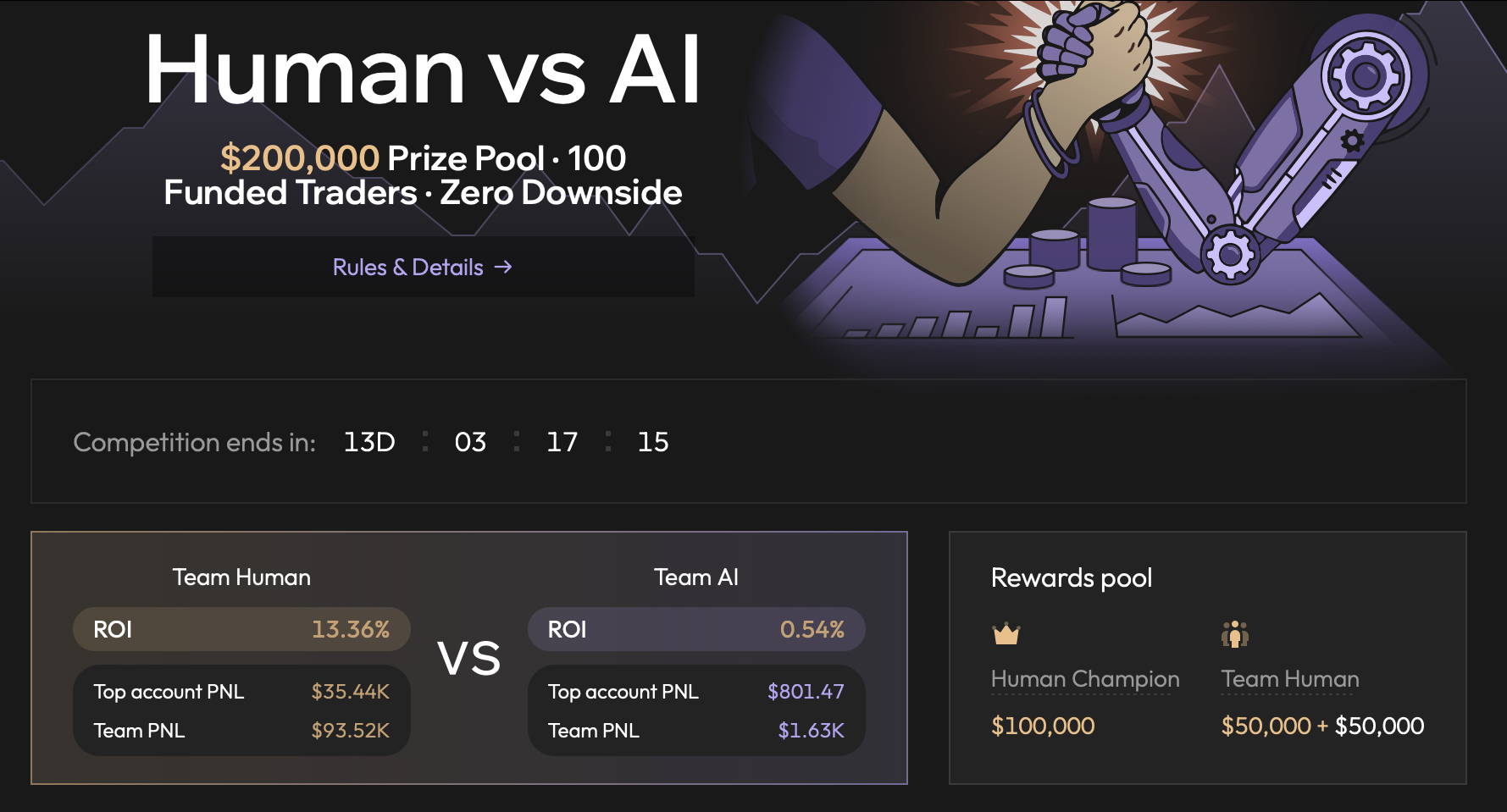
Human vs. AI trading scoreboard. Source: Asterdex.com

Magazine: Quantum attacking Bitcoin would be a waste of time: Kevin O’Leary

Letture associate

Central Bank Responds to Call to 'Exit the Sandbox' and Allows Stablecoins

Sberbank CEO Herman Gref expressed the bank's hope for the authorization of stablecoins for domestic transactions in Russia, stating that Sber is actively discussing this possibility with the Bank of Russia. He emphasized the need to move beyond the current regulatory "sandbox" and allow basic transactional functionality with stablecoins, primarily ruble-denominated tokens for internal use. However, the Bank of Russia maintains its position that stablecoins are a form of cryptocurrency and excludes their use for domestic payments. Kirill Pronin, head of the central bank's financial market infrastructure department, argued that Russia's digital payment ecosystem is already highly developed, making such authorization unnecessary. The article notes that Russia currently operates with Digital Financial Assets (DFAs), which are tokenized versions of real assets issued on approved blockchain platforms. Some foreign digital rights, including compliant stablecoins, can be classified as DFAs. The first such recognized asset was a Kyrgyzstani ruble stablecoin, permitted only for foreign economic activity. Pronin also mentioned that the central bank is considering allowing banks and token issuers to directly issue digital assets in public blockchains, as the current method of transferring domestically issued tokens to open networks has not gained significant traction. This shift could reduce operational costs and cybersecurity risks.

RBK-crypto10 min fa

Central Bank Responds to Call to 'Exit the Sandbox' and Allows Stablecoins

RBK-crypto10 min fa

17 Most Anticipated Things in the Cryptocurrency Space in 2026

17 Key Crypto Developments to Watch in 2026 Stablecoin on/off ramps will mature, connecting digital dollars to local payment systems and enabling new behaviors like real-time cross-border payments and merchant adoption without bank accounts. Stablecoins will evolve into a foundational internet settlement layer. RWA tokenization will shift toward crypto-native approaches like perpetual futures for deeper liquidity. Stablecoins will see more native issuance rather than tokenization, and on-chain native debt issuance will reduce costs and improve accessibility. Banks will leverage stablecoins to innovate without overhauling legacy systems. The internet itself will become a banking layer as value moves programmatically via smart contracts and new primitives like x402. Wealth management will become personalized and automated for everyone via tokenized assets and AI-driven portfolio management. DeFi tools and tokenized private markets will expand access. AI agents will require identity verification (KYA - Know Your Agent) and new economic models to compensate content creators as agents scrape the open web. AI will also enable new research methodologies via layered, reasoning agents. Privacy will become crypto's key moat, creating strong network effects as bridging between private and public chains risks metadata leakage. Decentralized, quantum-resistant messaging will rise, emphasizing user ownership. "Secrets-as-a-service" will emerge for programmable data access control. DeFi security will evolve from "code is law" to "specification is law" with runtime enforcement of invariants. Prediction markets will expand with more contracts, AI-powered oracles, and decentralized governance. "Staked media" will rise, where commentators back arguments with verifiable, on-chain commitments. SNARKs will become efficient enough (~10,000x overhead) for verifiable cloud computing, moving beyond blockchain. Finally, crypto market structure regulation could align legal and technical frameworks, enabling networks to operate as truly open, decentralized systems.

marsbit11 min fa

17 Most Anticipated Things in the Cryptocurrency Space in 2026

marsbit11 min fa

Trading

Spot
Futures
活动图片