P2P team admits to betting on its own raise days after Polymarket tightened insider trading rules

ambcryptoPubblicato 2026-03-27Pubblicato ultima volta 2026-03-27

Introduzione

P2P, a crypto project, has admitted that its team placed bets on Polymarket regarding the outcome of its own $6 million fundraising campaign. The bets were made approximately 10 days before the raise concluded, using funds from the project's treasury. This activity, which generated around $23,000 in profit and loss, occurred just days after Polymarket updated its rules to explicitly prohibit insider trading, including by individuals who can influence an event's outcome. While P2P stated the bets were not based on guaranteed information and plans to return all proceeds, the case highlights the enforcement challenges decentralized prediction markets face in preventing manipulation and maintaining trust, especially from involved actors. The incident is a real-world test of how newly tightened market integrity rules are applied in practice.

A crypto project has disclosed that it placed bets on its own fundraising outcome on Polymarket, drawing attention to how newly tightened market integrity rules may apply in practice.

In a public statement, P2P.me confirmed that an account labeled “P2P Team” on-chain was controlled by its team. The account was used to bet on whether the project would reach a $6 million fundraising target.

The bets were placed roughly 10 days before the raise concluded, when the outcome had not yet been finalized.

The project stated that the capital used came from its foundation’s treasury and that all proceeds would be returned. It added that it plans to liquidate the positions and introduce internal policies governing prediction market activity.

Case emerges days after Polymarket tightened insider trading rules

The disclosure comes just days after Polymarket updated its rules on 23 March, introducing stricter definitions around insider trading and manipulation.

Among the changes, the platform explicitly prohibited trading by individuals who hold positions of influence over an outcome. That category includes participants directly involved in events tied to prediction markets.

While P2P said the bets were placed before the raise was completed and not based on guaranteed allocations, the timing of the disclosure places the case within a broader shift toward tighter oversight on prediction platforms.

On-chain activity shows active trading and profits

Data from the “P2P Team” account indicates the activity was not purely symbolic.

The account recorded roughly $149,000 in trading volume and around $23,000 in profit and loss. Individual positions generated gains of over $11,000. The figures suggest the trades were executed as active positions rather than passive signaling.
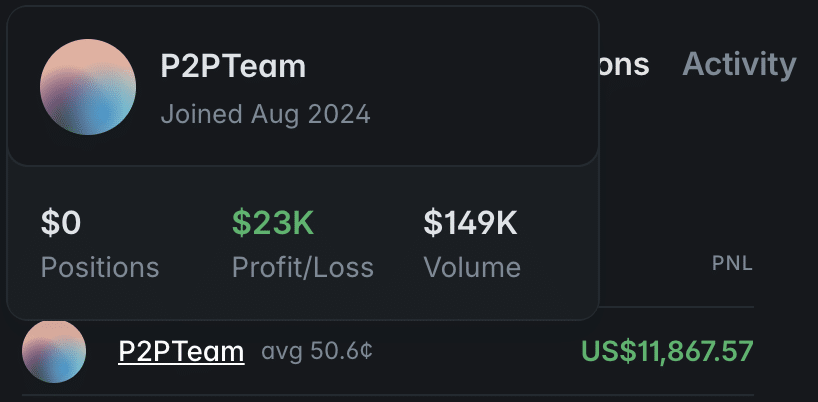
Source: Polymarket

P2P acknowledged that failing to disclose the activity at the time was a mistake. The team notes that trading on outcomes that a team can influence may erode trust, even if the result is not predetermined.

Incident highlights challenges in prediction market enforcement

The case underscores a broader challenge facing decentralized prediction markets: how to manage participation by individuals who may influence event outcomes.

Polymarket’s model relies on open participation and transparent on-chain activity. However, the presence of informed or involved actors can complicate enforcement, particularly when trades occur before outcomes are finalized.

As platforms move to formalize rules around insider activity, real-world cases like this may shape how those standards are interpreted and applied.


Final Summary

  • P2P disclosed betting on its own fundraise outcome, raising questions about insider participation in prediction markets.
  • The incident comes as platforms like Polymarket tighten rules, highlighting ongoing challenges in enforcing market integrity.


Domande pertinenti

QWhat did the P2P team admit to doing on Polymarket?

AThe P2P team admitted to placing bets on their own fundraising outcome, specifically on whether the project would reach its $6 million target.

QWhen did Polymarket update its rules regarding insider trading and manipulation?

APolymarket updated its rules, introducing stricter definitions around insider trading and manipulation, on March 23.

QWhat was the financial result of the 'P2P Team' account's trading activity?

AThe 'P2P Team' account recorded approximately $149,000 in trading volume and around $23,000 in profit and loss, with individual positions generating gains of over $11,000.

QAccording to the article, what is a key challenge for decentralized prediction markets highlighted by this incident?

AA key challenge is managing participation by individuals who may influence event outcomes, as the presence of informed or involved actors complicates enforcement, especially when trades occur before outcomes are finalized.

QWhat action did P2P say it would take following this disclosure?

AP2P stated it would liquidate the positions, return all proceeds to its foundation's treasury, and introduce internal policies governing prediction market activity.

Letture associate

L2 'Recalibration': When L1 Becomes Its Own Rollup, What Is Ethereum's Endgame?

The article discusses the evolving relationship between Ethereum's Layer 1 (L1) and Layer 2 (L2) solutions, moving beyond the initial "L2 for scaling" model. As Ethereum L1 itself scales (increasing Gas Limit, statelessness, zkEVM), the unique value proposition of L2s shifts from merely providing cheap execution to offering differentiated features like application-specific optimization, privacy, and flexible governance. The piece explores three key themes: 1. **L2's New Role:** L2s are transitioning from a pure scaling technology to a spectrum of execution environments with varying degrees of security inheritance from Ethereum L1. 2. **Interoperability as State Trust:** Solving L2 fragmentation is less about cross-chain bridges and more about enabling faster, trust-minimized state verification between environments. This involves initiatives like faster L1 finality, intent-based architectures (Open Intents Framework), and native account abstraction. 3. **Blurring Layers:** With the potential integration of zk-proofs into L1 validation (making L1 akin to its own "Rollup") and the concept of "Native Rollups," the rigid boundary between L1 and L2 may fade. The future could be a unified system with multiple execution domains (for DeFi, gaming, privacy, etc.) sharing a common security, settlement, and state framework. In conclusion, Ethereum's goal is not to abandon L2s or re-centralize everything on L1, but to re-integrate the fragmented user experience—liquidity, accounts, applications—while preserving the scaling benefits of a multi-environment ecosystem. The endgame is a cohesive "one chain" feeling for users, powered by diverse but securely interconnected execution layers.

marsbit19 min fa

L2 'Recalibration': When L1 Becomes Its Own Rollup, What Is Ethereum's Endgame?

marsbit19 min fa

The Encryption Bill Clarity's Challenge: A Thorny Path of Bipartisan Compromise in the U.S.

U.S. lawmakers are attempting to advance the Clarity Act, a significant crypto market structure bill, but its path is fraught with partisan hurdles. The process has been rocky since January, when a prior bipartisan deal in the Senate Banking Committee was upended. A key compromise in May on "yield" issues allowed the bill to move forward in committee, but only with the conditional support of two Democratic senators, Angela Alsobrooks and Ruben Gallego. They emphasized that their final vote depends on reaching an agreement on ethics provisions for elected officials. Ultimately, the Senate Agriculture Committee passed its version along party lines without Democratic support. As Republicans push for a full Senate vote in July, the demand for strong ethics language has expanded beyond Democrats. Additional controversies surround provisions related to yields (aligning some Republicans with large banks) and developer protections (opposed by enforcement agencies). Core concerns about illicit finance and consumer protection remain central to the debate. Despite consensus on the need for legislation, achieving the necessary bipartisan compromise is proving difficult. While momentum exists—including recent meetings between senators and White House officials—a reconciled bill text faces skepticism. Senator Gallego has stated that without ethics terms acceptable to Democrats, they will not provide the needed votes. The immediate goals for the crypto community in Congress are unclear: a symbolic Senate vote before the August recess, eventual passage into law by 2026, or forging a final compromise framework. The arduous, vote-by-vote effort to build bipartisan support continues, mirroring the traditional legislative grind the industry must now navigate.

Foresight News1 h fa

The Encryption Bill Clarity's Challenge: A Thorny Path of Bipartisan Compromise in the U.S.

Foresight News1 h fa

Trading

Spot
活动图片