P2P team admits to betting on its own raise days after Polymarket tightened insider trading rules

ambcryptoPubblicato 2026-03-27Pubblicato ultima volta 2026-03-27

Introduzione

P2P, a crypto project, has admitted that its team placed bets on Polymarket regarding the outcome of its own $6 million fundraising campaign. The bets were made approximately 10 days before the raise concluded, using funds from the project's treasury. This activity, which generated around $23,000 in profit and loss, occurred just days after Polymarket updated its rules to explicitly prohibit insider trading, including by individuals who can influence an event's outcome. While P2P stated the bets were not based on guaranteed information and plans to return all proceeds, the case highlights the enforcement challenges decentralized prediction markets face in preventing manipulation and maintaining trust, especially from involved actors. The incident is a real-world test of how newly tightened market integrity rules are applied in practice.

A crypto project has disclosed that it placed bets on its own fundraising outcome on Polymarket, drawing attention to how newly tightened market integrity rules may apply in practice.

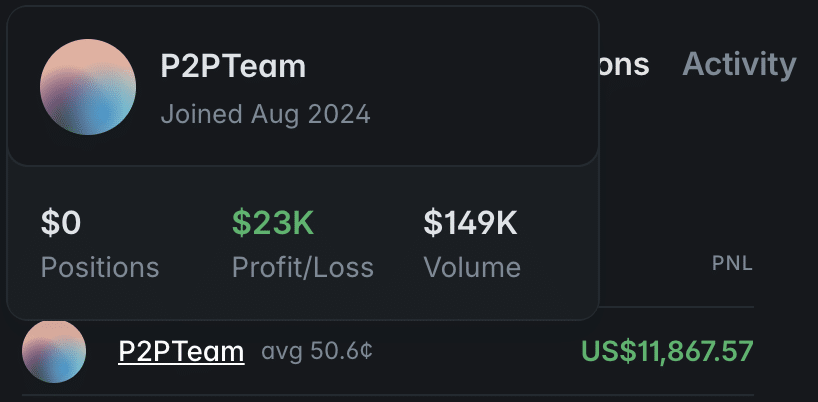
In a public statement, P2P.me confirmed that an account labeled “P2P Team” on-chain was controlled by its team. The account was used to bet on whether the project would reach a $6 million fundraising target.

The bets were placed roughly 10 days before the raise concluded, when the outcome had not yet been finalized.

The project stated that the capital used came from its foundation’s treasury and that all proceeds would be returned. It added that it plans to liquidate the positions and introduce internal policies governing prediction market activity.

Case emerges days after Polymarket tightened insider trading rules

The disclosure comes just days after Polymarket updated its rules on 23 March, introducing stricter definitions around insider trading and manipulation.

Among the changes, the platform explicitly prohibited trading by individuals who hold positions of influence over an outcome. That category includes participants directly involved in events tied to prediction markets.

While P2P said the bets were placed before the raise was completed and not based on guaranteed allocations, the timing of the disclosure places the case within a broader shift toward tighter oversight on prediction platforms.

On-chain activity shows active trading and profits

Data from the “P2P Team” account indicates the activity was not purely symbolic.

The account recorded roughly $149,000 in trading volume and around $23,000 in profit and loss. Individual positions generated gains of over $11,000. The figures suggest the trades were executed as active positions rather than passive signaling.
Source: Polymarket

P2P acknowledged that failing to disclose the activity at the time was a mistake. The team notes that trading on outcomes that a team can influence may erode trust, even if the result is not predetermined.

Incident highlights challenges in prediction market enforcement

The case underscores a broader challenge facing decentralized prediction markets: how to manage participation by individuals who may influence event outcomes.

Polymarket’s model relies on open participation and transparent on-chain activity. However, the presence of informed or involved actors can complicate enforcement, particularly when trades occur before outcomes are finalized.

As platforms move to formalize rules around insider activity, real-world cases like this may shape how those standards are interpreted and applied.


Final Summary

  • P2P disclosed betting on its own fundraise outcome, raising questions about insider participation in prediction markets.
  • The incident comes as platforms like Polymarket tighten rules, highlighting ongoing challenges in enforcing market integrity.


Domande pertinenti

QWhat did the P2P team admit to doing on Polymarket?

AThe P2P team admitted to placing bets on their own fundraising outcome, specifically on whether the project would reach its $6 million target.

QWhen did Polymarket update its rules regarding insider trading and manipulation?

APolymarket updated its rules, introducing stricter definitions around insider trading and manipulation, on March 23.

QWhat was the financial result of the 'P2P Team' account's trading activity?

AThe 'P2P Team' account recorded approximately $149,000 in trading volume and around $23,000 in profit and loss, with individual positions generating gains of over $11,000.

QAccording to the article, what is a key challenge for decentralized prediction markets highlighted by this incident?

AA key challenge is managing participation by individuals who may influence event outcomes, as the presence of informed or involved actors complicates enforcement, especially when trades occur before outcomes are finalized.

QWhat action did P2P say it would take following this disclosure?

AP2P stated it would liquidate the positions, return all proceeds to its foundation's treasury, and introduce internal policies governing prediction market activity.

Letture associate

Global Stock Market's Storm Center: South Korea's Stock Market De-leveraging Is Largely Complete

Storm's Eye: South Korean Market De-leveraging Nears Completion The recent sharp correction in South Korean equities, with the KOSPI index dropping 32% from its June high, has been a key trigger for global tech stock volatility. The core driver was not a fundamental shift but a forced de-leveraging process within the market's unique structure, which is now largely complete. Two main leverage channels amplified the sell-off: 1. **Leveraged ETFs:** Their size, proportionally four times larger than in the U.S., peaked near $50 billion. Their mandatory daily rebalancing mechanism created a vicious cycle of "price drop → forced selling → further drop." Approximately 75% of this excess has been unwound, shrinking to $26 billion, with regulatory curbs now blocking new inflows. 2. **Hedge Fund Leverage:** Using swaps to magnify exposure, hedge funds saw their net long positioning fall by over 50% from peak levels. The most intense phase of this institutional de-leveraging is over. In contrast, **retail margin debt** poses minimal systemic risk. At 0.5% of market cap, it is far lower than in the U.S. or China, lacks automatic triggers, and is concentrated in smaller stocks. The conclusion: the high-leverage structures most prone to "chain-reaction selling" have been substantially cleared. The market is transitioning from a liquidity-driven crash to one priced more on fundamentals. The article argues that the AI trend—centered on Korean memory chips—remains intact. This episode represents a painful but necessary clearing of crowded trades, not the end of the AI revolution. For investors, the key question is conviction in the long-term AI direction; if the trend is real, current volatility is a cost of entry, not a terminal risk.

链捕手45 min fa

Global Stock Market's Storm Center: South Korea's Stock Market De-leveraging Is Largely Complete

链捕手45 min fa

The Eternal Fragments of Money: Third-Party Payment Has No First Principle

"The Enduring Fragments of Money: Third-Party Payments Lack a First Principle" Stripe is reportedly attempting to acquire PayPal, marking a significant shift reminiscent of PayPal's merger with the original X.com 30 years ago. The article analyzes Stripe's strategic challenges and the broader payments industry landscape. Despite its initial success with a developer-friendly API model, Stripe missed its optimal IPO window during the pandemic and has since seen its valuation decline. Its attempts to expand through acquisitions and new ventures, particularly in stablecoins (like its OUSD project) and Agent-focused payments (ACP/MPP protocols), have faced headwinds. The author argues that the payment industry remains highly fragmented and is ultimately an adjunct to the traditional banking system. This structure limits the potential for any single player, including Stripe, to achieve complete dominance. While stablecoins and the future rise of autonomous Agent economies present potential growth avenues, they are not yet mainstream and still require integration with the existing financial system. For now, Agent-based transactions are largely used for speculative "volume boosting" rather than substantive business applications. Stripe's current move to acquire PayPal is seen as an attempt to bolster its weak consumer-facing (C-side) business after its stablecoin-focused strategies faltered. Meanwhile, PayPal is described as structurally outdated, unable to revive itself through new products like Venmo or PYUSD. The future of payments may lie not in payments themselves but in value-added services like more efficient settlement networks. The author suggests that companies like Stripe and Circle, which are building their own blockchains (Tempo, Arc) and stablecoins, are positioning themselves to eventually profit from high-efficiency settlement systems. These new networks could potentially bypass some traditional banking layers. In conclusion, the article posits that third-party payment is a perpetually fragmented battlefield where scale alone cannot ensure victory. Players must find new models, focusing on efficiency to compete with the entrenched banking system. Stripe's acquisition of PayPal represents a bet on this uncertain future.

链捕手1 h fa

The Eternal Fragments of Money: Third-Party Payment Has No First Principle

链捕手1 h fa

Trading

Spot
活动图片