Over 13% APY, Apyx Is Bringing the 'Killer App for Bitcoin' On-Chain

Odaily星球日报Pubblicato 2026-05-26Pubblicato ultima volta 2026-05-26

Introduzione

The article discusses the rise of high-yield stablecoins in DeFi, focusing on the Apyx protocol and its integration of STRC (Strategy's Bitcoin credit instrument) to generate sustainable on-chain yields. Apyx addresses a market need for stablecoins with yields exceeding typical DeFi offerings (often below 5-10%). Its core innovation is bridging STRC—a tradable, dividend-yielding equity instrument backed by Strategy's Bitcoin holdings—from traditional finance to the decentralized ecosystem. STRC offers a floating yield (over 12.3%) by converting Bitcoin's long-term appreciation potential into a "digital credit" product. Apyx employs a dual-token model: `apxUSD`, a stablecoin pegged to $1 for liquidity, and `apyUSD`, an interest-bearing token where yields accumulate (currently ~11% APY, targeting over 13%). The yield is derived from STRC dividends, providing a more sustainable income source compared to token-incentivized models. Since its February launch, Apyx has grown rapidly, with `apxUSD` becoming a top-20 DeFi stablecoin by issuance. The protocol enhances its utility and capital efficiency through deep integrations with major DeFi platforms: Morpho (for collateralized borrowing/lending), Curve (for low-slip liquidity pools), and Pendle (for trading and leveraging future yield via PT/YT tokens). Apyx is also running a multi-season points program leading to a Token Generation Event (TGE) and airdrop on October 13, 2026, incentivizing user engagement through activities li...

Original | Odaily Planet Daily(@OdailyChina)

Author | Liaoliao
The cryptocurrency market, particularly the decentralized finance (DeFi) sector, is perpetually in search of underlying assets that combine stability, high liquidity, and high yield. As the yields from traditional real-world assets (RWA, such as U.S. Treasuries) gradually stabilize, the DeFi market's craving for high-yielding, interest-bearing assets is fostering a new paradigm shift. Against this backdrop, stablecoin projects based on STRC are rising at a remarkable pace.

As the cornerstone of the crypto world, the evolution of stablecoins has progressed from early fiat-backed versions (like USDT, USDC), to crypto asset overcollateralized versions (like DAI), to algorithmic versions (like the imploded UST), and to the basis trade arbitrage versions (like USDe) that have emerged in recent years.

However, the current market pain point is that stablecoin yields below 10%, or even 5%, can no longer meet the risk premium demand of on-chain capital, while excessively high algorithmic yields often come with systemic risks like "death spirals."

STRC-driven stablecoin projects are filling this gap at an opportune time. Judging from TVL growth rates, on-chain capital flow directions, to community discussion heat, building stablecoins based on STRC has become one of the most watched niche sectors in the current DeFi market.

Especially with the support of yield protocols like Pendle and Morpho, these products have evolved beyond being mere "stablecoins" into a new asset form that combines stability, yield, and financial composability.

What is STRC?

STRC refers to a "Bitcoin Credit Facility" launched by the treasury company Strategy.

Odaily Note: For a detailed analysis of STRC, please refer to “In-depth Analysis of STRC: Strategy's New Magic Trick for Raising Money to Buy Bitcoin.”

Simply put, Strategy raises capital from the market by issuing STRC, then continuously uses the proceeds to buy Bitcoin. STRC holders receive a floating interest income exceeding 12.3%, paid monthly. Unlike traditional bonds, STRC is a preferred stock instrument, not debt, thus having no fixed maturity date. Simultaneously, its dividend rights are superior to common stock (MSTR), possessing strong "fixed-income-like" properties.

The most unique aspect of STRC is that it essentially transforms the long-term appreciation expectation of Bitcoin into a "Digital Credit" product acceptable to traditional capital markets.

To maintain STRC's value near its $100 face value, Strategy dynamically adjusts its dividend rate – increasing the yield to attract capital when STRC trades below par, and suppressing the premium by issuing more shares when it trades above.
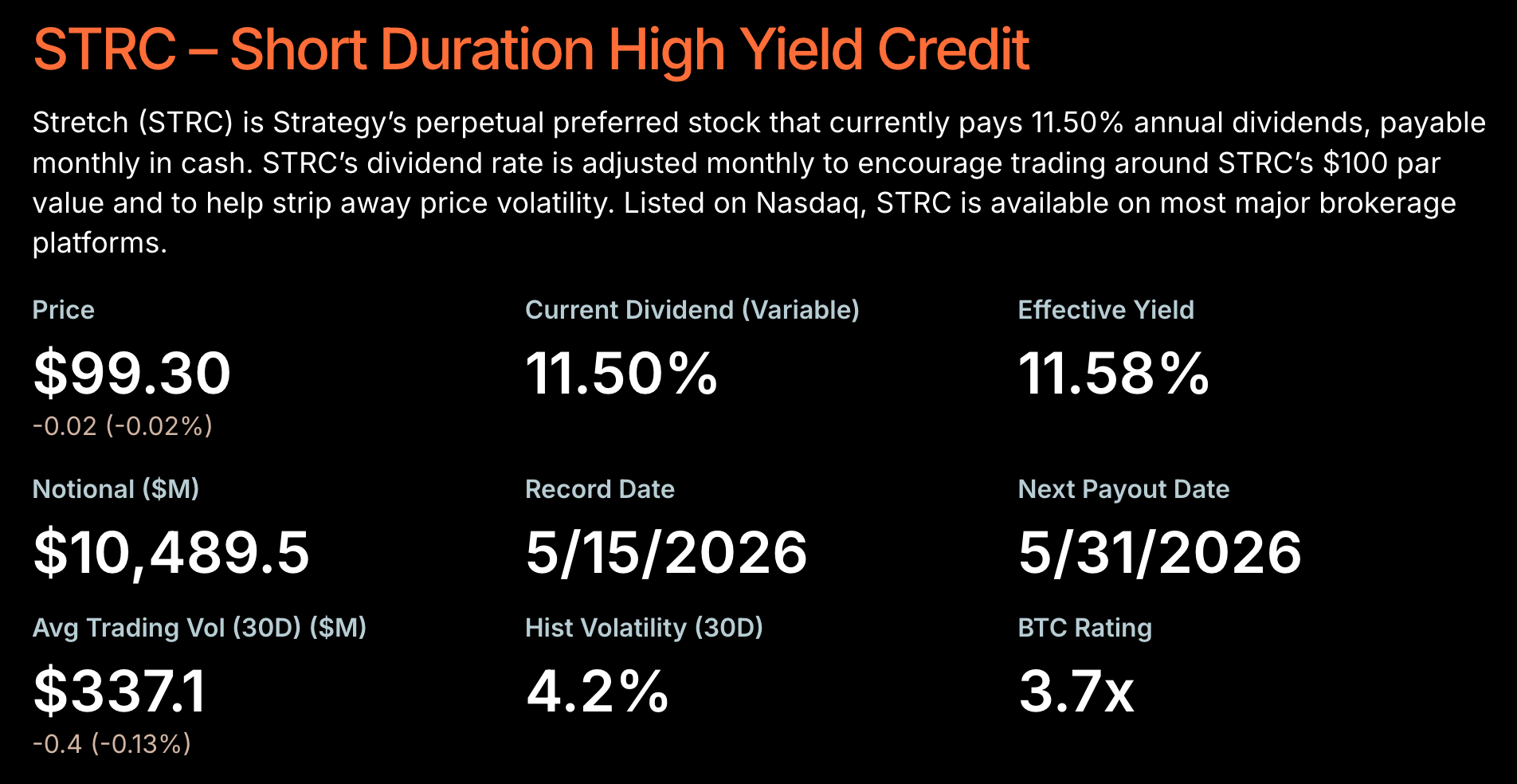
Since Strategy launched STRC, market reception has been quite positive, thanks to its relatively stable "peg" performance (successfully restored after a few brief deviations) and its considerable yield.

At the time of writing, the total issuance size of STRC has surpassed $10.4 billion, accounting for over 60% of the total preferred stock issuance in the global market for 2026.

Earlier this month, Strategy founder Michael Saylor stated in an interview with David Lin – Digital credit products like STRC are the killer application for Bitcoin (refer to Interview with Michael Saylor: I Did Say I'd Sell, But Never Net Sell).

However, traditional STRC shares typically circulate only among Wall Street hedge funds, compliant institutions, and high-net-worth accredited investors. On-chain DeFi users, due to barriers like access, compliance, and capital channels, find it difficult to directly access this high-yield product sweeping through traditional finance.

This is precisely where Apyx, the protagonist of this article, steps in.

What Apyx does is serve as a bridge between Wall Street's digital credit instruments and on-chain DeFi legos. Through innovative on-chain financial architecture, it brings STRC's excess yield opportunities on-chain, constructing the next generation of interest-bearing stablecoins with high liquidity, composability, and higher yields.

Deconstructing Apyx, Perhaps the Highest-Yielding Stablecoin in the Market

Unlike many stablecoin projects reliant on airdrop narratives and lacking real yield sources, Apyx's core competitiveness lies not just in "higher APY," but in its backing which combines traditional finance capital capabilities with on-chain protocol composability.

Regarding background, the core supporter behind Apyx is the NASDAQ-listed treasury company DeFi Development Corp. The latter not only participated in Apyx's incubation and strategic investment but also provided the critical bridge connecting traditional capital markets with the on-chain world.

In terms of product design, Apyx employs a dual-token model of apxUSD + apyUSD.

Among them, apxUSD is closer to a traditional stablecoin, pegged to $1, primarily serving as a medium of exchange and on-chain liquidity. apxUSD itself does not automatically accrue yield; it functions more like a highly liquid "base dollar asset," suitable for trading, payments, lending, etc.

The true embodiment of Apyx's core value is apyUSD – users can lock apxUSD to obtain apyUSD (a 20-day unlock period applies), the latter being similar to Lido's wstETH, with its price increasing continuously as underlying yield accumulates. In other words, apyUSD itself is the carrier of yield.
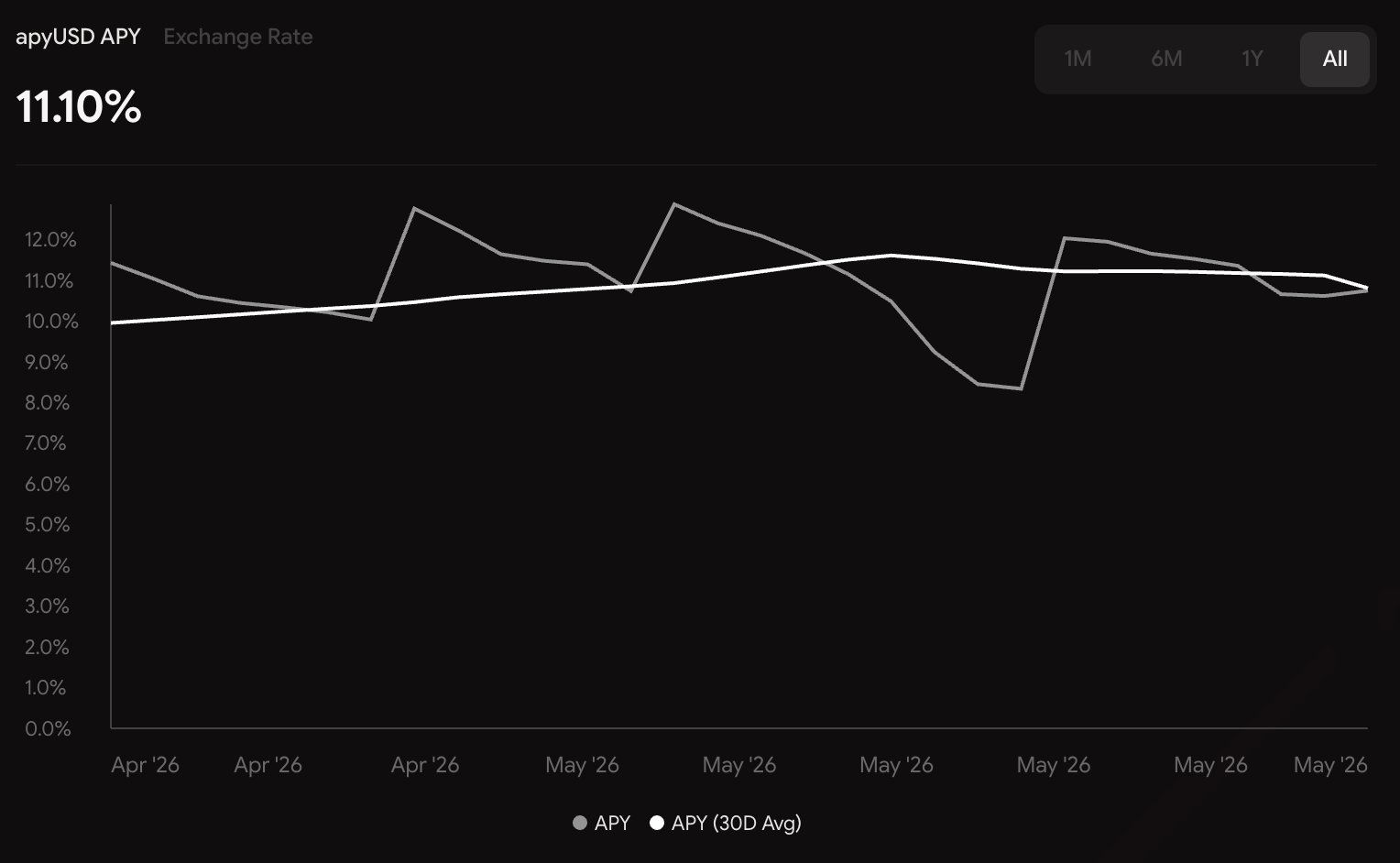
Currently, the real-time annualized yield for apyUSD is approximately 11%, with an expected annualized yield exceeding 13%. Against the backdrop of continuously declining yields for USD stablecoins overall, a stablecoin asset with a genuine yield source and double-digit yield is naturally exceptionally attractive.

Furthermore, it's crucial to emphasize that unlike many stablecoin projects relying on token subsidies to achieve short-term high yields, Apyx's core yield originates from STRC dividends, making the yield source more stable and sustainable.

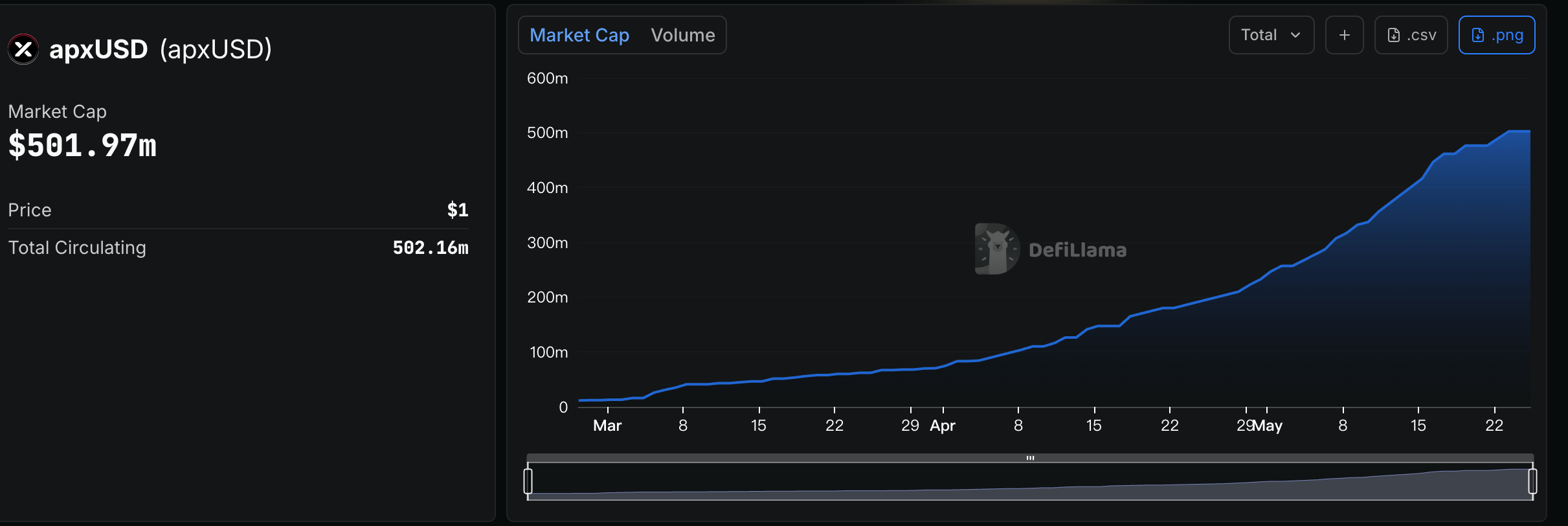
DefiLlama data shows that since its launch at the end of February this year, the issuance scale of apxUSD has rapidly reached 502 million tokens in less than three months, making it the 21st largest stablecoin protocol by issuance size in the DeFi world.
However, yield alone is insufficient to sustain a stablecoin ecosystem. What truly determines a protocol's ceiling is the asset's composability and liquidity efficiency. On this front, Apyx has clearly done extensive work – currently, Apyx is deeply integrated with several mainstream protocols including Morpho, Curve, and Pendle.

On Morpho, users can use apyUSD as collateral to borrow other assets, enabling operations like "earning yield while unlocking liquidity." For more aggressive players, even recursive lending can be employed to amplify yield exposure. Curve addresses liquidity issues. By constructing trading pools with apxUSD and mainstream stablecoins like USDC and USDT, Apyx ensures low slippage even during large-volume swaps, which is crucial for a stablecoin system.

As for Pendle, it might be the most explosive component within the entire Apyx ecosystem. Since Pendle can split yield-bearing assets into PT (Principal Token) and YT (Yield Token), apyUSD evolves beyond being just a "hold-to-earn-yield" asset into a tradable, leveragable, speculatable yield product – conservative users can lock in fixed yields via PT; more aggressive users can amplify bets on future yields by buying YT.

Precisely because of this high degree of composability, Apyx's ecosystem expansion speed is noticeably faster than many traditional stablecoin protocols.

In a sense, what Apyx is doing is not merely "issuing a high-yield stablecoin." It's more akin to attempting to establish an on-chain credit market centered around STRC.

Points Program and Point-Earning Strategies

In today's DeFi market, "points" are no longer just simple user incentive tools; they resemble a way to pre-price future token rights. Especially as the market re-enters a phase of liquidity competition, whether a project can continuously attract capital often depends on two things – whether the yield is sufficiently high, and whether the token expectation is sufficiently clear.

A significant reason for Apyx's rapid TVL accumulation in a short time is closely related to its current points system. According to the official plan, Apyx's points program follows a phased rollout model:

  • Season 1 concluded on May 22, 2026. The official has confirmed that 5% of the total token supply will be allocated to early participants in this stage;
  • Season 2 commenced immediately after Season 1 ended and will continue until October 11, releasing another 6% in token incentives;
  • After Season 2 concludes, Apyx will conduct its TGE and airdrop on October 13.

This rhythm is quite clever. On one hand, the Season deadlines naturally create "sprint windows," incentivizing capital inflows to accelerate before the end. On the other hand, the seamless transition from Season 1 to Season 2 avoids the common problem of "TVL collapse right after Season 1 ends" seen in many projects. Most importantly, Apyx has set a clear future TGE and airdrop date, providing users with more definite interaction expectations.

For the market, this means Apyx's airdrop expectation is not a short-term event but more like a liquidity war lasting several months. From the user's perspective, the more critical question is "how to earn points more efficiently."
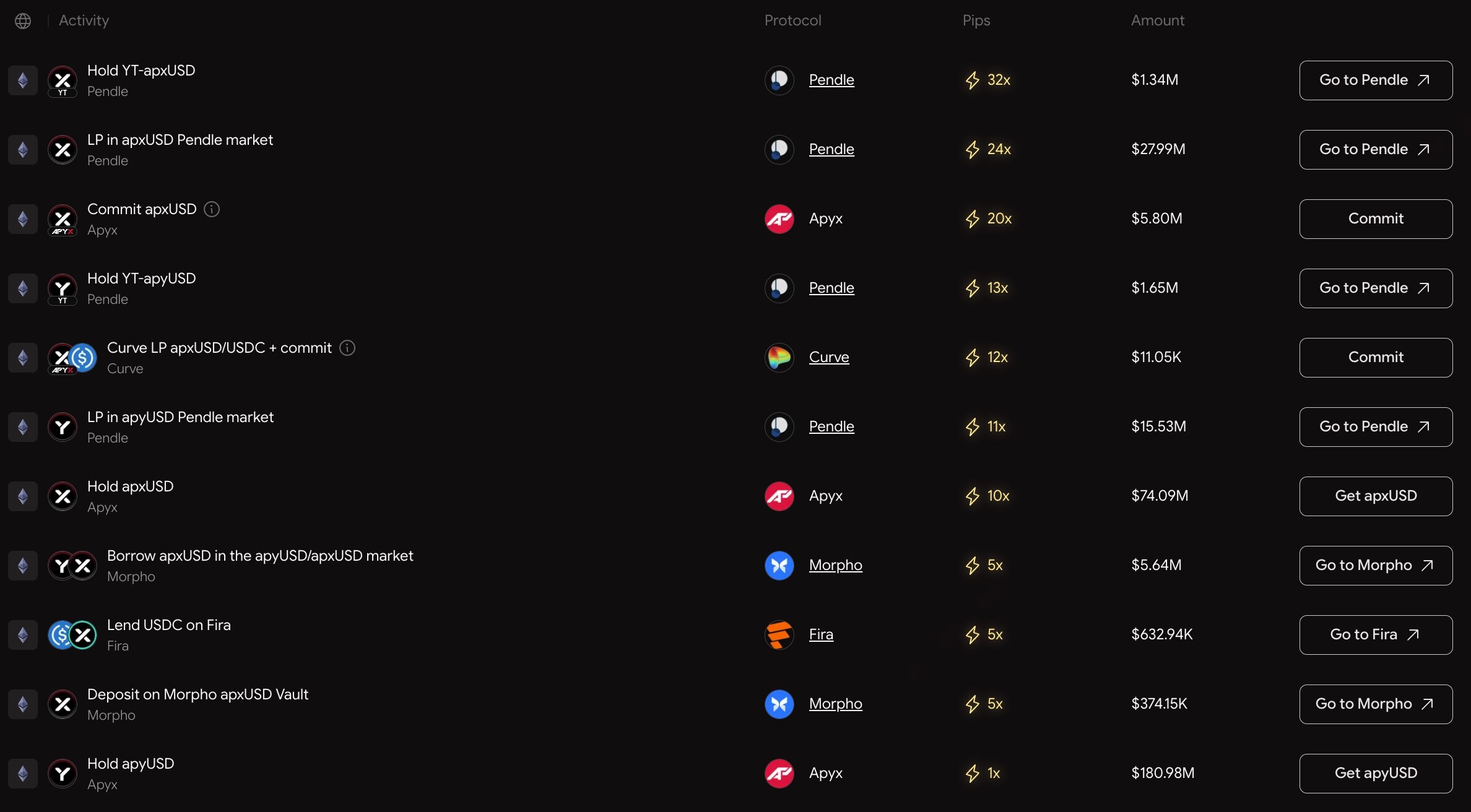
Apyx outlines point-earning efficiency for different operations on its official website, broadly categorized into "Basic Mode" and "Advanced Mode."

"Basic Mode" involves simply holding apxUSD (10x points) or apyUSD (1x point). "Advanced Mode" entails flexibly using the integrated protocols mentioned above, such as borrowing/lending apxUSD on Morpho (5x points), providing LP for apxUSD on Curve (12x points). The most efficient strategies revolve around Pendle: directly holding YT for apxUSD yields 32x points, and providing LP for apxUSD on Pendle also offers a 24x points multiplier.

Competitive Landscape of the Sector, and Apyx's Advantages

As an emerging sector still in its very early stages, the STRC-driven stablecoin market currently doesn't have many core players in the true sense. Judging by capital scale, market attention, and ecosystem expansion speed, the projects that have truly formed influence are essentially just Apyx and Saturn. In a sense, the entire "Digital Credit Stablecoin" sector is gradually evolving into a dual-leader competitive landscape.

Although Saturn launched earlier, Apyx has now surpassed it in terms of data metrics. Overall, Apyx's competitive advantages manifest in the following key dimensions.

First, absolute TVL size and underlying asset holdings advantage. Apyx established a clear strategic goal in its project positioning – to become the world's largest institutional holder of STRC. As of the end of April, holdings had reached $125 million (Saturn only $50 million). If Apyx achieves its strategic objective, it would essentially monopolize the on-chain yield distribution rights based on Strategy's digital credit at the source. Furthermore, for a stablecoin, Apyx's TVL size advantage translates to deeper trading pools, lower slippage for large swaps, and more robust liquidity efficiency, safely accommodating large capital inflows and outflows.

Second, higher yield, with no risk of yield pause. For the target clientele of Apyx and Saturn, the core demand is continuous and predictable yield. Compared to Saturn's sUSDat, Apyx's apyUSD static holding yield maintains an approximate 2% annualized yield advantage. Additionally, and very importantly, sUSDat's design is deeply tied to STRC's exchange rate. When STRC falls below the "Watermark" due to ex-dividend events or other reasons, YT-sUSDat's yield accumulation completely pauses, a problem Apyx does not have.

Third, clearer TGE expectations, and no VC sell-side pressure. Users in the crypto industry detest "indefinite points PUA." Compared to Saturn, Apyx has clearly disclosed the TGE date, the timing of each Season's points activities, and the allocated token amounts, making users psychologically more likely to stay. Moreover, Apyx's development did not involve VC funding, only minimal early investment, partly from the founding contributors themselves. This means there are no private round institutions dumping for profit before retail investors enter, making the token rewards corresponding to points more ideal.

Potential Risks and Outlook Expectations

It is crucial to clearly emphasize that Apyx's high yield does not equate to "risk-free." Essentially, Apyx remains a yield product built upon a Bitcoin credit structure, not a traditional risk-free dollar asset. Therefore, before discussing its growth potential, one must also acknowledge the risk sources behind it.

First, is the credit risk of the underlying asset itself. The core logic of STRC is built upon Strategy and its Bitcoin balance sheet. In other words, the market's acceptance of STRC's yield is fundamentally based on belief that Strategy can continuously utilize its Bitcoin assets to maintain its credit structure and perpetually execute financing, balance sheet expansion, and interest payments.

Should the Bitcoin market experience extreme volatility, such as a sharp crash in a short period, or a significant decline in market risk appetite towards Strategy's leveraged model, then STRC's market pricing, liquidity, and yield structure could all be impacted. While this "systemic risk" doesn't imply immediate protocol collapse, it does signify that Apyx's yield source is somewhat tied to the Bitcoin cycle itself.

Second, are the typical DeFi composability risks. Since Apyx is deeply integrated with protocols like Morpho, Curve, and Pendle, its ecosystem is built upon highly complex on-chain composability. The advantage of this structure is the极大提升资金效率; but the trade-off is that the system's risks become more coupled.

For instance, if a foundational protocol encounters a smart contract vulnerability, liquidity crisis, or abnormal liquidation mechanism, risks could propagate throughout the ecosystem via LP, collateral, and yield-splitting structures. Especially as recursive lending and high-leverage玩法 become more普及, market fluctuations can be further amplified.

Therefore, Apyx is better understood as a "medium-to-high risk, high yield" on-chain credit asset, not a replacement for traditional overcollateralized stablecoins. But it is precisely this risk stratification that gives Apyx its unique appeal in the current market environment.

The stablecoin market today faces an increasingly evident problem – yields are rapidly becoming homogenized. As U.S. Treasury yields recede and traditional arbitrage spaces narrow, the real yield most stablecoin protocols can provide is increasingly limited. The market needs new yield sources, and users are willing to bear a certain degree of risk for higher yields.

Over the past few years, from LSD, Restaking to Pendle yield trading, the entire DeFi market has essentially been validating one thing – users never reject risk; what they truly reject are assets with no "risk-reward ratio." The emergence of STRC恰好为市场提供了一种新的"风险 vs 收益"选项.

And over the past few months, the sustained growth in TVL for Apyx and the entire STRC sector demonstrates that the market is voting for this narrative with real capital.


Domande pertinenti

QWhat is STRC, and how does it generate high yields?

ASTRC is a 'Bitcoin credit instrument' issued by the company MicroStrategy. It is a form of preferred equity (not debt) that allows MicroStrategy to raise funds from the market to continuously buy Bitcoin. STRC holders receive a high, floating interest rate (over 12.3%, paid monthly). This effectively transforms the long-term appreciation expectation of Bitcoin into a 'Digital Credit' product with stable yield characteristics acceptable to traditional capital markets. Its yield is dynamically adjusted to maintain its price near a $100 par value.

QWhat are the two tokens in Apyx's model, and what are their respective functions?

AApyx uses a dual-token model. 1) apxUSD is a stablecoin pegged to $1, functioning primarily as a transaction medium and a source of on-chain liquidity for trading, payments, and lending. It does not automatically accrue yield. 2) apyUSD is the yield-bearing token. Users lock apxUSD to receive apyUSD (with a 20-day unlocking period). Its price increases over time as underlying yield accrues, making it the direct carrier of the protocol's returns.

QHow does Apyx achieve its high expected APY of over 13% for apyUSD?

AApyx's core yield is derived from the dividends paid by the underlying STRC assets. The protocol acts as a bridge, bringing the high-yield STRC product from traditional finance onto the blockchain. This provides a real, sustainable yield source rather than relying on temporary token subsidies, which differentiates it from many other high-APY stablecoin projects.

QWhat key DeFi protocols has Apyx integrated with to enhance its utility and capital efficiency?

AApyx has been deeply integrated with several major DeFi protocols: Morpho (for using apyUSD as collateral to borrow other assets, enabling leveraged yield strategies), Curve (for providing deep liquidity pools between apxUSD and other stablecoins like USDC/USDT, ensuring low slippage), and Pendle (for splitting apyUSD's yield into Principal Tokens (PT) and Yield Tokens (YT), allowing for fixed yield locking or speculative trading on future yields).

QWhat are the main potential risks associated with investing in or using Apyx?

AThe primary risks are twofold: 1) Underlying Asset Risk: Apyx's yield depends on STRC, which is tied to MicroStrategy's Bitcoin strategy. Extreme Bitcoin price volatility or a loss of market confidence in MicroStrategy's leveraged model could impact STRC's pricing, liquidity, and yield payments. 2) DeFi Composability Risk: Deep integration with protocols like Morpho and Pendle creates a complex, interconnected system. Smart contract vulnerabilities, liquidity crises, or liquidation issues in any integrated protocol could propagate risk throughout the Apyx ecosystem, especially when leverage is involved.

Letture associate

Investors Frantically Snap Up AI Firms with 'No Profits': A High-Stakes Gamble on 'the Right to Define the Future'

"Investors are pouring billions into Chinese AI startups with no profits, betting on the future of the industry. A state-backed fund is reportedly in talks to lead DeepSeek's funding at a $45B valuation, just weeks after it was valued at $10B. Along with companies like Zhipu AI, MiniMax, and Kimi (backed by Meituan and Alibaba), their combined valuation exceeds $140B. This isn't a typical venture capital play. Investors are paying for 'future definition rights'—a chance to set the standards for the next tech era. Morgan Stanley notes a 6-12 month window for this scarcity premium before more AI companies go public. Despite massive losses, these companies show strong growth. Zhipu AI's API revenue grew 60x, Kimi's annual recurring revenue doubled to $200M in a month, and MiniMax turned its gross margin positive, with over 70% of revenue from overseas. Their valuations vastly exceed profitable firms like iFlytek. Crucially, technical progress underpins this growth. DeepSeek's latest model boasts costs just 1% of a leading competitor's, while Zhipu AI has raised API prices due to high demand. However, gaps with top global models remain. Tech giants like Tencent and Alibaba, investing heavily while describing their own AI efforts as 'leaky boats,' are also investing in these startups as a hedge. Key risks loom: the closing scarcity window, computing power bottlenecks limiting growth, and the sustainability of DeepSeek's cost-advantage model. With state capital now a major player, the success of these companies has become a strategic national concern. The next year will test if their soaring valuations can be justified by future profits."

marsbit32 min fa

Investors Frantically Snap Up AI Firms with 'No Profits': A High-Stakes Gamble on 'the Right to Define the Future'

marsbit32 min fa

SEC Slams the Brakes at the Last Minute, Halting "Tokenized U.S. Stocks"

On May 22, the U.S. SEC postponed the release of a key "innovation exemption" draft that would have permitted crypto-native platforms to issue and trade tokenized U.S. stocks on decentralized venues without full traditional exchange compliance. This would have legalized a "third-party token" model used overseas, where platforms issue tokens tracking stock prices without the underlying company's involvement, raising unresolved questions about shareholder rights, dividends, and sanctions enforcement. Meanwhile, the SEC had already approved a different, compliant path for tokenization led by Nasdaq and NYSE. Their model integrates tokenized stocks into existing settlement systems (like DTCC), preserving all shareholder rights. This creates a fundamental conflict: crypto platforms seek a permissionless, 24/7 on-chain parallel market, while traditional exchanges advocate for an upgraded, regulated version of the current system. Intense lobbying from traditional exchange groups like the World Federation of Exchanges argued the exemption would create an unfair regulatory advantage and dilute investor protection. Even some compliant crypto firms favored delay. Internally, SEC commissioners were divided on the scope and pace of the exemption. The delay highlights a critical policy crossroads. With significant trading volume already occurring overseas, the SEC's decision will determine whether the U.S. embraces a dual-track system for tokenized equities or sidelines itself from an emerging global infrastructure. The core unresolved question remains the legal status and rights of holders of third-party tokenized stocks. The SEC paused because the draft framework risked creating a major new asset class with profound, unanswered legal implications.

marsbit40 min fa

SEC Slams the Brakes at the Last Minute, Halting "Tokenized U.S. Stocks"

marsbit40 min fa

Is a Super IPO Wave Coming? Will It Drain and Crash the U.S. Stock Market?

The article discusses concerns about a potential "super IPO wave" hitting the U.S. stock market, with major companies like SpaceX, OpenAI, and Anthropic preparing to go public. While these large IPOs could collectively raise hundreds of billions, raising fears of a market "blood drain," analysis suggests the impact may be limited. Key points include: * Historical data shows IPO waves often coincide with strong market returns, as they typically occur during periods of high investor demand. * Model estimates suggest even the largest IPOs might only cause a market dip of around 1%. They are more likely to trigger a routine market pullback rather than end a bull market. * The current demand side remains supportive due to high household cash balances, strong corporate earnings growth, continued stock fund inflows, and robust share buyback announcements. * The main risk lies in concentrated investor positions, particularly in large-cap tech stocks, which are at elevated levels. A shift in funds towards new issuances could pressure these crowded sectors. * Recent fund flows show strength concentrated in U.S. and tech stocks, while other regions like Europe and Japan are experiencing outflows. The conclusion is that the IPO wave itself is unlikely to crash the market unless it coincides with a weakening in underlying demand factors like earnings or fund inflows into U.S. equities. The focus should be on whether demand can continue to absorb the new supply.

marsbit46 min fa

Is a Super IPO Wave Coming? Will It Drain and Crash the U.S. Stock Market?

marsbit46 min fa

Vitalik is Personally 'Dismantling' the Ethereum Foundation

Vitalik Buterin recently published an extensive article addressing core concerns about Ethereum's future direction and the role of the Ethereum Foundation (EF). He clarifies that the EF is not his personal domain nor the central authority of Ethereum; it operates as just one node within the broader ecosystem. The board makes collective decisions, with significant operational work led by Aya Miyaguchi, allowing Vitalik to focus on technical matters. The article critiques the perception that the EF should act like a conventional, fast-moving tech company. Buterin warns that merely chasing higher TPS, lower latency, or better marketing—like other chains—risks diluting Ethereum's foundational values. He draws a parallel to Google's evolution away from its "Don't be evil" ethos. Instead, the EF's renewed mandate is to focus on preserving and strengthening Ethereum's core principles, summarized as CROPS: **C**ensorship-resistance, **R**esistance to capture, **O**pen source, **P**rivacy, and **S**ecurity. The foundation will concentrate its limited resources (holding only ~0.16% of ETH) on these long-term, non-commercializable fundamentals, while ecosystem growth, applications, and market-facing activities should be driven by external teams and capital. Buterin outlines key technical priorities aligned with this vision: 1) Advancing formal verification to mathematically prove the absence of bugs; 2) Enhancing consensus security to maintain operation without reliance on social coordination during outages; and 3) Reducing dependency on intermediaries (like RPCs) to strengthen user sovereignty and privacy. He acknowledges ETH as Ethereum's most valuable asset, crucial for security, but stresses that promoting its value is a task for the wider ecosystem, not the EF. Ultimately, Buterin's message is a strategic refocus: the EF will become a smaller, more focused entity guarding Ethereum's essential, harder-to-achieve properties, ensuring it remains distinct not just in performance but in its commitment to decentralization, resistance, and security.

marsbit51 min fa

Vitalik is Personally 'Dismantling' the Ethereum Foundation

marsbit51 min fa

Trading

Spot
Futures

Articoli Popolari

Cosa è BITCOIN

Comprendere HarryPotterObamaSonic10Inu (ERC-20) e la sua posizione nel mondo delle criptovalute Negli ultimi anni, il mercato delle criptovalute ha assistito a un aumento della popolarità delle meme coin, catturando l'interesse non solo dei trader, ma anche di coloro che cercano coinvolgimento comunitario e valore di intrattenimento. Tra questi token unici c'è HarryPotterObamaSonic10Inu (ERC-20), un progetto intrigante che mescola riferimenti culturali nel tessuto delle criptovalute. Questo articolo esplora gli aspetti chiave di HarryPotterObamaSonic10Inu, analizzando i suoi meccanismi, l'etica guidata dalla comunità e il suo coinvolgimento con il panorama crittografico più ampio. Che cos'è HarryPotterObamaSonic10Inu (ERC-20)? Come suggerisce il suo nome, HarryPotterObamaSonic10Inu è una meme coin costruita sulla blockchain di Ethereum, classificata secondo lo standard ERC-20. A differenza delle criptovalute tradizionali che possono enfatizzare l'utilità pratica o il potenziale investimento, questo token prospera grazie al valore di intrattenimento e alla forza della sua comunità. Il progetto mira a creare un ambiente in cui gli utenti coinvolti possono riunirsi, condividere idee e partecipare ad attività ispirate a diversi fenomeni culturali. Una caratteristica notevole di HarryPotterObamaSonic10Inu è la zero tassa sulle transazioni. Questo elemento allettante tende a incoraggiare il trading e il coinvolgimento della comunità, privo di costi aggiuntivi che possono scoraggiare i trader di piccole dimensioni. L'offerta totale della moneta è fissata a un miliardo di token, un numero che segna la sua intenzione di mantenere una circolazione sostanziale all'interno della comunità. Creatore di HarryPotterObamaSonic10Inu (ERC-20) Le origini di HarryPotterObamaSonic10Inu sono avvolte in un certo mistero; i dettagli sul creatore rimangono sconosciuti. Lo sviluppo di questo token non presenta un team identificabile o un piano esplicito, cosa non rara nel settore delle meme coin. Invece, il progetto è emerso organicamente, con il suo progresso fortemente dipendente dall'entusiasmo e dalla partecipazione della sua comunità. Investitori di HarryPotterObamaSonic10Inu (ERC-20) Per quanto riguarda investimenti esterni e finanziamenti, HarryPotterObamaSonic10Inu rimane ambiguo. Il token non elenca alcuna fondazione di investimento conosciuta o un sostegno organizzativo significativo. Invece, la linfa vitale del progetto è la sua comunità di base, che informa la sua crescita e sostenibilità attraverso azioni collettive e coinvolgimento nello spazio crittografico. Come funziona HarryPotterObamaSonic10Inu (ERC-20)? In quanto meme coin, HarryPotterObamaSonic10Inu opera principalmente al di fuori delle strutture tradizionali che governano spesso il valore degli asset. Ci sono diversi aspetti distintivi che definiscono il funzionamento del progetto: Transazioni senza tasse: Senza costi fiscali sulle transazioni, gli utenti possono comprare e vendere liberamente il token senza preoccuparsi di costi nascosti. Coinvolgimento della comunità: Il progetto prospera sull'interazione della comunità, sfruttando le piattaforme social per creare entusiasmo e facilitare il coinvolgimento. Discussioni, condivisione di contenuti e coinvolgimento sono elementi cruciali che aiutano ad espandere la sua portata e a favorire la lealtà tra i sostenitori. Nessuna utilità pratica: Va notato che HarryPotterObamaSonic10Inu non offre un'utilità concreta all'interno dell'ecosistema finanziario. Piuttosto, è classificato come un token principalmente per attività di intrattenimento e comunitarie. Riferimento culturale: Il token incorpora astutamente elementi della cultura pop per attirare interesse, collegandosi a appassionati di meme e seguaci delle criptovalute. HarryPotterObamaSonic10Inu esemplifica come le meme coin operino in modo diverso rispetto ai progetti di criptovalute più tradizionali, entrando nel mercato come costrutti sociali innovativi piuttosto che come asset utilitari. Cronologia di HarryPotterObamaSonic10Inu (ERC-20) La storia di HarryPotterObamaSonic10Inu è segnata da diversi traguardi notevoli: Creazione: Il token è emerso da un meme virale, catturando l'immaginazione di molti appassionati di criptovalute. Le date di creazione specifiche non sono disponibili, sottolineando la sua crescita organica. Inserimento negli scambi: HarryPotterObamaSonic10Inu ha fatto il suo ingresso in vari scambi, consentendo un accesso e un trading più facili da parte della comunità. Iniziative di coinvolgimento della comunità: Attività in corso volte a migliorare l'interazione della comunità, comprese gare, campagne sui social media e generazione di contenuti da parte di fan e sostenitori. Piani di espansione futura: La tabella di marcia del progetto include il lancio di una collezione NFT, merchandising e un sito di eCommerce relativo ai suoi temi culturali, coinvolgendo ulteriormente la comunità e cercando di aggiungere più dimensioni al suo ecosistema. Punti chiave su HarryPotterObamaSonic10Inu (ERC-20) Natura guidata dalla comunità: Il progetto dà priorità al contributo collettivo e alla creatività, garantendo che il coinvolgimento degli utenti sia al centro del suo sviluppo. Classificazione come meme coin: Rappresenta l'epitome delle criptovalute basate sull'intrattenimento, distinguendosi dai veicoli d'investimento tradizionali. Nessuna affiliazione diretta con Bitcoin: Nonostante la somiglianza nel nome del ticker, HarryPotterObamaSonic10Inu è distintivo e non ha alcuna relazione con Bitcoin o altre criptovalute consolidate. Focus sulla collaborazione: HarryPotterObamaSonic10Inu è progettato per creare uno spazio per la collaborazione e la condivisione di storie tra i suoi detentori, fornendo un canale per la creatività e il legame comunitario. Prospettive future: L'ambizione di espandersi oltre il suo presupposto iniziale verso NFT e merchandising delinea un percorso per il progetto per potenzialmente entrare in strade più mainstream all'interno della cultura digitale. Poiché le meme coin continuano a catturare l'immaginazione della comunità crittografica, HarryPotterObamaSonic10Inu (ERC-20) si distingue per i suoi legami culturali e il suo approccio centrato sulla comunità. Anche se potrebbe non adattarsi al modello tipico di un token orientato all'utilità, la sua essenza risiede nella gioia e nella camaraderia coltivate tra i suoi sostenitori, evidenziando la natura in evoluzione delle criptovalute in un'epoca sempre più digitale. Con la continuazione dello sviluppo del progetto, sarà importante osservare come le dinamiche della comunità influenzano la sua traiettoria nel panorama in continuo cambiamento della tecnologia blockchain.

1.5k Totale visualizzazioniPubblicato il 2024.04.01Aggiornato il 2024.12.03

Cosa è BITCOIN

Come comprare BTC

Benvenuto in HTX.com! Abbiamo reso l'acquisto di Bitcoin (BTC) semplice e conveniente. Segui la nostra guida passo passo per intraprendere il tuo viaggio nel mondo delle criptovalute.Step 1: Crea il tuo Account HTXUsa la tua email o numero di telefono per registrarti il tuo account gratuito su HTX. Vivi un'esperienza facile e sblocca tutte le funzionalità,Crea il mio accountStep 2: Vai in Acquista crypto e seleziona il tuo metodo di pagamentoCarta di credito/debito: utilizza la tua Visa o Mastercard per acquistare immediatamente BitcoinBTC.Bilancio: Usa i fondi dal bilancio del tuo account HTX per fare trading senza problemi.Terze parti: abbiamo aggiunto metodi di pagamento molto utilizzati come Google Pay e Apple Pay per maggiore comodità.P2P: Fai trading direttamente con altri utenti HTX.Over-the-Counter (OTC): Offriamo servizi su misura e tassi di cambio competitivi per i trader.Step 3: Conserva Bitcoin (BTC)Dopo aver acquistato Bitcoin (BTC), conserva nel tuo account HTX. In alternativa, puoi inviare tramite trasferimento blockchain o scambiare per altre criptovalute.Step 4: Scambia Bitcoin (BTC)Scambia facilmente Bitcoin (BTC) nel mercato spot di HTX. Accedi al tuo account, seleziona la tua coppia di trading, esegui le tue operazioni e monitora in tempo reale. Offriamo un'esperienza user-friendly sia per chi ha appena iniziato che per i trader più esperti.

3.8k Totale visualizzazioniPubblicato il 2024.12.12Aggiornato il 2025.03.21

Come comprare BTC

Cosa è $BITCOIN

ORO DIGITALE ($BITCOIN): Un'Analisi Completa Introduzione all'ORO DIGITALE ($BITCOIN) L'ORO DIGITALE ($BITCOIN) è un progetto basato su blockchain che opera sulla rete Solana, con l'obiettivo di combinare le caratteristiche dei metalli preziosi tradizionali con l'innovazione delle tecnologie decentralizzate. Sebbene condivida un nome con Bitcoin, spesso definito “oro digitale” a causa della sua percezione come riserva di valore, l'ORO DIGITALE è un token separato progettato per creare un ecosistema unico all'interno del panorama Web3. Il suo obiettivo è posizionarsi come un asset digitale alternativo valido, anche se i dettagli riguardanti le sue applicazioni e funzionalità sono ancora in fase di sviluppo. Cos'è l'ORO DIGITALE ($BITCOIN)? L'ORO DIGITALE ($BITCOIN) è un token di criptovaluta esplicitamente progettato per l'uso sulla blockchain di Solana. A differenza di Bitcoin, che fornisce un ruolo di stoccaggio di valore ampiamente riconosciuto, questo token sembra concentrarsi su applicazioni e caratteristiche più ampie. Aspetti notevoli includono: Infrastruttura Blockchain: Il token è costruito sulla blockchain di Solana, nota per la sua capacità di gestire transazioni ad alta velocità e a basso costo. Dinamiche di Offerta: L'ORO DIGITALE ha un'offerta massima fissata a 100 quadrilioni di token (100P $BITCOIN), sebbene i dettagli riguardanti la sua offerta circolante siano attualmente non divulgati. Utilità: Sebbene le funzionalità precise non siano esplicitamente delineate, ci sono indicazioni che il token potrebbe essere utilizzato per varie applicazioni, potenzialmente coinvolgendo applicazioni decentralizzate (dApp) o strategie di tokenizzazione degli asset. Chi è il Creatore dell'ORO DIGITALE ($BITCOIN)? Attualmente, l'identità dei creatori e del team di sviluppo dietro l'ORO DIGITALE ($BITCOIN) rimane sconosciuta. Questa situazione è tipica tra molti progetti innovativi nel settore blockchain, in particolare quelli allineati con la finanza decentralizzata e i fenomeni delle meme coin. Sebbene tale anonimato possa favorire una cultura guidata dalla comunità, intensifica le preoccupazioni riguardo alla governance e alla responsabilità. Chi sono gli Investitori dell'ORO DIGITALE ($BITCOIN)? Le informazioni disponibili indicano che l'ORO DIGITALE ($BITCOIN) non ha alcun sostenitore istituzionale noto o investimenti di venture capital prominenti. Il progetto sembra operare su un modello peer-to-peer incentrato sul supporto e sull'adozione della comunità piuttosto che su percorsi di finanziamento tradizionali. La sua attività e liquidità si trovano principalmente su exchange decentralizzati (DEX), come PumpSwap, piuttosto che su piattaforme di trading centralizzate consolidate, evidenziando ulteriormente il suo approccio di base. Come Funziona l'ORO DIGITALE ($BITCOIN) Le meccaniche operative dell'ORO DIGITALE ($BITCOIN) possono essere elaborate in base al suo design blockchain e alle caratteristiche della rete: Meccanismo di Consenso: Sfruttando il proof-of-history (PoH) unico di Solana combinato con un modello di proof-of-stake (PoS), il progetto garantisce una validazione efficiente delle transazioni contribuendo all'alta performance della rete. Tokenomics: Sebbene meccanismi deflazionistici specifici non siano stati dettagliati ampiamente, l'ampia offerta massima di token implica che potrebbe soddisfare microtransazioni o casi d'uso di nicchia che devono ancora essere definiti. Interoperabilità: Esiste il potenziale per l'integrazione con l'ecosistema più ampio di Solana, inclusi vari piattaforme di finanza decentralizzata (DeFi). Tuttavia, i dettagli riguardanti integrazioni specifiche rimangono non specificati. Cronologia degli Eventi Chiave Ecco una cronologia che evidenzia traguardi significativi riguardanti l'ORO DIGITALE ($BITCOIN): 2023: Il dispiegamento iniziale del token avviene sulla blockchain di Solana, contrassegnato dal suo indirizzo di contratto. 2024: L'ORO DIGITALE guadagna visibilità poiché diventa disponibile per il trading su exchange decentralizzati come PumpSwap, consentendo agli utenti di scambiarlo contro SOL. 2025: Il progetto assiste a un'attività di trading sporadica e a un potenziale interesse per impegni guidati dalla comunità, sebbene non siano state documentate partnership significative o avanzamenti tecnici fino ad ora. Analisi Critica Punti di Forza Scalabilità: L'infrastruttura sottostante di Solana supporta alti volumi di transazioni, il che potrebbe migliorare l'utilità di $BITCOIN in vari scenari di transazione. Accessibilità: Il potenziale basso prezzo di trading per token potrebbe attrarre investitori al dettaglio, facilitando una partecipazione più ampia grazie a opportunità di proprietà frazionata. Rischi Mancanza di Trasparenza: L'assenza di sostenitori, sviluppatori o di un processo di audit pubblicamente noti potrebbe generare scetticismo riguardo alla sostenibilità e all'affidabilità del progetto. Volatilità del Mercato: L'attività di trading è fortemente dipendente dal comportamento speculativo, il che può comportare una significativa volatilità dei prezzi e incertezze per gli investitori. Conclusione L'ORO DIGITALE ($BITCOIN) emerge come un progetto intrigante ma ambiguo all'interno dell'evolvente ecosistema di Solana. Sebbene tenti di sfruttare la narrativa dell'“oro digitale”, la sua partenza dal ruolo consolidato di Bitcoin come riserva di valore sottolinea la necessità di una chiara differenziazione della sua utilità e struttura di governance. L'accettazione e l'adozione future dipenderanno probabilmente dall'affrontare l'attuale opacità e dalla definizione più esplicita delle sue strategie operative ed economiche. Nota: Questo rapporto comprende informazioni sintetizzate disponibili a ottobre 2023, e potrebbero essersi verificati sviluppi oltre il periodo di ricerca.

99 Totale visualizzazioniPubblicato il 2025.05.13Aggiornato il 2025.05.13

Cosa è $BITCOIN

Discussioni

Benvenuto nella Community HTX. Qui puoi rimanere informato sugli ultimi sviluppi della piattaforma e accedere ad approfondimenti esperti sul mercato. Le opinioni degli utenti sul prezzo di BTC BTC sono presentate come di seguito.

活动图片