Over 1 in 20 emails are malicious, warns internet giant Cloudflare

cointelegraphPubblicato 2025-12-16Pubblicato ultima volta 2025-12-16

Introduzione

According to Cloudflare's 2025 year-in-review report, over 5.6% of global email traffic was malicious, meaning more than one in twenty emails contained harmful content. This figure surged to nearly 10% in November. Malicious emails aim to steal credentials, data, or money, with deceptive links being the most common threat category at 52%. Identity deception followed at 38%. The report highlights that crypto investors are particularly at risk, as phishing attacks have grown more complex and damaging. Additionally, highly abused top-level domains include “.christmas,” “.lol,” and “.forum.” Other studies support these findings, noting that a quarter of HTML attachments are malicious and email remains a primary attack vector.

More than 5% of all emails sent worldwide contain malicious content, according to internet infrastructure giant Cloudflare.

The web security giant revealed that an aggregate of 5.6% of global email traffic analyzed by the firm over the past year was found to be malicious. This equates to more than one in every twenty emails containing harmful content.

In November, that figure surged to almost one in ten, nearly double the average for the year, it found.

Malicious emails include those that can cause harm, such as the theft of credentials, data, or money, Cloudflare explained in its 2025 year-in-review report.

The findings are particularly relevant to crypto investors, as phishing attacks targeting crypto traders, investors, and executives have increased in complexity and surged in recent months.

Crypto phishing links can be especially damaging. Once a victim falls for one of these malicious links or sends cryptocurrency to a scammer, there’s usually no way back.
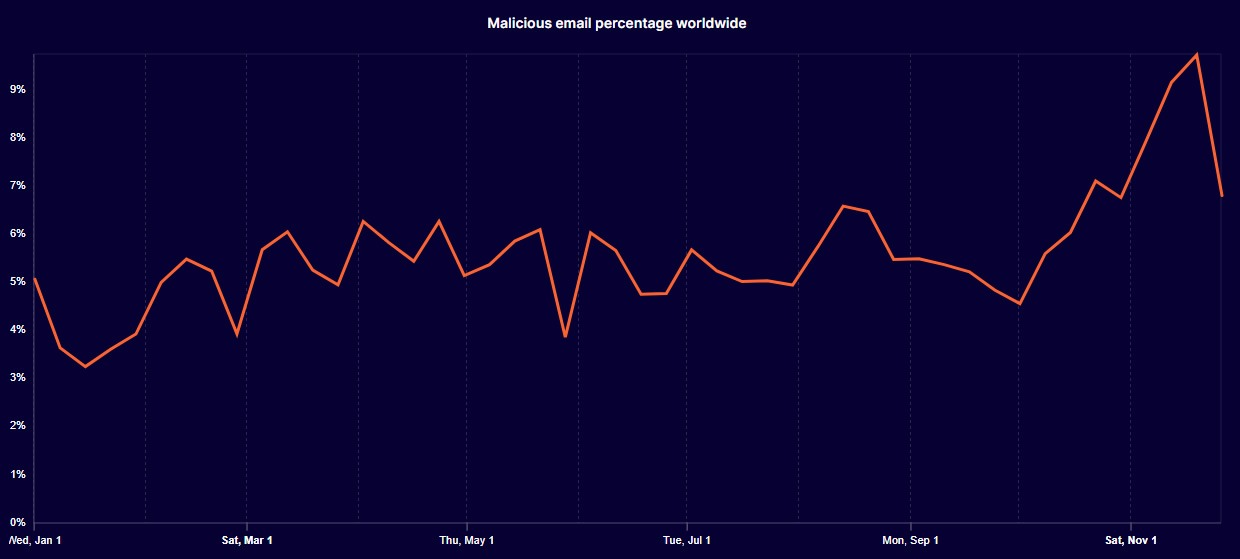
Malicious emails surged to 9.7% in November. Source: Cloudflare

Deceptive links dominate threat categories

More than half of these malicious emails, or 52%, contained a deceptive link, which was the highest threat category, it reported.

Identity deception was the second-highest at 38%, up from 35% in 2024, as attackers impersonated trusted individuals using spoofed domains, similar-looking domains, or display name tricks.

Related: Email auto-reply vulnerability allows hackers to mine cryptocurrency

Cloudflare also revealed that the most abused top-level domain (TLD) extension was “.christmas,” with 92.7% malicious emails and 7.1% spam originating from this domain type.

Other highly abused domain names included “.lol,” “.forum,” “.help,” “.best” and “.click.”
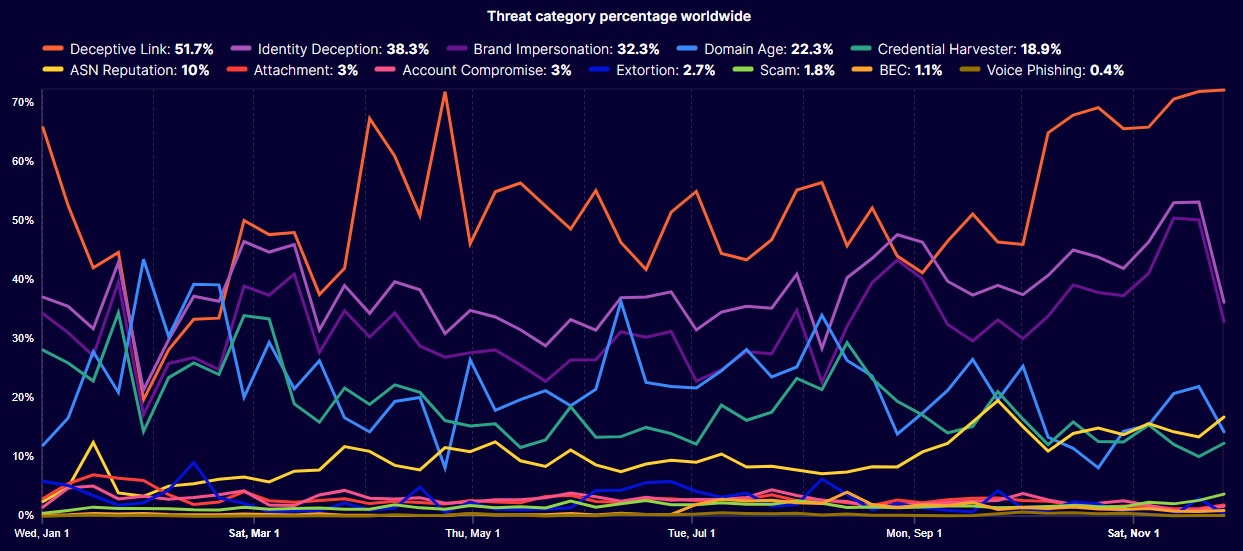
Deceptive links were the highest threat category among malicious emails. Source: Cloudflare

A quarter of HTML attachments are malicious

Earlier this year, researchers at cybersecurity company Barracuda analyzed 670 million emails that were malicious or unwanted spam.

They discovered that email remains the most common attack vector for cyber threats, with malicious attachments and links being used to distribute malware, launch phishing campaigns, and exploit vulnerabilities.

As many as one in four emails were unwanted spam, a quarter of all HTML attachments were malicious, and 12% of malicious PDF attachments were Bitcoin scams, they reported.

In November, Hornet Security reported that email was a “consistent delivery vector” for cyberattacks in 2025, with malware-laden emails surging by 131% year-over-year.

Magazine: Do Kwon sentenced to 15 years, Bitcoin’s ‘choppy dance’: Hodler’s Digest

Crypto di tendenza

Letture associate

Global Stock Market's Storm Center: South Korea's Stock Market De-leveraging Is Largely Complete

Storm's Eye: South Korean Market De-leveraging Nears Completion The recent sharp correction in South Korean equities, with the KOSPI index dropping 32% from its June high, has been a key trigger for global tech stock volatility. The core driver was not a fundamental shift but a forced de-leveraging process within the market's unique structure, which is now largely complete. Two main leverage channels amplified the sell-off: 1. **Leveraged ETFs:** Their size, proportionally four times larger than in the U.S., peaked near $50 billion. Their mandatory daily rebalancing mechanism created a vicious cycle of "price drop → forced selling → further drop." Approximately 75% of this excess has been unwound, shrinking to $26 billion, with regulatory curbs now blocking new inflows. 2. **Hedge Fund Leverage:** Using swaps to magnify exposure, hedge funds saw their net long positioning fall by over 50% from peak levels. The most intense phase of this institutional de-leveraging is over. In contrast, **retail margin debt** poses minimal systemic risk. At 0.5% of market cap, it is far lower than in the U.S. or China, lacks automatic triggers, and is concentrated in smaller stocks. The conclusion: the high-leverage structures most prone to "chain-reaction selling" have been substantially cleared. The market is transitioning from a liquidity-driven crash to one priced more on fundamentals. The article argues that the AI trend—centered on Korean memory chips—remains intact. This episode represents a painful but necessary clearing of crowded trades, not the end of the AI revolution. For investors, the key question is conviction in the long-term AI direction; if the trend is real, current volatility is a cost of entry, not a terminal risk.

链捕手1 h fa

Global Stock Market's Storm Center: South Korea's Stock Market De-leveraging Is Largely Complete

链捕手1 h fa

Trading

Spot

Articoli Popolari

Come comprare T

Benvenuto in HTX.com! Abbiamo reso l'acquisto di Threshold Network Token (T) semplice e conveniente. Segui la nostra guida passo passo per intraprendere il tuo viaggio nel mondo delle criptovalute.Step 1: Crea il tuo Account HTXUsa la tua email o numero di telefono per registrarti il tuo account gratuito su HTX. Vivi un'esperienza facile e sblocca tutte le funzionalità,Crea il mio accountStep 2: Vai in Acquista crypto e seleziona il tuo metodo di pagamentoCarta di credito/debito: utilizza la tua Visa o Mastercard per acquistare immediatamente Threshold Network TokenT.Bilancio: Usa i fondi dal bilancio del tuo account HTX per fare trading senza problemi.Terze parti: abbiamo aggiunto metodi di pagamento molto utilizzati come Google Pay e Apple Pay per maggiore comodità.P2P: Fai trading direttamente con altri utenti HTX.Over-the-Counter (OTC): Offriamo servizi su misura e tassi di cambio competitivi per i trader.Step 3: Conserva Threshold Network Token (T)Dopo aver acquistato Threshold Network Token (T), conserva nel tuo account HTX. In alternativa, puoi inviare tramite trasferimento blockchain o scambiare per altre criptovalute.Step 4: Scambia Threshold Network Token (T)Scambia facilmente Threshold Network Token (T) nel mercato spot di HTX. Accedi al tuo account, seleziona la tua coppia di trading, esegui le tue operazioni e monitora in tempo reale. Offriamo un'esperienza user-friendly sia per chi ha appena iniziato che per i trader più esperti.

448 Totale visualizzazioniPubblicato il 2024.12.10Aggiornato il 2026.06.02

Come comprare T

Discussioni

Benvenuto nella Community HTX. Qui puoi rimanere informato sugli ultimi sviluppi della piattaforma e accedere ad approfondimenti esperti sul mercato. Le opinioni degli utenti sul prezzo di T T sono presentate come di seguito.

活动图片













