Over 1 in 20 emails are malicious, warns internet giant Cloudflare

cointelegraphPubblicato 2025-12-16Pubblicato ultima volta 2025-12-16

Introduzione

According to Cloudflare's 2025 year-in-review report, over 5.6% of global email traffic was malicious, meaning more than one in twenty emails contained harmful content. This figure surged to nearly 10% in November. Malicious emails aim to steal credentials, data, or money, with deceptive links being the most common threat category at 52%. Identity deception followed at 38%. The report highlights that crypto investors are particularly at risk, as phishing attacks have grown more complex and damaging. Additionally, highly abused top-level domains include “.christmas,” “.lol,” and “.forum.” Other studies support these findings, noting that a quarter of HTML attachments are malicious and email remains a primary attack vector.

More than 5% of all emails sent worldwide contain malicious content, according to internet infrastructure giant Cloudflare.

The web security giant revealed that an aggregate of 5.6% of global email traffic analyzed by the firm over the past year was found to be malicious. This equates to more than one in every twenty emails containing harmful content.

In November, that figure surged to almost one in ten, nearly double the average for the year, it found.

Malicious emails include those that can cause harm, such as the theft of credentials, data, or money, Cloudflare explained in its 2025 year-in-review report.

The findings are particularly relevant to crypto investors, as phishing attacks targeting crypto traders, investors, and executives have increased in complexity and surged in recent months.

Crypto phishing links can be especially damaging. Once a victim falls for one of these malicious links or sends cryptocurrency to a scammer, there’s usually no way back.
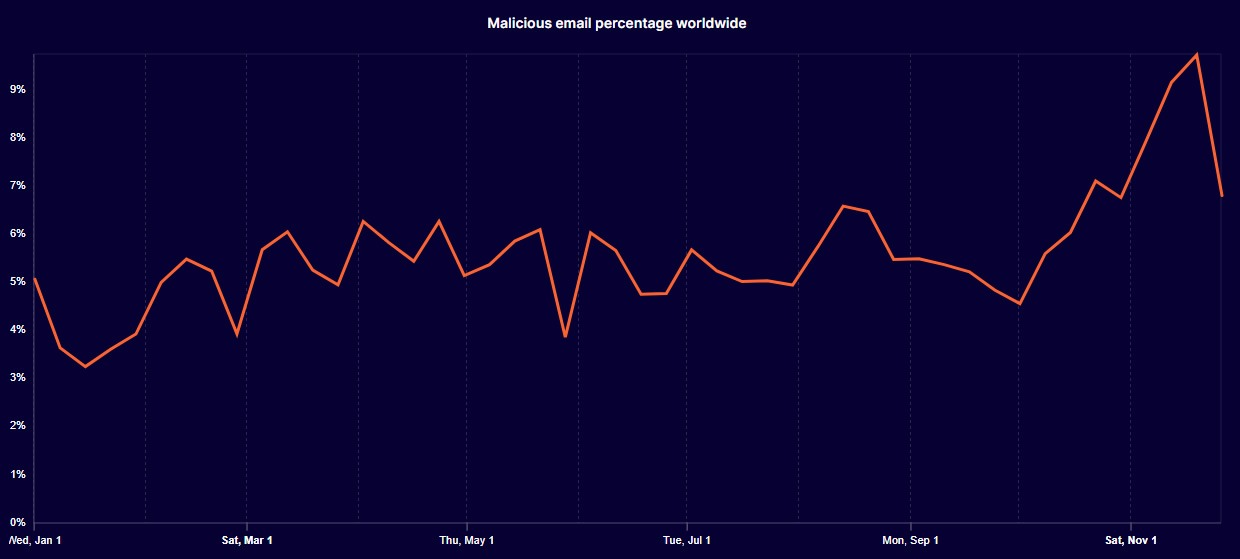
Malicious emails surged to 9.7% in November. Source: Cloudflare

Deceptive links dominate threat categories

More than half of these malicious emails, or 52%, contained a deceptive link, which was the highest threat category, it reported.

Identity deception was the second-highest at 38%, up from 35% in 2024, as attackers impersonated trusted individuals using spoofed domains, similar-looking domains, or display name tricks.

Related: Email auto-reply vulnerability allows hackers to mine cryptocurrency

Cloudflare also revealed that the most abused top-level domain (TLD) extension was “.christmas,” with 92.7% malicious emails and 7.1% spam originating from this domain type.

Other highly abused domain names included “.lol,” “.forum,” “.help,” “.best” and “.click.”
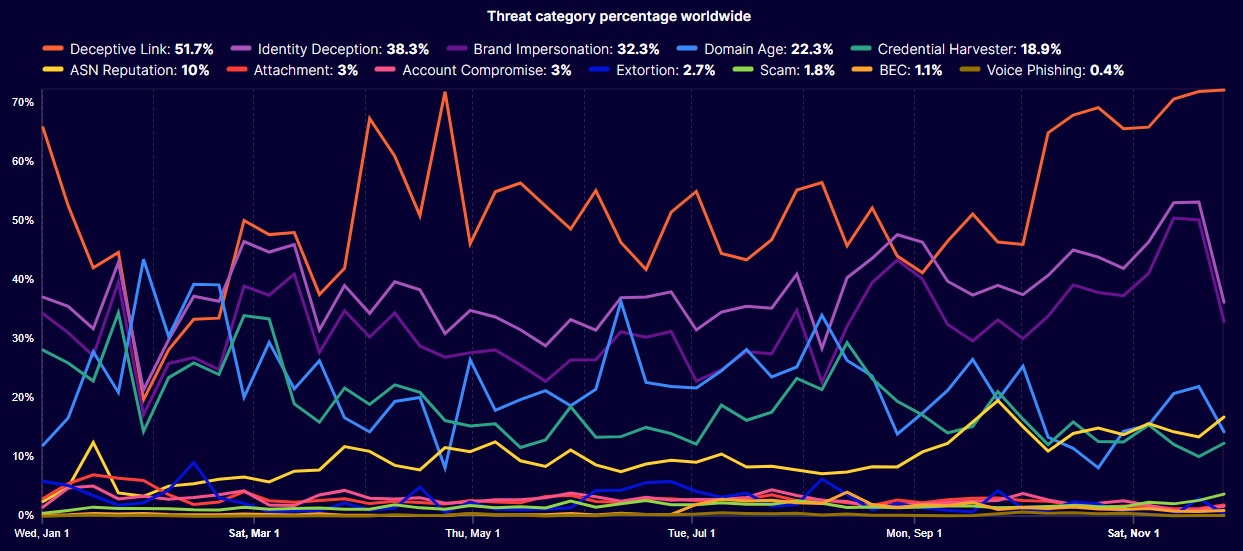
Deceptive links were the highest threat category among malicious emails. Source: Cloudflare

A quarter of HTML attachments are malicious

Earlier this year, researchers at cybersecurity company Barracuda analyzed 670 million emails that were malicious or unwanted spam.

They discovered that email remains the most common attack vector for cyber threats, with malicious attachments and links being used to distribute malware, launch phishing campaigns, and exploit vulnerabilities.

As many as one in four emails were unwanted spam, a quarter of all HTML attachments were malicious, and 12% of malicious PDF attachments were Bitcoin scams, they reported.

In November, Hornet Security reported that email was a “consistent delivery vector” for cyberattacks in 2025, with malware-laden emails surging by 131% year-over-year.

Magazine: Do Kwon sentenced to 15 years, Bitcoin’s ‘choppy dance’: Hodler’s Digest

Crypto di tendenza

Letture associate

Strategy's Loss in the Second Quarter Reaches $8.22 Billion Amid Bitcoin Decline

Strategy, the largest corporate holder of Bitcoin, reported a net loss of $8.22 billion for the second quarter. This loss was primarily driven by an $8.32 billion unrealized loss on its Bitcoin holdings due to a decline in the asset's price during the period. Despite these paper losses, the company increased its Bitcoin holdings to 843,775 BTC, a 25% growth since the start of the year. As part of a new monetization strategy, Strategy sold approximately $218.4 million worth of Bitcoin, mainly to fund dividends for preferred shareholders, with $216 million of that sold after Q2 ended. The company also built a $3.75 billion cash reserve, which it claims is sufficient to cover over two years of dividend and interest payments, aiming to insulate itself from Bitcoin's volatility while meeting obligations. Following the earnings release, Strategy's stock (MSTR) rose 4.7% in regular trading but corrected slightly after-hours. This pattern reflects how the company's accounting results are heavily tied to Bitcoin's price swings, even as its long-term strategy remains unchanged. The report indicates that Strategy is maintaining its core strategy of accumulating Bitcoin while building a financial buffer. This quarterly loss follows a recognizable pattern, with the company posting significant unrealized losses in previous quarters (e.g., $12.4 billion in Q4 2025 and ~$12.5 billion in Q1 2026) due to fair-value accounting. A key technical shift is its new monetization program, which introduces periodic selling pressure on the market, transitioning Strategy from a pure accumulator to a participant that occasionally adds supply. A critical question remains: how long can the cash reserve cover dividend obligations if a Bitcoin price downturn persists beyond two years?

cryptonews.ru12 min fa

Strategy's Loss in the Second Quarter Reaches $8.22 Billion Amid Bitcoin Decline

cryptonews.ru12 min fa

Will Terrorist Durov Ban Russian Officials?

Telegram founder Pavel Durov publicly reacted to being labeled a "terrorist" by Russian authorities, stating the designation came after he refused demands for mass surveillance and censorship on the platform. In a Telegram post, he highlighted that this status formally bans him from "publishing information online." Durov concluded with a statement widely circulated: Russian officials "clearly don't understand who can ban whom on the internet." This remark suggests Durov could potentially restrict official Russian government and officials' channels on Telegram, which continue to operate on the platform despite its formal blocking in Russia. The situation parallels previous, slow-moving state directives, like switching officials to domestic cars, contrasted with the current push to migrate all government communication to the Russian-made messenger MAX by 2030. However, reports indicate many officials still use Telegram via workarounds, fearing surveillance on MAX, while alternatives like BiP and KakaoTalk recently became inaccessible in Russia without a VPN. Durov has not specified any immediate actions against state channels. His statement is an initial response, with further developments depending on the authorities' reaction. The dynamic differs from 2020 when Russian regulators lifted a block on Telegram; now, Durov implies control from within the platform itself over the official accounts that persisted through that earlier blockade.

cryptonews.ru12 min fa

Will Terrorist Durov Ban Russian Officials?

cryptonews.ru12 min fa

DeepSeek V4 Official Version Arrives, New Capabilities Emerge, Value-for-Money King Enters the Fray

On July 31st, DeepSeek officially launched the public API beta for its DeepSeek-V4-Flash model. A key highlight is its performance on multiple Agent benchmark tests, reportedly nearing or even surpassing the level of the V4-Pro preview version from three months ago. Notably, the Flash model achieves this with significantly smaller scale (130B active parameters vs. Pro's 490B), suggesting that post-training optimization and data quality may be as crucial as raw model size. DeepSeek emphasized that the V4-Flash-0731 uses the same model architecture and size as its preview version, with improvements attributed solely to "re-trained post-training." The update also marks the official debut of DeepSeek's self-developed Agent framework, "Harness." The move signals DeepSeek's strategic push to position its cost-effective Flash model as a competitive base for Agent applications—scenarios requiring autonomous planning, tool usage, and complex task execution—where inference speed and cost are critical. By natively supporting OpenAI's Responses API format and adapting for code-generation scenarios, DeepSeek aims not just to be a cheaper alternative but to establish its own ecosystem in the Agent era. This release follows DeepSeek's record-breaking ~$50 billion fundraising round roughly two months prior, underscoring market confidence in its technology and commercialization prospects. The company is reportedly preparing for another funding round at a valuation of approximately $71 billion. The Flash model's advancement represents a step in fulfilling the high expectations that come with this valuation, setting the stage for the impending release of the V4-Pro official version and intensifying competition in the global Agent landscape.

marsbit17 min fa

DeepSeek V4 Official Version Arrives, New Capabilities Emerge, Value-for-Money King Enters the Fray

marsbit17 min fa

Trading

Spot

Articoli Popolari

Come comprare T

Benvenuto in HTX.com! Abbiamo reso l'acquisto di Threshold Network Token (T) semplice e conveniente. Segui la nostra guida passo passo per intraprendere il tuo viaggio nel mondo delle criptovalute.Step 1: Crea il tuo Account HTXUsa la tua email o numero di telefono per registrarti il tuo account gratuito su HTX. Vivi un'esperienza facile e sblocca tutte le funzionalità,Crea il mio accountStep 2: Vai in Acquista crypto e seleziona il tuo metodo di pagamentoCarta di credito/debito: utilizza la tua Visa o Mastercard per acquistare immediatamente Threshold Network TokenT.Bilancio: Usa i fondi dal bilancio del tuo account HTX per fare trading senza problemi.Terze parti: abbiamo aggiunto metodi di pagamento molto utilizzati come Google Pay e Apple Pay per maggiore comodità.P2P: Fai trading direttamente con altri utenti HTX.Over-the-Counter (OTC): Offriamo servizi su misura e tassi di cambio competitivi per i trader.Step 3: Conserva Threshold Network Token (T)Dopo aver acquistato Threshold Network Token (T), conserva nel tuo account HTX. In alternativa, puoi inviare tramite trasferimento blockchain o scambiare per altre criptovalute.Step 4: Scambia Threshold Network Token (T)Scambia facilmente Threshold Network Token (T) nel mercato spot di HTX. Accedi al tuo account, seleziona la tua coppia di trading, esegui le tue operazioni e monitora in tempo reale. Offriamo un'esperienza user-friendly sia per chi ha appena iniziato che per i trader più esperti.

457 Totale visualizzazioniPubblicato il 2024.12.10Aggiornato il 2026.06.02

Come comprare T

Discussioni

Benvenuto nella Community HTX. Qui puoi rimanere informato sugli ultimi sviluppi della piattaforma e accedere ad approfondimenti esperti sul mercato. Le opinioni degli utenti sul prezzo di T T sono presentate come di seguito.

活动图片