Over $1 Billion in Cryptocurrencies Forced to Liquidate, Bitcoin Plunges 6% Below $67,000

华尔街日报Pubblicato 2026-06-02Pubblicato ultima volta 2026-06-02

Introduzione

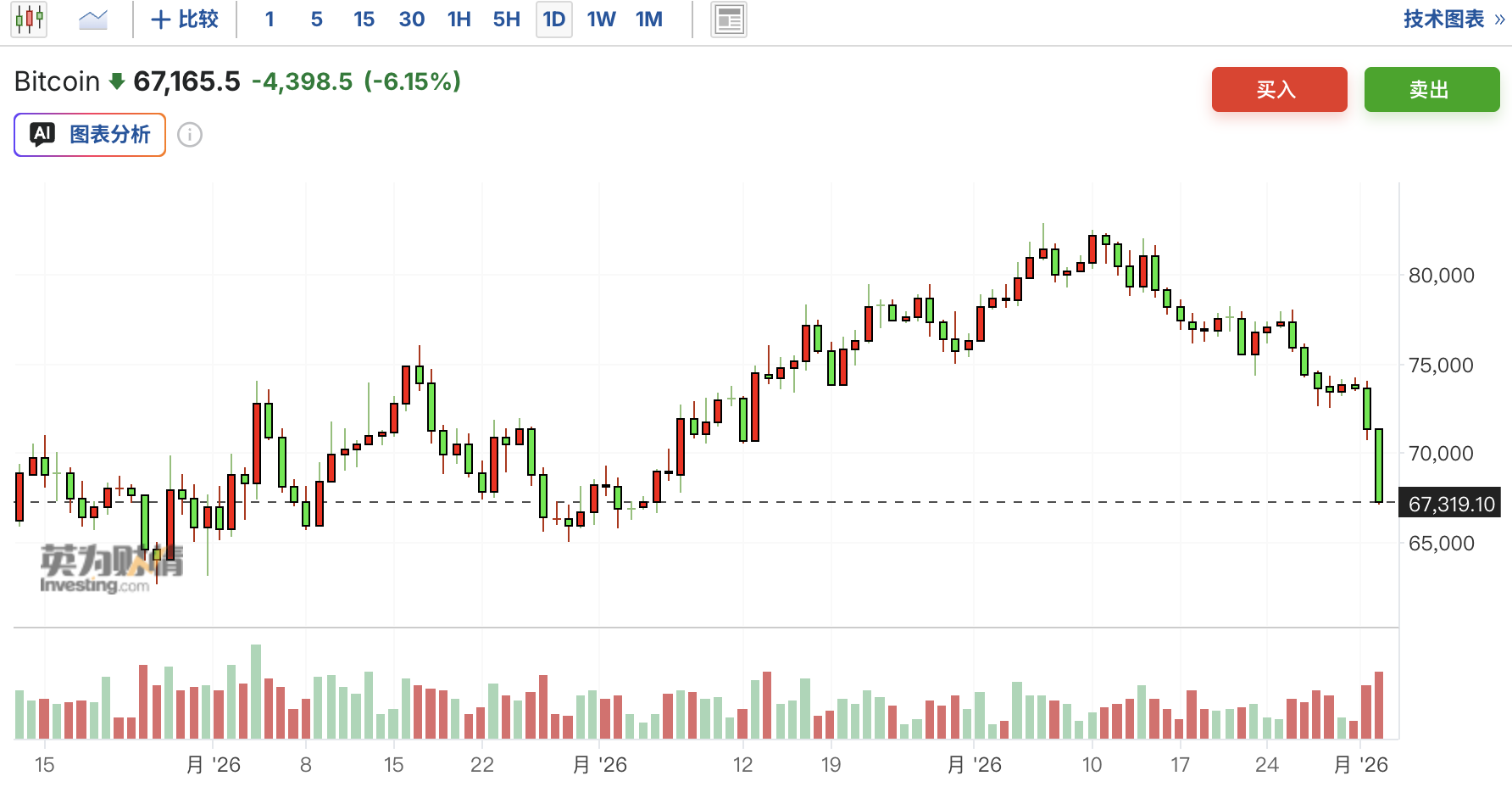
Bitcoin plunged over 6%, breaching the $67,000 mark for the first time since April 5, triggering more than $1 billion in cryptocurrency liquidations—the highest level since February. The sell-off was driven by deteriorating market sentiment amid heightened geopolitical risks from the Iran situation and a symbolic shift in strategy from a major holder. In a significant psychological blow to the market, MicroStrategy disclosed the sale of approximately 32 bitcoins, marking its first divestment since late 2022 and breaking its long-standing "buy-only" stance. Concurrently, U.S. spot Bitcoin ETFs have seen net outflows for a record 11 consecutive days, with approximately $3.5 billion withdrawn, removing a key traditional price support. Analysts note that positive catalysts from U.S. crypto regulatory progress have been completely offset by prevailing risk-off sentiment. Bitcoin is now down nearly 50% from its all-time high of around $126,000 set in October last year, starkly underperforming the rising Wall Street equity markets.

Bitcoin sentiment deteriorated sharply, triggering a wave of forced liquidations exceeding $1 billion, the most severe market pressure in recent months.

Bitcoin fell as much as 6% on Tuesday, breaking below $67,000 for the first time since April 5th. Geopolitical risks from the ongoing situation in Iran, coupled with selling actions from major holder Strategy, jointly dampened investor risk appetite. According to CoinGlass data, the scale of forced liquidations in this round reached its highest level since February this year.

Simultaneously, the two major traditional sources of demand that have historically supported Bitcoin's price—spot ETFs and Strategy—are concurrently turning into drags on the price, further intensifying market pressure.
Strategy's Selling Triggers Sentiment Turning Point

Strategy disclosed on Monday that the company sold approximately 32 bitcoins, raising about $2.5 million, marking its first reduction in holdings since late 2022. Compared to its total Bitcoin position of about $59 billion, the scale of this sale is minuscule. However, it broke the company's long-standing "only buy, never sell" minimalist strategy at a sensitive moment for the market.

Jasper De Maere, an over-the-counter trader at market maker Wintermute, stated:

"This selling wave appears to have been triggered by Strategy's disclosure of selling 32 bitcoins. But the reality is that even without this news, market momentum was already waning, and institutional participation on OTC desks had also receded to low levels."

Sustained ETF Net Outflows Heighten Price Fragility

According to data compiled by Bloomberg, U.S. spot Bitcoin ETFs have recorded net outflows for 11 consecutive trading days, setting a record for the longest consecutive outflow streak. During this period, investors redeemed a total of approximately $3.5 billion.

James Butterfill, Head of Research at CoinShares, pointed out that the price cushioning effect brought by the advancement of U.S. crypto regulatory legislation has been "completely offset" by safe-haven sentiment triggered by the situation in Iran.

Bitcoin is now down nearly 50% from its all-time high of approximately $126,000, which was set in October last year. Meanwhile, Wall Street stocks continue to rise amid a resurgence in AI trading and expectations of a ceasefire agreement, forming a stark contrast with the crypto market.


Domande pertinenti

QWhat event triggered over $1 billion in cryptocurrency liquidations according to the article?

AA sharp deterioration in Bitcoin sentiment, triggered by a combination of geopolitical risks from the Iran situation and the symbolic selling of 32 bitcoins by MicroStrategy.

QHow much did Bitcoin's price fall on Tuesday, and what key level did it break?

ABitcoin fell 6% and broke below the $67,000 level for the first time since April 5.

QWhat was significant about MicroStrategy's recent sale of 32 bitcoins, as described in the article?

AIt marked the company's first sale since late 2022 and broke its long-standing 'buy and hold only' minimalist strategy, acting as a negative sentiment trigger in a sensitive market.

QWhat is the current state of U.S. spot Bitcoin ETFs, and what record was mentioned?

AU.S. spot Bitcoin ETFs have experienced 11 consecutive days of net outflows, which is a record-long streak, with investors redeeming approximately $3.5 billion during this period.

QWhat two major traditional sources of Bitcoin demand have turned into a drag on its price?

ASpot Bitcoin ETFs (due to sustained net outflows) and MicroStrategy (due to its symbolic sell-off), both of which are now contributing to market pressure.

Letture associate

Can DeepSeek Save China One Trillion Dollars?

"DeepSeek and the $1 Trillion Infrastructure Question" The article examines whether DeepSeek's AI optimization breakthroughs could potentially save China $1 trillion in future AI infrastructure costs. The analysis begins with Nvidia's upcoming Vera Rubin AI platform, costing ~$7.8 million, where memory (HBM4/LPDDR5X) constitutes $2 million—a 435% cost increase in one year, highlighting how AI hardware spending is shifting toward expensive memory components. DeepSeek's approach works in the opposite direction. Through three key technical innovations showcased in DeepSeek V4, the company dramatically improves hardware efficiency: 1. **Memory Compression (MLA)**: Re-engineers the attention mechanism to compress long-context memory (KV Cache) by over 90%, drastically reducing expensive HBM usage. 2. **Selective Activation (MoE)**: Employs Mixture-of-Experts architecture where only a small fraction of parameters (e.g., 49B out of 1.6T in V4-Pro) are activated per token, allowing most parameters to reside in cheaper memory/SSD. 3. **Computation Caching**: Reuses previously computed results via cache hits, replacing expensive GPU computations with cheap memory reads. Combined, these optimizations allow the same hardware to produce approximately 4x more tokens, effectively reducing required hardware investment by 75%. DeepSeek's pricing reflects this: a 10-billion token workload costs ~$522 monthly versus ~$9,000-$10,000 for competitors. The $1 trillion savings projection stems from McKinsey's estimate that global AI infrastructure will require ~$5.2 trillion investment by 2030. As China's daily token consumption grows toward quadrillions, even marginal efficiency gains scale massively. With a conservative 4x throughput improvement, China could avoid building tens of thousands of AI data centers equivalent to ~7 trillion RMB ($1 trillion) in saved investment. Critically, this strategy shifts dependency from scarce, expensive GPU/HBM—where China lags—toward more accessible storage, caching, and systems engineering where domestic suppliers like CXMT are gaining strength. Rather than "replacing Nvidia," DeepSeek rebalances AI's value chain away from monolithic hardware dependency. Ultimately, DeepSeek's technical breakthroughs could lower the barrier to AI adoption across Chinese industries by making advanced capabilities affordable at scale—transforming who can access next-generation AI.

marsbit40 min fa

Can DeepSeek Save China One Trillion Dollars?

marsbit40 min fa

Overturning the Mainstream Approach to Hallucinations: Metacognition is the New Solution for Large Models to Break the Hallucination Barrier

This paper, "Hallucinations Undermine Trust; Metacognition is a Way Forward," proposes a paradigm shift in combating AI hallucination. It argues that the current mainstream approaches—striving for omniscience by scaling data/models or having AI abstain from uncertain answers—are fundamentally flawed. The former has inevitable knowledge gaps, while the latter imposes a crippling "utility tax," requiring the rejection of many correct answers to achieve high accuracy, due to models' poor "discrimination" (the ability to distinguish correct from incorrect answers internally). The core contribution is redefining hallucination not as "being wrong," but as "expressing false information with unwarranted certainty." The proposed solution is **Faithful Uncertainty** or **Metacognition**: enabling AI to accurately perceive its internal uncertainty and honestly express it in its language (e.g., using hedging phrases when unsure). This creates a more reliable assistant that provides useful information while signaling its confidence, minimizing harm from errors. The paper emphasizes that metacognition is critical for the era of AI Agents. Without it, Agents cannot intelligently decide when to use tools like search engines, leading to inefficiency and misuse. Key implementation challenges are highlighted: the "bootstrapping paradox" of training with static uncertainty data, the "alignment distortion signal" where human preference training suppresses internal uncertainty cues, and the difficulty of causally evaluating true metacognition vs. its superficial imitation. The paper concludes that the goal should not be an infallible AI, but one that is honest about the limits of its knowledge, thereby building user trust through transparent communication of its certainty.

marsbit45 min fa

Overturning the Mainstream Approach to Hallucinations: Metacognition is the New Solution for Large Models to Break the Hallucination Barrier

marsbit45 min fa

Hedge by Buying Gold and Oil, Chase Soaring Returns with AI. ‘Dated’ Bitcoin Enters a Bear Market

Bitcoin has recently declined, hitting a two-month low near $66,123, while Ethereum fell to a three-month low around $1,837. Analysts suggest the drop is not merely due to factors like ETF outflows or MicroStrategy's selling but reflects a deeper issue: Bitcoin is losing a broader asset competition. In a near-zero interest rate environment, Bitcoin previously thrived as an outlet for investor dissatisfaction with inflation and limited options. However, the market landscape has shifted. Bitcoin now occupies an "awkward middle ground," facing competition on three fronts. For inflation hedging, investors prefer gold, energy stocks, and commodity producers—assets with tangible backing and clearer pricing power. For growth exposure, AI-related companies with actual revenues and profits are more attractive. Even within crypto, investors can choose stablecoins, exchanges, or infrastructure firms tied directly to adoption, offering clearer business models and leverage. Thus, Bitcoin is no longer the top choice for hedging, growth, or crypto exposure. This shift is evident in market reactions: despite recent warnings about persistent inflation from a Fed official, Bitcoin did not rally as it might have in the past. Instead, capital flowed to assets with direct commodity or energy exposure. The recent ETF outflows and MicroStrategy sales are symptoms, not causes, of this new reality. Investors are becoming more selective, demanding clearer value propositions beyond mere scarcity. The emerging bear case for Bitcoin is not about it being a bubble or failed technology, but that scarcity alone is no longer sufficient.

华尔街日报48 min fa

Hedge by Buying Gold and Oil, Chase Soaring Returns with AI. ‘Dated’ Bitcoin Enters a Bear Market

华尔街日报48 min fa

Trading

Spot
Futures
活动图片