Orbs Launches Institutional DeFi Trading Infrastructure

TheNewsCryptoPubblicato 2026-06-12Pubblicato ultima volta 2026-06-12

Introduzione

Orbs has launched "Orbs Institutional," a new infrastructure offering designed to provide institutional clients like trading desks, OTC firms, and custodians with direct access to its on-chain execution technology. This move expands the reach of its protocol, which has processed over $2.5 billion in spot volume since 2023. The core of the service is the Liquidity Hub, an aggregation protocol that sources liquidity from professional market makers and DEXes to improve execution quality and reduce MEV risks. Institutions gain access to trading tools like dTWAP and dLIMIT, while maintaining control of their assets through EIP-712 compatible custody solutions. Orbs Institutional offers integration via direct APIs for clients or white-label solutions for platforms. The company believes this direct, transparent, and self-custodied infrastructure will drive the next phase of institutional DeFi adoption as demand for sophisticated on-chain trading grows.

Today, Orbs, the decentralized Layer-3 blockchain infrastructure dedicated to sophisticated on-chain trading, unveiled Orbs Institutional, a new offering that gives trading desks, OTC companies, treasuries, custodians, and financial platforms direct access to its on-chain execution infrastructure.

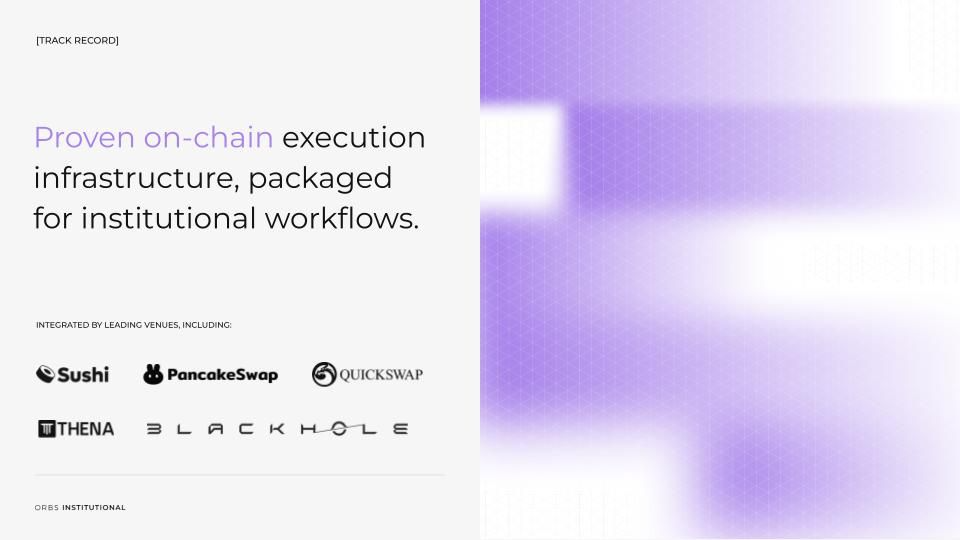
The rollout expands upon technology that, since 2023, has handled over $2.5 billion in spot trade volume across over 10 blockchain networks and over 30 decentralized exchange integrations. The infrastructure, which was previously accessible via well-known decentralized trading platforms like PancakeSwap, SushiSwap, QuickSwap, and THENA, is now being made directly available to institutional market players.

Businesses are increasingly investigating on-chain execution as a component of their trading operations as institutional acceptance of decentralized finance keeps expanding. However, while operating in decentralized markets, many institutions continue to encounter difficulties with regard to execution quality, custody requirements, and transparency.
“Institutions shouldn’t have to choose between the efficiency of decentralized markets and the standards they expect from professional trading infrastructure,” said Ran Hammer, Chief Business Officer at Orbs. “We’ve spent years building and refining execution technology that now powers some of the most active trading venues in DeFi. With Orbs Institutional, we’re making that infrastructure directly accessible to trading desks, treasuries, custodians and platforms looking to execute on-chain with greater transparency, competitive pricing and full control over their assets.”

Liquidity Hub, Orbs’ liquidity aggregation protocol, which sources liquidity from professional market makers and decentralized exchanges via a private RFQ layer intended to enhance execution quality while lowering exposure to MEV and front-running, is at the core of the offering. Additionally, Orbs’ execution tools, like as dTWAP, dLIMIT, and dSLTP, are made available to institutions.

Orders may be signed using current custody, treasury, or MPC infrastructure that meets the EIP-712 standard, and assets stay under client control throughout the execution lifecycle. Since 2017, the protocol has been operational in production with no known vulnerabilities thanks to audited smart contracts that don’t need admin keys.

There are two main integration routes that Orbs Institutional offers. While wallets, custodians, exchanges, MPC providers, and prime brokers may include Orbs’ execution capabilities into their current products via white-label or co-branded installations, institutional customers can connect directly using APIs to access the execution stack.

Orbs anticipates a rise in demand for transparent, self-custodied, and automated execution infrastructure as institutional involvement in digital asset markets continues to grow. According to the business, professional market players looking for direct access to on-chain liquidity and execution tools will spearhead the next stage of DeFi adoption.

A decentralized Layer 3 blockchain Orbs, was created for advanced on-chain trading. Orbs functions as an additional execution layer using a Proof-of-Stake consensus, allowing sophisticated logic and scripts that are not possible with traditional smart contracts. CeFi-level execution is brought to decentralized markets with Orbs-powered protocols such as dLIMIT, dTWAP, Liquidity Hub, and Perpetual Hub. Orbs continues to develop at the cutting edge of blockchain infrastructure with a worldwide staff spread across many locations. Visit www.orbs.com to find out more.


TagsAltcoinBlockchain

Domande pertinenti

QWhat is Orbs Institutional and what does it offer to the market?

AOrbs Institutional is a new offering from Orbs that provides trading desks, OTC companies, treasuries, custodians, and financial platforms with direct access to its on-chain execution infrastructure, aiming to bridge the gap between the efficiency of decentralized markets and professional trading standards.

QWhat technology is at the core of the Orbs Institutional offering?

AAt the core of the offering is Orbs' Liquidity Hub protocol, which aggregates liquidity from professional market makers and decentralized exchanges via a private RFQ layer to enhance execution quality and reduce exposure to MEV and front-running.

QWhat execution tools are made available to institutions through Orbs Institutional?

AOrbs Institutional makes execution tools such as dTWAP, dLIMIT, and dSLTP available to institutions for sophisticated on-chain trading.

QHow does Orbs Institutional address custody concerns for institutional clients?

AThroughout the execution lifecycle, client assets remain under their control. Orders can be signed using existing custody, treasury, or MPC infrastructure that complies with the EIP-712 standard, and the system uses audited smart contracts with no admin keys.

QWhat are the two main integration paths offered by Orbs Institutional?

AOrbs Institutional offers two main integration paths: 1) Institutional clients can connect directly via APIs to access the execution stack. 2) Wallets, custodians, exchanges, MPC providers, and prime brokers can integrate Orbs' execution capabilities into their existing products through white-label or co-branded installations.

Letture associate

$9.4 Billion: The Largest Robotics Funding This Year Has Emerged

Munich-based humanoid robotics company Neura has completed a $1.4 billion (approximately RMB 94.9 billion) Series C funding round, valuing the company at around $7 billion and positioning it among the global leaders in the sector. The investment round is notable not just for its size—reportedly the largest in robotics this year—but also for its strategic backers, which include tech giants like NVIDIA and Amazon, alongside established industrial players such as German engineering firms Bosch and Schaeffler. This mix of investors signals a significant shift in the industry's focus from technological demonstrations and general-purpose narratives toward practical, industrial deployment and commercialization. Neura's approach centers on developing humanoid robots for defined, high-value industrial tasks rather than pursuing a general-purpose model. Its early validation comes from a partnership with BMW, where its robots are being tested on actual production lines. The involvement of Bosch and Schaeffler, companies deeply embedded in global manufacturing, underscores a growing belief that humanoid robots are transitioning from labs to viable factory-floor solutions. The article highlights two converging trends driving investment: advancements in AI and large language models, which enhance robots' perception and decision-making in unstructured environments, and mounting pressure from labor shortages and rising costs in major manufacturing regions. The funding landscape is now bifurcating between companies like Figure AI, focusing on versatile general-purpose robots, and firms like Neura, targeting specific vertical industrial applications with clearer, shorter paths to ROI. While technical hurdles remain, the core challenges for widespread adoption are increasingly seen as engineering and commercial in nature: managing the high integration and customization costs for different factory environments and establishing robust, localized maintenance and service networks. The record investment in Neura, particularly from industrial capital, indicates the industry's growing confidence in moving from proving feasibility to solving the practical problems of scalability, reliability, and building sustainable business models around humanoid robots in real-world settings like automotive manufacturing and hazardous labor environments.

marsbit8 h fa

$9.4 Billion: The Largest Robotics Funding This Year Has Emerged

marsbit8 h fa

Trading

Spot
Futures
活动图片