Orbs Launches Institutional DeFi Trading Infrastructure

TheNewsCryptoPubblicato 2026-06-12Pubblicato ultima volta 2026-06-12

Introduzione

Orbs has launched "Orbs Institutional," a new infrastructure offering designed to provide institutional clients like trading desks, OTC firms, and custodians with direct access to its on-chain execution technology. This move expands the reach of its protocol, which has processed over $2.5 billion in spot volume since 2023. The core of the service is the Liquidity Hub, an aggregation protocol that sources liquidity from professional market makers and DEXes to improve execution quality and reduce MEV risks. Institutions gain access to trading tools like dTWAP and dLIMIT, while maintaining control of their assets through EIP-712 compatible custody solutions. Orbs Institutional offers integration via direct APIs for clients or white-label solutions for platforms. The company believes this direct, transparent, and self-custodied infrastructure will drive the next phase of institutional DeFi adoption as demand for sophisticated on-chain trading grows.

Today, Orbs, the decentralized Layer-3 blockchain infrastructure dedicated to sophisticated on-chain trading, unveiled Orbs Institutional, a new offering that gives trading desks, OTC companies, treasuries, custodians, and financial platforms direct access to its on-chain execution infrastructure.

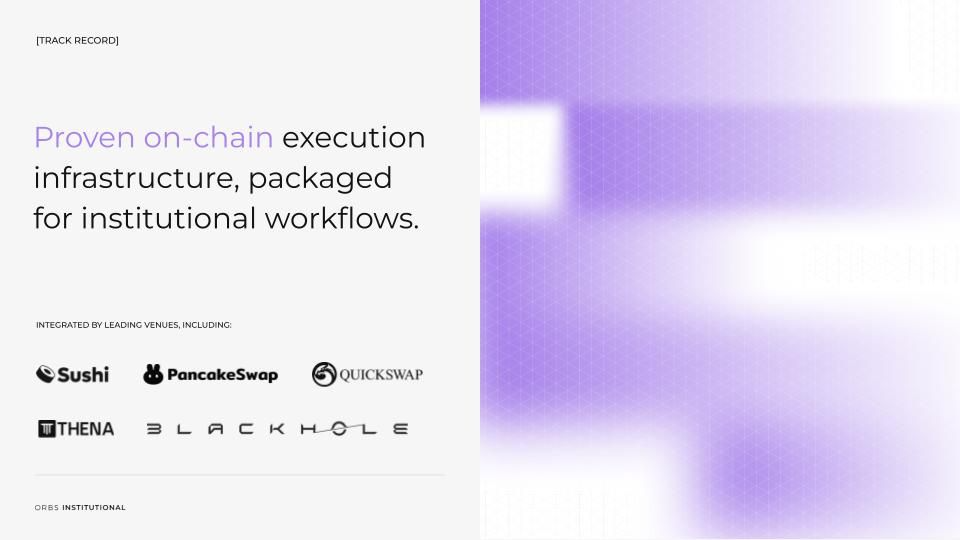
The rollout expands upon technology that, since 2023, has handled over $2.5 billion in spot trade volume across over 10 blockchain networks and over 30 decentralized exchange integrations. The infrastructure, which was previously accessible via well-known decentralized trading platforms like PancakeSwap, SushiSwap, QuickSwap, and THENA, is now being made directly available to institutional market players.

Businesses are increasingly investigating on-chain execution as a component of their trading operations as institutional acceptance of decentralized finance keeps expanding. However, while operating in decentralized markets, many institutions continue to encounter difficulties with regard to execution quality, custody requirements, and transparency.
“Institutions shouldn’t have to choose between the efficiency of decentralized markets and the standards they expect from professional trading infrastructure,” said Ran Hammer, Chief Business Officer at Orbs. “We’ve spent years building and refining execution technology that now powers some of the most active trading venues in DeFi. With Orbs Institutional, we’re making that infrastructure directly accessible to trading desks, treasuries, custodians and platforms looking to execute on-chain with greater transparency, competitive pricing and full control over their assets.”

Liquidity Hub, Orbs’ liquidity aggregation protocol, which sources liquidity from professional market makers and decentralized exchanges via a private RFQ layer intended to enhance execution quality while lowering exposure to MEV and front-running, is at the core of the offering. Additionally, Orbs’ execution tools, like as dTWAP, dLIMIT, and dSLTP, are made available to institutions.

Orders may be signed using current custody, treasury, or MPC infrastructure that meets the EIP-712 standard, and assets stay under client control throughout the execution lifecycle. Since 2017, the protocol has been operational in production with no known vulnerabilities thanks to audited smart contracts that don’t need admin keys.

There are two main integration routes that Orbs Institutional offers. While wallets, custodians, exchanges, MPC providers, and prime brokers may include Orbs’ execution capabilities into their current products via white-label or co-branded installations, institutional customers can connect directly using APIs to access the execution stack.

Orbs anticipates a rise in demand for transparent, self-custodied, and automated execution infrastructure as institutional involvement in digital asset markets continues to grow. According to the business, professional market players looking for direct access to on-chain liquidity and execution tools will spearhead the next stage of DeFi adoption.

A decentralized Layer 3 blockchain Orbs, was created for advanced on-chain trading. Orbs functions as an additional execution layer using a Proof-of-Stake consensus, allowing sophisticated logic and scripts that are not possible with traditional smart contracts. CeFi-level execution is brought to decentralized markets with Orbs-powered protocols such as dLIMIT, dTWAP, Liquidity Hub, and Perpetual Hub. Orbs continues to develop at the cutting edge of blockchain infrastructure with a worldwide staff spread across many locations. Visit www.orbs.com to find out more.


TagsAltcoinBlockchain

Domande pertinenti

QWhat is Orbs Institutional and what does it offer to the market?

AOrbs Institutional is a new offering from Orbs that provides trading desks, OTC companies, treasuries, custodians, and financial platforms with direct access to its on-chain execution infrastructure, aiming to bridge the gap between the efficiency of decentralized markets and professional trading standards.

QWhat technology is at the core of the Orbs Institutional offering?

AAt the core of the offering is Orbs' Liquidity Hub protocol, which aggregates liquidity from professional market makers and decentralized exchanges via a private RFQ layer to enhance execution quality and reduce exposure to MEV and front-running.

QWhat execution tools are made available to institutions through Orbs Institutional?

AOrbs Institutional makes execution tools such as dTWAP, dLIMIT, and dSLTP available to institutions for sophisticated on-chain trading.

QHow does Orbs Institutional address custody concerns for institutional clients?

AThroughout the execution lifecycle, client assets remain under their control. Orders can be signed using existing custody, treasury, or MPC infrastructure that complies with the EIP-712 standard, and the system uses audited smart contracts with no admin keys.

QWhat are the two main integration paths offered by Orbs Institutional?

AOrbs Institutional offers two main integration paths: 1) Institutional clients can connect directly via APIs to access the execution stack. 2) Wallets, custodians, exchanges, MPC providers, and prime brokers can integrate Orbs' execution capabilities into their existing products through white-label or co-branded installations.

Letture associate

Now the Greatest Regret Is to My Family: Crypto Experts Took a Stumble in the Stock Market

Summary: This article examines the significant losses recently suffered by cryptocurrency traders and influencers who ventured into the stock market, specifically by heavily investing in AI-related and semiconductor storage stocks. The narrative centers on the dramatic reversal in the Korean and US equity markets in late July, with stocks like SK Hynix and related leveraged ETFs experiencing historic plunges, erasing massive gains. The analysis highlights several key factors behind the "flip." Traders, accustomed to crypto's high volatility and frustrated by a stagnant market, chased the apparent momentum in AI-themed equities. Many made fatal mistakes: applying high-leverage strategies common in crypto (e.g., 2x ETFs, on-chain perpetual contracts) to stocks, and failing to understand the distinct rules of different stock markets (like Korean pre-market trading). This led to widespread liquidations, especially when a thin Korean pre-market trade triggered a cascading flash crash on a decentralized exchange. Post-crash reflections from prominent figures reveal deep regret and self-criticism. They acknowledge misjudging their expertise, overestimating their edge against sophisticated institutional players, and the dangers of leverage. The article concludes that while such setbacks are part of trading, surviving long-term requires recognizing one's limitations and the inherent risks of cross-market strategies.

marsbit49 min fa

Now the Greatest Regret Is to My Family: Crypto Experts Took a Stumble in the Stock Market

marsbit49 min fa

US Senate Makes Important Amendments to "Conflict of Interest" Section of Cryptocurrency Bill

The U.S. Senate has taken a key step regarding the CLARITY Act, which could shape the future of the U.S. crypto market. On July 29, Senators Tom Tillis and Ruben Gallego finalized amendments to the bill's "conflict of interest" rules, one of its most contentious aspects. The bipartisan bill aims to tighten restrictions on high-level federal officials' ties to digital assets. The new text, crafted as an alternative to a White House-endorsed ethics code, is expected to impose stricter rules limiting officials' ability to issue or directly participate in digital asset projects. However, with Congress entering an August recess and the revised text not yet reviewed by much of the Senate, the bill's timeline is uncertain. Senate Majority Leader John Thune indicated a procedural vote could occur between July 29 and August 1 but expressed doubt the full bill could pass before the break. The House-approved CLARITY Act, passed in July 2025, has been under Senate negotiation for over a year. Key goals of the CLARITY Act include clarifying jurisdictional boundaries between the SEC and CFTC, setting rules for digital commodity spot markets, and addressing topics like stablecoin yields, DeFi, and illicit financing. The stablecoin yield provisions could significantly impact U.S.-based DeFi protocols, exchanges, and issuers, affecting their global competitiveness. The outcome is being closely watched by both the U.S. and global digital asset markets.

cryptonews.ru1 h fa

US Senate Makes Important Amendments to "Conflict of Interest" Section of Cryptocurrency Bill

cryptonews.ru1 h fa

Pavel Durov Designated as a Terrorist in Russia. What Does This Mean for Telegram Users?

Pavel Durov, the founder of Telegram, has been added to Russia's list of terrorists and extremists by Rosfinmonitoring, as published on July 30. The entry includes his name and date of birth. The designation follows an announcement by the Russian Federal Security Service (FSB) on July 29, which charged Durov with aiding terrorist activity. The FSB alleges that a Telegram dating bot named "DaiVinchik" was used to recruit 46 individuals for attacks on police and arson, orchestrated by Ukrainian special services. The FSB also accuses Telegram's administration of failing to remove channels and bots used by Ukrainian intelligence and extremist groups. Durov is reportedly subject to an international arrest warrant. Inclusion on the Rosfinmonitoring list leads to significant restrictions: the freezing of Durov's bank accounts and assets, severe limitations on financial transactions, and a ban on election participation, media interaction, and event organization. Transfers to his accounts may be considered terrorism financing. For ordinary Russian Telegram users, purchasing Telegram Premium is not classified as financing terrorism, according to an IT expert. General use of the messenger—messaging, managing channels—does not automatically make a user a participant in extremist activity. There has been no official decision to ban Telegram itself. It is noted that French authorities are also investigating Durov over allegations of inadequate measures against criminal activity on the platform and insufficient cooperation with law enforcement. Durov denies all charges.

cryptonews.ru1 h fa

Pavel Durov Designated as a Terrorist in Russia. What Does This Mean for Telegram Users?

cryptonews.ru1 h fa

Trading

Spot
活动图片