Opinion Almost Entirely Flipped, Airdrop Value Less Than Platform Fee Revenue?

Odaily星球日报Pubblicato 2026-03-05Pubblicato ultima volta 2026-03-05

Introduzione

Opinion, a prediction market platform once hailed as one of the most anticipated airdrops of 2026, has sparked significant community backlash following its Token Generation Event (TGE). Despite raising over $25 million from top VCs and being deeply integrated with the Binance ecosystem, the project repeatedly delayed its TGE, causing its points' OTC value to drop from a peak of $45 to around $6. The controversy intensified when the tokenomics were revealed: only 3.5% of the airdropped tokens (23.5% of total supply) were unlocked at TGE, with the rest vested over 7 months. In contrast, the marketing allocation saw 7.7% unlocked immediately. This, combined with large allocations to investors, team, and advisors (totaling over 54%), angered early users who had paid high transaction fees to earn points. Many users reported losses, with one notable example being an investment of $200,000 yielding only around $1,000 worth of tokens at launch. Ironically, the platform’s cumulative fee revenue exceeded $17 million, surpassing the initial airdrop’s value. As a result, user activity and TVL plummeted, raising questions about the future of prediction markets on BNB Chain.

Original | Odaily Planet Daily (@OdailyChina)

Author | Asher(@Asher_ 0210)

TGE Repeatedly Delayed, Leading to a Continuous Drop in OTC Points Price

Another $20 Million Funding Round in February Made Opinion One of the Most Anticipated Airdrops of 2026

The rising narrative around prediction markets garnered significant attention for Opinion even before its TGE. Combined with top-tier VC backing and deep integration with the Binance ecosystem, the market once regarded it as one of the most anticipated airdrop projects of 2026.

In terms of funding, Opinion completed two rounds, raising over $25 million in total. In March 2024, the project was selected for the 7th season of Yzi Labs' MVB accelerator program, becoming one of 13 early-stage projects. In March 2025, Opinion completed a $5 million seed round led by Yzi Labs, with participation from Echo, Animoca Ventures, Manifold Trading, Amber Group, and others. By February 2026, Opinion announced another $20 million Pre-Series A funding round, co-led by Hack VC and Jump Crypto, with participation from Primitive Ventures, Decasonic, Continue Fund, and others.

Continuous support from several leading institutions led to higher market expectations for the airdrop scale and potential valuation.

TGE Was Originally Scheduled Before Chinese New Year But Repeatedly Postponed Due to Market Conditions

In December 2025, Opinion founder Forrest stated in the official Discord that the project's TGE was expected before the Chinese New Year. This quickly ignited community sentiment, with many users starting to "work overtime" to farm points and frequently participate in various prediction events to boost trading volume. As point farming became more competitive, some users' farming costs even exceeded $20 per point, all to accumulate more points before the TGE, hoping to snag the first "big airdrop" of 2026.

Opinion founder previously stated TGE would occur before Chinese New Year

However, entering February, the overall crypto market experienced a significant correction, and Opinion's TGE timeline became uncertain. The TGE, originally anticipated before the New Year, had no news, causing market expectations for the points to cool. Although Binance launched the Opinion-related Binance Wallet Booster and Alpha airdrop activities on February 4th, the official team still did not announce a clear TGE schedule. As expectations gradually cooled, the OTC price of Opinion points also fell from a high of about $45 per point to around $20 per point.

As the TGE was repeatedly delayed, community sentiment gradually turned negative. Some users began questioning the project's progress in community groups, but in the official Discord, any obvious negative comments often led to the swift removal of the involved members. Some dissatisfied users even went to other prediction market project communities, such as predict.fun, to continue venting their frustrations about Opinion's various issues.
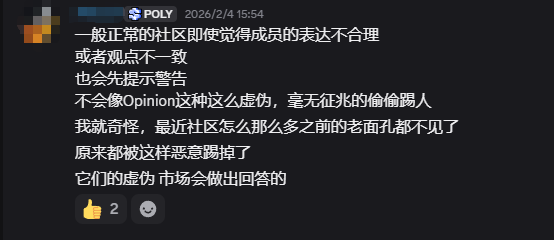
Opinion community members complaining in other prediction market project communities

Repeated TGE delays, continuous point dilution, and arbitrary kicking of members from the official community led to accumulating dissatisfaction within the Opinion community. Points kept increasing, fees kept being paid, but the answers to when the project would TGE and what it would ultimately be worth became increasingly elusive.

Airdrop Allocation Sparks Controversy: Only 3.5% of TGE Airdrop Unlocked, Marketing Allocation Unlocks a High 7.7%

After Tokenomics Revealed, Point Price Plunged to $6

On the evening of March 2nd, the Opinion Foundation officially announced the tokenomics of its native token OPN. The total supply of OPN is 1 billion tokens, with the airdrop accounting for 23.5% (235 million tokens). At first glance, this proportion is not low compared to current crypto projects.

However, the actual unlock ratio at TGE sparked controversy. Of the total airdrop allocation, only 3.5% (35 million tokens) were released on TGE day, with the remaining portion to be linearly released over 7 months. This means that for the vast majority of users who farmed points for the airdrop, the number of tokens actually received on TGE day was far lower than previous market expectations.

What further displeased the community was the unlock ratio of other allocation parts. According to the official token distribution, the Marketing portion accounts for 8.9%, but 7.7% is released at TGE, significantly higher than the airdrop release ratio. In comparison, users who participated in early interactions and contributed trading volume only received 3.5% at TGE.

This comparison quickly sparked controversy within the community—early interactive users contributing trading volume received a minimal share at TGE, while the related marketing share received a higher proportion of unlocks at launch. Simultaneously, Binance Launchpool directly received 2% of the token supply, further intensifying community dissatisfaction.

At the same time, the internal holding比例 further exacerbated community discontent. According to the token distribution, investors account for 23%, the team and advisors account for 19.5%, and the foundation accounts for 12%, totaling over 54%.
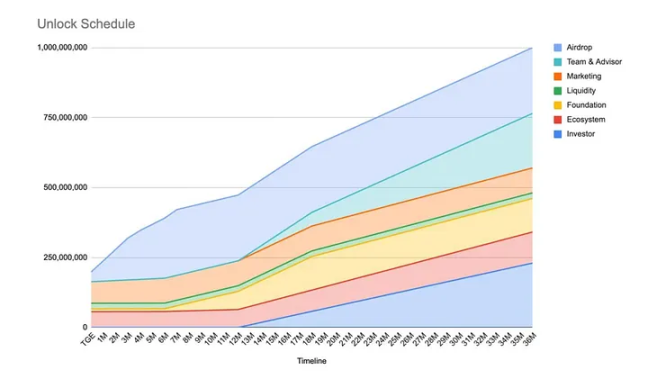
OPN Token Unlock Schedule

After the tokenomics were announced, market expectations quickly changed. Prior to this, OPN points were once quoted at $45 per point on the secondary market. With only 3.5% being airdropped at TGE, the OTC price of Opinion points plummeted, with pre-market quotes quickly falling to $6 per point.

Furthermore, many "airdrop farming whales" spent real money on fees to farm points, only to be flagged as Sybils. According to feedback data from community members, 1 point ultimately corresponded to $6, but many users with high point rankings received an airdrop value even lower than this. KOL Daidaidai Bitcoin posted his loss details on platform X: invested $200,000 to farm points,最终 received 2000 OPN, worth about $1000 at current prices. "200k USD for 2000 tokens. Yes, you read that right." This phrase quickly went viral in the Chinese crypto community.

What the community found even more ironic was that according to Dune data, Opinion's cumulative revenue from trading fees over the past months has exceeded $17 million. Calculated at current market prices, the TGE airdrop value is even lower than this figure.
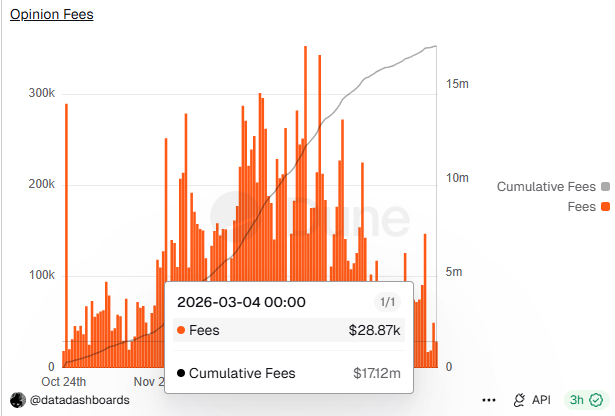
Opinion's cumulative fee revenue exceeds $17 million

Summary

From "the most anticipated airdrop of 2026" to being joked about by the community as "almost entirely flipped," Opinion's plot twist took only a few months. Although Opinion founder Forrest recently stated that more emphasis would be placed on Season 2 rewards, for many early participants, the Season 1 airdrop result has severely透支 trust.
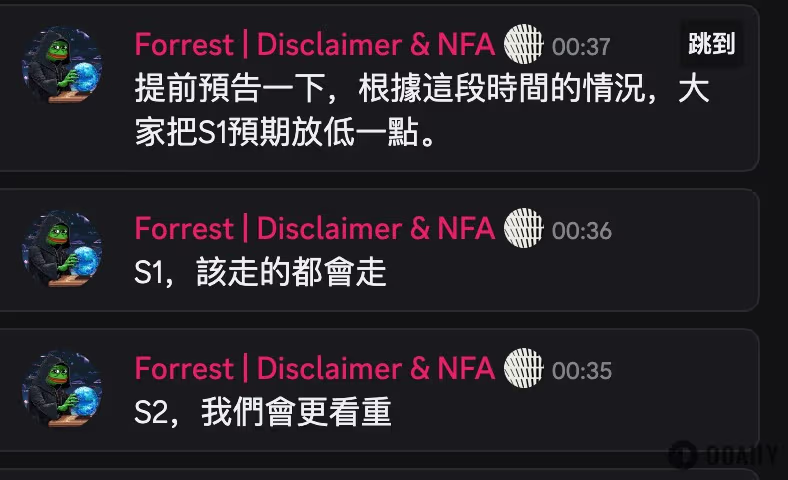
Opinion founder emphasizes greater focus on S2 rewards

This sentiment was quickly reflected in user behavior. More and more participants chose to reduce or even stop trading on the platform, and on-chain data showed a significant subsequent decline. Platform TVL plummeted from about $150 million to $36 million, and trading volume dropped from $150 million to about $15 million, indicating a clear cooling off in user activity.

Against this backdrop, the controversy surrounding Opinion is more than just an airdrop incident. As one of the most watched prediction market projects in the BNB Chain ecosystem, this event has also had a significant impact on the entire sector.

After this storm, can the BNB Chain ecosystem still produce new prediction market platforms?

Domande pertinenti

QWhat was the main reason for the community's disappointment with Opinion's airdrop?

AThe main reason was the extremely low initial unlock of the airdrop allocation. Only 3.5% of the total airdropped tokens (23.5% of total supply) were distributed at TGE, while a much higher percentage (7.7%) of the marketing allocation was unlocked immediately.

QHow did the delay of the TGE (Token Generation Event) impact the perceived value of Opinion's points?

AThe repeated delays of the TGE caused the OTC (Over-The-Counter) price of Opinion points to plummet, falling from a high of approximately $45 per point to around $6 per point after the tokenomics were revealed.

QAccording to the article, what was the total amount of fees that the Opinion platform generated from user transactions?

AAccording to Dune data cited in the article, the Opinion platform accumulated over $17 million in revenue from transaction fees.

QWhat drastic change in user activity did Opinion experience following the airdrop controversy?

AUser activity dropped significantly. The platform's TVL (Total Value Locked) plummeted from about $150 million to $36 million, and its trading volume fell from $150 million to approximately $15 million.

QWhat was the total supply of OPN tokens and what percentage was allocated to the airdrop?

AThe total supply of OPN tokens was 1 billion. The airdrop allocation was 23.5% of the total supply, which equals 235 million tokens.

Letture associate

$292 Million KelpDAO Cross-Chain Bridge Hack: Who Should Foot the Bill?

On April 18, 2026, an attacker stole 116,500 rsETH (worth ~$292M) from KelpDAO’s cross-chain bridge in 46 minutes—the largest DeFi exploit of 2026. The stolen assets were deposited into Aave V3 as collateral, causing $177–200M in bad debt and triggering a cascade of losses across nine DeFi protocols. Aave’s TVL dropped by ~$6B overnight. This legal analysis argues that KelpDAO and LayerZero Labs share concurrent liability, with fault apportioned 60%/40%. KelpDAO negligently configured its bridge with a 1-of-1 decentralized verifier network (DVN)—a single point of failure—despite LayerZero’s explicit recommendation of a 2-of-3 setup. LayerZero, which operated the compromised DVN, failed to secure its RPC infrastructure against a known poisoning attack vector. Both protocols’ terms of service cap liability at $200 (KelpDAO) or $50 (LayerZero), but these limits are likely unenforceable due to unconscionability, gross negligence exceptions, and potential securities law invalidation (if rsETH is deemed a security under the Howey test). Aave’s governance also faces fiduciary duty claims for raising rsETH’s loan-to-value ratio to 93%—far above competitors’ 72–75%—without adequately assessing bridge risks, amplifying the systemic fallout. Practical recovery targets include LayerZero Labs (a registered Canadian entity), KelpDAO’s founders, auditors, and identifiable Aave governance delegates. The incident underscores escalating legal risks for DeFi protocols, infrastructure providers, and governance participants.

marsbit4 min fa

$292 Million KelpDAO Cross-Chain Bridge Hack: Who Should Foot the Bill?

marsbit4 min fa

Insider Trading in War: 5 People Involved, the Highest Earner Was Arrested

On April 24, the U.S. Department of Justice arrested U.S. Army Special Forces Staff Sergeant Gannon Ken Van Dyke for insider trading related to the capture of Venezuelan President Nicolás Maduro on January 3. Van Dyke allegedly profited over $400,000 by placing bets on a prediction market, Polymarket, using insider knowledge of the covert operation. According to the indictment, Van Dyke registered an account (0x31a5) on December 26 and made a series of bets predicting Maduro’s capture and U.S. military involvement in Venezuela. He withdrew most of his funds on the day of the operation and attempted to obscure his tracks by transferring assets through crypto and brokerage accounts. This case marks the first time the DOJ has prosecuted insider trading on Polymarket. PolyBeats had previously identified five suspicious accounts, including Van Dyke’s—the highest earner—in January. The other accounts, with profits ranging from $34,000 to $145,000, remain under unofficial scrutiny but have not been charged. Their lower profits, indirect access to information, and unclear legal boundaries may complicate prosecution. Polymarket has since strengthened its market integrity rules, explicitly prohibiting trading based on confidential or insider information. Van Dyke’s arrest, nearly four months after his trades, signals increased regulatory attention and the persistent traceability of blockchain-based transactions.

marsbit5 min fa

Insider Trading in War: 5 People Involved, the Highest Earner Was Arrested

marsbit5 min fa

Bitwise: Bullish on Bitcoin's Performance in the Second Half of the Year, AI and Regulation Will Spark a New Altcoin Season

Bitwise CIO Matt Hougan and Research Lead Ryan Rasmussen express strong bullish sentiment on Bitcoin's long-term prospects, suggesting that its $1 million price target may be too conservative. They argue Bitcoin serves a dual role: as digital gold and a potential global settlement asset, especially amid declining trust in traditional monetary systems. Despite a weak Q1 2026 where nearly all crypto assets and prices saw double-digit declines, the analysts remain optimistic due to strong forward-looking catalysts, including institutional adoption via Bitcoin ETFs from major firms like Morgan Stanley and Goldman Sachs. Geopolitical instability, such as Iran’s mention of using Bitcoin for international payments, increases the value of Bitcoin’s “out-of-the-money call option” as a non-political, global settlement currency. This enhances its appeal beyond a mere store of value. . Additionally, Hougan highlights that a clearer regulatory token framework under current SEC leadership, combined with AI efficiency gains and high-performance blockchains, could fuel a new “altseason” by late 2026. This may lead to a wave of legitimate, value-capturing token projects, unlike the earlier ICO boom. . Bitwise also announced an Avalanche ETF, citing its unique architecture and rapid growth in real-world asset (RWA) tokenization, which has surged 10x to nearly $30 billion in two years. The firm believes Layer 1 blockchains are still early in their growth cycle, with significant potential ahead.

marsbit51 min fa

Bitwise: Bullish on Bitcoin's Performance in the Second Half of the Year, AI and Regulation Will Spark a New Altcoin Season

marsbit51 min fa

Trading

Spot
Futures
活动图片