OpenSea Launches ERC-8257: A Tool Store for AI Agents, Unlock APIs by Buying an NFT

marsbitPubblicato 2026-05-27Pubblicato ultima volta 2026-05-27

Introduzione

OpenSea has merged the ERC-8257 standard, an on-chain "Agent Tool Registry" that enables AI Agents to autonomously discover, pay for, and access tools. This standard allows developers to publish tools with programmable access rules (e.g., NFT ownership, subscriptions) and pricing directly on-chain. For example, an AI Agent needing a premium API can buy the required NFT itself and gain access without human intervention, turning NFTs into keys for the agent economy. The system works with complementary standards like ERC-8004 for agent identity and x402 for payments. A live demo shows an NFT appraisal tool offering discounted rates to holders of a specific NFT collection. ERC-8257 aims to decentralize tool distribution and access control, allowing any on-chain asset to grant utility to AI agents. The SDK is available for building on Ethereum and Base.

Author: OpenSea

Compiled by: TechFlow

TechFlow Introduction: When an AI Agent is denied by an API due to insufficient permissions, it goes and buys an NFT on-chain, then retries and succeeds — this is not science fiction; OpenSea's newly merged ERC-8257 standard makes this a reality. For NFT holders, the JPGs you own might suddenly become keys to the Agent economy. For developers, tool publishing, pricing, and access control are all placed on-chain, no longer requiring endorsement from centralized platforms.

App Store provides developers with a place to publish tools, users with a place to browse, and built-in access control and payment. The AI Agent tool ecosystem requires similar infrastructure.

But today, Agent tools are scattered across documentation, GitHub repositories, and centralized directories. There is no open tool registry, no standardized access control, and Agents cannot browse available tools and acquire them as needed.

Watching a software pay another software autonomously for access, with no human intervention — it feels a bit strange indeed. But that's precisely the point.

ERC-8257: Agent Tool Registry is the foundational layer that makes all this work. This is the newly merged open Ethereum standard: an on-chain registry where anyone can publish tools, declare access rules and pricing, allowing Agents to autonomously meet these requirements.

For Tool Developers: Publish once, set access thresholds for your NFT holders, offer subscription packages, limit seat counts, let them trade in open markets. Your rules, executed on-chain.

For Agents: Browse the registry, see what's required, then handle it. Purchase an NFT, mint a subscription, sign a payment. No human intervention needed.

Imagine This Scenario

An AI Agent is helping you evaluate NFT prices. It tries to call a professional pricing tool. The tool responds: Access denied, you need to hold a specific NFT for a discounted price. The Agent immediately buys one on-chain, retries, and gets the answer.

Seconds, not days. No human involvement throughout.

This is the world ERC-8257 makes possible. Not five years from now. Today.

Why On-Chain?

Crypto is the only infrastructure that allows access rules to be both rich and self-service. x402 proved it: pay-per-call, immediate access. But pay-per-call is just one form of access. Trading signals might need limited seats. Partner APIs might be open only to holders. Research subscriptions might require tiered pricing. ERC-8257 handles it all.

How It Works

You register a tool with a manifest (tool functions, invocation methods, fees) and an "access predicate." The access predicate is a smart contract that answers one question: Does this address have access?

A predicate can check any condition: NFT ownership, active subscription (ERC-5643), whitelist, ZK proof, DAO vote, staking amount. Predicates are pluggable, following the same pattern as Seaport zones and Uniswap v4 hooks: an extension point, an open design space.

ERC-8257 handles discovery and access control. Payment is handled by the most suitable protocol: x402 for micropayments, MPP for metered billing, others join as needed. These layers are composable.

What This Means for NFTs

Every NFT collection just gained new potential utility.

Hold the right token, and your Agent gets cheaper API packages. Mint a limited seat, and your Agent gains access that others can't buy at any price. PFP collections, membership passes, CC0 artwork — any on-chain asset can become a key to tools your Agent needs to do its job.

Projects built around community identity now have a way to extend membership into the Agent economy.

Its Place in the Tech Stack
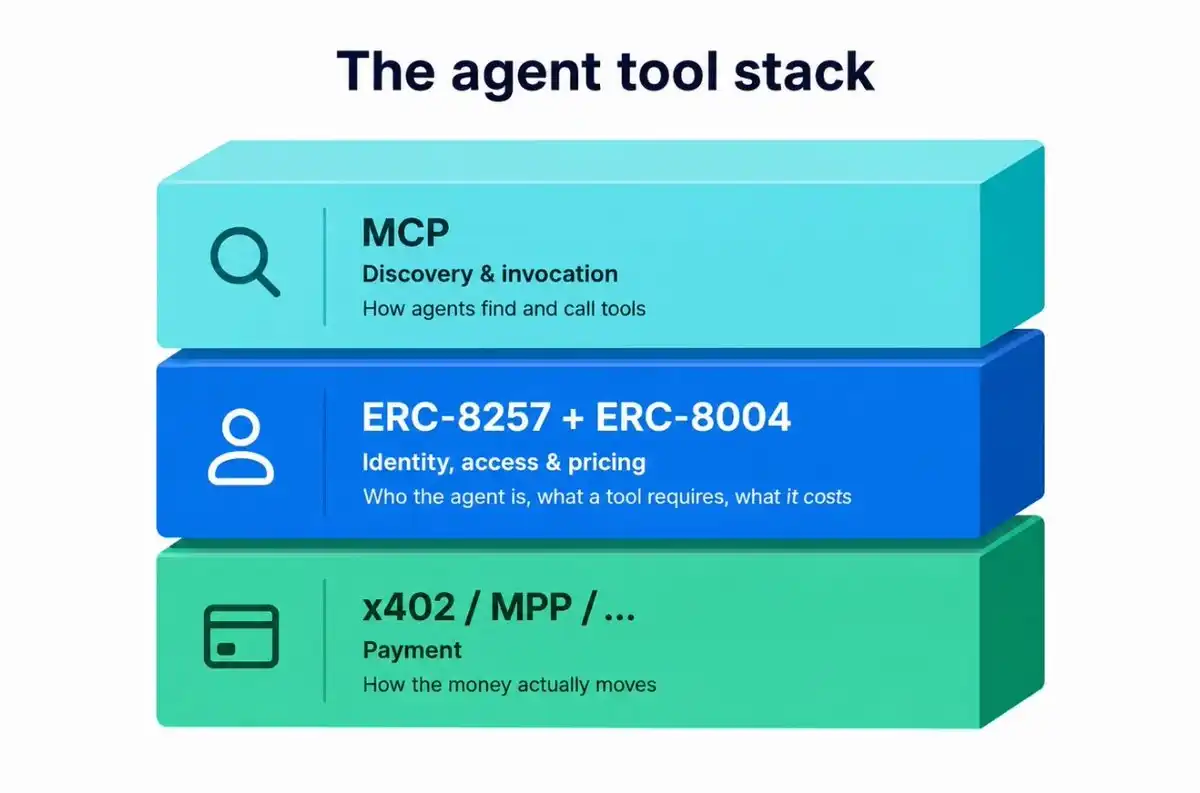
MCP tells your Agent what tools exist. ERC-8004 defines your Agent's identity. ERC-8257 explains how to actually use a tool. x402 handles payment. Each layer is composable.

An Agent registered via ERC-8004 can link to restricted tools from the ERC-8257 registry in its services array. You don't need to choose between them. They are different layers of the same tech stack.

See It in Action

nft-appraisal-tool: Point it to any NFT, it returns a price appraisal including low/mid/high ranges, confidence, recent trades, and comparable cases. Two tiers: 0.05 USD/call for anyone, 0.01 USD/call for CHONK holders on Base.

An Agent without CHONK calls the holder endpoint. Response: 403 — predicate gate denied. You need CHONK on Base.

The Agent buys one, retries, and the same call returns success.

$ npx @opensea/tool-sdk pay https://nft-appraisal-tool.vercel.app/api/holder --auth siwe \

--body '{"chain":"ethereum","contractAddress":"0x79fcdef22feed20eddacbb2587640e45491b757f","tokenId":"4707"}'

Wallet: 0x3184...0465

Response (403):

{"error":"Predicate gate: access predicate denied","toolId":"2","predicate":"0xc872..."}

The predicate explicitly tells it what's needed: CHONK on Base. The Agent buys one on OpenSea and retries, the call goes through.

$ npx @opensea/tool-sdk pay https://nft-appraisal-tool.vercel.app/api/holder --auth siwe \
--body '{"chain":"ethereum","contractAddress":"0x79fcdef22feed20eddacbb2587640e45491b757f","tokenId":"4707"}'
Wallet: 0x5eca...e2a8

Response (200):
{
"low": {"amount": "1.8", "currency": "ETH", "usd": 5460},
"mid": {"amount": "2.3", "currency": "ETH", "usd": 6970},
"high": {"amount": "3.1", "currency": "ETH", "usd": 9400},
"confidence": "medium",
"reasoning": "Comparable Squiggles in this color band sold between 1.9 and 2.6 ETH...",
...
}

No human between the 403 and the 200. Whoever holds the access NFT has the access.

What Can Be Built Next?

Professional pricing oracles. On-chain analytics subscriptions. Research subscriptions. Partner whitelist APIs. Limited-seat tools traded in open markets like any other asset.

None of these needed to exist a year ago. The moment the registry goes live, they all become possible.

Start Building

Live on Ethereum and Base.

@opensea/tool-sdk handles the low-level details, providing scaffolding, gating, registration, deployment to Vercel, Cloudflare, or Express. Includes usable examples.

npx @opensea/tool-sdk init my-tool

Full specification at 8257.ai.

Get Involved

ERC-8257 is still in draft. Help us improve the spec before we launch Registry 1.0. Publish a tool, even a small one. We'll promote interesting projects.

Join the Telegram group t.me/ERC8257 to discuss ERC, tool SDK, and more with the authors @CodinCowboy and @ralxz.

Disclaimer: This content is for informational purposes only and does not constitute financial or trading advice. Mention of specific projects, products, services, or tokens does not constitute endorsement, sponsorship, or recommendation by OpenSea. OpenSea does not guarantee the accuracy or completeness of the information presented, and readers should independently verify any statements before taking action. Readers should conduct their own due diligence and assume full responsibility for any decisions made.


Domande pertinenti

QWhat is the main purpose of ERC-8257 introduced by OpenSea?

AThe main purpose of ERC-8257 is to serve as an on-chain registry for AI agent tools. It allows developers to publish tools, set access rules (like requiring a specific NFT for access), define pricing, and manage subscriptions. This enables AI agents to autonomously discover, pay for, and use these tools without human intervention.

QHow does an AI agent gain access to a restricted tool according to the article's example?

AIn the article's example, an AI agent is initially denied access (403 error) to an NFT appraisal tool because it lacks the required CHONK NFT on Base. The agent autonomously purchases the necessary NFT on-chain and retries the request. With the NFT now in its possession, the access predicate grants permission, and the tool call succeeds (200 response), providing the price assessment.

QWhat is an 'access predicate' in the context of ERC-8257?

AAn 'access predicate' in ERC-8257 is a smart contract that defines the conditions for accessing a tool. Its sole function is to answer the question: 'Does this address have access?' It can check for various conditions such as NFT ownership, active subscriptions (e.g., ERC-5643), inclusion in a whitelist, ZK proofs, DAO votes, or staking amounts, making the access control system flexible and pluggable.

QHow does ERC-8257 potentially change the utility of existing NFTs?

AERC-8257 gives existing NFT collections new potential utility by allowing them to act as keys or passes for AI agent tool access. Holding a specific NFT could grant an agent discounted API rates, exclusive tool access, or membership privileges. This extends the value of PFP collections, membership passes, and other on-chain assets into the emerging agent economy.

QWhat role does the x402 protocol play in the ERC-8257 ecosystem?

AThe x402 protocol handles the payment layer within the ERC-8257 ecosystem. It is designed for micro-payments, enabling per-use, immediate payment for tool access. While ERC-8257 manages tool discovery and access control, x402 (alongside other protocols like MPP for metered billing) provides the financial infrastructure for agents to autonomously pay for the services they consume.

Letture associate

DAT Failure? Listed Companies Betting on HYPE Floating Profit of $12.5 Billion

Several public companies that adopted a "HYPE Treasury" strategy—holding significant reserves of the HYPE token from the Hyperliquid ecosystem—have achieved substantial paper gains, collectively exceeding $1.25 billion. This contrasts with the reported struggles of MicroStrategy's flagship BTC treasury strategy. The article profiles three such HYPE-focused treasury companies: 1. **Hyperliquid Strategies Inc. (PURR):** The largest holder, with approximately 22.3 million HYPE tokens valued at ~$1.636 billion, resulting in an unrealized gain of ~$1.22 billion. It has fully transitioned from a biotech firm to a dedicated crypto treasury, adding staking and validator operations to enhance returns. 2. **Hyperion DeFi (HYPD):** Holds around 2 million HYPE tokens (~$147 million value) with a gain of ~$49.4 million. It is deeply integrated into the Hyperliquid ecosystem, running a major validator node and building DeFi products for additional yield. 3. **Lion Group Holding (LGHL):** A smaller holder with ~194,000 HYPE tokens (~$14.14 million value), maintaining a long-term commitment to the token. The success of these HYPE treasuries is attributed not only to the token's significant price appreciation but also to active on-chain participation through staking, validation, and ecosystem integrations, creating a compounding "flywheel" effect. The article posits that while MicroStrategy's BTC strategy faces challenges, HYPE treasuries may offer a more sustainable model through deeper protocol engagement, with potential for further growth if HYPE's price rises as predicted by some analysts.

marsbit3 min fa

DAT Failure? Listed Companies Betting on HYPE Floating Profit of $12.5 Billion

marsbit3 min fa

DAT Failing? Listed Companies Betting on HYPE Have Floating Profits of $12.5 Billion

Facing a potential need to sell Bitcoin to pay dividends amid a $12.5B quarterly net loss, the crypto treasury strategy pioneered by Strategy appears strained. In contrast, public companies that adopted a similar strategy by betting on the HYPE token are seeing massive gains, with collective unrealized profits exceeding $1.25 billion. Three key HYPE treasury companies are highlighted: 1. **Hyperliquid Strategies Inc. (PURR):** The largest holder, with approximately 22.3 million HYPE tokens valued at ~$1.636 billion, resulting in ~$1.22 billion in unrealized gains. It has fully transitioned from a biotech firm to a native crypto treasury, focusing on staking and ecosystem participation via validator operations. 2. **Hyperion DeFi (HYPD):** Holds about 2 million HYPE tokens (~$147M value) with ~$49.4M in gains. It is deeply integrated into the Hyperliquid ecosystem, running a top validator node and building DeFi products to generate additional yield. 3. **Lion Group Holding (LGHL):** A smaller player holding ~193,775 HYPE tokens (~$14.14M value), maintaining a long-term holding strategy alongside other crypto assets. The article argues that HYPE treasuries have an advantage over Bitcoin-based ones like Strategy's. Their success stems not just from price appreciation but from active on-chain participation—staking, earning validator rewards, and engaging with ecosystem protocols—creating a compounding "flywheel" effect. With Hyperliquid dominating the on-chain perpetuals market and HYPE's tokenomics encouraging buys and burns, these treasuries are positioned to benefit further if HYPE's price rises as some predict. While the original Bitcoin treasury strategy isn't declared a failure, the current narrative highlights the outsized success of early movers into the HYPE ecosystem.

Odaily星球日报7 min fa

DAT Failing? Listed Companies Betting on HYPE Have Floating Profits of $12.5 Billion

Odaily星球日报7 min fa

Comics Illustration: Helping You Understand China's New Regulations on Outbound Investment

Summary: Understanding China's New Regulations on Overseas Investment The State Council has announced new regulations on overseas investment, effective July 1, 2026. The core message is not a prohibition on international investment, but a call for both companies and individuals to operate with strong regulatory awareness. Here are the key points: 1. **Scope is Broad:** The rules apply not only to companies but also to other organizations and individual residents. 2. **Definition of Investment is Wide:** It encompasses not just capital transfers but also asset contributions, obtaining equity or rights, financing, providing guarantees, and direct or indirect acquisition of rights related to overseas entities or assets. 3. **Companies Must Plan Comprehensively:** Beyond simple ownership charts, firms need clear plans covering the investing entity, required approvals or filings, fund transfer paths, and compliance with technology, data, and security reviews. 4. **Individuals Should Prioritize Compliance:** Before focusing on returns, individuals must first assess their eligibility, understand legal channels for capital outflow, know what they are acquiring, and identify responsible parties in case of issues. 5. **Penalties are Significant:** Violations can result in fines and potentially restrictions on future overseas investment activities. In essence, overseas investment remains possible, but it must be approached with regulatory compliance as a fundamental priority, not solely based on commercial opportunity. *Note: This is a general informational summary and does not constitute legal advice or investment recommendations.*

marsbit22 min fa

Comics Illustration: Helping You Understand China's New Regulations on Outbound Investment

marsbit22 min fa

Nvidia Rack Disassembly Reveals New Growth Opportunity, MLCC Value Surges 182%

Supply bottlenecks in AI infrastructure have expanded to fundamental hardware components like multilayer ceramic capacitors (MLCCs), crucial for stabilizing power and filtering noise in AI servers. Both Goldman Sachs and Morgan Stanley highlight MLCCs as entering a historic "volume-price dual increase" supercycle driven by AI. Goldman forecasts the AI server MLCC market to surge over fourfold from ~$1.4B in FY2025 to ~$5.8B in FY2030, a 34% CAGR. The core driver is a structural supply-demand imbalance. While AI server demand is projected to grow ~4.3x by 2030, industry capacity expands at only ~10% annually, constrained by internal production of equipment and materials. This is compounded by strong demand from electric vehicles. The shortage is evident, with lead times for high-end MLCCs exceeding 20 weeks. The price cycle has officially begun. Japanese leaders Murata and Taiyo Yuden have raised prices by 15-35% for AI server and automotive MLCCs since April, citing material costs. Japan's April export data confirms the trend, with MLCC export value up 28% year-over-year. Profit leverage is significant: Goldman estimates a mere 5% price increase could boost Murata's FY2027 operating profit by ~13% and Taiyo Yuden's by up to 37%. Morgan Stanley's teardown of Nvidia's upcoming Vera Rubin AI rack reveals another catalyst: the MLCC value per rack has skyrocketed 182% from the previous generation to ~$4,320, highlighting the component's growing importance. With demand set to massively outstrip constrained supply, and price increases just starting, analysts position MLCCs at the beginning of a major, prolonged upcycle.

marsbit22 min fa

Nvidia Rack Disassembly Reveals New Growth Opportunity, MLCC Value Surges 182%

marsbit22 min fa

A 134% Surge, 75 P/E Ratio: Why Is the Market Paying Up for Murata's 'Zero Growth'?

Murata Manufacturing, the world's largest passive components maker, saw its stock price surge 134% over the past year and hit a record high on May 28th, despite reporting nearly zero growth in operating profit for its latest fiscal year. This has pushed its valuation to a P/E ratio of approximately 75x. The disconnect is driven by a fundamental market re-rating. The catalyst was a late-May meeting where management upgraded the AI investment cycle outlook to "lasting until around 2030" and noted that demand for its components is roughly double its supply capacity, with customers prioritizing securing volume over price. While Murata's revenue grew only 5.0% and operating profit stagnated at ¥281.8 billion for the fiscal year ending March 2026, its guidance for the current fiscal year projects a 34.8% jump in operating profit to ¥380 billion. This sharp growth is underpinned by expectations that its AI/data center-related revenue will nearly double from ¥170 billion to ¥325 billion, becoming a key pillar of its business. Analysts highlight that this growth stems not from broad price hikes but from a shift towards higher-value, cutting-edge MLCCs for AI servers, where Murata holds over 70% market share. The market is now pricing Murata not as a cyclical component maker but as a critical "AI pick-and-shovel" supplier with structural pricing power. However, the high valuation also carries risk if future AI demand or quarterly guidance falls short of the elevated expectations.

marsbit45 min fa

A 134% Surge, 75 P/E Ratio: Why Is the Market Paying Up for Murata's 'Zero Growth'?

marsbit45 min fa

Trading

Spot
Futures

Articoli Popolari

Come comprare NFT

Benvenuto in HTX.com! Abbiamo reso l'acquisto di APENFT (NFT) semplice e conveniente. Segui la nostra guida passo passo per intraprendere il tuo viaggio nel mondo delle criptovalute.Step 1: Crea il tuo Account HTXUsa la tua email o numero di telefono per registrarti il tuo account gratuito su HTX. Vivi un'esperienza facile e sblocca tutte le funzionalità,Crea il mio accountStep 2: Vai in Acquista crypto e seleziona il tuo metodo di pagamentoCarta di credito/debito: utilizza la tua Visa o Mastercard per acquistare immediatamente APENFTNFT.Bilancio: Usa i fondi dal bilancio del tuo account HTX per fare trading senza problemi.Terze parti: abbiamo aggiunto metodi di pagamento molto utilizzati come Google Pay e Apple Pay per maggiore comodità.P2P: Fai trading direttamente con altri utenti HTX.Over-the-Counter (OTC): Offriamo servizi su misura e tassi di cambio competitivi per i trader.Step 3: Conserva APENFT (NFT)Dopo aver acquistato APENFT (NFT), conserva nel tuo account HTX. In alternativa, puoi inviare tramite trasferimento blockchain o scambiare per altre criptovalute.Step 4: Scambia APENFT (NFT)Scambia facilmente APENFT (NFT) nel mercato spot di HTX. Accedi al tuo account, seleziona la tua coppia di trading, esegui le tue operazioni e monitora in tempo reale. Offriamo un'esperienza user-friendly sia per chi ha appena iniziato che per i trader più esperti.

499 Totale visualizzazioniPubblicato il 2024.12.10Aggiornato il 2025.03.21

Come comprare NFT

Cosa è AINFT

EternaFi Agents e $AINFT: Un'Analisi Completa dell'Infrastruttura NFT Potenziata dall'AI nell'Ecosistema Web3 L'intersezione tra intelligenza artificiale (AI) e tecnologia blockchain sta rapidamente evolvendo, stabilendo piattaforme innovative che ridefiniscono i modelli di proprietà e partecipazione economica. EternaFi Agents, insieme al suo token nativo $AINFT, esemplifica un approccio rivoluzionario alla tokenizzazione delle infrastrutture AI attraverso i token non fungibili (NFT). Lanciato a luglio 2025 dal team di sviluppo di Nova Club, EternaFi unisce i progressi dell'AI con i meccanismi finanziari decentralizzati della blockchain, presentando un'opportunità di investimento unica per i partecipanti all'interno dell'ecosistema web3. Questo articolo mira a fornire una valutazione approfondita di EternaFi Agents, coprendo i suoi componenti principali, la funzionalità e il significato nel panorama crypto. Introduzione e Panoramica del Progetto EternaFi Agents si presenta come un esempio saliente di come la tecnologia blockchain possa democratizzare l'accesso a capacità avanzate di AI. Il progetto si impegna a rimodellare il paradigma della proprietà dell'AI diversificando la partecipazione economica, rendendo i sistemi AI sofisticati accessibili a un numero maggiore di stakeholder. Al suo interno, il progetto tokenizza un modello di linguaggio di grandi dimensioni (LLM) proprietario sviluppato da Nova Club, consentendo ai detentori di NFT di ottenere un'esposizione frazionaria alle performance economiche del modello. Utilizzando NFT che rappresentano quote nel LLM, EternaFi Agents promuove un modello in cui gli stakeholder non solo partecipano al consumo dei servizi AI, ma godono anche della condivisione delle ricompense economiche generate dalla piattaforma. Questo approccio trasformativo consente lo sviluppo di modelli di reddito sostenibili per i servizi AI, promuovendo al contempo un ampio coinvolgimento della comunità e facilitando una governance trasparente. Cos'è EternaFi Agents? EternaFi Agents rappresenta un progetto di infrastruttura AI-NFT che mira a mescolare le capacità dell'AI con la tecnologia blockchain in un ecosistema coerente. La caratteristica essenziale di questo progetto è la creazione di NFT che fungono da strumenti finanziari, rappresentando frazioni di proprietà nell'infrastruttura AI proprietaria di Nova Club. Ogni NFT simboleggia un'esposizione diretta alle performance economiche del sistema AI sottostante, fornendo un'opportunità redditizia per gli investitori. Il progetto opera sulla blockchain Base, nota per la sua scalabilità e efficienza, garantendo così costi di transazione gestibili mentre facilita un'esperienza operativa senza soluzione di continuità. Una delle caratteristiche notevoli include un meccanismo di condivisione dei ricavi, in cui i detentori di NFT possono ricevere porzioni del reddito da abbonamenti generato dai servizi AI forniti sulla piattaforma. Questo approccio innovativo stabilisce una connessione tra il successo dei servizi AI e i dividendi economici distribuiti tra i detentori, garantendo così un allineamento degli interessi all'interno della comunità. Chi è il Creatore di EternaFi Agents? La forza creativa dietro EternaFi Agents è Nova Club, un team di sviluppo con sede a Singapore esperto nell'amalgama di AI e tecnologia blockchain. La loro esperienza precedente nello sviluppo di AI e nell'analisi delle criptovalute conferisce credibilità al progetto, contribuendo con una vasta gamma di competenze alla creazione di EternaFi Agents. La missione di Nova Club si concentra sulla democratizzazione dell'accesso alle tecnologie AI all'avanguardia, costruendo modelli economici sostenibili che avvantaggiano gli utenti insieme agli sviluppatori. Il loro impegno per la trasparenza, la governance della comunità e l'innovazione si riflette nel design e nell'implementazione della piattaforma EternaFi, mirando a stabilire un ecosistema unico che favorisca un coinvolgimento positivo e la creazione di valore a lungo termine. Chi sono gli Investitori di EternaFi Agents? I dettagli specifici riguardanti gli investitori o le organizzazioni di investimento che supportano EternaFi Agents non sono disponibili pubblicamente. Tuttavia, EternaFi ha adottato un approccio inclusivo per finanziare il suo sviluppo attraverso la vendita di NFT al pubblico, consentendo a una vasta gamma di partecipanti di investire nell'ecosistema. L'architettura del progetto garantisce che l'infrastruttura fondamentale sia finanziata in modo responsabile, consentendo ai membri della comunità di partecipare alla proprietà e ai ritorni economici generati dai servizi AI. Questo modello enfatizza il coinvolgimento della comunità allineando gli interessi degli investitori e degli sviluppatori del progetto, creando un ambiente collaborativo in cui la partecipazione a lungo termine è incentivata. Come Funziona EternaFi Agents? EternaFi Agents opera attraverso un ecosistema multifaccettato in cui gli NFT fungono da principale mezzo di rappresentazione della proprietà all'interno del progetto. Ogni detentore di NFT ha diritto a una quota del reddito mensile da abbonamento prodotto dalla piattaforma AI-powered sottostante, posizionando così la proprietà di NFT come un veicolo di investimento redditizio. Meccanismo di Generazione di Ricavi La principale fonte di generazione di ricavi per la piattaforma EternaFi deriva dalle commissioni di abbonamento relative ai servizi AI forniti. Gli utenti possono accedere a vari servizi a livelli, che vanno da strumenti di analisi di mercato di base a soluzioni di trading assistite da AI complete. Questi servizi sono monetizzati e formano la base per il framework di condivisione dei ricavi, che distribuisce i profitti ai detentori di NFT attraverso contratti intelligenti automatizzati. Una caratteristica innovativa dell'ecosistema EternaFi è il meccanismo di condivisione dei ricavi che opera in modo trasparente, garantendo che le ricompense siano allocate in base a metriche verificabili delle operazioni della piattaforma AI. Questo crea un legame diretto tra le performance dei servizi AI e i ritorni disponibili per gli investitori della comunità, stabilendo un modello economico sostenibile. Meccanismi di Staking e Vesting I partecipanti all'interno di EternaFi possono impegnarsi nello staking dei loro NFT per sbloccare ulteriori benefici economici. Il piano di vesting è progettato per promuovere un impegno a lungo termine tra i partecipanti, premiando coloro che mostrano un supporto continuo per il progetto. Questo garantisce un robusto allineamento degli interessi e favorisce un senso di coinvolgimento della comunità essenziale per raggiungere gli obiettivi a lungo termine del progetto. Governance Trasparente EternaFi Agents abbraccia la governance decentralizzata, consentendo ai detentori di NFT di svolgere un ruolo attivo nel processo decisionale riguardante lo sviluppo della piattaforma e le direzioni future. La struttura di governance include meccanismi di voto della comunità, fornendo ai detentori di NFT l'opportunità di influenzare decisioni significative e contribuendo a un approccio collaborativo alla crescita del progetto. Cronologia di EternaFi Agents La traiettoria di sviluppo di EternaFi Agents mostra un approccio sistematico verso la costruzione di un'infrastruttura AI sostenibile, soddisfacendo le esigenze dei partecipanti della comunità. Di seguito è riportata una cronologia delle tappe importanti nella storia del progetto: Luglio 2025: Lancio di EternaFi Agents, inclusa la vendita pubblica di NFT e il deployment del token $AINFT sulla blockchain Base. Q4 2025: Creazione dell'infrastruttura di mercato, inclusi pool di liquidità e lancio di dashboard di staking per i detentori di NFT. 2026: Inizio di programmi di coinvolgimento della comunità, espansione delle capacità AI e integrazione con tecnologie cross-chain. Q4 2026: Implementazione del sistema di distribuzione dei dividendi, consentendo ai detentori di NFT di raccogliere benefici economici dai loro investimenti. Queste tappe significano l'attenzione verso l'istituzione di un ecosistema funzionale e partecipativo, garantendo al contempo un'evoluzione continua per soddisfare le esigenze del mercato. Infrastruttura Tecnologica e Integrazione Blockchain EternaFi Agents è ancorato in un avanzato framework tecnologico che combina sistemi AI con capacità blockchain. Operando sulla blockchain Base, il progetto sfrutta i vantaggi della scalabilità e dei bassi costi di transazione. L'architettura sottostante dei contratti intelligenti governa la proprietà degli NFT, la condivisione dei ricavi e le caratteristiche di gestione della comunità, garantendo efficienza e trasparenza. Sviluppo del Sistema AI Il modello di linguaggio di grandi dimensioni proprietario che sostiene EternaFi Agents è stato sviluppato in modo indipendente ed è progettato per soddisfare applicazioni generatrici di reddito senza fare affidamento su framework esterni proprietari. Questo impegno riflette una dedizione a creare un'infrastruttura AI versatile e adattabile in grado di fornire servizi significativi agli utenti, generando così valore economico per gli investitori. Misure di Sicurezza La robustezza dell'infrastruttura di sicurezza di EternaFi è fondamentale. Audit regolari e misure di sicurezza rigorose garantiscono l'integrità dei sistemi AI e dei meccanismi blockchain, proteggendo da potenziali vulnerabilità mentre si favorisce la fiducia tra i partecipanti. Conclusione EternaFi Agents segna un'innovazione fondamentale nel campo dell'intelligenza artificiale e della tecnologia blockchain, aprendo strade per la proprietà della comunità e la partecipazione economica in capacità AI avanzate. La strategia globale del progetto di tokenizzare l'infrastruttura AI tramite NFT stabilisce un precedente per futuri ecosistemi decentralizzati. Armonizzando la sofisticazione tecnica con modelli economici centrati sull'utente, EternaFi non solo promuove il coinvolgimento, ma genera anche un framework di condivisione dei ricavi sostenibile per i partecipanti della comunità. L'importanza di EternaFi si estende ben oltre il suo successo operativo, poiché esemplifica come la blockchain possa democratizzare le tecnologie AI all'avanguardia, aprendo la strada a future iniziative in questo spazio intersezionale. L'evoluzione di EternaFi Agents potrebbe annunciare una nuova era di sviluppo dell'AI caratterizzata da governance guidata dai partecipanti, modelli economici sostenibili e verifica trasparente, contribuendo infine alla più ampia democratizzazione dell'AI e dell'accessibilità tecnologica in tutti i settori.

483 Totale visualizzazioniPubblicato il 2025.08.14Aggiornato il 2025.08.14

Cosa è AINFT

Discussioni

Benvenuto nella Community HTX. Qui puoi rimanere informato sugli ultimi sviluppi della piattaforma e accedere ad approfondimenti esperti sul mercato. Le opinioni degli utenti sul prezzo di NFT NFT sono presentate come di seguito.

活动图片













