OpenClaw vs. Hermes: Which One Is Right for You?

marsbitPubblicato 2026-04-26Pubblicato ultima volta 2026-04-26

Introduzione

Two leading AI agent projects, OpenClaw and Hermes, represent a fundamental divergence in design philosophy rather than just a feature competition. OpenClaw, a GitHub phenomenon, prioritizes user control and customization, offering a powerful, flexible platform for building and orchestrating agents. It boasts a massive ecosystem with over 44,000 skills, extensive model flexibility (supporting Anthropic, OpenAI, and others), and deep integrations across multiple messaging platforms. In contrast, Hermes Agent, developed by Nous Research, champions automation and efficiency. It is designed for lower cost and a lower barrier to entry, learning and improving automatically from user workflows. It runs tasks in isolated environments for security and offers significantly lower token costs out-of-the-box. The choice between them mirrors historical tech divides like Windows vs. Mac. OpenClaw is for users who want maximum control, customization, and don't mind a complex setup. Hermes is the smarter default for those seeking an affordable, easy-to-use agent that learns autonomously. The real competition is not about which is better, but which philosophy—a programmable personal OS or a self-evolving work proxy—better suits the user's needs for control, cost, and ease of use.

Editor's Note: If 2025 was the year of the "large model capability race," then by early 2026, the competitive focus has clearly shifted to another, more specific and realistic track—how personal AI agents can truly be implemented.

This article provides a systematic comparison of two of the most talked-about projects in the AI Agent space—OpenClaw and Hermes Agent. The former has amassed an astonishing community size and developer ecosystem in a short time, becoming a phenomenal AI project on GitHub; the latter has quickly gained traction with its path of "lower cost, lower barrier to entry, and stronger self-learning capabilities," beginning to overtake in search popularity and user migration.

In fact, the difference between the two is not at the functional level, but in their design philosophies. One path emphasizes control and customizability, where users personally build, schedule models, and orchestrate skills; the other path emphasizes automation and efficiency, where the system learns on its own, compresses costs, and lowers the usage barrier.

This divergence has a structure highly similar to the Windows vs. Mac debate of the PC era, or even the earlier stratification of software tools: it's not about one replacing the other, but about different user groups making different trade-offs regarding "efficiency, control, and cost."

In this sense, the competition between OpenClaw and Hermes is essentially answering a longer-term question: Will AI agents become "programmable personal operating systems" or "self-evolving work proxies"?

As model capabilities gradually converge, the real watershed is shifting from "which is smarter" to "which is easier to use, which is cheaper, and which fits real workflows better." The value of this article lies in its attempt to cut through emotional partisanship and return to the structure itself, unraveling this key competition that has not yet been fully explained.

Below is the original text:

In early 2026, OpenClaw achieved something no software project had done before. It garnered 346,000 stars on GitHub—surpassing React's decade-long total in less than five months. It became the most-starred AI project in GitHub's history. 38 million monthly visitors, 500,000 running instances globally.

For a few months, if you were in the AI agent space, OpenClaw was the only topic, and Anthropic firmly held dominance.

Then, the winds changed.

In March, Hermes Agent—built by Nous Research—barged into GitHub Trending. Search热度 (heat) began to move. By April, Hermes had surpassed OpenClaw in Google search volume for the agent category. The project that had dominated this track for months was now watching a new challenger eat into its search traffic.

Now, everyone has an opinion. Most opinions are either hardcore OpenClaw camp or Hermes狂热派 (fanatics)—yet no one has truly explained the substantive differences between the two.

So, I'll do an honest breakdown and comparison, so everyone can see what's really happening behind the noise.

First, What Are They Respectively?

OpenClaw

OpenClaw is a personal AI agent that runs on your local machine. It connects to your messaging channels, manages context across sessions, and executes tasks through skills. You can use it to call any model—Anthropic's Claude (Opus, Sonnet), OpenAI's GPT-5.5, Kimi K2.6, Grok, etc.

It integrates with Claude Code for handling heavy programming tasks. Think of it as a persistent brain residing on your hardware, aware of your full configuration, capable of running 24/7 in the background—connected to every tool and channel you use.

Hermes Agent

Hermes Agent is built by Nous Research. It is also a personal AI agent that runs locally—but the underlying philosophy is completely different. You don't need to write skills yourself or configure everything; Hermes learns on its own.

Every task it completes is distilled into reusable knowledge. Over time, it becomes increasingly proficient at handling your specific workflows without you actively telling it. It comes with over 40 built-in tools and runs at a significantly lower cost than OpenClaw for equivalent tasks.

Both are solving the same problem: giving you an AI agent that runs on your own hardware, not someone else's server. But their philosophies for reaching this goal are completely different.

This is what makes this debate interesting. The question isn't which is better, but which philosophy is better suited for you.

It's like the Windows and Apple debate. Both have similar functions, both run on your hardware, but they attract different users. Windows attracts developers and gamers who want control and customization space; Apple attracts designers and entrepreneurs who want out-of-the-box usability. There's no right or wrong; they are for different people with different priorities.

Analogy: Ferrari vs. Honda

The most accurate one-sentence summary of the difference between these two comes from @garrytan.

That's it. That's the real difference. OpenClaw gives you more performance and higher customization—but you also have to be your own mechanic. Hermes is more stable out of the box, runs cheaper, and is easier to get started with. No right or wrong, they are built for different drivers.

OpenClaw's Advantages

Skill Ecosystem

OpenClaw has the most mature skill marketplace in the field. The official ClawHub directory lists over 44,000 skills—all reviewed for security before listing, no malware, no scams. There are also paid curated options like LarryBrain, offering over 100 high-quality automation skills installable in seconds. The community has been深耕 (cultivating deeply) on OpenClaw for longer, and the accumulated depth is evident. Hermes is catching up fast, but it's not at that level yet.

Model Flexibility

This is one of OpenClaw's biggest advantages, yet it's often overlooked. You are not locked into a single provider. Anthropic, OpenAI, Kimi, Grok, local models run via Ollama—you can choose the most suitable model for each task. Use Opus for strategy, Sonnet workers for execution, GPT-5.5 for specific tasks—all within the same configuration. This flexibility is a real competitive edge.

Channel Integration

OpenClaw supports connecting to more platforms like Telegram, Discord, WhatsApp, iMessage, Slack. Your agent exists across messaging channels, handling multi-platform tasks. Hermes' channel support is comparatively very limited—this is an area where OpenClaw clearly leads.

Multi-Agent Architecture

Running multiple specialized agents simultaneously, with different roles, different models, sub-agents for specific tasks—OpenClaw supports this natively. The sub-agent system is built-in and mature.

Community, Documentation & Backing

OpenClaw started earlier. The community is much larger, with 38 million monthly visitors, 500,000 running instances. The documentation is also more complete. Notably, the original author steipete was recruited by OpenAI, bringing more contributors and resources to the project. When problems arise—and they will—many more people have already stepped on the same landmines and fixed the same issues.

Hermes' Advantages

Self-Improvement Loop

This is where Hermes is truly exciting—and the core of its philosophical distinction from everything else. Every time it completes a task, it extracts what worked and stores it as a reusable skill. Your agent gets better at your specific workflows without you doing anything. OpenClaw also has memory and skills, but you have to build them manually. Hermes builds them itself. Over time, this difference compounds into something meaningful.

Token Cost

The data here is hard to ignore. One founder reported spending $130 in 5 days on OpenClaw for equivalent tasks, switching to Hermes cost him $10—and performed better. It should be noted that cost differences depend on the models each platform uses—but Hermes is designed from the ground up with cost efficiency as a core principle. If your API bill gives you a headache, this is the main reason people are switching to Hermes.

Out-of-the-Box Usability

Hermes comes with over 40 ready-to-run tools built-in—memos, iMessage, browser, image generation, scheduled tasks, Obsidian integration. You can use it right after installation. OpenClaw gives you a blank canvas. That blank canvas is powerful—but it can take weeks to build something impressive. For most people, this barrier is the reason they never really get started. Hermes completely removes this barrier.

Isolated Models

Hermes runs tasks in isolated environments. Each task is独立封闭 (independent and封闭 closed off), not interfering with others. For those running sensitive workflows—customer data, financial tasks, anything you want to compartmentalize—this is a substantive security advantage.

Honest Comparison

OpenClaw

· Higher configuration complexity—you build it, you control it

· Higher out-of-the-box token cost (depends on models used)

· Huge skill marketplace—44,000+ free skills on ClawHub, plus paid options

· Self-improvement is manual—you need to write or download skills yourself

· Extensive channel integration (Telegram, Discord, WhatsApp, iMessage, Slack)

· Can run any model—Anthropic, OpenAI, Kimi, Grok, local models via Ollama

· Native multi-agent architecture

· Largest community, most complete documentation

Hermes

· Lower configuration complexity—install and use

· ~90% lower token cost in practice

· Over 40 tools built-in from day one

· Self-improvement loop—automatically learns your workflows

· Channel integration limited compared to OpenClaw

· Multi-agent functionality in development

· Rapid growth, real momentum

Which One Should You Use?

Choose OpenClaw, if you:

· Want maximum customization and don't mind getting your hands dirty

· Need deep channel integration across messaging platforms

· Want to run multiple specialized agents simultaneously

· Want full model flexibility—switching providers for different tasks

· Are already invested in the skill ecosystem

· Enjoy the process of building and tinkering

Choose Hermes, if you:

· Want out-of-the-box usability with minimal configuration

· Token cost is a concern for you

· Want the agent to truly learn your workflows over time

· Are just starting out and don't want to spend weeks configuring

· Security and task isolation are important to you

My Personal Judgment

They aren't really competing. At least not yet.

OpenClaw is the more powerful, more customizable, more deeply integrated choice. If you want an agent that exists across channels, can run any model, and handle complex skill configurations—OpenClaw is still the answer.

Hermes is the smarter default choice for most people. Cheaper, faster to get started, self-improving. I understand why it's growing so fast. If you haven't really gotten an agent running because it felt too complex—Hermes removes most of the friction. Try it first, then decide if you want to migrate to OpenClaw later.

Ferrari and Honda. Drive them and see.

Crypto di tendenza

Domande pertinenti

QWhat is the core difference in design philosophy between OpenClaw and Hermes Agent?

AOpenClaw emphasizes user control and customizability, requiring users to build, schedule models, and orchestrate skills themselves. Hermes Agent prioritizes automation and efficiency, with the system learning on its own, reducing costs, and lowering the barrier to entry.

QWhich agent offers a larger ecosystem of pre-built skills and integrations?

AOpenClaw has the most mature skills ecosystem with over 44,000 reviewed skills in its official ClawHub directory, along with extensive channel integrations like Telegram, Discord, WhatsApp, iMessage, and Slack.

QWhat is the key feature that allows Hermes Agent to improve automatically over time?

AHermes Agent features a self-improvement loop where it extracts effective methods from each completed task and stores them as reusable skills, allowing it to get better at handling a user's specific workflows without manual intervention.

QFor a user primarily concerned with API token cost, which agent is generally more advantageous and why?

AHermes Agent is generally more cost-effective, with reports showing it can be up to 90% cheaper for similar tasks. This is because cost efficiency is a core design principle, and it uses models and methods optimized for lower token consumption.

QWhich agent is recommended for a beginner who wants a ready-to-use solution with minimal configuration?

AHermes Agent is the recommended choice for beginners as it is designed for immediate use with over 40 built-in tools, requires minimal setup, and eliminates the steep learning curve associated with configuring an agent from scratch.

Letture associate

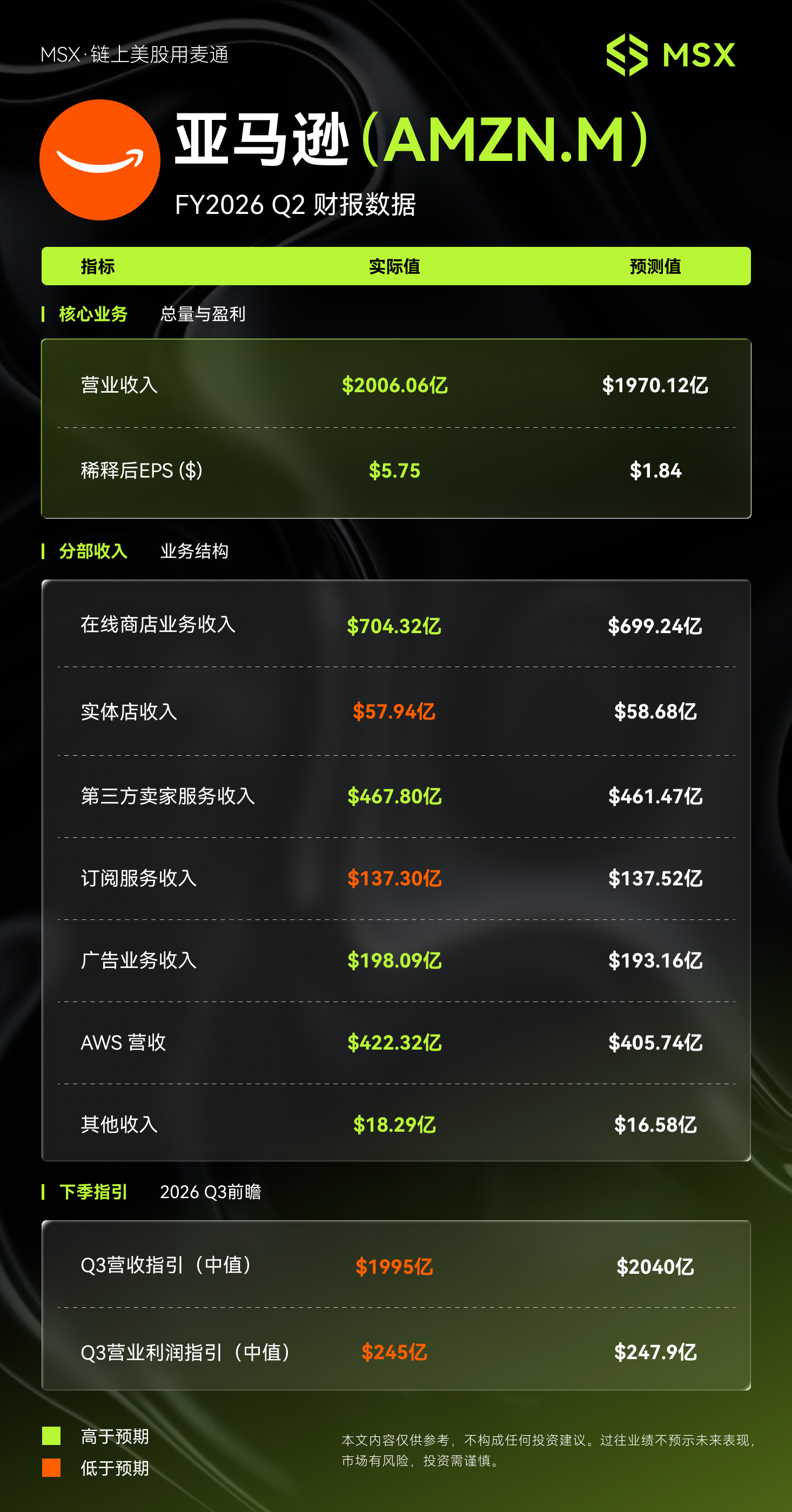
MSX US Stock Daily Insight: Amazon 2026 Q2 Earnings: AWS Records Fastest Growth in Five Years

**MSX Daily US Stock Observation: Amazon's Q2 2026 Earnings: AWS Achieves Fastest Growth in Five Years** Amazon's latest quarterly results exceeded expectations, driven by a strong performance from its cloud computing unit. The company reported revenue of $200.66 billion, surpassing estimates of approximately $197 billion. The key highlight was Amazon Web Services (AWS), which generated $42.232 billion in revenue, surging 37% year-over-year. This marked the segment's fastest growth pace in 18 quarters, indicating robust demand for cloud services. Reported Earnings Per Share (EPS) of $5.75 significantly exceeded the $1.84 forecast. However, this figure included a substantial one-time, non-operating gain of $53.4 billion, primarily from the revaluation of Amazon's investment in AI company Anthropic. Excluding this item, core operating profit was $27.461 billion, a strong increase of 43% compared to the same period last year. Despite the positive results, Amazon provided guidance for the upcoming third quarter that fell short of market expectations. The company's revenue guidance midpoint is $199.5 billion, below the consensus estimate of around $204 billion. Operating profit guidance of $24.5 billion also slightly missed expectations of approximately $247.9 billion. Furthermore, Amazon raised its forecast for full-year capital expenditures to $220 billion, citing rising memory chip costs, which weighed on investor sentiment regarding future profitability. In summary, Amazon's quarter showcased accelerating momentum in its core AWS business. The underlying operational profit growth remains solid. However, cautious forward guidance and increased investment spending present key areas for monitoring in the coming quarters, as the market assesses whether the current growth phase will translate into sustained profit margin expansion.

Odaily星球日报5 min fa

MSX US Stock Daily Insight: Amazon 2026 Q2 Earnings: AWS Records Fastest Growth in Five Years

Odaily星球日报5 min fa

Cyclical Stock or Growth Stock? Coinbase's Q2 Earnings Report Reveals 'Valuation Disagreement'

Coinbase's Q2 2026 financial results revealed a mixed performance, reigniting debate over whether the company should be valued as a cyclical stock tied to crypto markets or a growth stock with future potential. Total revenue missed expectations at $1.22 billion, down 19% year-over-year. Transaction revenue fell to $599 million, with retail crypto spot trading revenue dropping 30% to $452 million, back to 2023 levels. The company reported a net loss of $359 million, marking its third consecutive quarterly loss. Despite CEO Brian Armstrong's positive commentary on metrics like a 10.3% overall crypto trading market share and 106% growth in prediction markets, the market reacted negatively, with shares dropping over 5% after-hours. A key issue is the decline in core retail trading. While Coinbase touted record market share, this figure includes derivatives and new products. Its traditional crypto spot trading share is likely shrinking. New ventures like prediction markets, while growing, contributed less than $30 million, insufficient to offset the core revenue decline. The valuation debate hinges on perspective. As a cyclical stock, Coinbase remains deeply tied to the crypto bear market, with user attrition and competitive pressures justifying a lower valuation. The company's strategy appears focused on surviving until the next bull cycle. Viewed as a growth stock, however, Coinbase shows promising diversification. Subscription and service revenue reached $555 million, nearly matching transaction revenue. Stablecoin revenue, its second-largest source at $292 million, remains strong through its partnership with Circle. Critically, Coinbase is positioning itself as a leader in the emerging on-chain "agent economy." Over 90% of agent-based stablecoin transactions occur on its Base network, which it believes could handle trillions in future agent transactions. The recent acquisition of Deribit also aims to boost its international derivatives offering. In summary, Coinbase's present struggles are clear, but its future hinges on whether its investments in revenue diversification, stablecoins, and the agent economy can ultimately transform its business model and justify a growth premium.

Odaily星球日报25 min fa

Cyclical Stock or Growth Stock? Coinbase's Q2 Earnings Report Reveals 'Valuation Disagreement'

Odaily星球日报25 min fa

Global Market Share Survey: Japanese Firms Lead in Semiconductor Materials

Global Market Share Survey: Japanese Firms Lead in Semiconductor Materials According to the 2025 "Major Goods and Services Market Share Survey" by Nikkei, Japanese companies maintain strong positions in semiconductor-related materials. In silicon wafers, Shin-Etsu Chemical ranks first with a 26.3% share, followed by SUMCO at 17.8%. Together, they hold 44.1% of the market, widening their lead over competitors from Taiwan, Germany, and South Korea. In photoresists, Tokyo Ohka Kogyo, JSR, and Shin-Etsu Chemical occupy the top three spots, with a combined share of 60.5%. Despite their strength in materials, Japanese firms have a weaker presence in core semiconductor segments like DRAM and NAND flash memory, where South Korean and U.S. companies dominate. For instance, SK Hynix and Samsung lead in DRAM, while China’s CXMT doubled its share to 6% in 2025. The semiconductor market is projected to grow rapidly, with WSTS forecasting a 90% increase to $1.5112 trillion by 2026. Major players like Samsung, SK Hynix, and Micron are making massive investments to expand capacity. To maintain their edge in materials, Japanese companies must similarly commit to large-scale, risk-taking investments. In contrast, Japan’s automotive sector shows stagnation. Toyota remains the global leader but with only a slight share increase to 12.3%, while Japanese brands are absent from the top five in the EV market. In shipbuilding, Imabari Shipbuilding rose to third place globally with a 7.2% share, benefiting from large container ship deliveries. However, Chinese and South Korean firms dominate the sector, holding the top two positions. Japan aims to revitalize its shipbuilding industry through government and corporate efforts, targeting a near doubling of output by 2035. Addressing labor shortages and adopting advanced technologies like physical AI will be critical for competitiveness.

marsbit49 min fa

Global Market Share Survey: Japanese Firms Lead in Semiconductor Materials

marsbit49 min fa

Trading

Spot

Articoli Popolari

Come comprare ONE

Benvenuto in HTX.com! Abbiamo reso l'acquisto di Harmony (ONE) semplice e conveniente. Segui la nostra guida passo passo per intraprendere il tuo viaggio nel mondo delle criptovalute.Step 1: Crea il tuo Account HTXUsa la tua email o numero di telefono per registrarti il tuo account gratuito su HTX. Vivi un'esperienza facile e sblocca tutte le funzionalità,Crea il mio accountStep 2: Vai in Acquista crypto e seleziona il tuo metodo di pagamentoCarta di credito/debito: utilizza la tua Visa o Mastercard per acquistare immediatamente HarmonyONE.Bilancio: Usa i fondi dal bilancio del tuo account HTX per fare trading senza problemi.Terze parti: abbiamo aggiunto metodi di pagamento molto utilizzati come Google Pay e Apple Pay per maggiore comodità.P2P: Fai trading direttamente con altri utenti HTX.Over-the-Counter (OTC): Offriamo servizi su misura e tassi di cambio competitivi per i trader.Step 3: Conserva Harmony (ONE)Dopo aver acquistato Harmony (ONE), conserva nel tuo account HTX. In alternativa, puoi inviare tramite trasferimento blockchain o scambiare per altre criptovalute.Step 4: Scambia Harmony (ONE)Scambia facilmente Harmony (ONE) nel mercato spot di HTX. Accedi al tuo account, seleziona la tua coppia di trading, esegui le tue operazioni e monitora in tempo reale. Offriamo un'esperienza user-friendly sia per chi ha appena iniziato che per i trader più esperti.

368 Totale visualizzazioniPubblicato il 2024.12.12Aggiornato il 2026.06.02

Come comprare ONE

Discussioni

Benvenuto nella Community HTX. Qui puoi rimanere informato sugli ultimi sviluppi della piattaforma e accedere ad approfondimenti esperti sul mercato. Le opinioni degli utenti sul prezzo di ONE ONE sono presentate come di seguito.

活动图片