OpenAI's Largest Internal Wealth Creation: 600 Individuals Cash Out $6.6 Billion Combined, 75 Take the Full $30 Million Cap

marsbitPubblicato 2026-05-11Pubblicato ultima volta 2026-05-11

Introduzione

OpenAI conducted its largest-ever internal stock sale in October, allowing over 600 current and former employees to collectively cash out approximately $6.6 billion. About 75 individuals sold the maximum allowed amount of $30 million per person, a limit tripled from $10 million due to high investor demand. The tender offer was based on a $500 billion company valuation. President Greg Brockman confirmed in court that his OpenAI stake is worth around $30 billion. Employees collectively own about 26% of the company, with average paper wealth per employee around $1 billion, far exceeding pre-IPO norms at other major tech firms. Following a recent funding round at an $852 billion valuation and with monthly revenue reaching $2 billion, OpenAI is reportedly preparing for a potential trillion-dollar IPO in late 2026.

Author: Claude, Shenchao TechFlow

Synopsis: The Wall Street Journal revealed the scale of wealth creation within OpenAI. In a staff stock sale last October, the company raised the personal cash-out limit from $10 million to $30 million. Over 600 current and former employees participated, cashing out a combined $6.6 billion, with approximately 75 individuals taking the full maximum amount. President Brockman confirmed in court this week that his stake is worth about $30 billion. Silicon Valley has never seen such a concentration of millionaires created by a private company before its IPO.

Image source: Wall Street Journal

In the past Silicon Valley, the typical path for ordinary employees to strike it rich was one: wait for the company to go public. OpenAI is rewriting that rule.

According to The Wall Street Journal, in an internal stock transaction completed last October, OpenAI allowed employees to sell up to $30 million in shares each. Over 600 current and former employees participated, cashing out approximately $6.6 billion in total. Informed sources revealed that about 75 of them took the full $30 million cap. This is the largest single employee stock sale event in the tech industry to date.

Cash-Out Cap Tripled, Driven by External Investor Demand

OpenAI originally set a single cash-out limit of $10 million for employees. However, due to external investor demand far exceeding expectations, the company tripled the cap to $30 million last fall.

The transaction was completed at a $500 billion valuation, with investors including Thrive Capital, SoftBank, Dragoneer Investment Group, Abu Dhabi's MGX, and T. Rowe Price. As previously reported by CNBC, OpenAI initially planned a sale of about $6 billion, later expanded to $10.3 billion, but the actual transaction ended up being around $6.6 billion. Internally, the lower participation rate was interpreted as a vote of confidence in the long-term prospects by employees.

According to OpenAI's rules, employees can sell shares after two years of service. This means many employees who joined after ChatGPT's launch at the end of 2022 had their first opportunity to cash in options in this transaction. The value of OpenAI's stock has increased over 100-fold in the past seven years.
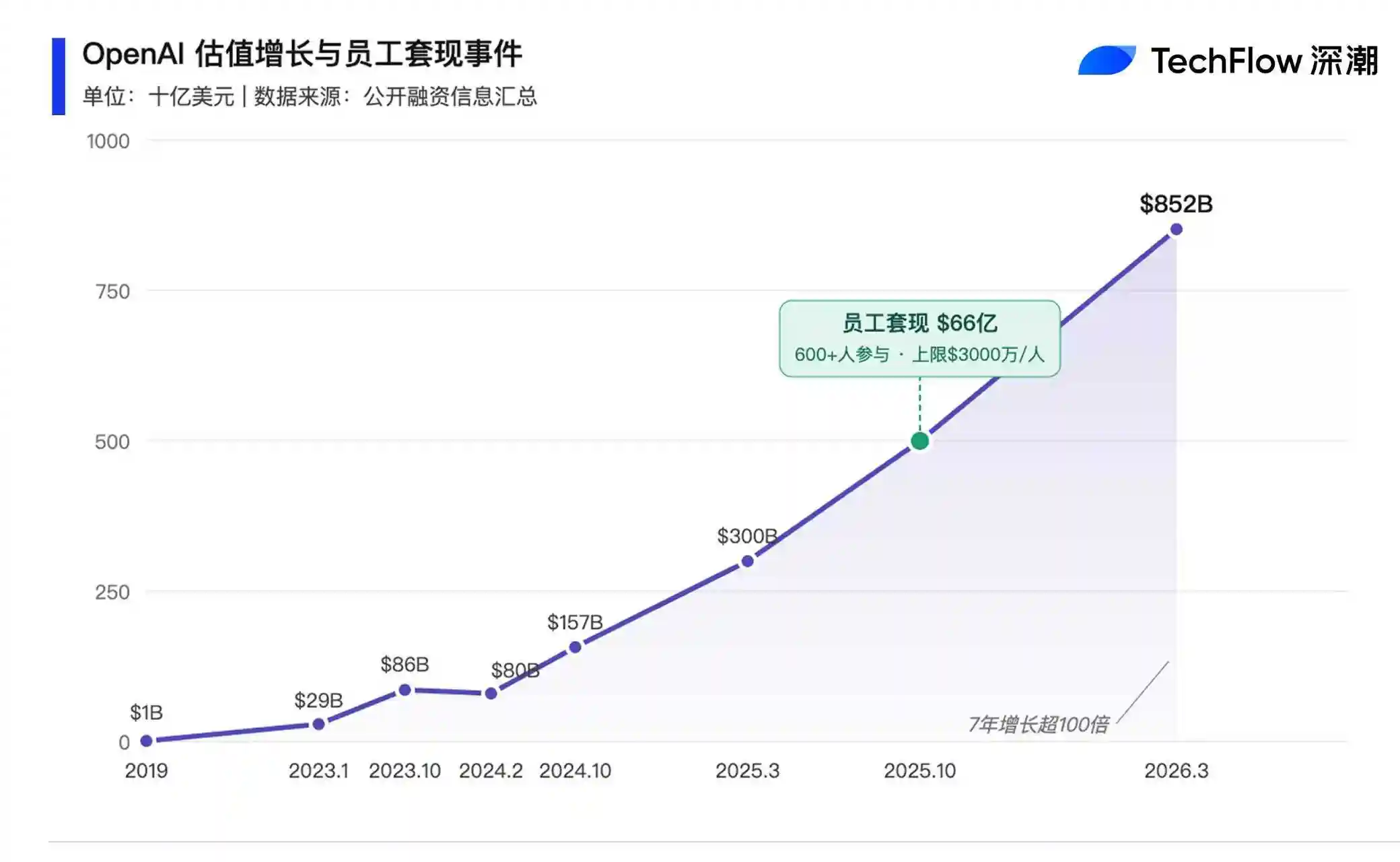
Brockman Confirms $30 Billion Stake in Court, Musk's Lawyer Presses Relentlessly

The scale of wealth held by executives is even more staggering. According to NBC, OpenAI President and Co-founder Greg Brockman confirmed during testimony on May 4th that his current OpenAI equity is worth approximately $30 billion.

This figure was disclosed on the fourth day of the trial in Elon Musk's lawsuit against OpenAI. Musk's lawyer, Steven Molo, repeatedly referenced this number during over two hours of questioning, pressing Brockman on why he hadn't fulfilled a promised $100,000 donation while amassing a $30 billion fortune. According to CNBC, Brockman admitted, "It is true I ultimately did not make the donation."

As reported by Fortune, Musk's legal team also revealed multi-layered financial ties between Brockman and CEO Sam Altman: Altman provided Brockman with about $10 million in equity from his family office as early as 2017; Brockman also holds stakes in AI chip startup Cerebras and nuclear fusion company Helion Energy. OpenAI had previously discussed acquiring Cerebras, and Altman has invested hundreds of millions in Helion. Musk's side argues these cross-holdings compromised Brockman's independence as a fiduciary.

Employees Hold 26% Stake, Average Paper Wealth Exceeds Returns of Most VC Funds

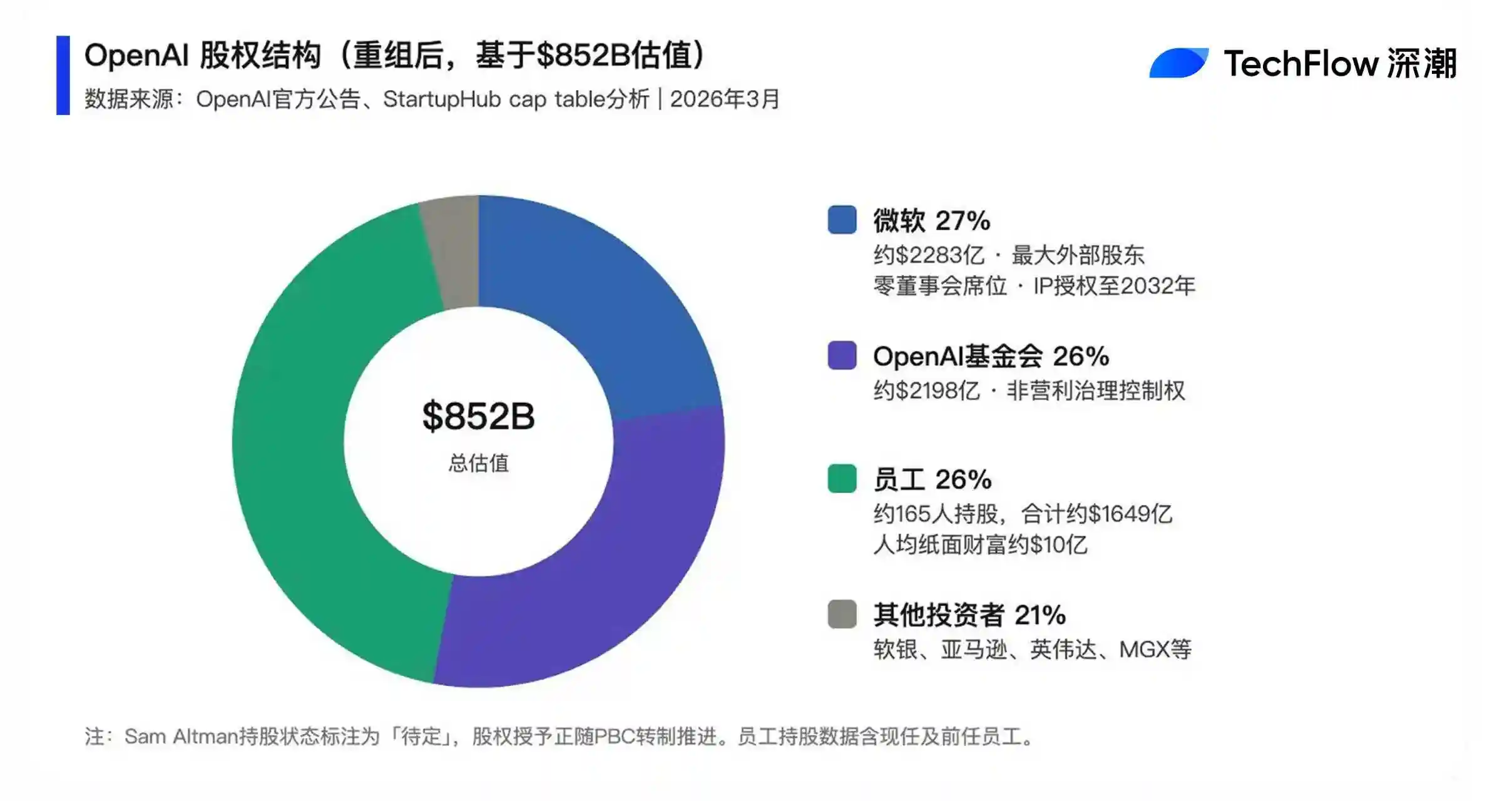
Following the company restructuring completed last October, OpenAI employees collectively hold about 26% of the company's equity.

According to an analysis by StartupHub, approximately 165 current and former employees collectively hold equity worth about $164.9 billion, averaging nearly $1 billion in paper wealth per person. This exceeds the total lifetime returns of most venture capital funds.

According to an analysis by The Wall Street Journal and data firm Equilar, OpenAI's per capita stock-based compensation in 2025 is about $1.5 million. This is over 7 times the figure for Google before its 2004 IPO, and 34 times the average for 18 large tech companies in the year before their IPOs over the past 25 years.

The company's equity-based compensation expense constitutes nearly half of its projected revenue, far surpassing peers like Palantir, Meta, and Salesforce.

$852 Billion Valuation, Trillion-Dollar IPO on Horizon, Wealth Creation Far From Over

OpenAI completed a $122 billion financing round on March 31st this year at an $852 billion valuation, setting a new record for the largest single private funding round in Silicon Valley history. Amazon led the investment with $50 billion, while Nvidia and SoftBank each invested $30 billion. The company's current monthly revenue is $2 billion, with over 900 million weekly active ChatGPT users and more than 50 million paid subscribers.
According to multiple media reports, OpenAI is preparing for an IPO in the fourth quarter of 2026, with a target valuation potentially reaching $1 trillion. If successful, this would become one of the largest tech IPOs in history. CFO Sarah Friar previously stated at Davos that the company plans to allocate a portion of the IPO shares to retail investors.


Domande pertinenti

QAccording to the article, how many OpenAI employees participated in the internal stock sale and what was the total amount cashed out?

AOver 600 current and former employees participated, cashing out a total of approximately $6.6 billion.

QWhat was the new individual cash-out limit set for the October stock sale, and how did it compare to the previous limit?

AThe new individual cash-out limit was set at $30 million. It was a threefold increase from the previous limit of $10 million.

QWhat did OpenAI president Greg Brockman reportedly confirm about his stake in the company during the Musk vs. OpenAI trial?

AHe confirmed that his current OpenAI equity is worth approximately $30 billion.

QWhat percentage of OpenAI is owned by employees, and what is the approximate average paper wealth per employee as cited by StartupHub?

AEmployees collectively own about 26% of OpenAI. According to StartupHub, around 165 employees hold a total of approximately $164.9 billion in equity, averaging about $1 billion in paper wealth per person.

QWhat is OpenAI's reported monthly revenue, and when is its IPO potentially scheduled to launch according to the article?

AOpenAI's monthly revenue is reported to be $2 billion. Its IPO is potentially scheduled to launch in the fourth quarter of 2026.

Letture associate

"Water Scarcity": The Hidden Fatal Flaw of AI Infrastructure

“Water Scarcity: The Hidden Vulnerability of AI Infrastructure” In June 2026, SpaceX revised its IPO prospectus to highlight a core resource constraint alongside power and processors: water. This move signals a pivotal shift where water scarcity has transformed from an operational cost to a major, uncontrollable investment risk, directly threatening AI data center expansion. The scale of the problem is immense. U.S. data centers consumed an estimated 17 billion gallons of water for direct cooling in 2023, with indirect water use for power generation exceeding 211 billion gallons. Giants like Google alone use billions of gallons annually, with single sites consuming volumes equivalent to a medium-sized city. This water is largely “consumptive,” evaporated into the atmosphere and lost. This massive demand is colliding with scarcity. Tech companies are building “water tigers” in arid regions, sparking community protests in places like Mexico and Arizona, where data centers can legally use millions of gallons daily—enough for tens of thousands of residents. These conflicts are not about illegality, but about a mismatch between historic water allocation frameworks and new, colossal demand. The consequences are real. Community opposition, largely centered on water, has reportedly stalled or canceled $64 billion in U.S. data center projects over two years. Simultaneously, investors are pressuring companies for greater water footprint transparency, viewing it as a financial risk, not just an ESG metric. Technological solutions like air or liquid cooling involve trade-offs between water and electricity use, with final choices dictated by local constraints. The irony is stark: while industry leaders envision AI as a utility “like water,” its physical infrastructure is straining real-world water supplies. The race for AI supremacy may ultimately be governed not by the fastest chip, but by the slowest water meter.

marsbit24 min fa

"Water Scarcity": The Hidden Fatal Flaw of AI Infrastructure

marsbit24 min fa

Global Card Issuance Enters a Compliance-Driven Era: WasabiCard is Building the Next-Generation Payment Infrastructure

Global card issuance is entering a compliance-driven era, with WasabiCard building next-generation payment infrastructure. The platform asserts that as stablecoins increasingly enter cross-border payments, corporate settlements, and global commerce, the industry is shifting focus from "availability" and "growth-driven" models to long-term, compliant operation under global frameworks. Competition will center on sustainable compliance and global infrastructure capabilities. Stablecoins are evolving from on-chain assets into key payment tools in global business, with card issuance acting as critical infrastructure connecting digital assets to traditional payment networks like Visa and Mastercard. This expansion has revealed structural issues, including cross-regional issuance, BIN resource management, and insufficient AML and risk controls. In response, the industry is moving away from reliance on "grey efficiency" towards prioritizing compliance, risk management, and long-term operational stability. WasabiCard outlines its strategy: collaborating with licensed principals and local partners for localized operations, building robust KYC/AML systems, strictly separating commercial and consumer BIN usage, and enhancing global issuance, payment, and cross-border fund flow infrastructure. The goal is to build stable, scalable payment infrastructure amid evolving global regulations, shifting industry competition from scale to infrastructure capability. As stablecoins integrate further with global commerce, payment infrastructure will become a fundamental, embedded component of internet business. WasabiCard will continue to develop capabilities in global card issuance, stablecoin payments, cross-border fund flows, and API-driven financial workflows.

marsbit34 min fa

Global Card Issuance Enters a Compliance-Driven Era: WasabiCard is Building the Next-Generation Payment Infrastructure

marsbit34 min fa

Zhou Hang: How Much Is SpaceX Really Worth?

**Zhou Hang: How Much is SpaceX Really Worth?** SpaceX, arguably one of the greatest industrial companies of the past 50 years, is reportedly targeting a staggering $1.75 trillion valuation in its potential IPO. However, the author argues this figure is inflated by approximately $1.25 trillion when assessed through standard financial metrics. The analysis begins by acknowledging SpaceX's undeniable success: drastically reducing launch costs, achieving near-monopoly in commercial launches, and building the strategic Starlink network. Its achievement surpasses even Tesla's, given it disrupted a state-monopolized industry. Despite this greatness, a $1.75 trillion valuation places SpaceX above the combined market cap of Boeing, Lockheed Martin, Northrop Grumman, RTX, and General Dynamics. Projecting optimistic 2030 revenues of $50-80 billion and applying generous tech-sector multiples yields a "reasonable" valuation range of $500 billion to $1.2 trillion. The $1.25 trillion gap is attributed to three non-financial premiums: 1. **Long-term vision premium** for future Starship-enabled markets (e.g., space-based computing). 2. **Sovereign asset/strategic premium**, as SpaceX is deeply integrated into U.S. national security. 3. **Retail narrative/Musk cult premium**, driven by a heroic story and personal following. Post-IPO, three scenarios are outlined: valuation solidifying (25% probability), sideways volatility as narrative outpaces reality (50%), or a re-rating down to $800B-$1.2T if execution falters or Musk-related risks emerge (25%). The probability-weighted expected value is $1.3-1.5 trillion, suggesting negative expected returns for those buying at the IPO price. The conclusion advises investors to separate the company's excellence from its stock price. Buying at the IPO likely prices in excessive optimism. A more prudent strategy would be to wait for key milestones (e.g., Starship V3 stability) or a significant price correction before investing, or to treat an early purchase as a long-term, high-conviction hold with limited position size, not a short-term bet.

链捕手39 min fa

Zhou Hang: How Much Is SpaceX Really Worth?

链捕手39 min fa

Trading

Spot
Futures
活动图片




