OpenAI Official Plugin Strongly Integrated into Claude Code

marsbitPubblicato 2026-03-31Pubblicato ultima volta 2026-03-31

Introduzione

OpenAI has officially released the "codex-plugin-cc" on GitHub, enabling developers to integrate OpenAI’s Codex model capabilities directly into Anthropic’s command-line development tool, Claude Code. This cross-platform integration breaks down ecosystem barriers between major AI tools, allowing developers to leverage the strengths of both models without switching environments. With simple configuration, Claude Code becomes a versatile programming assistant combining the advantages of both companies. Key features include: - Standard code review via the `/codex:review` command, providing expert improvement recommendations and double-checking for logic errors. - Adversarial review using `/codex:adversarial-review`, which challenges design decisions to identify potential performance bottlenecks or security risks. - Task delegation through `/codex:rescue`, allowing complex debugging or repair tasks to be handed off to a Codex sub-agent for collaborative problem-solving. This integration enhances code quality and development efficiency through multi-model collaboration.

Recently, the AI developer community welcomed a major update: OpenAI officially released an open-source project named codex-plugin-cc on GitHub. This plugin allows developers to directly utilize the capabilities of OpenAI's Codex model within the command-line development tool Claude Code, introduced by Anthropic.

This "cross-brand" integration breaks down the ecosystem barriers that previously existed between major AI model tools, enabling developers to leverage the technical strengths of both industry giants without switching environments. With simple command configurations, Claude Code instantly transforms into an all-in-one programming assistant that combines the best of both.
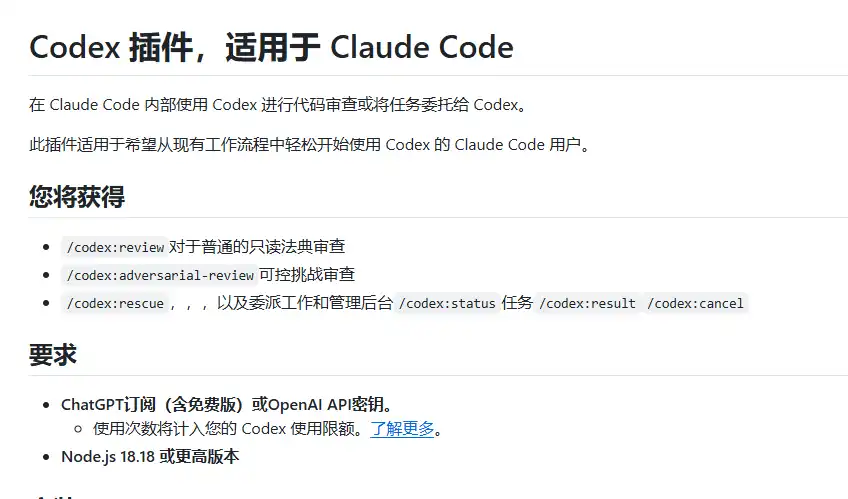
Empowered by this plugin, users can initiate a standard read-only code review using the /codex:review command to receive professional improvement suggestions from Codex. This dual verification mechanism effectively catches logical vulnerabilities that a single model might miss, adding a "double insurance" for code quality.

More uniquely, its "adversarial review" feature allows developers to use /codex:adversarial-review to actively request Codex to challenge existing design decisions. This mode is specifically designed to stress-test the rationality of system architecture, uncovering potential performance bottlenecks or security risks from a "fault-finding" perspective.

Additionally, the plugin introduces a task delegation mechanism, enabling users to transfer complex debugging or repair tasks to a Codex sub-agent via /codex:rescue. This collaborative model achieves automatic task distribution, allowing the primary model and auxiliary models to each focus on their respective areas of expertise.

github:https://github.com/openai/codex-plugin-cc

Domande pertinenti

QWhat is the name of the official OpenAI plugin that integrates with Claude Code?

AThe plugin is called codex-plugin-cc.

QWhat is the primary function of the /codex:review command in the new plugin?

AThe /codex:review command is used to initiate a standard read-only code review to get professional improvement suggestions from the Codex model.

QWhat unique feature does the /codex:adversarial-review command provide?

AThe /codex:adversarial-review command enables an 'adversarial review' function, which actively challenges existing design decisions to stress-test the system architecture and uncover potential performance bottlenecks or security risks.

QHow does the /codex:rescue command facilitate task management?

AThe /codex:rescue command allows users to delegate complex debugging or repair tasks to a Codex sub-agent, enabling a collaborative model where the main and auxiliary models work in their respective areas of expertise.

QWhere was the codex-plugin-cc project officially released?

AThe project was officially released by OpenAI on GitHub.

Letture associate

Within Strategy's Framework, STRC's Dividend Yield Remains at 12% as Share Price Stays Below Par Value

Michael Saylor, Executive Chairman of Strategy (MSTR), confirmed that the dividend rate for its STRC perpetual preferred shares will remain at 12.00% through August 2026. The rate has increased from 9% at its July 2025 launch to the current high via a "ratchet" mechanism, which permanently raises the rate by 0.5% whenever the share price falls below $95. This mechanism is intended to push the price back toward its $100 par value and support Strategy's "at-the-market" (ATM) program for issuing new shares to fund Bitcoin purchases. However, the mechanism has not worked as intended. STRC shares closed at $89.46 on July 31, remaining about 10-11% below par value despite the record-high dividend. Competition from rival Strive's higher-yielding SATA securities has pressured demand. The persistent discount has forced Strategy to suspend new STRC issuances via its ATM program, limiting this funding channel for Bitcoin acquisitions. STRC's struggles reflect Bitcoin's own volatility, as the preferred shares historically move in tandem. Analysts have warned the ratchet structure carries long-term, one-way risk. A law firm is investigating Strategy's ability to maintain dividend payments if Bitcoin's price stays low. Retail investors own roughly 83% of outstanding STRC shares, a group seen as prone to panic selling during downturns. In response, Strategy has established financial reserves, including a liquidity cushion covering about 26 months of dividend/interest obligations, and a $2 billion share buyback program alongside a Bitcoin monetization framework, though the company emphasized it is not obligated to sell any Bitcoin.

cryptonews.ru6 min fa

Within Strategy's Framework, STRC's Dividend Yield Remains at 12% as Share Price Stays Below Par Value

cryptonews.ru6 min fa

Analyst: Bitcoin's Price Will Drop to $60k in August, Then Rebound to $70k

Financial analyst Andrey Poroshin has provided a new forecast for Bitcoin's price dynamics in August. Poroshin, an analyst at the Bitbanker exchange, expects the cryptocurrency market to experience a downturn this month, with prices retesting the $60,000 level due to a lack of supportive macroeconomic catalysts. He noted that the recent US Federal Reserve decision to hold interest rates did not significantly impact the market, while inflation remains above the 2% target. Poroshin stated that Bitcoin is ending July under pressure from moderate volatility and a lack of new macroeconomic stimuli, leading to continued market caution. According to his base scenario, Bitcoin will drop to a range of $60,000 to $62,000 before recovering to $70,000. He pointed out that even $70,000 remains below the cost of mining in the US, which has prompted some miners to shift towards AI data center operations. Poroshin cited the winding down of BitMEX's operations as a potential catalyst for a price rebound, suggesting the exit of weaker players often coincides with market reversals and reduced short-term selling pressure. He believes Bitcoin is currently less susceptible to geopolitical shocks, such as the Iran-US conflict, and does not expect significant market changes in August related to the pending CLARITY Act. Looking ahead, Poroshin forecasts that September will bring more active price fluctuations driven by potential Fed rate decisions and possible discussions or approval of the CLARITY Act.

cryptonews.ru6 min fa

Analyst: Bitcoin's Price Will Drop to $60k in August, Then Rebound to $70k

cryptonews.ru6 min fa

Trading

Spot
活动图片