OpenAI Is Turning AI into a Nuclear Arms Race That Ordinary People Can't Afford

marsbitPubblicato 2026-02-28Pubblicato ultima volta 2026-02-28

Introduzione

In a record-breaking funding round, OpenAI has secured $110 billion, raising its post-money valuation to $840 billion. This investment, led by Amazon, NVIDIA, and SoftBank, marks the largest-ever private tech funding and signals a new phase in the global AI race—one defined by extreme capital concentration and geopolitical significance. The scale of funding dwarfs the GDP of many mid-sized nations and equals nearly half of NVIDIA’s annual revenue. It also accounts for more than half of all AI startup funding in 2025, accelerating an industry-wide arms race in compute, talent, and model development. This capital influx, however, risks widening the gap between giants and smaller players, potentially stifling innovation and increasing market consolidation. Strategic investors are not merely providing capital: Amazon’s $50 billion commitment includes an eight-year, $100 billion cloud expansion deal. SoftBank’s $30 billion staged investment serves as both a hedge and a bridge for future sovereign wealth entrants. NVIDIA’s $30 billion replaces an earlier partnership promise and effectively locks up its advanced GPU supply, creating a closed loop that sidelines competitors. Despite ChatGPT reaching 900 million weekly active users and 50 million paid subscribers, OpenAI’s burn rate remains high. It spent $0.62 for every dollar earned in 2025, with cumulative cash burn projected to hit $1150 billion by 2029. At the same time, its market share is eroding amid rising competition from...

Author: Nancy, PANews

Last night, the air in Silicon Valley was thick with the smell of burning money.

$110 billion in funding, an $840 billion post-money valuation—the depth charge thrown by OpenAI not only shattered the ceiling for private tech companies but also plunged the global AI competition into an extremely brutal "folded space."

This is no longer a romantic tale of tech entrepreneurship but a high-stakes game concerning national destiny, computing supremacy, and the direction of civilization.

A Hundred Billion Dollars Poured into AI, OpenAI Becomes the Most Expensive Experiment

In tech history, OpenAI has set a staggering funding record.

On February 27, OpenAI announced a new massive funding round of $110 billion at a $730 billion valuation, directly pushing its post-money valuation to $840 billion. Compared to the $40 billion funding round a year earlier, this round has multiplied in size, setting a new record for private tech company funding. The capital bet on it has shifted from "betting on the future" to "locking in the future in advance."
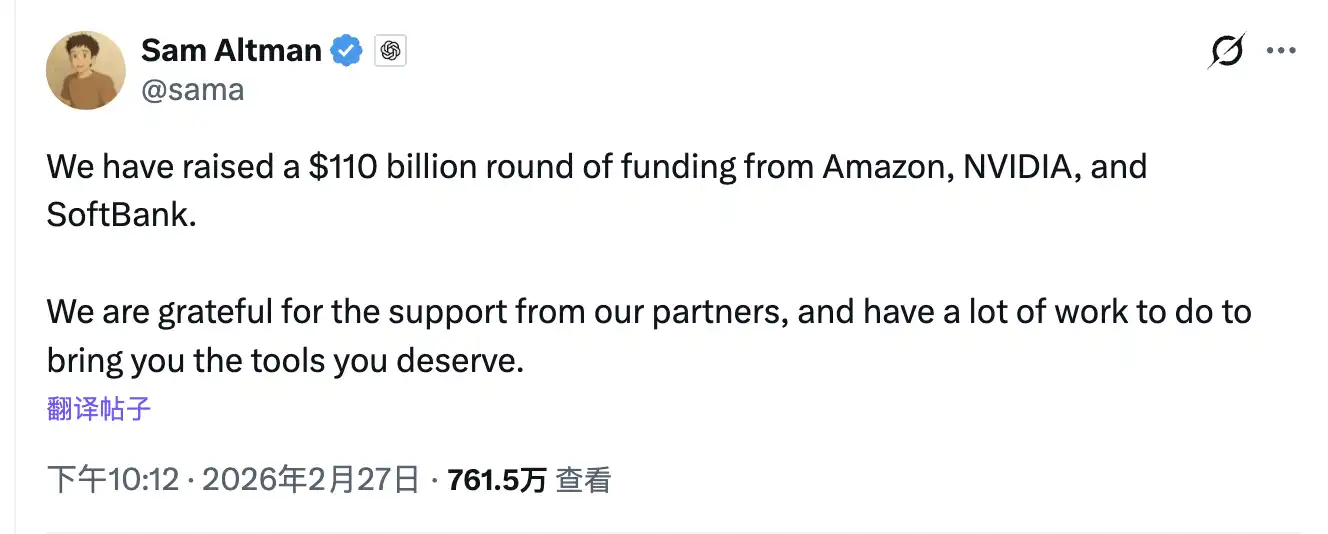
What does $110 billion mean?

This figure exceeds the annual GDP of medium-sized countries like Kenya, Venezuela, Luxembourg, and Panama. Even the global oil powerhouse Saudi Arabia has an annual GDP of about $1 trillion. OpenAI's single funding round is equivalent to roughly one-tenth of Saudi Arabia's annual output.

This amount is roughly equivalent to NVIDIA's annual revenue, close to half of SpaceX's current valuation, and the sum of the funding amounts of internet golden age giants like Uber, Didi, Alibaba, ByteDance, Tencent, and Meituan.

In the AI landscape, a single funding round of $110 billion is undoubtedly a watershed moment, overnight changing the entire industry's funding rules. In 2025, the total funding for AI startups broke through $200 billion, hitting a historical high, and OpenAI alone took over half of that in one night.

Such funding scale intensifies the arms race in the AI field. Top competitors must follow up with larger funding rounds; otherwise, they will gradually fall behind in the competition for computing power, models, and talent. However, the expansion of funding scale also brings higher valuation pressures and return requirements. When massive capital is concentrated and siphoned away, the funding window will inevitably narrow sharply. The valuation negotiation space for small and medium-sized AI enterprises shrinks, their survival cycles lengthen, and the risk of industry consolidation further increases, potentially leading to valuation bubbles, resource monopolies, and a decline in innovative vitality.

From this perspective, when capital bets with such enormous volume, AI is no longer just the protagonist of a tech narrative but truly transforms into the mainline asset of the capital era, becoming a battleground for giant capital gambles.

A Capital Gambit Around AGI, Three Giants Take the Field

The backers writing this $110 billion check are Amazon, NVIDIA, and SoftBank, assembling computing power, channels, and capital.

But this is not a simple funding round. Rather than mere financial transfusion, it is a strategic high-stakes bet centered on the prospects of AGI, deeply intertwined with technology, computing power, and commercial interests.

The most generous contributor this round is Amazon, which is both a key investor in OpenAI and its long-term strategic partner.

Out of a total commitment of $50 billion, an initial $15 billion has been confirmed, with the remaining $35 billion to be delivered in the coming months based on specific conditions. Trigger conditions include achieving AGI milestones or advancing an IPO by year-end. Additionally, the two parties signed an 8-year, $100 billion expansion agreement.

This model of exchanging capital investment for future computing power needs and technological priority is similar to OpenAI's previous cooperation logic with Microsoft. It is worth mentioning that OpenAI and Microsoft have a special clause: once AGI is achieved, Microsoft will lose access to the related technology (Note: In the new agreement signed in 2025, Microsoft's IP rights to models and products were extended to 2032).

SoftBank Group contributed $30 billion, with funds to be delivered in three installments in April, July, and October 2026. This staged arrangement is also interpreted as a risk hedge. SoftBank's role in this funding round is not just about providing money. Market消息称, OpenAI is expected to raise about another $10 billion from investors before March, including sovereign wealth funds and investment institutions, potentially pushing the overall valuation to $850 billion, and these potential investors are likely to enter through SoftBank's bridge.

SoftBank founder Masayoshi Son has frequently bet on AI in recent years, publicly stating that "the AI revolution is the most exciting and dynamic front-end trend of the future." Son visited Trump's Mar-a-Lago at the end of 2024, promising $100 billion in U.S. investments, and last year officially announced participation in "Stargate," a $500 billion AI infrastructure investment project in the U.S., serving as its chairman. SoftBank is responsible for financial obligations, while OpenAI handles operational responsibilities. To support OpenAI, Son even reluctantly sold off NVIDIA shares last year "with tears," using the proceeds for additional investment in OpenAI, becoming one of OpenAI's largest external investors.

NVIDIA, which had long预告 its investment,掏出了 $30 billion this time, replacing the $100 billion long-term cooperation commitment agreed upon last year. This also allows OpenAI to monopolize NVIDIA's production capacity in advance, creating an exclusive "internal循环 system." Any competitor outside this circle would have to queue until 2030 just to buy graphics cards.

This循环 model is seen as a typical supplier financing, essentially tech giants using capital binding to lock in long-term商业合作. It can be said that in this AI race, capital is no longer just a financial tool but a chip to lock in computing resources and seize discourse power.

The Race Between Technology and Capital, Considering an IPO at the Right Time

Behind the massive capital injection is not only a collective bet on the AGI track but also recognition of OpenAI's business growth.

According to official disclosures, OpenAI's flagship product ChatGPT now has over 900 million weekly active users, a number that stood at around 200 million 18 months ago; individual subscription users have surpassed the 50 million mark, hitting a historical high with a paid penetration rate of over 5%; paid商业 users exceed 9 million, including numerous enterprises and government agencies using ChatGPT or building products based on the OpenAI API.

However, behind the rapid growth is an expanding cash burn. OpenAI's revenue in 2025 was approximately $13 billion, with cash expenditures of $80 billion, meaning that for every dollar earned, about $0.62 of rigid cash outflow is burned. According to The Information, internal projections disclosed by OpenAI to investors show that cumulative cash burn by the end of 2029 will reach $115 billion, with profitability expected only by 2030. Meanwhile, OpenAI recently disclosed plans to invest a total of about $600 billion in computing power construction by 2030.

This means that if substantial profitability cannot be achieved in the short term, this astonishing "burn rate" forces OpenAI to continuously rely on transfusions to stay alive.

But more critically, OpenAI's once impregnable moat is loosening.

According to data from mobile analytics firm Apptopia, ChatGPT's app market share has declined from 69.1% in January 2025 to 45.3% in 2026. During the same period, Google's Gemini chatbot app's market share rose from 14.7% to 25.2%; Musk's Grok climbed to 15.2%, up from just 1.6% a year earlier.

With profitability challenges and strong competitors closing in, an IPO might become OpenAI's "lifesaving ammunition."

Currently, OpenAI's IPO timetable may be approaching. According to a recent Wall Street Journal report citing informed sources, OpenAI is paving the way for a Q4 2026 listing, has contacted Wall Street investment banks, and recruited a chief accounting officer and head of investor relations. Its founder Sam Altman最新 disclosed that he will consider going public at the appropriate time. If realized, this would be one of the most important IPO events in the tech industry in 2026.

This means Sam Altman is running blindfolded on the tightrope of an IPO. This is not just a race of technology but a life-and-death sprint against capital's patience.

And this target IPO at year-end might be the peak of this AI bubble, or perhaps the true beginning of the AGI era. But until then, everyone is holding their breath at the most expensive gambling table, waiting for the cards to be revealed.


Crypto di tendenza

Domande pertinenti

QWhat is the total amount of funding OpenAI's latest round and what is the post-investment valuation?

AOpenAI raised $110 billion in its latest funding round, with a post-investment valuation of $840 billion.

QWhich three major companies are the primary investors in OpenAI's $110 billion funding round?

AThe primary investors are Amazon, NVIDIA, and SoftBank.

QWhat is the current weekly active user count for ChatGPT and how much has it grown in the last 18 months?

AChatGPT currently has over 900 million weekly active users, up from 200 million 18 months ago.

QWhat significant financial challenge does OpenAI face despite its revenue growth, according to the article?

AOpenAI faces a significant cash burn, spending approximately $0.62 for every $1 it earns in revenue, and is projected to have a cumulative cash consumption of $1.15 trillion by the end of 2029.

QWhat is OpenAI's reported plan regarding an Initial Public Offering (IPO)?

AOpenAI is reportedly preparing for an IPO in Q4 of 2026 and has begun engaging with Wall Street banks and hiring key financial executives.

Letture associate

Must-Watch Events Next Week|CLARITY Act Could Face Senate Vote; SpaceX, Circle to Report Earnings (8.3-8.9)

**Summary: Key Events and Developments to Watch (August 3-9)** The upcoming week is marked by significant financial disclosures, key legislative deadlines, and notable product updates. **Major Financial Events:** Several companies are scheduled to release their Q2 2026 earnings. American Bitcoin (ABTC) will report on August 3, followed by SpaceX and Hut 8 Mining Corp. on August 4, and Circle on August 5. Notably, a significant portion of SpaceX shares (up to 12% of total shares) will be unlocked on August 6 following their earnings release. **Key Legislative Deadline:** The U.S. Senate faces an August 7 deadline to secure 60 votes for the CLARITY Act, a bipartisan bill aiming to establish a federal regulatory framework for cryptocurrencies. The Senate may hold a full vote on the bill during the week. **Economic Data:** The U.S. July Non-Farm Payrolls report will be released on August 7, providing crucial labor market data. **Technology & Product Updates:** * **Shutdowns:** DeFi portfolio tracker Zapper and wallet app Ctrl Wallet will cease operations on August 3. * **Upgrades:** LayerZero will deprecate its v1 relayers on August 3. XRP Ledger's new version 3.3.0, featuring five new functions, is expected next week. * **AI:** Elon Musk announced that the advanced Grok 4.6 AI model is set for release around August 7. * **Bitcoin:** The BIP-110 forced signaling for a potential Bitcoin network change is scheduled to begin around August 8. **Other Notable Events:** Chinese robotics firm Unitree Tech has set its preliminary price inquiry for its IPO for August 5. South Korean exchange Upbit will delist AQT and AERGO tokens on August 3.

marsbit1 h fa

Must-Watch Events Next Week|CLARITY Act Could Face Senate Vote; SpaceX, Circle to Report Earnings (8.3-8.9)

marsbit1 h fa

Stocks Are Plummeting More Sharply Than Cryptocurrencies. Where Has the Money Gone?

Stock Markets Plunge Deeper Than Cryptocurrencies: Where Did the Money Go? In late July, Seoul's Kospi index triggered circuit breakers for two consecutive days, plummeting over 40% from its June high. The collapse was led by heavyweight stocks like SK Hynix, whose record profits still disappointed investors, and devastating leveraged ETFs, with one major product losing over 83% of its value. This signaled a global, forced deleveraging targeting the most crowded trades. Interestingly, while stocks exhibited extreme volatility akin to crypto markets, Bitcoin rose nearly 15% in July after a prior steep drop. Analysis shows the money fleeing equities did not flow into Bitcoin. Instead, Bitcoin had already absorbed its sell-off in May-June, when U.S. spot Bitcoin ETFs saw historic outflows. The true safe-haven beneficiary was gold, whose price rose over 20% year-on-year, highlighting a decoupling between Bitcoin and gold as "digital gold." The sell-off was a targeted unwinding of leveraged positions in tech and semiconductors, accelerated by broker-dealer risk management and shifts in the AI narrative, including new competition from Chinese memory chipmakers. The retreat path was clear: from high-valuation tech stocks to cash and U.S. Treasuries, then to gold. For Bitcoin to attract sustained institutional inflows, conditions like eased global liquidity pressure, a "soft-landing" Fed rate cut, and U.S. regulatory clarity via legislation like the stalled CLARITY Act are needed. Currently, Bitcoin is not a safe haven but an already-cleared asset. Its low correlation with tech stocks, however, makes it a potential diversification play for institutional portfolios once the storm passes. The money isn't here yet, but the positioning is underway.

marsbit1 h fa

Stocks Are Plummeting More Sharply Than Cryptocurrencies. Where Has the Money Gone?

marsbit1 h fa

In Conversation with Ray Dalio: We Are Currently in an AI Bubble, with 1% of My Portfolio in Bitcoin

Ray Dalio, founder of Bridgewater Associates, warns in an interview that the current AI boom shows classic bubble characteristics, which could lead to significant economic downturns as seen in past cycles like 1929 or 2000. He explains that speculative enthusiasm, fueled by debt and overvaluation, often precedes a crash when rising rates or taxation force asset sales, causing widespread losses and recession. Dalio also outlines his "Big Cycle" theory, describing an approximate 80-year pattern where widening wealth gaps, massive government deficits, and shifting geopolitical power (like China's rise) create internal conflict and global instability. He emphasizes that we are in a late-cycle, transitional phase where traditional powers like the US and UK face decline. For personal wealth protection, Dalio advises diversification beyond cash into assets like stocks, bonds, real estate, and particularly gold, which he prefers over Bitcoin. While he holds about 1% of his portfolio in Bitcoin as a non-printable hard asset, he views gold as more secure from technological or governmental threats. Regarding AI's impact, Dalio believes it will disproportionately benefit capital owners, worsening inequality by replacing both physical and cognitive labor. He suggests that human intuition and emotional intelligence, combined with AI, will be key for future workers. On taxation, Dalio argues that wealth taxes are impractical and risk triggering asset sell-offs, reducing productive investment. He points to the UK as a cautionary example of debt, low productivity, and political strife. Geopolitically, Dalio foresees a more regionalized world, with the US showing weakness in prolonged conflicts like with Iran, akin to past imperial declines. The ideal outcome, he suggests, is coexisting powerful blocs (e.g., Americas, China-Asia Pacific) without major war.

marsbit5 h fa

In Conversation with Ray Dalio: We Are Currently in an AI Bubble, with 1% of My Portfolio in Bitcoin

marsbit5 h fa

Trading

Spot

Articoli Popolari

Come comprare PEOPLE

Benvenuto in HTX.com! Abbiamo reso l'acquisto di ConstitutionDAO (PEOPLE) semplice e conveniente. Segui la nostra guida passo passo per intraprendere il tuo viaggio nel mondo delle criptovalute.Step 1: Crea il tuo Account HTXUsa la tua email o numero di telefono per registrarti il tuo account gratuito su HTX. Vivi un'esperienza facile e sblocca tutte le funzionalità,Crea il mio accountStep 2: Vai in Acquista crypto e seleziona il tuo metodo di pagamentoCarta di credito/debito: utilizza la tua Visa o Mastercard per acquistare immediatamente ConstitutionDAOPEOPLE.Bilancio: Usa i fondi dal bilancio del tuo account HTX per fare trading senza problemi.Terze parti: abbiamo aggiunto metodi di pagamento molto utilizzati come Google Pay e Apple Pay per maggiore comodità.P2P: Fai trading direttamente con altri utenti HTX.Over-the-Counter (OTC): Offriamo servizi su misura e tassi di cambio competitivi per i trader.Step 3: Conserva ConstitutionDAO (PEOPLE)Dopo aver acquistato ConstitutionDAO (PEOPLE), conserva nel tuo account HTX. In alternativa, puoi inviare tramite trasferimento blockchain o scambiare per altre criptovalute.Step 4: Scambia ConstitutionDAO (PEOPLE)Scambia facilmente ConstitutionDAO (PEOPLE) nel mercato spot di HTX. Accedi al tuo account, seleziona la tua coppia di trading, esegui le tue operazioni e monitora in tempo reale. Offriamo un'esperienza user-friendly sia per chi ha appena iniziato che per i trader più esperti.

548 Totale visualizzazioniPubblicato il 2024.12.12Aggiornato il 2026.06.02

Come comprare PEOPLE

Discussioni

Benvenuto nella Community HTX. Qui puoi rimanere informato sugli ultimi sviluppi della piattaforma e accedere ad approfondimenti esperti sul mercato. Le opinioni degli utenti sul prezzo di PEOPLE PEOPLE sono presentate come di seguito.

活动图片












