Open Systems Will Ultimately Prevail: Why Ethereum Is the Next Linux?

Foresight NewsPubblicato 2026-06-22Pubblicato ultima volta 2026-06-22

Introduzione

The article "Open Systems Will Ultimately Prevail: Why Ethereum Is the Next Linux?" argues that Ethereum, like Linux before it, will triumph over closed, proprietary systems in finance due to its open, permissionless, and credibly neutral nature. It draws a historical parallel: just as the open internet defeated corporate private networks and Linux outcompeted proprietary Unix systems, open financial infrastructure like Ethereum will surpass private blockchains. The core advantage lies in the "bazaar" development model (as described in Eric Raymond's "The Cathedral and the Bazaar"), where decentralized, permissionless innovation by a global community of developers outpaces the controlled "cathedral" approach of centralized entities. This model fosters rapid innovation, as seen with Ethereum standards like ERC-20 and applications like Uniswap, which were built without needing permission. Ethereum's key, irreplicable strength is its credible neutrality: transparent, equally applicable, immutable rules that allow anyone to participate. This ensures sovereign independence, meaning no single entity (company, government) can control or change its core rules—a critical feature for global financial infrastructure. In contrast, private blockchains and consortium chains (like SWIFT or various bank-led projects) suffer from platform risk, central control, and an inability to attract broad developer ecosystems, leading to frequent failures. The article notes that major institutions (e...


Author: Etherealize

Compiled by: Luffy, Foresight News


History Repeats: The Cathedral Eventually Loses to the Open Bazaar


In 1995, the vast majority of tech industry authorities were convinced that the open internet would ultimately lose out to proprietary private enterprise networks. History proved them wrong, and today's skeptics of Ethereum are likely to be mistaken again for the same reasons. The most prominent figure at the time was Bill Gates, who argued in his book "The Road Ahead" that the future of digital commerce lay not with the open internet, but with private, proprietary networks controlled by companies like Microsoft and Oracle. This was the mainstream consensus in the industry. Ben Horowitz, co-founder of a16z, wrote: "Almost no one thought the internet would move beyond academia, let alone compete with the major tech giants, who at the time were all busy building their own private networks to fight against it."


Linux followed an identical path. In the late 1990s, Sun Microsystems dominated the high-end Unix server market. But by the early 2000s, cheap, generic hardware running the open-source Linux system rapidly ate away the vast majority of its business.
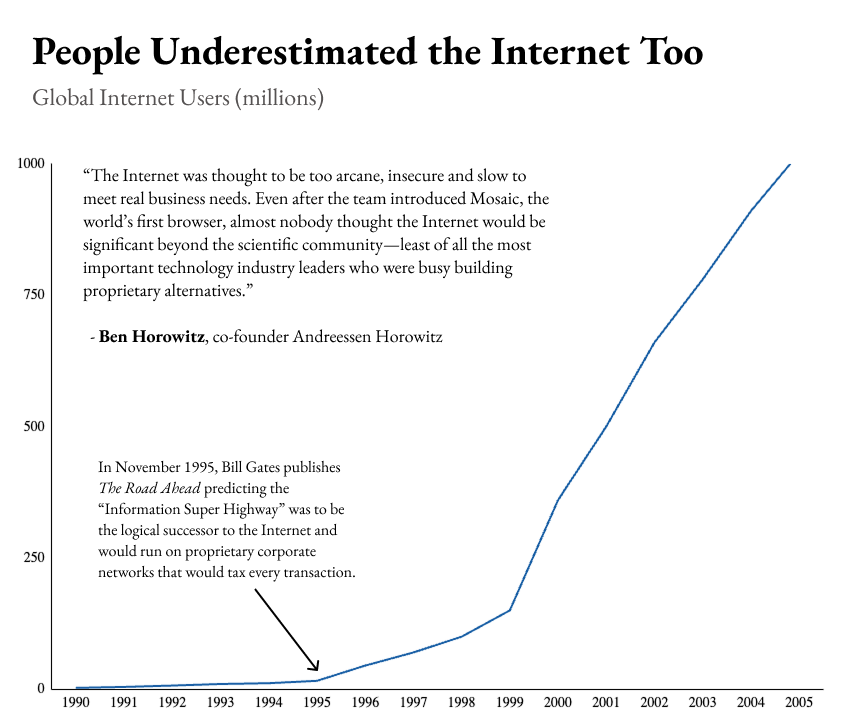


Today, the same historical script is playing out in the realm of financial infrastructure. Sensing both opportunity and threat, major corporations are racing to build private blockchains. In the short term, private chains appear to have the upper hand: faster transaction speeds, better user experience, and large business development teams pushing for adoption. But over time, open, credibly neutral alternatives will slowly erode their market share for two key reasons: 1) No single company can permanently keep up with the pace of innovation in a permissionless system. 2) No legitimate institution wants to build on infrastructure controlled by a competitor.


In 1997, Eric Raymond, a core Linux contributor, explained the underlying logic for the long-term victory of open, permissionless infrastructure in his essay "The Cathedral and the Bazaar." The previously accepted classic theory came from Fred Brooks's "The Mythical Man-Month": software must be developed by a single architect overseeing a small, tightly-knit team, otherwise communication costs would skyrocket exponentially. But Raymond observed that thousands of developers who had never met could simultaneously work on different modules of the Linux kernel, ultimately producing a product that dwarfed those from multi-billion dollar commercial companies. Traditional software was like a finely crafted "cathedral"; the "bazaar" was Fred's term for Linux's distributed development model: public, decentralized, and full of the chaotic, free-flowing energy of iteration. When Linus Torvalds open-sourced the kernel and accepted patches from anyone, he inadvertently pioneered this development paradigm. As Raymond put it: "Release early, release often. Delegate everything you can. Be open to the point of promiscuity." The operating system built using this model powered most internet services by the early 2000s.


Raymond explained that the bazaar model circumvented the problem of exponentially rising communication costs: developers don't need to coordinate directly with each other; everyone simply works synchronously around the code repository, interacting through patches and version updates. The project maintainer integrates all submissions to form a unified standard, which all other developers then use as a baseline. He wrote: "Brooks's law isn't repealed... but given a large enough beta-tester and co-developer base, almost every problem will be characterized quickly and the fix obvious to someone." He added that the negative effects predicted by the law were "overcome by other, nonlinear growth effects."


Raymond also pointed out that the bazaar model breaks down the barrier between users and developers. In the cathedral model, users are merely customers who report bugs to a support ticket system. In the bazaar model, users are co-builders who, upon finding a problem, either submit a fix directly or provide detailed technical descriptions for others to follow up. In the open-source community, "given enough eyeballs, all bugs are shallow." The collective effort of massive participation ultimately leads to overall efficiency surpassing any centralized competitor: "The Linux community... in many ways resembles a free market or an ecology. Many agents pursue their own self-interest, yet the combined result is a self-correcting, resilient system of astonishing complexity and efficiency, far beyond what any centralized planning could achieve."


The Ethereum ecosystem perfectly embodies this pattern. Fabian Vogelsteller, while developing a wallet, found the chaos in various token interface standards and wrote the now-ubiquitous ERC-20 standard. The NFT standard ERC-721 was born from the CryptoKitties development team. Uniswap, now the world's largest decentralized exchange, started as an idea in a Vitalik Buterin blog post, built by Hayden Adams, a mechanical engineer with no financial industry background. These individuals advanced network upgrades without needing anyone's permission. As Sun Microsystems co-founder Bill Joy famously said: "No matter who you are, most of the smartest people work for someone else." A permissionless system allows innovation to spring from anywhere.


The core distinction between the bazaar and the cathedral lies in this: the bazaar's integration layer is lightweight, completely public, and operates on credibility, not top-down authority. Core leaders like Linus Torvalds or Vitalik Buterin gain influence through the voluntary following of developers. Developers follow because core decisions are fully transparent, subject to public critique, and the community can always fork the project if necessary. The internet uses lightweight centralized coordination layers like the IETF and IANA. Wikipedia has a structured editorial review process. All projects that thrive on permissionless innovation manage to be truly open to contributions while having structured integration mechanisms to avoid the feared chaos. And the coordination layer must be maintained by credibility, not coercive control, or the system will quickly collapse.


The bazaar model also requires that the underlying infrastructure cannot be monopolized by a single entity. If Torvalds had tried to privatize the Linux kernel, developers worldwide would have immediately forked the project and continued iterating independently. Raymond refined this theory in "Homesteading the Noosphere." Open-source systems evolved rules similar to Lockean property rights: the developer who writes the initial code first gains founder ownership; continued contribution maintains that ownership; ownership is transferred through formal community succession. Open-source licenses are the formal guarantee of these rules, with community consensus as the soft constraint. If either is missing, developers will migrate to other open-source projects that won't appropriate their labor.


Ethereum's Unreplicable Core Moat


In the Ethereum community, Vitalik has summarized these underlying requirements as "credible neutrality." A coordination mechanism is credibly neutral if it possesses four characteristics simultaneously: the rules are completely transparent, apply equally to all participants, are difficult to arbitrarily change, and anyone can freely participate by following them. These four traits are distilled from mature systems like the internet, Linux, and Wikipedia that attract massive collaboration. Private networks, closed ecosystems, and enterprise blockchains all fail to meet these four points simultaneously.


Over a long enough timeline, credibly neutral systems tend to prevail: the open web replaced corporate private networks, Linux replaced proprietary Unix, Wikipedia replaced Encyclopædia Britannica. In each iteration, the private alternatives held tangible advantages: focused product positioning, strong financial backing, dedicated customer support, professional marketing, and business development teams. But as the open ecosystem matures, these advantages erode, and network effects completely reverse. Once an open system accumulates enough developer tools, applications, and credibility, establishing a perception of stable, unchanging rules, closed systems can no longer compete.


This development pattern is now permeating every layer of financial infrastructure. SWIFT, Visa, Mastercard, and the consortium chains being promoted to institutions today vary in product form and history, but share the same underlying logic: controlled by a centralized entity, harboring platform risk.


For forty years, SWIFT has been owned by member banks and should have remained neutral. But in 2012, under US pressure, it cut off Iranian banks, and in 2022, it was pressured to block several Russian financial institutions. Despite being registered in Belgium and governed by banks, SWIFT ultimately succumbed to US influence, a weakness observed globally. Subsequently, China accelerated its Cross-Border Interbank Payment System (CIPS), Russia built its own System for Transfer of Financial Messages (SPFS), India expanded its Unified Payments Interface (UPI), and Brazil's Pix became a core component of BRICS payment systems. Visa and Mastercard also started as bank cooperatives but have become toll collectors, charging merchants 1.5% to 3.5% fees. Current consortium chains (Canton, Tempo, Arc, etc.) share the same fatal flaw: the interests of the platform operator can always conflict with those of developers building on top.


"The original idea of consortium chains—multiple banks, large companies building their own blockchain together—has largely failed," Vitalik explained. "Such systems combine the worst of both centralized and decentralized worlds." He noted that while the first few participating banks might seem like equal co-builders, the twentieth institution joining is essentially plugging into a system controlled by its competitors. Companies bear all the development costs of a distributed system without gaining the core value blockchains were born to provide: open composability and credible neutrality. Past failures confirm this. From 2017 to 2019, multiple bank consortia tried to rebuild trade finance on blockchain: We.trade, backed by over a dozen institutions including HSBC and Deutsche Bank, went bankrupt in 2022; Marco Polo, with over thirty banks, entered liquidation the next year; Contour followed shortly after, shutting down. The Australian Securities Exchange spent six years and roughly A$250 million building a permissioned ledger with Digital Asset (now developer of Canton), ultimately scrapping the project in 2022. In contrast, Ethereum, owned by no one, has never experienced a full network outage in over a decade, with its ecosystem continually expanding.


This is also the fundamental reason developers choose Ethereum. According to Electric Capital, over 1 million developers have participated in the Ethereum ecosystem since its inception, with 232,000 active developers in the past year alone—no other public chain comes close. Some growth comes from the standard virtuous cycle: Ethereum's concentration of development tools, industry standards, and job opportunities naturally attracts newcomers to learn and build there, which in turn attracts more tools and jobs. But developers and institutions actively choose Ethereum precisely for its extreme decentralization and credible neutrality. For example, last year Robinhood chose to build its Layer 2 on Ethereum rather than develop its own base layer. Johann Kerbrat, head of crypto at the company, stated: "Today, many companies are building their own L1 chains. We also desired the control of our own system, but building a truly secure, decentralized base layer is extremely difficult. Ethereum inherently provides this security base for free. Many new L1s aren't truly decentralized, their security is questionable, and they're essentially just slower, improved databases. We saw no core value."


Erik Voorhees, founder of the privacy-focused AI inference platform Venice AI, expressed a similar view a few days ago. The platform has over 3 million users and generates tens of millions in annual revenue. When asked why they chose to build on Base, Coinbase's Ethereum Layer 2, he said: "We didn't hesitate at all. Among all smart contract platforms, the Ethereum ecosystem is the purest, most resilient, and most mature."


The most fundamental trait of a blockchain is sovereignty. Bitcoin's revolutionary nature lies in being the world's first sovereign computing platform. Before Bitcoin, all computer systems belonged to individuals, companies, or governments and had to obey their owner's will and local laws. A sovereign system follows only its own predetermined rules; no single entity can forcibly change Bitcoin's rules. In the past, sovereignty belonged to monarchs and nations; now, for the first time, a computing platform has achieved sovereignty. This is also why decentralization is so valued in crypto: it's the only path to sovereignty. A chain with only ten validating nodes has its rules dictated by those ten entities. Ethereum, with hundreds of thousands of independent validators spread across global jurisdictions, multiple independent client implementations, and a foundation that explicitly renounces governance power, has long crossed the sovereignty threshold. No single party can claim exclusive ownership of the network. The core value of sovereignty is this: the global financial system can build applications on Ethereum, and all participants need not worry about other institutions, governments, or foundations arbitrarily changing rules to their detriment.


Global Institutions Bet on Ethereum's Open Ecosystem


Ethereum's lead in sovereignty and credible neutrality stems from a historical path dependency that other chains cannot replicate. Ethereum launched in 2015 with Proof of Work, ran for seven years, and only transitioned to Proof of Stake in 2022. Network ownership was sufficiently decentralized through a public crowd sale in 2014 and mining accessible with consumer-grade GPUs, ensuring no single entity holds a large enough token stake to control the network (a key prerequisite for sovereignty in a Proof of Stake system). Most consortium chains today are venture-backed, with tokens concentrated among founding teams, giving a few entities absolute say over consensus. Competitors can copy the technical architecture but not Ethereum's development history.


Since then, Ethereum's lead has compounded: sovereignty and credible neutrality attract developers; an influx of developers brings better libraries, tools, and job markets, further lowering the barrier to entry and attracting more practitioners; applications deposit liquidity and tokenized assets, driving institutional participation. Each layer of the ecosystem reinforces the others. Competitors must build a complete industrial chain simultaneously, while Ethereum's scale advantage continues to grow with compound interest.
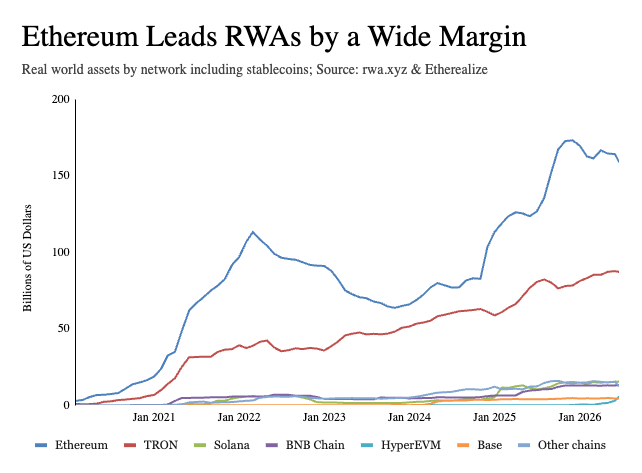


The industry's most sophisticated players are already betting on Ethereum: Coinbase and Robinhood built their Layer 2s on Ethereum; BlackRock and JPMorgan launched tokenized money market funds BUIDL and MONY, both on Ethereum; leading DeFi protocols like Aave, Maker/Sky, Maple, and Uniswap are primarily on Ethereum; the world's top stablecoin issuers settle on Ethereum. Data from Token Terminal's "Q1 2026 Ethereum Industry Report" shows: among the top five public chains, Ethereum hosts 79% of active DeFi lending, 62% of stablecoin issuance, 73% of tokenized funds, and 84% of tokenized commodity assets.


Ethereum's applications are also permissionless, further amplifying its advantages. For example, Uniswap's permissionless listing mechanism gives pricing and liquidity to thousands of long-tail assets, a service centralized exchanges would never provide. Aave's open and highly composable lending markets have spawned an entire ecosystem of specialized pools and risk management tools, far exceeding what the core team alone could develop. Closed systems require platform operators to anticipate all use cases in advance; open systems do not.


The most potent counter-argument to the thesis that "permissionless systems will ultimately win" is not technical but relates to the specific nature of finance: privately controlled networks might be an advantage, not a defect, for the financial industry. When payments fail or funds flow abnormally, regulators need a clear responsible entity; "no one in charge" sounds more like a huge risk than an advantage in a legal context. But this criticism confuses two completely separate layers: accountability mechanisms are built at the application layer; the settlement layer does not need to bear this function. For instance, the ERC-3643 token standard directly embeds KYC verification and cross-border transfer restrictions into smart contracts; issuers can set wallet whitelists, restrict asset transfers, freeze, or recover tokens. Privacy technologies work similarly; zero-knowledge proofs allow institutions to settle on a public chain while hiding transaction details. In contrast, on consortium chains, transaction data is visible only to the company itself and its competitors.


In the early days of the internet, it was widely believed its security was insufficient for commercial transactions. After the HTTPS protocol enhanced security capabilities, most commercial activity migrated to the open web, and such skepticism vanished. The skeptics back then weren't wrong about the internet's early flaws, but they underestimated the self-evolving potential of open networks.


Today, banks and fintech companies building private chains are repeating the mistakes of AOL and Microsoft: trying to replicate an open system but building a walled garden, extracting rent through platform control. This model is doomed to fail. The walls built to exert control also block out external innovation.


Netscape is the model for success. Netscape never tried to monopolize the internet; it built a browser to guide global users onto the open network. Riding the explosive growth of the internet, Netscape became a defining company of its era. Ethereum, with its almost unreplicable credible neutrality, already possesses the potential to become the global settlement layer for finance. The optimal industry strategy is to build applications on top of permissionless infrastructure, not to compete with it head-on.


Crypto di tendenza

Domande pertinenti

QAccording to the article, what is the 'Cathedral vs. Bazaar' analogy, and how does it relate to Ethereum's development?

AThe 'Cathedral vs. Bazaar' analogy, from Eric Raymond's essay, contrasts traditional, centralized 'cathedral' software development with the open, decentralized 'bazaar' model of Linux. The article argues that Ethereum perfectly embodies this 'bazaar' model, where innovation is permissionless and contributions come from a global, decentralized network of developers, leading to superior long-term evolution and resilience compared to closed, corporate-controlled systems.

QWhat are the four key characteristics of 'credible neutrality' as defined by Vitalik Buterin in the context of Ethereum?

AAccording to the article, Vitalik Buterin defines a credibly neutral coordination mechanism as one that possesses four key characteristics: 1) The rules are completely transparent. 2) The rules apply equally to all participants. 3) The rules are difficult to change arbitrarily. 4) Anyone who follows the rules can participate freely. Ethereum is presented as a system that embodies these traits.

QWhy does the author argue that private or consortium blockchains (like Canton, Tempo) are fundamentally flawed for financial infrastructure?

AThe author argues that private or consortium blockchains suffer from a fatal flaw: they reintroduce platform risk controlled by a centralized entity or a consortium of competitors. This structure fails to provide the core value of blockchains—open composability and credible neutrality. Institutions are reluctant to build on infrastructure controlled by rivals, and these systems cannot match the innovation speed of permissionless networks. Historical failures like We.trade and the Australian Stock Exchange's project are cited as evidence.

QWhat historical examples does the article use to support the thesis that open, permissionless systems ultimately triumph over closed ones?

AThe article supports its thesis with several historical examples: the open Internet defeating corporate proprietary networks (like those envisioned by Bill Gates), the Linux operating system displacing proprietary Unix systems (like Sun Microsystems), and Wikipedia replacing the Encyclopaedia Britannica. Each case shows closed systems initially having advantages but ultimately being overtaken by open ecosystems due to network effects and innovation.

QWhat is described as Ethereum's 'unreplicable core moat' or competitive advantage, and how was it established?

AEtheream's 'unreplicable core moat' is its sovereign independence and credible neutrality, achieved through a unique historical path dependence. This was established by launching with Proof-of-Work in 2015, which allowed for highly decentralized ownership via GPU mining, and conducting a public crowd sale with no single entity holding a controlling stake. This history, combined with its subsequent network effects in developers, tools, and applications, creates a competitive advantage that new chains backed by venture capital and centralized token allocations cannot easily replicate.

Letture associate

Report Interpretation: J.P. Morgan Details Micron's Pre-Earnings Sentiment, Current Hardware Sector Dynamics

Morgan Stanley analyst Joshua Meyers' report (June 21, 2026) highlights key trends in the hardware and semiconductor sector ahead of Micron's earnings. The core takeaways are: 1. **Micron & Memory:** Memory remains a high-conviction long theme, driven by strong AI demand and rising ASPs. However, investor focus is shifting to the sustainability of Micron's >80% gross margins and the specifics of potential new long-term supply agreements (SCAs). 2. **Hardware Supply Chain:** AI-related demand for servers, networking, and storage remains robust, but company performance is diverging. Celestica (CLS) shows improved margin confidence, Western Digital and Seagate benefit from pricing, Fabrinet (FN) sees predictable AI optics growth, and Teradyne (TER) anticipates a new Google customer. 3. **AI Capex & WFE Forecasts:** JPMorgan increased its Wafer Fab Equipment (WFE) market growth forecasts to 28% in 2026 and 29% in 2027. AI infrastructure financing is evolving, with higher project-level debt reducing constraints on capex expansion. The report signals that while the AI-driven hardware cycle is strong, the market is entering a phase focused on execution verification (e.g., Micron's SCA details, Fabrinet's ramp with Amazon) and valuation sustainability. Key near-term signals include Micron's guidance, Arista Networks' outlook, and the pace of demand normalization post potential tariff-related pull-ins.

marsbit1 h fa

Report Interpretation: J.P. Morgan Details Micron's Pre-Earnings Sentiment, Current Hardware Sector Dynamics

marsbit1 h fa

Research Report Analysis: The Fed's New Chair's Debut – New Leader, But Same Script?

Report Analysis: Federal Reserve's New Chair Debut – A New Captain, But the Same Script? Morgan Stanley's chief global economist Seth B. Carpenter analyzes the first FOMC meeting under new Fed Chair Kevin Warsh in a June 21 report. Warsh deliberately avoided providing forward guidance on interest rates, aligning with his philosophy. However, market expectations for a rate hike this year were reinforced. Key signals lie elsewhere: inflation may fall more than expected, and quantitative tightening (QT) could be more aggressive than anticipated. The FOMC's "dot plot" suggests only one rate hike in 2026. Carpenter argues that if inflation undershoots forecasts, the logic for even a single hike weakens, especially as projections indicate potential rate cuts in 2027. On QT, Warsh's stance is clear. Carpenter notes that measures like halving the Treasury's account balance could shrink the Fed's balance sheet by around $500 billion with minimal market impact. Combined with adjustments to reserve interest and liquidity rules, the ultimate QT scale may exceed expectations, though its market effect might be less disruptive unless the Fed actively sells Mortgage-Backed Securities (MBS). While Warsh initiated a review of the Fed's policy framework, the 2% inflation target remains intact for now. The report concludes that the market may be overestimating the significance of reduced forward guidance and the near-term rate hike risk, while potentially underestimating the scope and manageable nature of the coming balance sheet reduction. The key debates will hinge on upcoming core PCE data, the specifics of the QT path, and the framework review's findings.

marsbit1 h fa

Research Report Analysis: The Fed's New Chair's Debut – New Leader, But Same Script?

marsbit1 h fa

Critical Game Week: BTC Retracement Confirmation vs. HYPE Support Battle | Guest Analysis

This weekly analysis outlines a critical juncture for BTC and HYPE markets, focusing on key price level confirmations. **BTC Analysis:** BTC is at a pivotal point after a five-wave rally from the June 5th low of $59,100. The price has broken below a short-term rising channel's lower boundary, with the current move seen as a pullback to test this breakdown. Failure to reclaim this level could lead to a retest of the $59,000-$60,000 support zone. The core scenario hinges on this channel retest outcome. * **Key Levels:** Resistance at $64,500-$65,000 (channel boundary) and $69,500-$70,500. Support at $59,000-$60,000 and $55,000. * **Strategy:** A core bearish stance is maintained (20% short from last week), with short-term plans for tactical trades. Three detailed contingency plans (A/B/C) are provided for short positions on resistance tests or breakdowns, emphasizing strict stop-loss discipline. **HYPE Analysis:** HYPE shows strong momentum but is currently in a corrective phase after hitting a new high of $76.94. The price is retesting the crucial $64-$66 support area. * **Key Levels:** Resistance near $77 and $80-$82. Support at $64-$66 and $52-$54. * **Strategy:** The short-term approach is "buy on dips, avoid chasing rallies." A long position is considered only if clear stabilization signals appear at the $64-$66 or deeper $52-$54 support zones, with tight risk controls. **General Risk Management:** A standardized trailing stop-loss protocol is emphasized: set initial stop, breakeven at +1% profit, then trail stops upward to lock in gains. *Disclaimer: All analysis is presented as a personal trading framework, not investment advice. Market conditions are complex and require dynamic adjustment.*

marsbit1 h fa

Critical Game Week: BTC Retracement Confirmation vs. HYPE Support Battle | Guest Analysis

marsbit1 h fa

Research Report Interpretation: Citi Attends AWS Summit, Bullish on Cloud Business Acceleration but Data Governance Remains Key Variable

Citi analyst Tyler Radke's team attended the AWS New York Summit (June 17-18), engaging with over 10 clients and partners. In a June 19 report, they highlighted the summit's focus on scaling agent AI for enterprise deployment. Citi maintains a "Buy" rating on Amazon, forecasting AWS revenue growth to accelerate to 37% in FY27 from 30% in FY26, noting this estimate may be conservative. Key takeaways: 1. **AWS Strategy Shift:** AWS is moving from proof-of-concepts to scalable deployment. New offerings like AWS Context (building enterprise knowledge graphs), Amazon Quick (cross-application AI assistant), and security tool Continuum address core enterprise pain points for AI adoption. 2. **Data Infrastructure Beneficiaries:** Data infrastructure companies like Snowflake, Elastic, Oracle, and ClickHouse are seen as direct beneficiaries of scaling AI workloads, as evidenced by strong growth and use cases presented. 3. **Critical Role of Data Governance:** As AI agents scale from hundreds to thousands, effective data governance becomes the key variable for deploying AI in core business processes. AWS Context represents AWS's strategic extension from providing compute/models to offering a data governance infrastructure layer. The report emphasizes that without solving data governance, AI will remain confined to pilot projects. The investment thesis focuses on AWS revenue acceleration and data infrastructure vendors' growth, while monitoring signals like AWS's quarterly revenue growth, Bedrock AgentCore task volume, and pricing impacts on companies like Elastic.

marsbit1 h fa

Research Report Interpretation: Citi Attends AWS Summit, Bullish on Cloud Business Acceleration but Data Governance Remains Key Variable

marsbit1 h fa

Trading

Spot
Futures

Articoli Popolari

Cosa è ETH 3.0

ETH3.0 e $eth 3.0: Un'Analisi Approfondita del Futuro di Ethereum Introduzione Nel panorama in rapida evoluzione delle criptovalute e della tecnologia blockchain, ETH3.0, spesso indicato come $eth 3.0, è emerso come un argomento di considerevole interesse e speculazione. Il termine comprende due concetti principali che warrantono chiarimenti: Ethereum 3.0: Questo rappresenta un potenziale futuro aggiornamento volto ad aumentare le capacità dell'attuale blockchain di Ethereum, concentrandosi principalmente sul miglioramento della scalabilità e delle prestazioni. ETH3.0 Meme Token: Questo progetto di criptovaluta distinto cerca di sfruttare la blockchain di Ethereum per creare un ecosistema incentrato sui meme, promuovendo il coinvolgimento all'interno della comunità delle criptovalute. Comprendere questi aspetti di ETH3.0 è essenziale non solo per gli appassionati di criptovalute, ma anche per coloro che osservano tendenze tecnologiche più ampie nello spazio digitale. Che cos'è ETH3.0? Ethereum 3.0 Ethereum 3.0 è pubblicizzato come un aggiornamento proposto per la rete Ethereum già stabilita, che è stata la spina dorsale di molte applicazioni decentralizzate (dApps) e contratti smart sin dalla sua nascita. I miglioramenti previsti si concentrano principalmente sulla scalabilità, integrando tecnologie avanzate come lo sharding e le prove a conoscenza zero (zk-proofs). Queste innovazioni tecnologiche mirano a facilitare un numero senza precedenti di transazioni al secondo (TPS), potenzialmente raggiungendo milioni, affrontando così una delle limitazioni più significative della tecnologia blockchain attuale. Il miglioramento non è meramente tecnico, ma anche strategico; è volto a preparare la rete Ethereum per un'adozione e un'utilità diffuse in un futuro contrassegnato da un aumento della domanda di soluzioni decentralizzate. ETH3.0 Meme Token Al contrario di Ethereum 3.0, l'ETH3.0 Meme Token si avventura in un dominio più leggero e giocoso, combinando la cultura dei meme di internet con la dinamica delle criptovalute. Questo progetto consente agli utenti di acquistare, vendere e scambiare meme sulla blockchain di Ethereum, fornendo una piattaforma che promuove il coinvolgimento della comunità attraverso la creatività e interessi condivisi. L'ETH3.0 Meme Token mira a dimostrare come la tecnologia blockchain possa intersecarsi con la cultura digitale, creando casi d'uso che siano sia divertenti che finanziariamente praticabili. Chi è il Creatore di ETH3.0? Ethereum 3.0 L'iniziativa verso Ethereum 3.0 è principalmente propulsa da un consorzio di sviluppatori e ricercatori all'interno della comunità di Ethereum, tra cui Justin Drake. Conosciuto per le sue intuizioni e contributi all'evoluzione di Ethereum, Drake è stato una figura di spicco nelle discussioni riguardanti la transizione di Ethereum verso un nuovo livello di consenso, chiamato “Beam Chain.” Questo approccio collaborativo allo sviluppo significa che Ethereum 3.0 non è il prodotto di un creatore singolo, ma piuttosto una manifestazione di ingegno collettivo focalizzato sul progresso della tecnologia blockchain. ETH3.0 Meme Token I dettagli riguardanti il creatore dell'ETH3.0 Meme Token sono attualmente non rintracciabili. La natura dei token meme conduce spesso a una struttura più decentralizzata e guidata dalla comunità, il che potrebbe spiegare la mancanza di attribuzione specifica. Questo si allinea con l'etica della comunità crypto più ampia, dove l'innovazione spesso nasce da sforzi collaborativi piuttosto che individuali. Chi sono gli Investitori di ETH3.0? Ethereum 3.0 Il supporto per Ethereum 3.0 proviene principalmente dalla Ethereum Foundation insieme a una comunità entusiasta di sviluppatori e investitori. Questa associazione fondamentale fornisce un considerevole grado di legittimità e migliora le prospettive di implementazione di successo poiché sfrutta la fiducia e la credibilità costruite nel corso degli anni di operazioni della rete. Nel clima in rapida evoluzione delle criptovalute, il supporto della comunità gioca un ruolo cruciale nello sviluppo e nell'adozione, posizionando Ethereum 3.0 come un serio contenditore per i futuri progressi della blockchain. ETH3.0 Meme Token Sebbene le fonti attualmente disponibili non forniscano informazioni esplicite riguardo ai fondamenti o alle organizzazioni di investimento che sostengono l'ETH3.0 Meme Token, ciò è indicativo del modello di finanziamento tipico per i token meme, che spesso si basa sul supporto di base e sul coinvolgimento della comunità. Gli investitori in tali progetti sono tipicamente individui motivati dal potenziale per innovazioni guidate dalla comunità e dallo spirito di cooperazione trovato all'interno della comunità crypto. Come Funziona ETH3.0? Ethereum 3.0 Le caratteristiche distintive dell'Ethereum 3.0 risiedono nella sua proposta di implementazione della tecnologia di sharding e zk-proof. Lo sharding è un metodo di partizionamento della blockchain in pezzi più piccoli e gestibili o “shard,” che possono elaborare transazioni in modo concorrente piuttosto che sequenziale. Questa decentralizzazione dell'elaborazione aiuta a prevenire la congestione e garantisce che la rete rimanga reattiva anche sotto un carico pesante. La tecnologia delle prove a conoscenza zero (zk-proof) contribuisce con un ulteriore livello di sofisticazione consentendo la validazione delle transazioni senza rivelare i dati sottostanti coinvolti. Questo aspetto non solo migliora la privacy, ma aumenta anche l'efficienza complessiva della rete. Si parla anche di incorporare una macchina virtuale Ethereum a conoscenza zero (zkEVM) in questo aggiornamento, amplificando ulteriormente le capacità e l'utilità della rete. ETH3.0 Meme Token L'ETH3.0 Meme Token si distingue capitalizzando sulla popolarità della cultura dei meme. Stabilisce un mercato per gli utenti che desiderano partecipare al trading di meme, non solo per divertimento, ma anche per potenziale guadagno economico. Integrando funzioni come lo staking, la fornitura di liquidità e meccanismi di governance, il progetto promuove un ambiente che incentiva l'interazione e la partecipazione della comunità. Offrendo una miscela unica di intrattenimento e opportunità economica, l'ETH3.0 Meme Token mira ad attrarre un pubblico variegato, che va dagli appassionati di crypto ai semplici intenditori di meme. Timeline di ETH3.0 Ethereum 3.0 11 Novembre 2024: Justin Drake accenna al prossimo aggiornamento ETH 3.0, incentrato sui miglioramenti della scalabilità. Questo annuncio segna l'inizio delle discussioni formali riguardo l'architettura futura di Ethereum. 12 Novembre 2024: La proposta attesa per Ethereum 3.0 dovrebbe essere svelata a Devcon a Bangkok, preparando il terreno per un feedback più ampio della comunità e potenziali passi successivi nello sviluppo. ETH3.0 Meme Token 21 Marzo 2024: L'ETH3.0 Meme Token viene ufficialmente elencato su CoinMarketCap, segnando il suo ingresso nel dominio pubblico delle criptovalute e aumentando la visibilità per il suo ecosistema basato sui meme. Punti Chiave In conclusione, Ethereum 3.0 rappresenta una significativa evoluzione all'interno della rete Ethereum, concentrandosi sul superamento delle limitazioni riguardanti scalabilità e prestazioni attraverso tecnologie avanzate. I suoi aggiornamenti proposti riflettono un approccio proattivo alle future esigenze e usabilità. D'altra parte, l'ETH3.0 Meme Token incarna l'essenza della cultura guidata dalla comunità nello spazio delle criptovalute, sfruttando la cultura dei meme per creare piattaforme coinvolgenti che incoraggiano la creatività e la partecipazione degli utenti. Comprendere gli scopi e le funzionalità distinte di ETH3.0 e $eth 3.0 è fondamentale per chiunque sia interessato ai continui sviluppi nello spazio crypto. Con entrambe le iniziative che tracciano percorsi unici, esse sottolineano collettivamente la natura dinamica e multifacetica dell'innovazione blockchain.

186 Totale visualizzazioniPubblicato il 2024.04.04Aggiornato il 2024.12.03

Cosa è ETH 3.0

Cosa è ETHEREUM

HarryPotterTrumpHomerSimpson777Inu: Panoramica di un Progetto Crypto Web3 Introduzione Nel mondo in rapida evoluzione delle criptovalute e della finanza decentralizzata, progetti innovativi emergono frequentemente, catturando l'interesse della comunità degli investitori e degli appassionati di crypto. Uno di questi progetti è HarryPotterTrumpHomerSimpson777Inu, una criptovaluta che si trova all'incrocio tra cultura popolare e tecnologia blockchain. Questo token guidato dalla comunità mescola personaggi e figure politiche ben noti, con l'obiettivo di creare una piattaforma coinvolgente e promuovere un'adozione diffusa. Che cos'è HarryPotterTrumpHomerSimpson777Inu? HarryPotterTrumpHomerSimpson777Inu è un token costruito sulla blockchain di Ethereum, progettato per essere accessibile e divertente per un pubblico diversificato. L'unicità di questo progetto deriva dal suo approccio tematico, che intreccia elementi di fantasia, politica e intrattenimento. Sfruttando il fascino nostalgico di personaggi amati, il progetto cerca di creare un'esperienza di criptovaluta coinvolgente, incoraggiando il coinvolgimento e la partecipazione della comunità. L'obiettivo principale di HarryPotterTrumpHomerSimpson777Inu è stabilire un token che risuoni con gli utenti a livello personale, promuovendo sia il divertimento che il coinvolgimento nell'ambito crypto. Questo branding distintivo mira ad attrarre individui che in precedenza potrebbero non essersi interessati alle criptovalute, facilitando un nuovo punto di ingresso per utenti potenziali. Creatore di HarryPotterTrumpHomerSimpson777Inu L'identità del creatore dietro HarryPotterTrumpHomerSimpson777Inu rimane sconosciuta. Questa non è una pratica rara nel dominio delle criptovalute, dove l'anonimato è spesso preferito dai fondatori come mezzo di protezione della privacy e promozione di un ethos decentralizzato. Questa oscurità non diminuisce il valore del progetto; al contrario, riflette una tendenza più ampia all'interno del settore, dove molti progetti di successo sono emersi da origini anonime. Investitori di HarryPotterTrumpHomerSimpson777Inu Le informazioni pubbliche riguardo agli investitori di HarryPotterTrumpHomerSimpson777Inu sono limitate. La natura del progetto, incentrata sul coinvolgimento della comunità, suggerisce una dipendenza da investimenti di piccole dimensioni da parte di singoli appassionati piuttosto che da sostegni sostanziali da fondazioni di investimento consolidate o corporation. Questo livello di trasparenza nel finanziamento è tipico di molti progetti di criptovaluta guidati dalla comunità, dove il supporto spesso proviene da movimenti di base piuttosto che da investitori istituzionali. Come Funziona HarryPotterTrumpHomerSimpson777Inu? Operando sulla blockchain di Ethereum, HarryPotterTrumpHomerSimpson777Inu sfrutta la sua solida infrastruttura per facilitare transazioni e promuovere interazioni tra gli utenti all'interno della comunità. Ciò che distingue questo progetto è il suo posizionamento tematico: canalizzando il carisma di personaggi iconici provenienti da diversi ambiti culturali, crea un'identità di marca distintiva. Questo approccio non solo attrae gli utenti, ma coltiva anche una comunità fedele attorno al token. Le meccaniche operative del progetto si concentrano sul coinvolgimento della comunità. Adotta un modello decentralizzato che incoraggia la partecipazione, consentendo agli utenti di interagire attraverso vari canali mentre promuovono lo scambio di idee e esperienze. Inoltre, il progetto abbraccia i principi del Web3, privilegiando la sovranità degli utenti e la decentralizzazione, che sono i pilastri del futuro di Internet. Timeline di HarryPotterTrumpHomerSimpson777Inu La storia di HarryPotterTrumpHomerSimpson777Inu è segnata da diversi eventi decisivi: 12 agosto 2023: L'inizio di HarryPotterTrumpHomerSimpson777Inu, segnando il suo ingresso nell'ecosistema delle criptovalute. Fase di Sviluppo: Un periodo focalizzato sulla costruzione di una strategia completa per stimolare la crescita guidata dalla comunità e il coinvolgimento degli utenti. Listing sugli Scambi: Sebbene i dettagli specifici di listing non siano stati divulgati, il progetto è stato reso accessibile su vari scambi di criptovalute, migliorando la sua visibilità nel mercato. Coinvolgimento della Comunità: Sforzi continui per coinvolgere attivamente la comunità, stabilendo canali di dialogo e promuovendo la partecipazione attraverso varie attività, tra cui concorsi, discussioni e votazioni comunitarie. Aspetti Chiave di HarryPotterTrumpHomerSimpson777Inu Focus sulla Comunità Un tratto distintivo di HarryPotterTrumpHomerSimpson777Inu è la sua forte enfasi sul coinvolgimento della comunità. Il progetto incoraggia attivamente gli utenti a partecipare a discussioni, condividere idee e contribuire all'evoluzione del progetto. Questa interazione coltiva un senso di appartenenza e di ownership tra i membri della comunità, essenziale per la sostenibilità a lungo termine del token. Utilizzo della Blockchain di Ethereum La scelta di costruire sulla blockchain di Ethereum consente a HarryPotterTrumpHomerSimpson777Inu di sfruttare le sue caratteristiche di sicurezza ben consolidate e architettura decentralizzata. Questa base garantisce affidabilità per le transazioni e fornisce un framework affidabile su cui sviluppare varie funzionalità. Approccio Tematico Unico Fusione di elementi della cultura pop nella sua identità, HarryPotterTrumpHomerSimpson777Inu crea una narrazione coinvolgente che lo differenzia da altre criptovalute. L'amalgama di personaggi e temi genera riconoscimento e intrigo immediati, rendendo il token relazionabile a un'ampia gamma di utenti potenziali. Anonimato nello Sviluppo Il creatore anonimo del progetto rimane una caratteristica ricorrente in molte iniziative di criptovaluta. Questo aspetto evidenzia un ethos di decentralizzazione, introducendo anche un livello di mistero che potrebbe affascinare un segmento della comunità crypto, attirando l'attenzione sul progetto e invitando l'impegno da parte di utenti che supportano l'idea di un'iniziativa decentralizzata e gestita dalla comunità. Conclusione HarryPotterTrumpHomerSimpson777Inu si presenta come un'aggiunta distintiva al panorama delle criptovalute, combinando il fascino della cultura popolare con le meccaniche innovative della tecnologia blockchain. Sebbene i dettagli riguardanti il creatore e gli investitori specifici rimangano non divulgati, il focus del progetto sulla comunità e il suo approccio tematico lo contraddistinguono come un potenziale attore influente nel contesto del Web3 e delle criptovalute. Man mano che l'ecosistema delle criptovalute continua ad espandersi, iniziative come HarryPotterTrumpHomerSimpson777Inu ci ricordano le molteplici modalità in cui la blockchain può connettere le comunità globali attraverso narrazioni e valori condivisi.

956 Totale visualizzazioniPubblicato il 2024.04.06Aggiornato il 2024.12.03

Cosa è ETHEREUM

Come comprare ETH

Benvenuto in HTX.com! Abbiamo reso l'acquisto di Ethereum (ETH) semplice e conveniente. Segui la nostra guida passo passo per intraprendere il tuo viaggio nel mondo delle criptovalute.Step 1: Crea il tuo Account HTXUsa la tua email o numero di telefono per registrarti il tuo account gratuito su HTX. Vivi un'esperienza facile e sblocca tutte le funzionalità,Crea il mio accountStep 2: Vai in Acquista crypto e seleziona il tuo metodo di pagamentoCarta di credito/debito: utilizza la tua Visa o Mastercard per acquistare immediatamente EthereumETH.Bilancio: Usa i fondi dal bilancio del tuo account HTX per fare trading senza problemi.Terze parti: abbiamo aggiunto metodi di pagamento molto utilizzati come Google Pay e Apple Pay per maggiore comodità.P2P: Fai trading direttamente con altri utenti HTX.Over-the-Counter (OTC): Offriamo servizi su misura e tassi di cambio competitivi per i trader.Step 3: Conserva Ethereum (ETH)Dopo aver acquistato Ethereum (ETH), conserva nel tuo account HTX. In alternativa, puoi inviare tramite trasferimento blockchain o scambiare per altre criptovalute.Step 4: Scambia Ethereum (ETH)Scambia facilmente Ethereum (ETH) nel mercato spot di HTX. Accedi al tuo account, seleziona la tua coppia di trading, esegui le tue operazioni e monitora in tempo reale. Offriamo un'esperienza user-friendly sia per chi ha appena iniziato che per i trader più esperti.

2.9k Totale visualizzazioniPubblicato il 2024.12.10Aggiornato il 2026.06.02

Come comprare ETH

Discussioni

Benvenuto nella Community HTX. Qui puoi rimanere informato sugli ultimi sviluppi della piattaforma e accedere ad approfondimenti esperti sul mercato. Le opinioni degli utenti sul prezzo di ETH ETH sono presentate come di seguito.

活动图片