Only 3 Points for the Public Chain Moat? Alliance DAO Founder's Remarks Ignite Crypto Community Debate

Odaily星球日报Pubblicato 2025-12-11Pubblicato ultima volta 2025-12-11

Introduzione

In a recent debate sparked by Alliance DAO founder qw (@QwQiao), the crypto community is divided over the "moat" of blockchain technology. Qw controversially rated the moat of L1 public chains at just 3/10, arguing that their defensibility is limited compared to traditional tech and financial giants like Microsoft (10/10), Apple (10/10), or Visa (10/10). He suggested that even top crypto projects only score around 5/10, with Bitcoin being an exception at 9/10 due to its unique founding narrative and Lindy effect. The discussion originated from a Paradigm researcher’s critique that "liquidity is not a moat," which drew mixed reactions. Some, like Dragonfly Capital’s Haseeb, strongly disagreed with qw, pointing to Ethereum’s decade-long dominance despite numerous challengers as proof of a significant moat. Others argued that network effects, trust, and ecosystem maturity are critical moats in crypto. The article explores seven potential components of a public chain’s moat: technical vision, founder influence, developer/user networks, application ecosystems, token market cap, external connectivity, and long-term roadmaps. It concludes that the crypto industry is still too small and nascent to focus heavily on moat analysis—instead, it should prioritize scaling users, capital, and real-world utility.

Original / Odaily Planet Daily (@OdailyChina)

Author / Wenser(@wenser2010)
Recently, Alliance DAO founder qw(@QwQiao) dropped a bombshell opinion: "Blockchain moats are limited," rating the moat of L1 public chains at a mere 3/10.

This statement quickly ignited the overseas crypto circle, sparking heated discussions among crypto VCs, public chain builders, and KOLs. Dragonfly partner Haseeb angrily retorted that rating the "blockchain moat at 3/10" was utterly ridiculous, noting that even Aave founder Santi, who dislikes the industry's gambling tendencies, never believed blockchain "has no moat."

Debates about the meaning, value, and business models of blockchain & cryptocurrency consistently resurface throughout market cycles. The crypto industry constantly oscillates between idealism and reality: people nostalgically yearn for the original decentralized ideals while simultaneously craving the status and recognition of the traditional financial industry, all while being deeply mired in self-doubt about whether it's "just a repackaged casino." The root of all these contradictions perhaps lies in scale—the total market capitalization of the crypto industry has hovered around $3-4 trillion, still appearing minuscule compared to traditional financial giants often worth hundreds of billions or even trillions of dollars.

As practitioners in the industry, everyone harbors a contradictory psychology of both arrogance and inferiority—arrogant about blockchain's birth embodying Satoshi Nakamoto's ideal of de-monetization and decentralized spirit, and about the crypto industry indeed becoming an emerging financial sector that is gradually gaining attention, acceptance, and participation from mainstream forces; the point of inferiority, however, is probably like a poor kid always feeling that what they are doing isn't quite honorable, filled with blood, tears, bitterness, and pain from a zero-sum game where people prey on each other. In short, the limitations of the industry's scale have bred this cyclical identity anxiety, self-doubt, and self-denial.

Today, let's use the topic of "moat business ratings" raised by qw to discuss the existing chronic problems and core advantages of the crypto industry.

Origin of the Debate: Is Liquidity the Moat of the Crypto Industry?

This major industry discussion about "whether the crypto industry has a moat" originally stemmed from a statement by Paradigm team researcher frankie—"The greatest trick the devil ever pulled was convincing crypto people that liquidity is a moat."(Odaily Planet Daily Note: Original quote: the greatest trick the devil ever pulled was convincing crypto people that liquidity is a moat.)

It's clear that frankie, a "purebred" VC, somewhat scoffs at the current industry trend of highly推崇 "liquidity is everything." After all, for an investment manager or research expert who holds advantages in capital and information, they often hope their managed funds are spent on projects and businesses with real operational support, capable of generating genuine cash flow and continuously providing financial returns.

This view also gained agreement from many in the comments:

  • Multicoin partner Kyle Samani directly said "+1";
  • Ethereum Foundation member binji believed that "trust is the real moat; even if trust might flow opportunistically in the short term, liquidity will always reside where trust is placed."
  • Chris Reis from Circle's Arc blockchain team also pointed out: "TVL always seems to be the wrong North Star metric (business guiding goal)."
  • Justin Alick from the Aura foundation remarked somewhat jokingly: "Liquidity is like a fickle woman; she might leave you at any time."
  • DeFi researcher Defi peniel stated bluntly: "Relying solely on liquidity is not a moat; hype can disappear overnight."

Of course, many also refuted this—

  • DFDV COO & CIO Parker commented: "What are you talking about? USDT is the worst stablecoin but holds absolute dominance. Bitcoin is the (performance/experience) worst blockchain but holds dominant地位 absolutely."
  • Former Sequoia investor, now Folius Ventures investor KD, simply asked: "Isn't it?"
  • Fabric VC investor Thomas Crow pointed out: "In exchanges, liquidity *is* a moat—the deeper the liquidity, the better the user experience; this is the most important characteristic in this vertical industry, without exception. This is why major innovations in crypto asset trading focus on solving insufficient liquidity (which leads to worse user experience). Examples include Uniswap acquiring liquidity for long-tail assets through LPs, and Pump.Fun attracting pre-token launch liquidity through standardized contracts and bonding curves."
  • Pantera investor Mason Nystrom retweeted and commented: "Liquidity is absolutely a moat." He then provided various examples: Among public chains, Ethereum leads today because of DeFi liquidity (and developers); among CEXs, Binance, Coinbase, etc.; among lending platforms, Aave, MakerDAO; among stablecoins, USDT; among DEXs, Uniswap, Pancakeswap.

Then came the "moat rating" tweet from Alliance DAO founder qw:
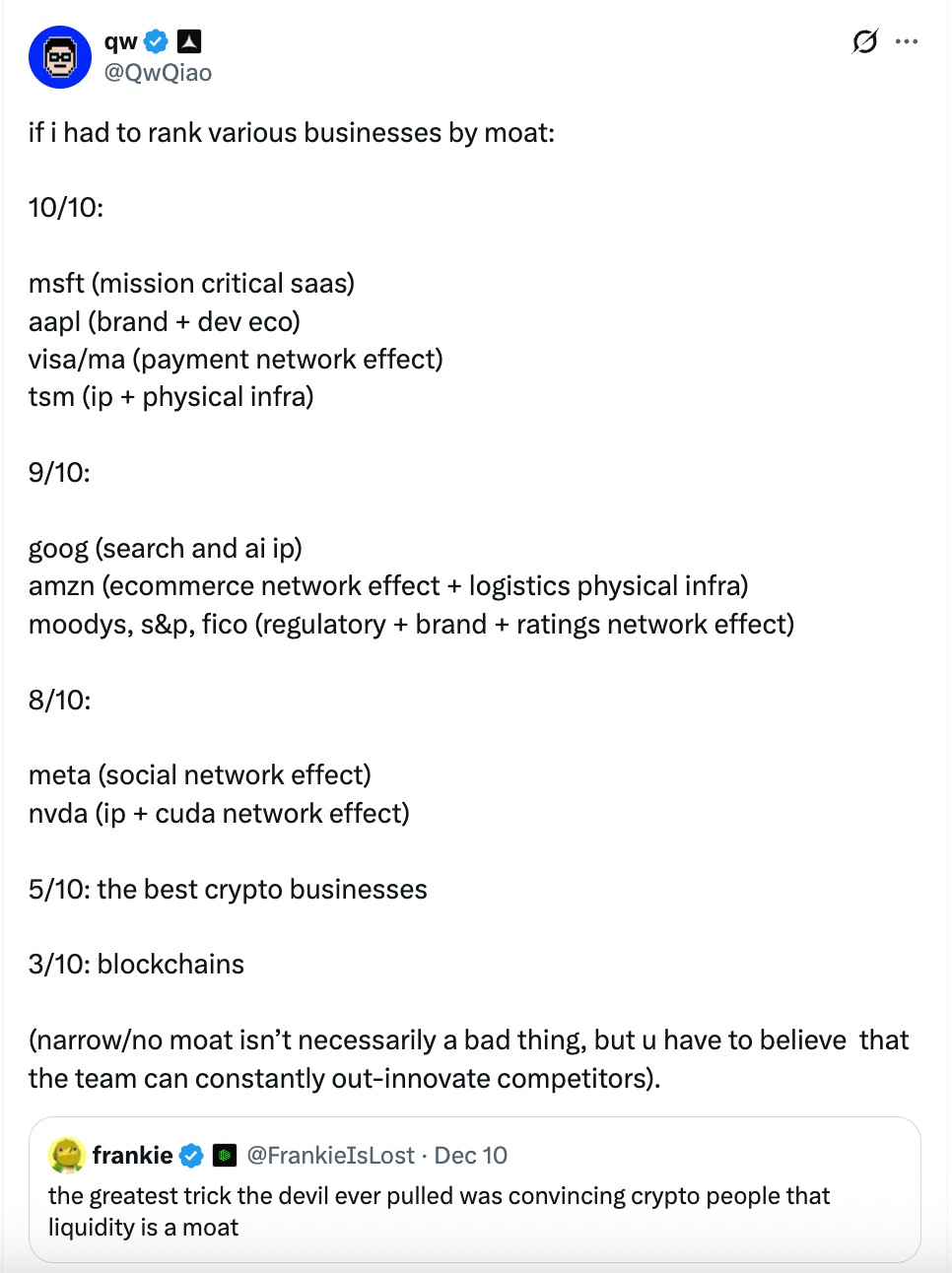
In his view, the moat of the blockchain (public chain) itself is very limited, rated only 3/10.

  • He believes Microsoft (key SaaS), Apple (brand + developer ecosystem), Visa/Mastercard (payment network effects), TSMC (IP + physical infrastructure) can score 10/10 (strongest moat);
  • Google (search and AI IP), Amazon (e-commerce network effects + logistics infrastructure), rating agencies like Moody's, S&P, FICO (regulation-driven + brand + rating network effects), large-scale cloud computing (AWS/Azure/GCP etc.) can score 9/10;
  • Meta (social network effects), NVIDIA (IP + CUDA network effects) score 8/10;
  • The best crypto businesses in the crypto industry score 5/10;
  • Public chains (blockchains) score only 3/10 (narrow moat).

qw further stated that a low moat score isn't necessarily bad, but it means teams must continuously lead innovation, otherwise they will be quickly replaced. Later, perhaps feeling the initial rating was too hasty, he added some supplementary ratings in the comments:

  • The 3 major cloud service infrastructure providers score 9/10;
  • BTC's moat scores 9/10 (Odaily Planet Daily Note: qw pointed out that no one can replicate BTC's founding story and the "Lindy Effect," but deducted 1 point because it's unclear if it can handle security budget and quantum threats);
  • Tesla 7/10 (Odaily Planet Daily Note: qw believes automated IP like self-driving is insane, but the car industry is commoditized, and humanoid robots might be similar)
  • Lithography machine manufacturer ASML 10/10.
  • AAVE's moat score might be higher than 5/10, qw's reason: "As a user, you must trust their smart contract security testing is thorough enough not to lose your funds".

Of course, seeing qw so grandly play the "sharp critic," besides debates about the "moat system," some in the comments made unrelated sarcastic remarks, even mentioning: "What about those terrible launch platforms you invested in?" (Odaily Planet Daily Note: After investing in pump.fun, Alliance DAO's subsequent investments in one-click token issuance platforms (like Believe) performed poorly, even he himself didn't want to rate them)

With such a火药味十足 (fireworks-filled) focal topic, Dragonfly partner Haseeb's subsequent angry retort followed.

Dragonfly Partner's Inner OS: Nonsense, I've Never Seen Someone So Shameless

Responding to qw's "moat rating system," Dragonfly partner Haseeb posted angrily: "What? 'Blockchain moat: 3/10'? That's kinda absurd. Even Santi doesn't think public chains 'have no moat'.

Ethereum has held a dominant position for *10 consecutive years*, hundreds of challengers have raised over $10 billion trying to grab market share. After a decade of competitors trying to defeat it, Ethereum has successfully defended its throne every time. If that doesn't indicate Ethereum has a moat, I don't know what a moat is!"

In the comments of this tweet, qw gave his perspective: "You're talking about looking back ('the past ten years') and it's factually incorrect (on multiple metrics Ethereum no longer holds the throne)."

Subsequently, the two exchanged several rounds on "what exactly is a moat?" and "does Ethereum really have a moat", with qw even pulling out a post he made in November, pointing out that the "moat" in his mind is actually revenue/profit. But Haseeb immediately counterargued with examples—once-popular crypto projects like OpenSea, Axie, BitMEX, although they had high revenues, actually had no moat; the real moat should focus on—"can it be replaced by competitors".

Abra Global management director Marissa also joined the discussion: "Agree (with Haseeb). qw's statement is a bit strange—switching costs and network effects can be strong moats—Solana and Ethereum both have these, I think they will be stronger than other public chains over time. They both have strong brands and developer ecosystems, clearly also part of the moat. Maybe he's referring to other public chains that don't have the above advantages."

Haseeb continued, full of sarcasm: "qw is just splitting hairs, asking for trouble."

Based on the above discussion, perhaps we should break down the "real moat" of public chains in the cryptocurrency industry and what aspects it comprises.

The 7 Components of a Public Chain Moat: From People to Business, From Origin to Network

In my opinion, the main reasons why qw's "moat rating system" seems somewhat unable to justify itself are:

First, its rating标准 only looks at current industry status and revenue while ignoring multi-dimensional evaluation. Whether it's infrastructure like Microsoft, Apple, Amazon Web Services, or payment giants like Visa, Mastercard, the main reason qw gives high scores is their strong revenue models, which obviously oversimplifies and superficializes the business moat of a giant company. Moreover, Apple's global market share is not dominant, and payment giants like Visa also face challenges like market shrinkage and regional business decline.

Second, it overlooks the complexity and uniqueness of public chains and crypto projects区别于 (differentiating them from) traditional internet businesses. As challengers to the fiat system, cryptocurrency, blockchain technology, and subsequent public chains and crypto projects立足点 (base themselves) on the inherent "anonymity," "nodality" of decentralized networks, which is often something traditional revenue-driven businesses cannot achieve.

Based on this, I believe the moat of public chain businesses mainly lies in the following 7 aspects, including:

1. Technical Philosophy. This is also the biggest advantage and differentiating feature of the Bitcoin network, Ethereum network, Solana network, and countless public chain projects. As long as humanity remains wary of centralized systems, authoritarian governments, and the fiat system, and accepts the concepts of sovereign individuals and related viewpoints, the real demand for decentralized networks will always exist;

2. Founder Charisma. Satoshi Nakamoto disappeared after inventing Bitcoin and ensuring the Bitcoin network ran smoothly, sitting on tens of billions of dollars in assets but unmoved; from a World of Warcraft enthusiast abused by the game company to Ethereum co-founder, Vitalik resolutely embarked on his decentralized spiritual journey; Solana founder Toly and others were originally elite engineers at US big tech companies but were unwilling to stop there, thus starting their own "capital internet" construction journey, not to mention the various public chains built inheriting the ambition of Meta's Libra network with the Move language. The personal charm and appeal of founders are particularly important in the crypto industry. This is also why countless crypto projects receive VC favor, community追捧 (praise), and capital influx because of their founders, but also fade into obscurity due to founder resignation or accidents. A good founder is the true soul of a public chain乃至 (and even) a crypto project;

3. Developer and User Network. On this point,正如 (just as) the Metcalfe effect and Lindy effect emphasize, the stronger the network effect of something and the longer it exists, the more likely it is to persist. The developer and user network is the cornerstone of public chains and many crypto projects, because developers can be said to be the first and most enduring users of a crypto public chain or project;

4. Application Ecosystem. A tree with roots but no branches and leaves can hardly survive, and the same goes for crypto projects. Therefore, a rich application ecosystem capable of self-closure and synergistic effects is crucial. The reason why public chains like Ethereum and Solana can survive the winter and still exist is inseparable from the various application projects that are always building. Furthermore, the richer the application ecosystem, the more it can continuously generate造血 (blood-making), feeding back to the public chain;

5. Token Market Cap. If the aforementioned are the inner part and foundation of a "moat," then the token market cap is the external form and brand image of a public chain and a crypto project. Only when you "look expensive" will more people believe you "have a lot of money," that you are a "gold mining ground." This is true for individuals, and likewise for projects;

6. Openness to the Outside. Besides building their own internal循环 (circulation) ecosystems, public chains and other crypto projects also need to maintain openness and operability and exchange value with the external environment. Therefore, openness to the outside is also crucial. Taking public chains like Ethereum and Solana as examples, this refers to the convenience and scale of their bridging with traditional finance, user fund inflows/outflows, and various industries through windows like payments and lending;

7. Long-Term Roadmap. A truly solid moat must not only provide support in the short term but also constantly update, iterate, and innovate, maintaining its own vitality and longevity in the long term. For public chains, the long-term roadmap is both a North Star metric and a powerful抓手 (lever) to激励 (incentivize) continuous development and innovation inside and outside the ecosystem. Ethereum's success is closely related to the planning of its long-term roadmap.

Based on the above elements, a public chain can grow from zero to one, from nothing to something, gradually moving through the野蛮生长 (wild growth) period into the mature iteration period. Corresponding liquidity and user stickiness will naturally follow.

Conclusion: The Crypto Industry Has Not Yet Reached the Stage of "Competing on Talent"

Recently, Moore Threads, known as the "Chinese version of NVIDIA," successfully listed on the Hong Kong stock market, achieving a milestone of 300 billion CNY on its first day of trading; then, within just a few days, its stock price soared all the way, reaching another astonishing breakthrough with a market cap exceeding 400 billion CNY today.

Compared to Ethereum, which took 10 years of operation to finally reach a $300 billion market cap, Moore Threads covered 1/7 of that journey in just a few days. And compared to US stock giants often worth trillions, the crypto industry is even more insignificant.

This makes us sigh again that today, with the scale of capital and user involvement far smaller than the financial and internet industries, we are far from the stage of "competing on talent." The only pain point of the crypto industry today is that we don't have enough people, we don't attract enough capital, and the industries involved are not broad enough. Rather than worrying about those grand, all-encompassing "moats," perhaps what we should think about is how cryptocurrency can更快 (faster), lower cost, and more conveniently meet the real needs of more market users.

Domande pertinenti

QWhat controversial rating did Alliance DAO founder qw assign to L1 public blockchains' moat, and why did it spark debate?

Aqw assigned a moat rating of only 3/10 to L1 public blockchains, arguing their moat is very limited. This sparked intense debate because many industry leaders, such as Dragonfly's Haseeb, found it absurd, citing Ethereum's decade-long dominance despite numerous well-funded challengers.

QAccording to the article, what did Paradigm researcher frankie criticize as a false belief in crypto, and how did the community respond?

Afrankie criticized the belief that 'liquidity is a moat' as a deceptive notion. The community was divided: some agreed, like Multicoin's Kyle Samani and others emphasizing trust or better metrics, while defenders like DFDV's Parker argued liquidity is crucial, citing examples like USDT and Bitcoin's dominance.

QHow did Dragonfly partner Haseeb counter qw's low moat rating for blockchains?

AHaseeb strongly countered by pointing to Ethereum's sustained dominance for over a decade despite hundreds of competitors raising over $10 billion to challenge it. He argued that if this doesn't constitute a moat, nothing does, emphasizing that a true moat is about being hard to replace.

QWhat are the seven components of a public blockchain's moat as outlined in the article?

AThe seven components are: 1. Technical philosophy, 2. Founder charisma, 3. Developer and user network, 4. Application ecosystem, 5. Token market capitalization, 6. Openness to the outside world, and 7. Long-term roadmap.

QWhat does the article conclude is the crypto industry's main challenge regarding its 'moat' and future growth?

AThe article concludes that the crypto industry's main challenge is its relatively small scale in terms of user adoption and capital compared to traditional finance and internet giants. It argues the focus should be on attracting more users and capital by meeting real market needs quickly, cheaply, and conveniently, rather than worrying about abstract moats.

Letture associate

First Batch of Keynote Speakers and Partners Announced! Web2+3 Summit: Defining the Next Generation of Digital Economy

Web2+3 Summit: Defining the Next Generation of Digital Economy The 6th BEYOND International Technology Innovation Expo (BEYOND Expo 2026), Asia's largest tech and ecosystem exhibition, is launching a dedicated Web2+3 stage for the first time. Co-hosted by BEYOND Expo and ChainNeXT Group, the Web3 Summit will take place from May 28–30, 2026. Against the backdrop of accelerating global tech integration, the boundaries between Web2 and Web3 are rapidly blurring. With clearer global regulations for blockchain-driven internet (Web3) and the special issuance of a Hong Kong dollar stable币 license by the Hong Kong SAR government on April 10, 2026, Web3's decentralized principles are quickly merging with traditional industries (Web2) such as e-commerce, finance, and artificial intelligence. Focused on blockchain-driven digital economy elements, the summit will center on three core principles—implementability, commercial viability, and compliance. It will bring together top Web3 experts to discuss key integration areas like stablecoin payment finance (PayFi), real-world asset tokenization (RWA), and decentralized AI (DeAI), unveiling new opportunities for industrial innovation. The first wave of confirmed speakers includes Jack Kong (Director of Hong Kong Cyberport, Chairman of Nano Labs), Yat Siu (Chairman of Animoca Brands), Michael Wu (Co-founder & CEO of Amber Group), Michael Heinrich (Co-founder & CEO of 0G), and Art Abal (Co-founder of Vana). More Web3 ecosystem pioneers, AI, and fintech experts will be announced soon. Core forum topics include: - Web2+DeAI: New AI Paradigms Driven by Decentralized Infrastructure - Web2+RWA: Real-World Asset Tokenization and Global Liquidity - Web2+PayFi: Cross-Border Payments and Financial Innovation Powered by Crypto Infrastructure - Web2+3 AI: Autonomous Agents and the Crypto Economy - Web2+3 Wealth: On-Chain and Off-Chain Integrated Investment Ecosystems - Web2+3 Commerce: A New Landscape for Global Trade Driven by Stablecoins Additional agenda details will be released in the near future.

marsbit4 h fa

First Batch of Keynote Speakers and Partners Announced! Web2+3 Summit: Defining the Next Generation of Digital Economy

marsbit4 h fa

Trading

Spot
Futures

Articoli Popolari

Cosa è $S$

Comprendere SPERO: Una Panoramica Completa Introduzione a SPERO Mentre il panorama dell'innovazione continua a evolversi, l'emergere delle tecnologie web3 e dei progetti di criptovaluta gioca un ruolo fondamentale nel plasmare il futuro digitale. Un progetto che ha attirato l'attenzione in questo campo dinamico è SPERO, denotato come SPERO,$$s$. Questo articolo mira a raccogliere e presentare informazioni dettagliate su SPERO, per aiutare gli appassionati e gli investitori a comprendere le sue basi, obiettivi e innovazioni nei domini web3 e crypto. Che cos'è SPERO,$$s$? SPERO,$$s$ è un progetto unico all'interno dello spazio crypto che cerca di sfruttare i principi della decentralizzazione e della tecnologia blockchain per creare un ecosistema che promuove l'impegno, l'utilità e l'inclusione finanziaria. Il progetto è progettato per facilitare interazioni peer-to-peer in modi nuovi, fornendo agli utenti soluzioni e servizi finanziari innovativi. Al suo interno, SPERO,$$s$ mira a responsabilizzare gli individui fornendo strumenti e piattaforme che migliorano l'esperienza dell'utente nello spazio delle criptovalute. Questo include la possibilità di metodi di transazione più flessibili, la promozione di iniziative guidate dalla comunità e la creazione di percorsi per opportunità finanziarie attraverso applicazioni decentralizzate (dApps). La visione sottostante di SPERO,$$s$ ruota attorno all'inclusività, cercando di colmare le lacune all'interno della finanza tradizionale mentre sfrutta i vantaggi della tecnologia blockchain. Chi è il Creatore di SPERO,$$s$? L'identità del creatore di SPERO,$$s$ rimane piuttosto oscura, poiché ci sono risorse pubblicamente disponibili limitate che forniscono informazioni dettagliate sul suo fondatore o fondatori. Questa mancanza di trasparenza può derivare dall'impegno del progetto per la decentralizzazione—un ethos che molti progetti web3 condividono, dando priorità ai contributi collettivi rispetto al riconoscimento individuale. Centrando le discussioni attorno alla comunità e ai suoi obiettivi collettivi, SPERO,$$s$ incarna l'essenza dell'empowerment senza mettere in evidenza individui specifici. Pertanto, comprendere l'etica e la missione di SPERO rimane più importante che identificare un creatore singolo. Chi sono gli Investitori di SPERO,$$s$? SPERO,$$s$ è supportato da una varietà di investitori che vanno dai capitalisti di rischio agli investitori angelici dedicati a promuovere l'innovazione nel settore crypto. Il focus di questi investitori generalmente si allinea con la missione di SPERO—dando priorità a progetti che promettono avanzamenti tecnologici sociali, inclusività finanziaria e governance decentralizzata. Queste fondazioni di investitori sono tipicamente interessate a progetti che non solo offrono prodotti innovativi, ma contribuiscono anche positivamente alla comunità blockchain e ai suoi ecosistemi. Il supporto di questi investitori rafforza SPERO,$$s$ come un concorrente degno di nota nel dominio in rapida evoluzione dei progetti crypto. Come Funziona SPERO,$$s$? SPERO,$$s$ impiega un framework multifunzionale che lo distingue dai progetti di criptovaluta convenzionali. Ecco alcune delle caratteristiche chiave che sottolineano la sua unicità e innovazione: Governance Decentralizzata: SPERO,$$s$ integra modelli di governance decentralizzati, responsabilizzando gli utenti a partecipare attivamente ai processi decisionali riguardanti il futuro del progetto. Questo approccio favorisce un senso di proprietà e responsabilità tra i membri della comunità. Utilità del Token: SPERO,$$s$ utilizza il proprio token di criptovaluta, progettato per servire varie funzioni all'interno dell'ecosistema. Questi token abilitano transazioni, premi e la facilitazione dei servizi offerti sulla piattaforma, migliorando l'impegno e l'utilità complessivi. Architettura Stratificata: L'architettura tecnica di SPERO,$$s$ supporta la modularità e la scalabilità, consentendo un'integrazione fluida di funzionalità e applicazioni aggiuntive man mano che il progetto evolve. Questa adattabilità è fondamentale per mantenere la rilevanza nel panorama crypto in continua evoluzione. Coinvolgimento della Comunità: Il progetto enfatizza iniziative guidate dalla comunità, impiegando meccanismi che incentivano la collaborazione e il feedback. Nutrendo una comunità forte, SPERO,$$s$ può affrontare meglio le esigenze degli utenti e adattarsi alle tendenze di mercato. Focus sull'Inclusione: Offrendo basse commissioni di transazione e interfacce user-friendly, SPERO,$$s$ mira ad attrarre una base utenti diversificata, inclusi individui che potrebbero non aver precedentemente interagito nello spazio crypto. Questo impegno per l'inclusione si allinea con la sua missione generale di empowerment attraverso l'accessibilità. Cronologia di SPERO,$$s$ Comprendere la storia di un progetto fornisce preziose intuizioni sulla sua traiettoria di sviluppo e sui traguardi. Di seguito è riportata una cronologia suggerita che mappa eventi significativi nell'evoluzione di SPERO,$$s$: Fase di Concettualizzazione e Ideazione: Le idee iniziali che formano la base di SPERO,$$s$ sono state concepite, allineandosi strettamente con i principi di decentralizzazione e focus sulla comunità all'interno dell'industria blockchain. Lancio del Whitepaper del Progetto: Dopo la fase concettuale, è stato rilasciato un whitepaper completo che dettaglia la visione, gli obiettivi e l'infrastruttura tecnologica di SPERO,$$s$ per suscitare interesse e feedback dalla comunità. Costruzione della Comunità e Prime Interazioni: Sono stati effettuati sforzi attivi di outreach per costruire una comunità di early adopters e potenziali investitori, facilitando discussioni attorno agli obiettivi del progetto e ottenendo supporto. Evento di Generazione del Token: SPERO,$$s$ ha condotto un evento di generazione del token (TGE) per distribuire i propri token nativi ai primi sostenitori e stabilire una liquidità iniziale all'interno dell'ecosistema. Lancio della Prima dApp: La prima applicazione decentralizzata (dApp) associata a SPERO,$$s$ è stata attivata, consentendo agli utenti di interagire con le funzionalità principali della piattaforma. Sviluppo Continuo e Partnership: Aggiornamenti e miglioramenti continui alle offerte del progetto, inclusi partnership strategiche con altri attori nello spazio blockchain, hanno plasmato SPERO,$$s$ in un concorrente competitivo e in evoluzione nel mercato crypto. Conclusione SPERO,$$s$ rappresenta una testimonianza del potenziale del web3 e delle criptovalute di rivoluzionare i sistemi finanziari e responsabilizzare gli individui. Con un impegno per la governance decentralizzata, il coinvolgimento della comunità e funzionalità progettate in modo innovativo, apre la strada verso un panorama finanziario più inclusivo. Come per qualsiasi investimento nello spazio crypto in rapida evoluzione, si incoraggiano potenziali investitori e utenti a ricercare approfonditamente e a impegnarsi in modo riflessivo con gli sviluppi in corso all'interno di SPERO,$$s$. Il progetto mostra lo spirito innovativo dell'industria crypto, invitando a ulteriori esplorazioni delle sue innumerevoli possibilità. Mentre il percorso di SPERO,$$s$ è ancora in fase di sviluppo, i suoi principi fondamentali potrebbero effettivamente influenzare il futuro di come interagiamo con la tecnologia, la finanza e tra di noi in ecosistemi digitali interconnessi.

75 Totale visualizzazioniPubblicato il 2024.12.17Aggiornato il 2024.12.17

Cosa è $S$

Cosa è AGENT S

Agent S: Il Futuro dell'Interazione Autonoma in Web3 Introduzione Nel panorama in continua evoluzione di Web3 e criptovalute, le innovazioni stanno costantemente ridefinendo il modo in cui gli individui interagiscono con le piattaforme digitali. Uno di questi progetti pionieristici, Agent S, promette di rivoluzionare l'interazione uomo-computer attraverso il suo framework agentico aperto. Aprendo la strada a interazioni autonome, Agent S mira a semplificare compiti complessi, offrendo applicazioni trasformative nell'intelligenza artificiale (AI). Questa esplorazione dettagliata approfondirà le complessità del progetto, le sue caratteristiche uniche e le implicazioni per il dominio delle criptovalute. Cos'è Agent S? Agent S si presenta come un innovativo framework agentico aperto, progettato specificamente per affrontare tre sfide fondamentali nell'automazione dei compiti informatici: Acquisizione di Conoscenze Specifiche del Dominio: Il framework apprende in modo intelligente da varie fonti di conoscenza esterne ed esperienze interne. Questo approccio duale gli consente di costruire un ricco repository di conoscenze specifiche del dominio, migliorando le sue prestazioni nell'esecuzione dei compiti. Pianificazione su Lungo Orizzonte di Compiti: Agent S impiega una pianificazione gerarchica potenziata dall'esperienza, un approccio strategico che facilita la suddivisione e l'esecuzione efficiente di compiti complessi. Questa caratteristica migliora significativamente la sua capacità di gestire più sottocompiti in modo efficiente ed efficace. Gestione di Interfacce Dinamiche e Non Uniformi: Il progetto introduce l'Interfaccia Agente-Computer (ACI), una soluzione innovativa che migliora l'interazione tra agenti e utenti. Utilizzando Modelli Linguistici Multimodali di Grandi Dimensioni (MLLM), Agent S può navigare e manipolare senza sforzo diverse interfacce grafiche utente. Attraverso queste caratteristiche pionieristiche, Agent S fornisce un framework robusto che affronta le complessità coinvolte nell'automazione dell'interazione umana con le macchine, preparando il terreno per innumerevoli applicazioni nell'AI e oltre. Chi è il Creatore di Agent S? Sebbene il concetto di Agent S sia fondamentalmente innovativo, informazioni specifiche sul suo creatore rimangono elusive. Il creatore è attualmente sconosciuto, il che evidenzia sia la fase embrionale del progetto sia la scelta strategica di mantenere i membri fondatori sotto anonimato. Indipendentemente dall'anonimato, l'attenzione rimane sulle capacità e sul potenziale del framework. Chi sono gli Investitori di Agent S? Poiché Agent S è relativamente nuovo nell'ecosistema crittografico, informazioni dettagliate riguardanti i suoi investitori e sostenitori finanziari non sono documentate esplicitamente. La mancanza di approfondimenti pubblicamente disponibili sulle fondazioni di investimento o sulle organizzazioni che supportano il progetto solleva interrogativi sulla sua struttura di finanziamento e sulla roadmap di sviluppo. Comprendere il supporto è cruciale per valutare la sostenibilità del progetto e il suo potenziale impatto sul mercato. Come Funziona Agent S? Al centro di Agent S si trova una tecnologia all'avanguardia che gli consente di funzionare efficacemente in contesti diversi. Il suo modello operativo è costruito attorno a diverse caratteristiche chiave: Interazione Uomo-Computer Simile a Quella Umana: Il framework offre una pianificazione AI avanzata, cercando di rendere le interazioni con i computer più intuitive. Mimando il comportamento umano nell'esecuzione dei compiti, promette di elevare le esperienze degli utenti. Memoria Narrativa: Utilizzata per sfruttare esperienze di alto livello, Agent S utilizza la memoria narrativa per tenere traccia delle storie dei compiti, migliorando così i suoi processi decisionali. Memoria Episodica: Questa caratteristica fornisce agli utenti una guida passo-passo, consentendo al framework di offrire supporto contestuale mentre i compiti si sviluppano. Supporto per OpenACI: Con la capacità di funzionare localmente, Agent S consente agli utenti di mantenere il controllo sulle proprie interazioni e flussi di lavoro, allineandosi con l'etica decentralizzata di Web3. Facile Integrazione con API Esterne: La sua versatilità e compatibilità con varie piattaforme AI garantiscono che Agent S possa adattarsi senza problemi agli ecosistemi tecnologici esistenti, rendendolo una scelta attraente per sviluppatori e organizzazioni. Queste funzionalità contribuiscono collettivamente alla posizione unica di Agent S all'interno dello spazio crittografico, poiché automatizza compiti complessi e multi-fase con un intervento umano minimo. Man mano che il progetto evolve, le sue potenziali applicazioni in Web3 potrebbero ridefinire il modo in cui si svolgono le interazioni digitali. Cronologia di Agent S Lo sviluppo e le tappe di Agent S possono essere riassunti in una cronologia che evidenzia i suoi eventi significativi: 27 Settembre 2024: Il concetto di Agent S è stato lanciato in un documento di ricerca completo intitolato “Un Framework Agentico Aperto che Usa i Computer Come un Umano”, mostrando le basi per il progetto. 10 Ottobre 2024: Il documento di ricerca è stato reso pubblicamente disponibile su arXiv, offrendo un'esplorazione approfondita del framework e della sua valutazione delle prestazioni basata sul benchmark OSWorld. 12 Ottobre 2024: È stata rilasciata una presentazione video, fornendo un'idea visiva delle capacità e delle caratteristiche di Agent S, coinvolgendo ulteriormente potenziali utenti e investitori. Questi indicatori nella cronologia non solo illustrano i progressi di Agent S, ma indicano anche il suo impegno per la trasparenza e il coinvolgimento della comunità. Punti Chiave su Agent S Man mano che il framework Agent S continua a evolversi, diversi attributi chiave si distinguono, sottolineando la sua natura innovativa e il potenziale: Framework Innovativo: Progettato per fornire un uso intuitivo dei computer simile all'interazione umana, Agent S porta un approccio nuovo all'automazione dei compiti. Interazione Autonoma: La capacità di interagire autonomamente con i computer attraverso GUI segna un passo avanti verso soluzioni informatiche più intelligenti ed efficienti. Automazione di Compiti Complessi: Con la sua metodologia robusta, può automatizzare compiti complessi e multi-fase, rendendo i processi più veloci e meno soggetti a errori. Miglioramento Continuo: I meccanismi di apprendimento consentono ad Agent S di migliorare dalle esperienze passate, migliorando continuamente le sue prestazioni e la sua efficacia. Versatilità: La sua adattabilità attraverso diversi ambienti operativi come OSWorld e WindowsAgentArena garantisce che possa servire un'ampia gamma di applicazioni. Man mano che Agent S si posiziona nel panorama di Web3 e delle criptovalute, il suo potenziale per migliorare le capacità di interazione e automatizzare i processi segna un significativo avanzamento nelle tecnologie AI. Attraverso il suo framework innovativo, Agent S esemplifica il futuro delle interazioni digitali, promettendo un'esperienza più fluida ed efficiente per gli utenti in vari settori. Conclusione Agent S rappresenta un audace passo avanti nell'unione tra AI e Web3, con la capacità di ridefinire il modo in cui interagiamo con la tecnologia. Sebbene sia ancora nelle sue fasi iniziali, le possibilità per la sua applicazione sono vaste e coinvolgenti. Attraverso il suo framework completo che affronta sfide critiche, Agent S mira a portare le interazioni autonome al centro dell'esperienza digitale. Man mano che ci addentriamo nei regni delle criptovalute e della decentralizzazione, progetti come Agent S giocheranno senza dubbio un ruolo cruciale nel plasmare il futuro della tecnologia e della collaborazione uomo-computer.

397 Totale visualizzazioniPubblicato il 2025.01.14Aggiornato il 2025.01.14

Cosa è AGENT S

Come comprare S

Benvenuto in HTX.com! Abbiamo reso l'acquisto di Sonic (S) semplice e conveniente. Segui la nostra guida passo passo per intraprendere il tuo viaggio nel mondo delle criptovalute.Step 1: Crea il tuo Account HTXUsa la tua email o numero di telefono per registrarti il tuo account gratuito su HTX. Vivi un'esperienza facile e sblocca tutte le funzionalità,Crea il mio accountStep 2: Vai in Acquista crypto e seleziona il tuo metodo di pagamentoCarta di credito/debito: utilizza la tua Visa o Mastercard per acquistare immediatamente SonicS.Bilancio: Usa i fondi dal bilancio del tuo account HTX per fare trading senza problemi.Terze parti: abbiamo aggiunto metodi di pagamento molto utilizzati come Google Pay e Apple Pay per maggiore comodità.P2P: Fai trading direttamente con altri utenti HTX.Over-the-Counter (OTC): Offriamo servizi su misura e tassi di cambio competitivi per i trader.Step 3: Conserva Sonic (S)Dopo aver acquistato Sonic (S), conserva nel tuo account HTX. In alternativa, puoi inviare tramite trasferimento blockchain o scambiare per altre criptovalute.Step 4: Scambia Sonic (S)Scambia facilmente Sonic (S) nel mercato spot di HTX. Accedi al tuo account, seleziona la tua coppia di trading, esegui le tue operazioni e monitora in tempo reale. Offriamo un'esperienza user-friendly sia per chi ha appena iniziato che per i trader più esperti.

782 Totale visualizzazioniPubblicato il 2025.01.15Aggiornato il 2025.03.21

Come comprare S

Discussioni

Benvenuto nella Community HTX. Qui puoi rimanere informato sugli ultimi sviluppi della piattaforma e accedere ad approfondimenti esperti sul mercato. Le opinioni degli utenti sul prezzo di S S sono presentate come di seguito.

活动图片