One Piece of Content Attracts 150 Million Views, Revealing the Monetization Code of the Super Individual Business

比推Pubblicato 2026-01-19Pubblicato ultima volta 2026-01-19

Introduzione

Dan Koe, a prominent creator in the "super individual" or one-person business space, gained massive attention with a viral post titled “How to fix your entire life in 1 day,” which reached 150 million views on X. Despite earning only $4,495 in platform revenue from the post, his actual income stems from a diversified business model that includes paid newsletters, books, and an AI tool called Eden. In 2024, he reported earning over $4 million annually. Koe’s content targets individuals seeking financial independence through personal branding and content creation. His success is built on years of consistent content output and a relatable narrative of failure and persistence. While his viral article served as a top-of-funnel audience builder, his real revenue comes from converting followers into paying customers through premium products. The article also discusses how platforms like X are incentivizing long-form content to compete with short-video platforms, offering financial rewards to boost creator engagement. However, the surge in AI-assisted content creation has led to widespread imitation of Koe’s style, though few achieve similar success due to the importance of trust, timing, and existing audience size. Ultimately, the "super individual" economy benefits a small number of established creators, while most followers remain consumers rather than successful practitioners.

Author: Curry, Deep Tide TechFlow

Original Title: 150 Million Views on a Single Post, Dan Koe and His Super Individual Business


What was the hottest article on X last week?

"How to fix your entire life in 1 day". Fix your entire life in one day.

Author Dan Koe, American, creates content about "super individuals", teaching people how to not work a 9-to-5 and support themselves by writing. A week after its release, this article's views had reached 150 million.
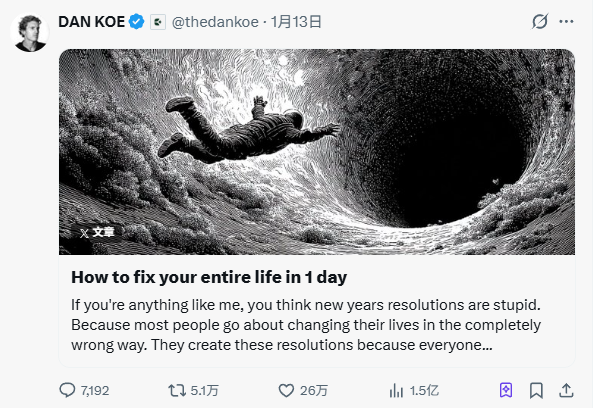
What does 150 million mean? X has just over 600 million monthly active users globally, meaning roughly one in four users has seen this article.

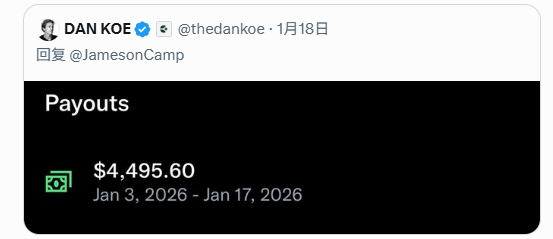
Some wonder how much money this can make. Dan Koe shared a screenshot of his earnings: in 14 days, the X platform shared $4,495 with him.

150 million views, $4,495. But Dan Koe actually earned over $4 million last year.

The money clearly doesn't come from platform revenue sharing.
You've definitely seen the term "super individual".

The general idea is, you don't need a job, you don't need a team, just put your ideas and creativity into content posted online to attract a group of people who identify with you, and then sell courses to them. In the US, this is called a One-Person Business.

Dan Koe is a top player in this field. 750k X followers, 1.2 million YouTube subscribers, 170k email subscribers.

His story is also standard. Studied design in college, became a freelancer after graduation, tried e-commerce, lost money. Started writing on Twitter in 2019, no one read it, persisted for two years before gaining traction.

These experiences are part of the content itself. Failure, struggle, persistence, counterattack—you can see this narrative structure on any successful motivational blogger.

Li Xiaolai talked about it, Luo Zhenyu talked about it, Fan Deng talked about it.

Americans package it as Philosophy and Productivity, Chinese package it as "cognitive upgrade", the skeleton is the same.

How does Dan Koe make money?

Open his official website, you can see several types of products: paid newsletter subscriptions, two books ("The Art of Focus" and "Purpose & Profit"), and an AI tool he co-founded called Eden.
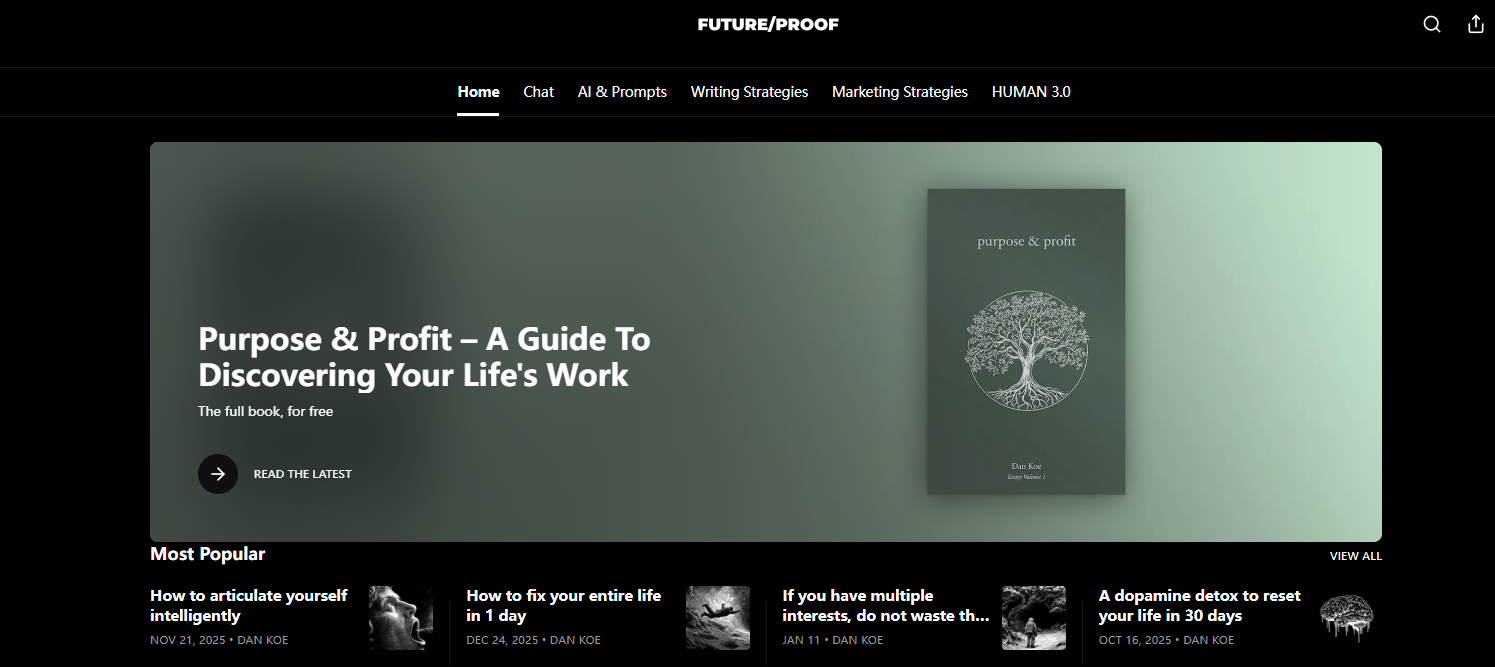
He used to sell writing courses and membership communities, which are no longer visible on the official website, maybe taken down, or merged into the paid subscriptions.

I didn't find official pricing data, but the logic of these products is similar:

Free content filters out people willing to pay, low-priced products filter out people willing to pay more.

How much does he earn? In 2023 he posted on Twitter saying his income that year was $2.5 million. In a 2024 interview with the subscription software beehiiv, Dan also revealed earning over $4 million annually.

But推算 from his follower size, it's not离谱. With nearly 200k email subscribers and millions of YouTube fans,假设 5% have bought paid products, that's nearly fifty thousand paying users.

So what is that 150 million views to him?

The traffic entry point at the top of the funnel. The $4,495 platform share on X is pocket change, more importantly it increases his brand awareness and spread, the real money is with those willing to pay later.

You might ask, who is buying these things?

The answer is definitely people who want to become the next Dan Koe.

The goals of students taking these courses are basically "build a personal brand", "monetize self-media", "escape the 9-to-5". What they are paying to learn is the very thing Dan Koe is doing.

For this model to work, there is one prerequisite: there are always new people wanting to enter the field.

Just like gym memberships always surge at the beginning of the year, the "super individual"赛道 always has people who believe they can become the next top player. Dan Koe published that article on January 12th,刚好是外国人新年决心最旺盛的时候.

The title is "Fix your entire life in one day", what do you think people clicking on it are thinking?

At the same time, X is also placing its bets.

On January 16th, a few days after Dan Koe's article went viral, X announced a new policy: the creator revenue pool doubled, increased weight for long-form articles, and an additional $1 million reward for the best performing original articles.
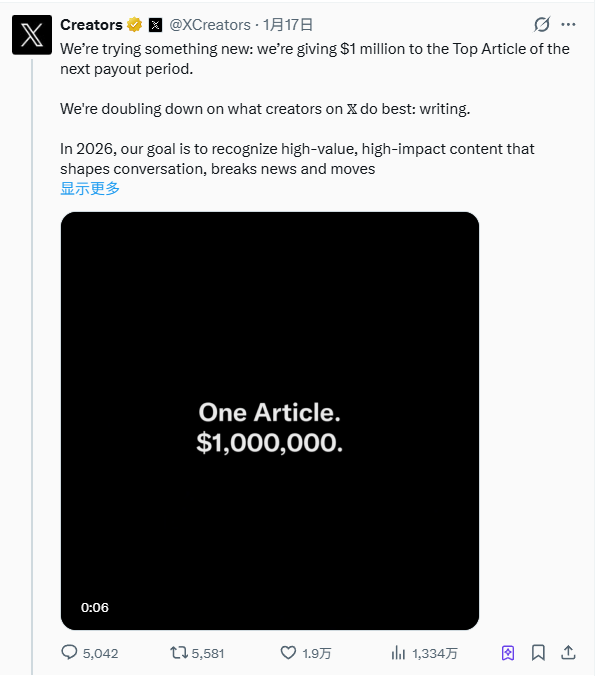
What Musk wants to do is obvious. TikTok has cut everyone's attention into 15-second fragments, X wants to go the opposite way, using long-form content to retain users. Dan Koe wrote a comment大意是短视频刷得太狠了,现在互联网有机会往回摆一摆.

X loves to hear that.

But what can $1 million buy?

Open X and search, there are already a lot of imitators. Various AI skill tutorials and inspirational鸡汤 articles are emerging, like "How to change your life in 2026", "The one skill you need", "Why most people will never succeed"...

The structure is the same, the image style is the same as Dan's viral post, even the "I'm here to tell you the truth" tone is the same.

This style of writing has even become a meme,引得大家争相模仿和尝试.
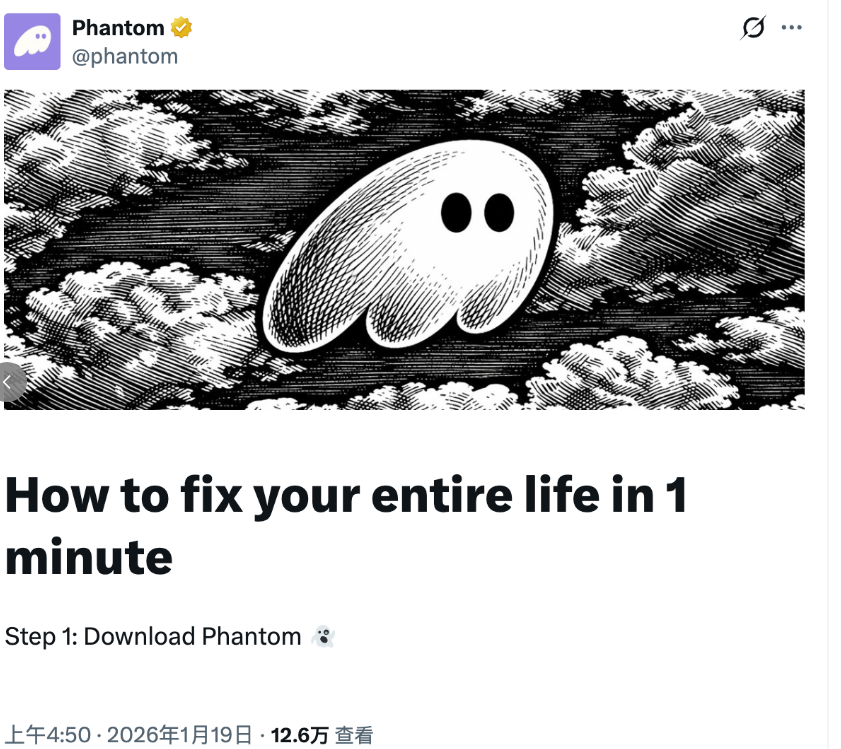
It's not really strange. Dan Koe himself said he uses AI to assist writing, the method is to have AI interview himself, extract ideas, and then format them into a high-spread content structure.

Anyone can learn this method. ChatGPT can generate a "life-changing" long article in ten minutes, grammatically correct, structurally complete,还能自动加上几个心理学术语显得有深度.

But it's Dan Koe who got popular, not the imitators.

Why?

One explanation is that trust takes time. Dan Koe has written for six years, has real failure experiences, has a traceable growth trajectory. AI can imitate his sentence patterns, but cannot复制 these.

Another explanation is, the super individual赛道 is too crowded.

When everyone is teaching "how to become a super individual", whether talking about AI tools, guide to getting started, life fixes or business tips, attention concentrates towards the top. Those who enter early eat meat, those who come later drink soup, and those even later get neither.

Another explanation is luck. Dan Koe hit the window of X adjusting its algorithm, the New Year emotional cycle, and the policy tailwind of Musk wanting to push long-form content. Three things叠加在一起, the 150 million appeared.

Change the person, change the time, the same quality article, might only get 1.5 million views.

An interesting point is, Dan Koe's article was published a few days too early, so it doesn't qualify for X's $1 million content reward selection.

But this doesn't matter to him. His business model doesn't rely on platform revenue sharing, the 150 million views have completed their mission, letting more people know the name Dan Koe, letting more people pour into the top of the funnel.

So who will X's $1 million eventually go to? According to the rules, it must be original long-form articles, at least 1000 words, calculated based on impressions on paying users' homepages.

Translation: you not only have to write well, but you also need to already have a large number of fans.

So most likely it will still be taken by the top players.

This is the structure of this game. The platform needs top creators to prove "long-form content has a future", top creators need platform traffic to feed their funnel, AI allows everyone to mass-produce "life-changing" content, but only a very few can actually make money from this.

What is the role of most people?

Readers.

After reading an article "Fix your entire life in one day", feel inspired to become a super individual, then share, like, bookmark, and then continue scrolling to the next one.


Twitter:https://twitter.com/BitpushNewsCN

Bitpush TG Discussion Group:https://t.me/BitPushCommunity

Bitpush TG Subscription: https://t.me/bitpush

Original link:https://www.bitpush.news/articles/7604151

Crypto di tendenza

Domande pertinenti

QWhat was the title of Dan Koe's viral article that garnered 150 million views?

AThe title was 'How to fix your entire life in 1 day'.

QHow much revenue did Dan Koe report from X platform for his viral article, and what was his total annual income in 2024?

AHe reported $4,495 in platform revenue from X for the article, and his total annual income in 2024 was over $4 million.

QWhat is the core business model of a 'super individual' or 'one-person business' as described in the article?

AThe core business model involves creating free content to build an audience and personal brand, then monetizing through selling paid products like newsletters, books, or tools to that audience, rather than relying on platform ad shares.

QWhat key factor does the article suggest contributed to the massive success of Dan Koe's article beyond just the content quality?

AThe article suggests that timing played a crucial role, as it coincided with New Year's resolution periods, X's algorithm changes favoring long-form content, and policy shifts by the platform under Musk's leadership.

QAccording to the article, what role do most people play in the 'super individual' ecosystem, despite many aspiring to become one?

AMost people end up as readers or consumers of the content—clicking, sharing, and engaging—but do not successfully monetize their own efforts, effectively serving as the audience funnel for the top creators.

Letture associate

Within Strategy's Framework, STRC's Dividend Yield Remains at 12% as Share Price Stays Below Par Value

Michael Saylor, Executive Chairman of Strategy (MSTR), confirmed that the dividend rate for its STRC perpetual preferred shares will remain at 12.00% through August 2026. The rate has increased from 9% at its July 2025 launch to the current high via a "ratchet" mechanism, which permanently raises the rate by 0.5% whenever the share price falls below $95. This mechanism is intended to push the price back toward its $100 par value and support Strategy's "at-the-market" (ATM) program for issuing new shares to fund Bitcoin purchases. However, the mechanism has not worked as intended. STRC shares closed at $89.46 on July 31, remaining about 10-11% below par value despite the record-high dividend. Competition from rival Strive's higher-yielding SATA securities has pressured demand. The persistent discount has forced Strategy to suspend new STRC issuances via its ATM program, limiting this funding channel for Bitcoin acquisitions. STRC's struggles reflect Bitcoin's own volatility, as the preferred shares historically move in tandem. Analysts have warned the ratchet structure carries long-term, one-way risk. A law firm is investigating Strategy's ability to maintain dividend payments if Bitcoin's price stays low. Retail investors own roughly 83% of outstanding STRC shares, a group seen as prone to panic selling during downturns. In response, Strategy has established financial reserves, including a liquidity cushion covering about 26 months of dividend/interest obligations, and a $2 billion share buyback program alongside a Bitcoin monetization framework, though the company emphasized it is not obligated to sell any Bitcoin.

cryptonews.ru3 min fa

Within Strategy's Framework, STRC's Dividend Yield Remains at 12% as Share Price Stays Below Par Value

cryptonews.ru3 min fa

Analyst: Bitcoin's Price Will Drop to $60k in August, Then Rebound to $70k

Financial analyst Andrey Poroshin has provided a new forecast for Bitcoin's price dynamics in August. Poroshin, an analyst at the Bitbanker exchange, expects the cryptocurrency market to experience a downturn this month, with prices retesting the $60,000 level due to a lack of supportive macroeconomic catalysts. He noted that the recent US Federal Reserve decision to hold interest rates did not significantly impact the market, while inflation remains above the 2% target. Poroshin stated that Bitcoin is ending July under pressure from moderate volatility and a lack of new macroeconomic stimuli, leading to continued market caution. According to his base scenario, Bitcoin will drop to a range of $60,000 to $62,000 before recovering to $70,000. He pointed out that even $70,000 remains below the cost of mining in the US, which has prompted some miners to shift towards AI data center operations. Poroshin cited the winding down of BitMEX's operations as a potential catalyst for a price rebound, suggesting the exit of weaker players often coincides with market reversals and reduced short-term selling pressure. He believes Bitcoin is currently less susceptible to geopolitical shocks, such as the Iran-US conflict, and does not expect significant market changes in August related to the pending CLARITY Act. Looking ahead, Poroshin forecasts that September will bring more active price fluctuations driven by potential Fed rate decisions and possible discussions or approval of the CLARITY Act.

cryptonews.ru4 min fa

Analyst: Bitcoin's Price Will Drop to $60k in August, Then Rebound to $70k

cryptonews.ru4 min fa

In Jinjiang, Fujian, a Storage Super Unicorn Lies Quiet

In Fujian's Jinjiang, a city known for sportswear, lies a quiet semiconductor giant: Fujian Jinhua Integrated Circuit Co. (JHICC). Once a promising domestic DRAM manufacturer alongside Yangtze Memory and ChangXin Memory Technologies (CXMT), its journey was derailed in 2018 when the U.S. placed it on an Entity List and filed criminal charges for alleged trade secret theft. This halted production for years. A turning point came in February 2024 when a U.S. federal court found JHICC not guilty. However, it had lost crucial time. While CXMT soared to become a top-valued A-share company in 2024, JHICC, with an estimated valuation of 80 billion RMB, was just restarting. Its current output is primarily customized DDR4 chips, not the advanced DDR5/HBM demanded for AI, but it still benefits from the broader memory chip upcycle. JHICC's story is tied to Chen Zhengkun, a veteran engineer who left Micron to lead the venture. Founded in 2016 with state-backed funding, JHICC partnered with Taiwan's UMC to develop DRAM technology. Rapid progress was cut short by the U.S. actions, which Micron initiated, partly due to its heavy reliance on the Chinese market. Post-sanctions, Chen's team worked to rebuild the production line with reduced reliance on U.S. technology. According to its records, JHICC achieved small-scale production and revenue growth under immense pressure. It now focuses on the stable "niche" DRAM market (e.g., TVs, routers) with a monthly capacity of ~40,000 wafers, aiming for 60,000 by 2026. It holds over 1,000 patents but remains on the Entity List. For Jinjiang, investing in JHICC was a bold industrial leap. The local government provided unwavering financial and logistical support during the crisis, helping the company survive. JHICC has become the anchor for a growing local semiconductor cluster. Though its scale lags behind domestic peers, JHICC's persistence symbolizes a hard-won foothold in a global market long dominated by Samsung, SK Hynix, and Micron. Having missed one boom, it seeks a place in the new AI-driven memory supercycle.

marsbit2 h fa

In Jinjiang, Fujian, a Storage Super Unicorn Lies Quiet

marsbit2 h fa

Trading

Spot

Articoli Popolari

Come comprare ONE

Benvenuto in HTX.com! Abbiamo reso l'acquisto di Harmony (ONE) semplice e conveniente. Segui la nostra guida passo passo per intraprendere il tuo viaggio nel mondo delle criptovalute.Step 1: Crea il tuo Account HTXUsa la tua email o numero di telefono per registrarti il tuo account gratuito su HTX. Vivi un'esperienza facile e sblocca tutte le funzionalità,Crea il mio accountStep 2: Vai in Acquista crypto e seleziona il tuo metodo di pagamentoCarta di credito/debito: utilizza la tua Visa o Mastercard per acquistare immediatamente HarmonyONE.Bilancio: Usa i fondi dal bilancio del tuo account HTX per fare trading senza problemi.Terze parti: abbiamo aggiunto metodi di pagamento molto utilizzati come Google Pay e Apple Pay per maggiore comodità.P2P: Fai trading direttamente con altri utenti HTX.Over-the-Counter (OTC): Offriamo servizi su misura e tassi di cambio competitivi per i trader.Step 3: Conserva Harmony (ONE)Dopo aver acquistato Harmony (ONE), conserva nel tuo account HTX. In alternativa, puoi inviare tramite trasferimento blockchain o scambiare per altre criptovalute.Step 4: Scambia Harmony (ONE)Scambia facilmente Harmony (ONE) nel mercato spot di HTX. Accedi al tuo account, seleziona la tua coppia di trading, esegui le tue operazioni e monitora in tempo reale. Offriamo un'esperienza user-friendly sia per chi ha appena iniziato che per i trader più esperti.

401 Totale visualizzazioniPubblicato il 2024.12.12Aggiornato il 2026.06.02

Come comprare ONE

Discussioni

Benvenuto nella Community HTX. Qui puoi rimanere informato sugli ultimi sviluppi della piattaforma e accedere ad approfondimenti esperti sul mercato. Le opinioni degli utenti sul prezzo di ONE ONE sono presentate come di seguito.

活动图片













