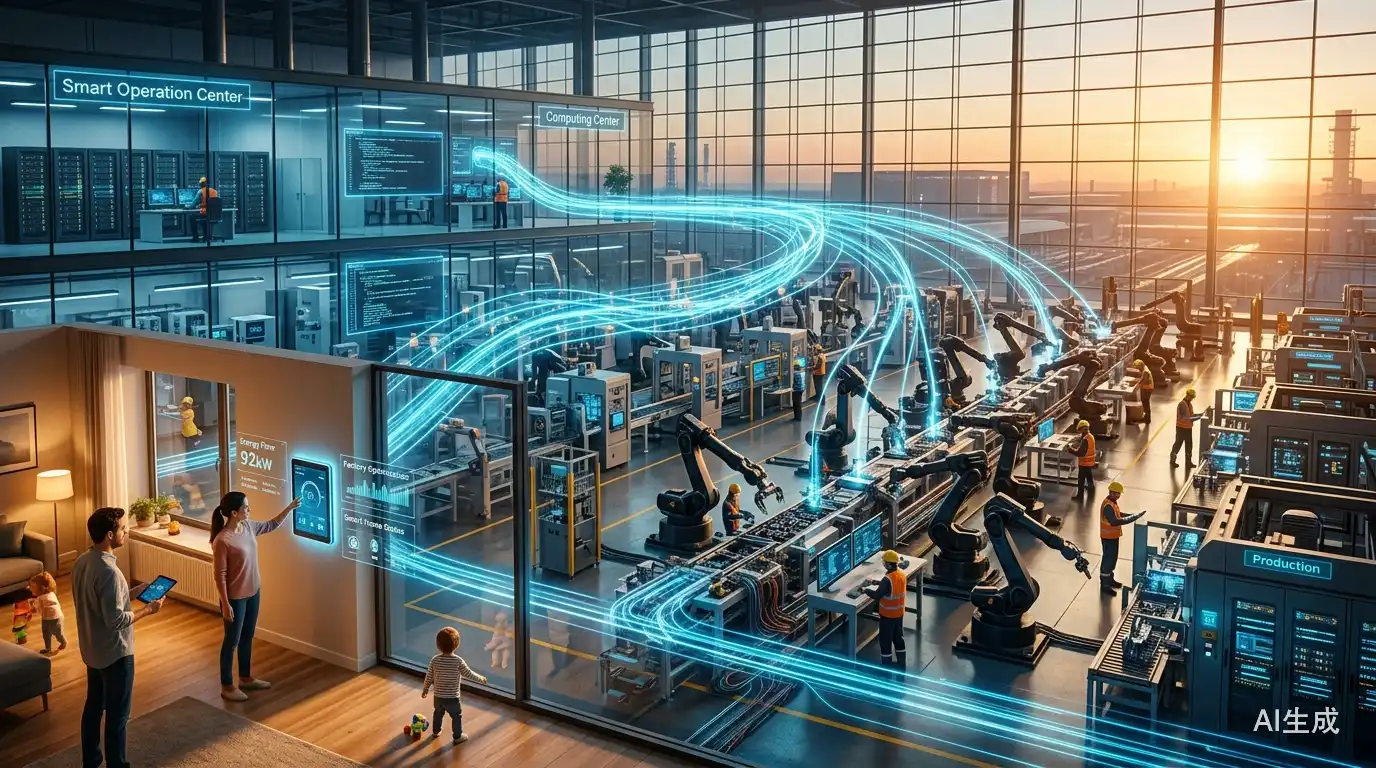
One Megawatt Sustains 60,000 Agents, NVIDIA GB300 Crushes Previous Generation by 20x

marsbitPubblicato 2026-07-06Pubblicato ultima volta 2026-07-06

Introduzione

NVIDIA's latest GB300 NVL72 system achieves a 20x improvement in AI agent throughput per megawatt compared to its predecessor, the H200, according to a new industry benchmark called AA-AgentPerf. Where the H200 could handle roughly 2,600 concurrent agents per megawatt, the GB300 NVL72 can support approximately 61,400. The significance lies less in raw chip performance and more in the new benchmark itself. AA-AgentPerf, created by the independent firm Artificial Analysis, is the first benchmark designed specifically for "AI agent" workloads. Traditional benchmarks measure single, fixed-length requests, but AI agents operate in long, complex chains involving dozens of model calls, tool use, and ever-growing context. These create unique system pressures that older tests cannot capture. AA-AgentPerf replays real programming agent trajectories with lengthy sessions and varying input lengths. Its key metric is "agents per megawatt," measured under strict Service Level Objectives (SLOs) that guarantee a minimum token output speed per agent. It also allows real-world optimizations like KV cache reuse and speculative decoding, which older benchmarks often disable. The results highlight two key trends: rack-scale systems like the 72-GPU GB300 NVL72 are inherently more efficient than single nodes, and the architectural leap from Hopper to Blackwell (H200 to GB300) represents a systemic, not just incremental, performance gain. The GB300's advantage stems from its high-bandwidth NVLink...

With the same one megawatt of power, NVIDIA's latest GB300 NVL72 can handle 61,400 agents simultaneously, while the previous generation H200 could only handle around 2,600.

That's a full 20 times difference.
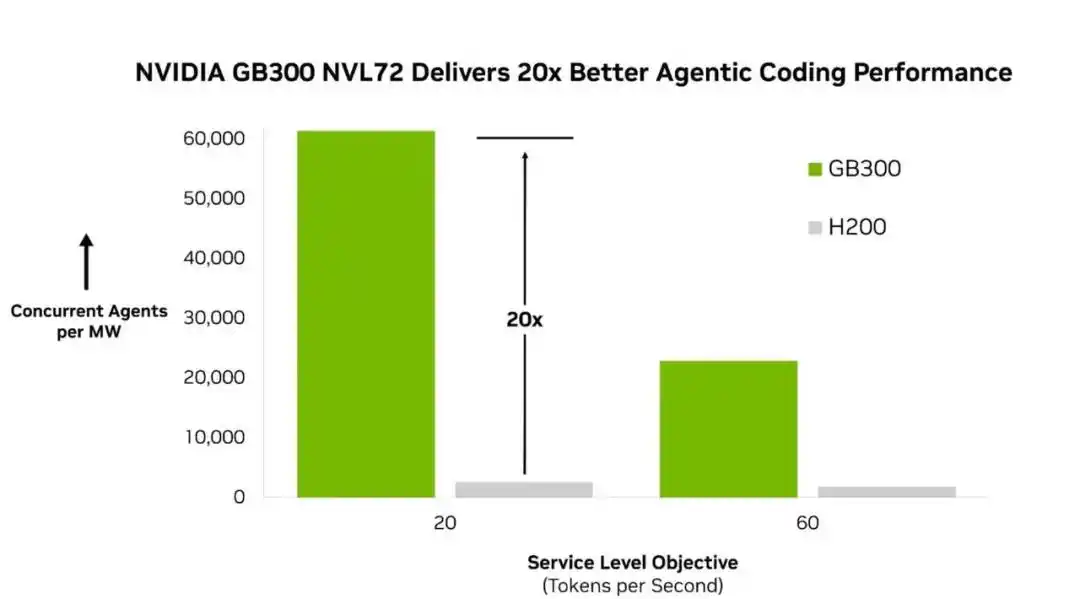
NVIDIA's announced AA-AgentPerf scores: Under two service standards of 20 and 60 tokens per second, the concurrent agent count per megawatt for the GB300 NVL72 is about 20 times that of the H200.

When NVIDIA released these figures on June 12th, the initial external reaction was another performance flex.

But what truly changed wasn't how powerful this generation of chips is, but the ruler used to measure compute power.

It is the new benchmark released by independent evaluation agency Artificial Analysis: AA-AgentPerf.

In its official blog, Artificial Analysis called it the industry's first inference benchmark specifically designed for "AI agents."
Its main metric is also different from before: not tokens per second, but "Agents per Megawatt."

More colloquially, it's how many agents the system can simultaneously "sustain" for every 1 megawatt of electricity supplied.

We've measured FLOPS for years, and tokens per second has been used just fine, so why introduce this new AA-AgentPerf benchmark?

The Old Ruler

Can't Measure Agents Anymore

To answer this, we first need to understand what the workload really is when an agent runs.

Artificial Analysis's judgment is clear: by 2026, the most mainstream AI workload is no longer the thing those old benchmarks were designed to target: old benchmarks measure fixed-length synthetic requests and conveniently turn off optimizations that are actually enabled in production environments.

NVIDIA also gave an apt analogy:

An ordinary conversation is a 100-meter dash; the model receives a question, spits out an answer, done. But an agent working is more like a relay race.

It breaks a goal into dozens or hundreds of steps: reading files, writing code, running commands, checking results, then deciding the next step, one baton pass after another, until the task is truly done.

Along this journey, dozens or even hundreds of large model calls are strung together, each passing an ever-growing context to the next, mixed with tool calls like compilation, database queries, and searches.

The complexity isn't simply additive; it's multiplicative.
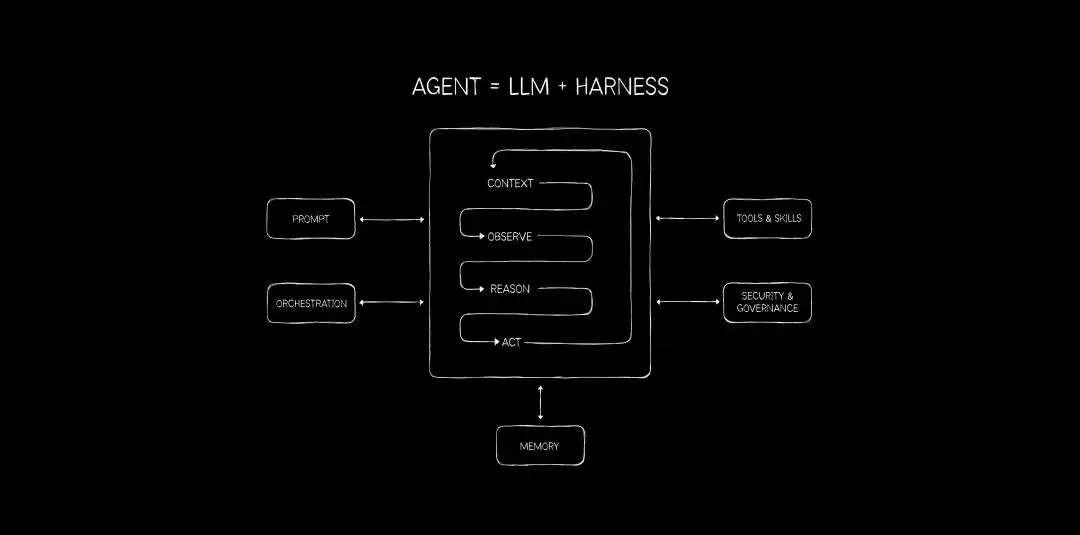
NVIDIA uses a "relay race" metaphor for agentic workloads. A goal is broken into dozens or hundreds of steps, with large model calls and tool calls passed like batons, forming a long, ever-lengthening chain.

The problem lies precisely here.

Existing inference benchmarks on the market measure single calls: how long one request takes to return, how many concurrent requests a machine can handle.

They weren't designed for agents. Chained calls, tool waiting, context inflation—the way these things stress a system is completely different from single requests.

Long sessions alone hide blind spots in old benchmarks: the same long prefix appears round after round; whoever can cache it, avoiding recomputation each time, saves a huge amount of compute.

Add to that tool outputs suddenly inflating the context, while outputs themselves are often only a few hundred tokens—whether the scheduler and memory hierarchy can handle this irregular rhythm directly determines whether a system runs smoothly or crashes.

This is precisely where fixed-length synthetic tests cannot reach.

For those spending real money on cards and building data centers, what they truly care about is how many working agents the system can sustain simultaneously, and how much useful output each kilowatt-hour and each GPU translates to.

Old benchmarks cannot answer these questions.

The First Ruler Built for Agents

AA-AgentPerf's approach differs from old benchmarks; it doesn't feed fixed-length synthetic prompts but replays real programming agent traces.
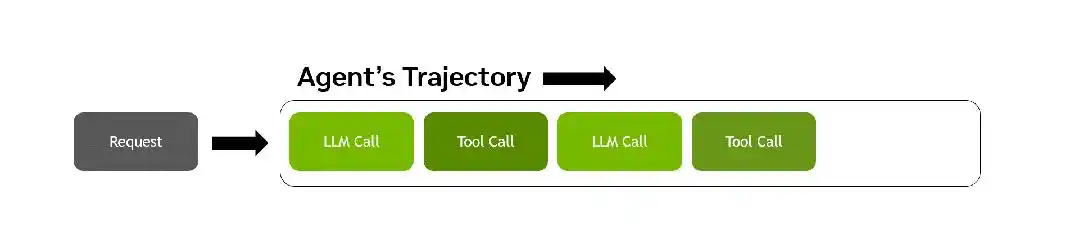
Illustration of an agent trace replayed by AA-AgentPerf. Starting from one request, LLM calls and tool calls alternate, advancing until the task is truly complete.

These traces are accumulated by having agents solve problems in real code repositories, covering over 12 programming languages. A single session can run up to 200 rounds, easily pushing context beyond 100,000 tokens.

Input lengths range from 5,000 to 130,000 tokens, averaging about 27,000. What truly inflates the length isn't the prompt itself, but the accumulated tool outputs and conversation history over multiple rounds.

More crucially, how it calculates the score.

It doesn't chase extreme concurrency. Once concurrency is stacked too high, each agent becomes slow as a crawl; high concurrency numbers are just for show, not practical.

AA-AgentPerf does the opposite: first, lock in a service standard—each agent's output speed and time-to-first-token (TTFT) must meet the target. Then see how many agents the system can sustain at most while maintaining that line.

This set of constraints has a name: Service Level Objective (SLO).

This standard is also divided into tiers, from a "good enough" tier of 20 tokens per second to a "very fast" tier of 180 tokens per second, each measuring the maximum concurrency separately, corresponding to several service levels that actually exist in the market.
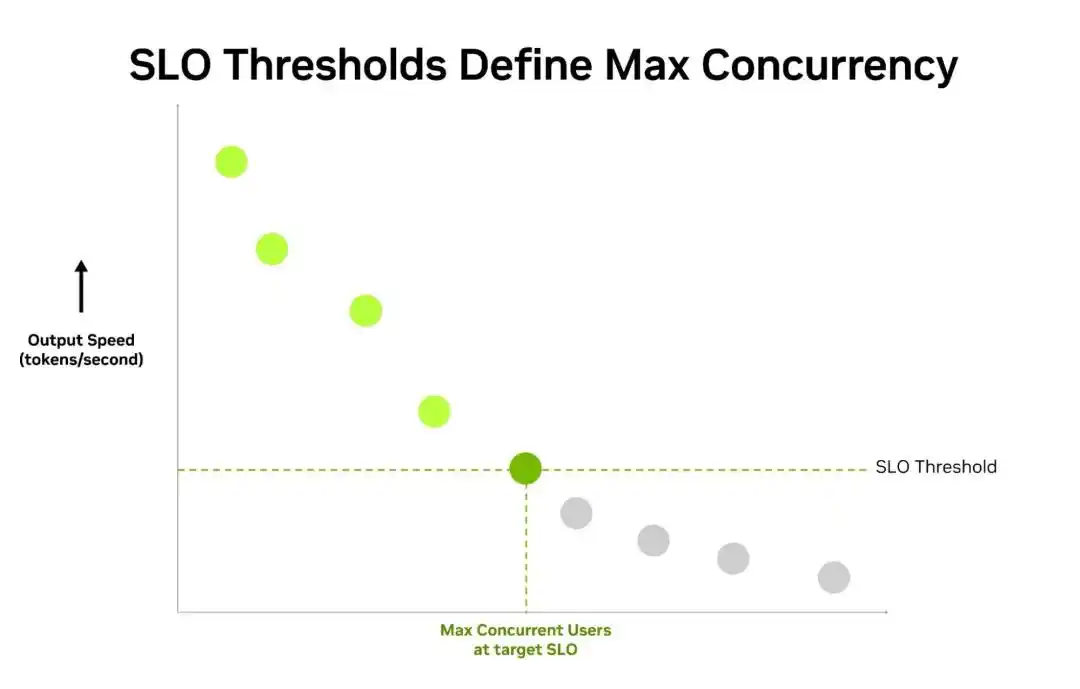
How the Service Level Objective (SLO) caps maximum concurrency. The green zone is the passing area. Once concurrency increases and speed falls below the threshold, the corresponding concurrency limit becomes that system's score.

It also does something other benchmarks often avoid: it allows all optimizations vendors truly enable in production.

KV cache reuse, speculative decoding, splitting prefill and decode across deployments—tricks often turned off by benchmarks—are all permitted this time.

The reason is simple: measurements taken with these optimizations turned off are meaningless.

Simultaneously, it monitors output quality, preventing any optimization from trading answer quality for concurrency. This way, every gain from hardware or software improvements can be accurately measured.

Finally, it boils down to a core metric: Agents per Megawatt. In a world where power is increasingly tight and energy consumption is cost, this metric is what buyers truly care about: from tokens per second to agents per megawatt.

20x Lead Per Megawatt

40x Lead Per GPU

In a test representing one of the strongest current frontier Mixture-of-Experts (MoE) models, the GB300 NVL72 can sustain 61,400 concurrent agents per megawatt, averaging 57.5 agents per GPU.

The control group, H200, manages about 2,600 per megawatt, with only 1.4 agents per GPU. That's about a 20x difference per megawatt and about a 40x difference per GPU.

The significance of these two numbers also differs.

Per megawatt measures how much agent capacity you get for the same unit of electricity, an efficiency calculation. Per GPU measures the service density of a single card, a hardware calculation.

Based on these numbers, you can directly calculate what scale of agent application your power budget can actually run.

The leaderboard isn't limited to NVIDIA's GB300; it includes AMD's MI355X. Single cards, whole systems, and entire racks are all put to the test.

The first batch of results revealed two clear patterns.

Pattern 1: Rack-scale systems are inherently cheaper. They can more fully split inference and spread it across more cards, surpassing single nodes in both raw compute and efficiency per megawatt.

Pattern 2: The leap from Hopper to Blackwell pushed the concurrent capacity of systems to a whole new level, not just minor tweaks.

From Single Card to Rack

A System-Level Victory

From H200 to GB300, this might look like a single-card performance leap, but in fact, it's a system-level victory.

More crucially, the GB300 NVL72 connects 72 GPUs via NVLink into a rack-scale whole.

For such massive MoE models, this is the key: the model can be fully spread out, with experts distributed across a whole fleet of GPUs for parallel execution, rather than all crammed into a single card, wasting resources.

CUDA cores made further optimizations underneath, overlapping communication and computation across experts, letting the overhead of coordinating various experts be quietly absorbed by compute power instead of piling up as latency.

TensorRT-LLM is responsible for maintaining efficiency as concurrent sessions keep increasing, such as splitting input processing and output generation into two separate tasks, each optimized individually.

Simply put, this test score is the result of hardware, interconnect, and software stack working together.
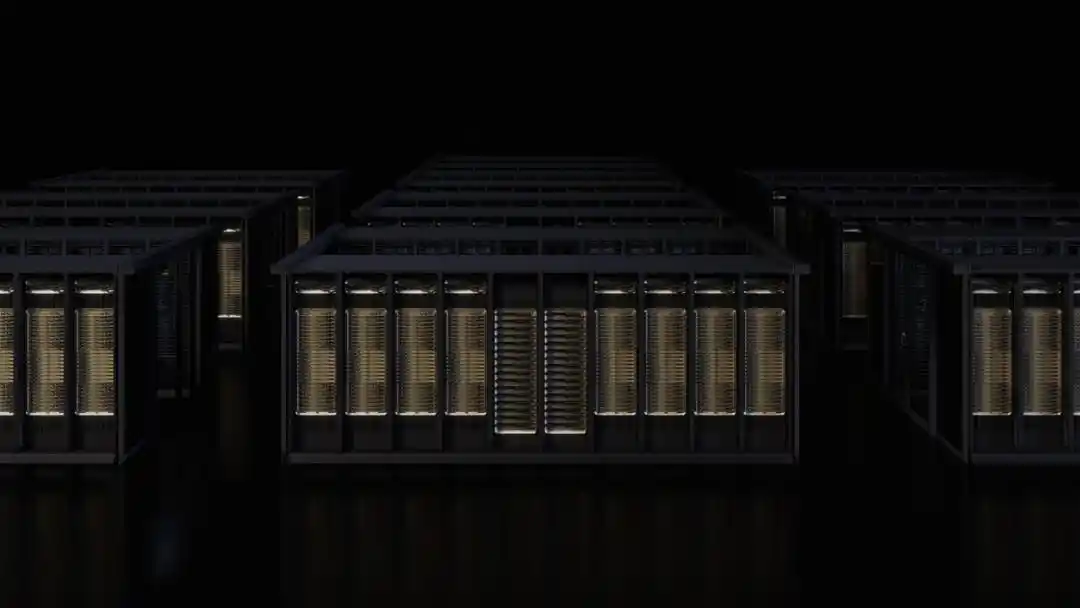
The GB300 NVL72 rack. 72 GPUs connected via NVLink into a single high-bandwidth whole—this is the hardware foundation enabling 60,000 agents to run cooperatively.

Welding 72 cards into a high-bandwidth whole, where each GPU can rapidly share parameters, KV cache, and intermediate results—this is the confidence enabling 60,000 agents to run cooperatively.

Some Boundaries That Cannot Be Overlooked

A few points need attention here; benchmark tests cannot be equated with production reality.

First, the number 60,000 does not mean one machine simultaneously runs 60,000 independent large models.

It's a simulation of concurrent sessions under the benchmark's definition. Each agent follows a pre-recorded trace; even tool calls aren't actually executed but simulated with a fixed CPU duration.

This design ensures the final result only reflects differences in compute power itself, but it cannot be directly equated with the actual service capacity deliverable in a real production environment.

Second, benchmark scores are not production service agreements.

Artificial Analysis itself states this is a snapshot of a rapidly evolving frontier; each system still has untapped potential, and scores will climb as software optimizations advance.

Third, AA-AgentPerf is currently a standard proposed by a single organization.

Whether it will eventually grow into an industry-wide accepted ruler like MLPerf is still too early to conclude.

References:

https://artificialanalysis.ai/articles/aa-agentperf

https://developer.nvidia.com/blog/nvidia-achieves-leading-agentic-coding-performance-on-first-agentic-ai-benchmark/

This article is from the WeChat public account "New Zhiyuan", author: ASI Revelation, editor: Yuanyu


Crypto di tendenza

Domande pertinenti

QWhat is the key metric used in the new AA-AgentPerf benchmark, and why is it considered significant?

AThe key metric is 'Agents per Megawatt,' which measures how many AI agents a system can concurrently 'support' while consuming 1 megawatt of power. It is significant because it shifts the focus from raw performance (like tokens per second) to energy efficiency and practical service capacity, directly addressing the operational costs and scalability concerns in data centers running complex AI agent workloads.

QHow does the workload of an AI agent differ from a standard conversational AI request, according to the article?

AA standard conversational request is like a sprint—a single question and answer. In contrast, an AI agent's workload is like a relay race. It breaks a goal into dozens or hundreds of steps involving multiple LLM calls and tool calls (like reading files, writing code, executing commands). These steps chain together with growing context length and varying computational demands, creating a far more complex and sustained load on the system.

QWhat are two main factors that contribute to the reported 20x improvement in 'Agents per Megawatt' for NVIDIA's GB300 NVL72 over the H200?

AThe improvement stems from both a generational hardware leap and a system-level architecture. Firstly, the Blackwell-generation GB300 GPUs offer significant performance gains. Secondly, and crucially, the GB300 NVL72 system connects 72 GPUs into a single, high-bandwidth unit via NVLink. This allows large models (like MoE models) to be distributed efficiently across many GPUs, enabling superior parallelism, better cache sharing, and higher overall efficiency compared to a collection of individual nodes.

QWhat is the Service Level Objective (SLO) in the AA-AgentPerf benchmark, and how does it determine the final score?

AThe Service Level Objective (SLO) in AA-AgentPerf defines a performance threshold that must be maintained for each agent, such as a minimum tokens-per-second generation speed and a maximum Time-To-First-Token (TTFT). The benchmark does not maximize raw concurrency. Instead, it finds the maximum number of concurrent agents the system can handle while still meeting the predefined SLO. The point where adding more agents causes performance to drop below the SLO becomes the system's score for that service tier.

QWhat are two important caveats or limitations mentioned about the AA-AgentPerf benchmark results?

AFirst, the benchmark simulates agent workloads by replaying pre-recorded trajectories, including simulated (not real) tool execution times. This isolates hardware/software performance but does not perfectly mirror a live production environment's complexities. Second, AA-AgentPerf is a new benchmark from a single organization. It is a snapshot of rapidly evolving technology, and its status as a future industry-standard, like MLPerf, is not yet assured. The scores represent potential and are not service-level guarantees.

Letture associate

The 'Saving U.S. Treasuries' Baton Pass: Bessent Fumbled Last Week, This Week It's Wash's Turn

"Rescuing US Treasuries" Relay: After Bessent's Miss, All Eyes Are on Walsh Last week, US Treasury Secretary Bessent's announcement to at least double long-term Treasury buybacks failed to sustainably lower yields, which quickly rebounded. The market response saw a drop in the dollar alongside surges in gold and Bitcoin, interpreted as a "pressure release valve" for anxiety. The focus now shifts to Fed Chairman Walsh's upcoming Jackson Hole speech. Markets are highly sensitive to his message, seeking clarity on the Fed's policy response to stubborn inflation and worsening fiscal conditions. Analysts warn that a lack of new guidance could disappoint markets and worsen the sell-off in long-dated bonds. Analysts question the scale of Bessent's operations, noting they are too small relative to the overall debt market and do not constitute quantitative easing. A key issue is the Fed's massive holdings of long-term bonds, which distorts the market. With the Fed holding low-yielding short-term bonds that are losing money relative to its policy rate, discussion is growing around a potential Fed-led "Operation Twist." This would involve selling short-term bonds to buy long-term ones, aiming to lower long-end yields without expanding the balance sheet. The upcoming PCE inflation data will set the stage for Walsh's speech. However, the window for action is narrowing amid political pressures. A critical threshold is the 30-year yield at 5%; holding above it could increase stress on the dollar and leveraged sectors. Overall, the article suggests that without coordinated Fed action to anchor inflation expectations, Treasury interventions may ultimately fail, with investors increasingly looking to assets like gold as hedges.

marsbit18 min fa

The 'Saving U.S. Treasuries' Baton Pass: Bessent Fumbled Last Week, This Week It's Wash's Turn

marsbit18 min fa

Hyperliquid's Compliance Journey: From Permissionless to Permissioned via HIP-3

Hyperliquid’s Compliance Path: From Permissionless to Permissioned HIP-3 Hyperliquid currently blocks U.S. access because its permissionless, on-chain infrastructure conflicts with U.S. market structure laws, which restrict futures trading to registered exchanges, clearinghouses, and brokers. Through its Hyperliquid Policy Center (HPC), the project is advocating for regulatory modernization, proposing that regulated entities be allowed to build products on HyperCore (its exchange and clearing layer) while fulfilling their compliance obligations. The platform’s modular stack separates roles like a traditional exchange (DCM), clearinghouse (DCO), and broker (FCM), but reconstructs them on-chain with code. This enables permissionless access, self-custody, and 24/7 global trading, but clashes with U.S. rules requiring KYC, specific margin models, and custodial arrangements. To resolve this, HPC is engaging with U.S. regulators (CFTC, SEC) to seek clarity that deploying on-chain software does not itself trigger licensing, and to establish exemptions allowing non-custodial wallets to route users to regulated derivatives. Recent political signals suggest openness to this approach. On the technical side, Hyperliquid Labs has introduced permissioned HIP-3 deployers on testnet. These allow regulated entities to launch markets, perform KYC, and whitelist compliant users. While these create separate order books, whitelisted market makers can bridge liquidity between them, ensuring deep, shared liquidity across the same L1. Features like payload-based “PA” permissions enable DEX-level account controls (e.g., reduce-only orders), mirroring traditional broker authorities. The strategy is not to open the native, permissionless front-end to U.S. users, but to position Hyperliquid as neutral infrastructure that U.S. regulated firms can use while meeting their legal duties. This paves a compliant path for U.S. investor access while preserving the protocol’s core, permissionless nature.

marsbit42 min fa

Hyperliquid's Compliance Journey: From Permissionless to Permissioned via HIP-3

marsbit42 min fa

Two Funding Rounds in Three Months: The Chinese Version of Palantir is on Fire

Investment Community AI has learned that Beijing Zhongshu Ruizhi Technology Co., Ltd., a domestic industrial-grade causal intelligence and high-reliability decision-making AI company, has recently completed a strategic financing round worth hundreds of millions of RMB. This round saw participation from China Internet Investment Fund, Suzhou Chuangtou National Social Security Fund, Financial Street Capital, ICBC Capital, Kunlun Capital, among others, with existing shareholders also increasing their investment. This follows a Series B funding round in the hundreds of millions completed just three months prior. The rapid succession of two major funding rounds signifies strong market recognition of the company's underlying original technology and scaled commercial implementation. Often referred to as the "Chinese version of Palantir," Zhongshu Ruizhi is entering a new phase of accelerated technological iteration, widespread scenario replication, and scaled performance release, mirroring the explosive growth of China's AI market. Founded in April 2020 by Dr. Han Han, a Tsinghua University Ph.D. and former core drafter of national AI policies, the company is mission-driven to "move AI from the digital world to the physical world." It focuses on the high-reliability, strong-decision industrial AI track and enterprise-grade AI Agent full-stack infrastructure. The team tackles the challenge of applying AI to China's vast and complex industrial and energy systems by developing a new intelligent operating system from scratch. Its core technological breakthrough lies in three proprietary底层 technologies: meta-causal cognitive theory, causal models, and a dynamic ontology engine. These address critical pain points of generative large models in industrial settings—such as AI hallucinations, insufficient reasoning, lack of temporal logic, unverifiable decisions, and multi-source rule conflicts—thereby providing trustworthy, explainable, and executable智能决策 capabilities. Commercially, Zhongshu Ruizhi has achieved scaled deployment, serving over 50 central state-owned enterprises and industrial groups in sectors like power, petroleum, and aerospace, with implementations in more than 800 highly complex production scenarios. The company reported doubled revenue in 2025, demonstrating strong self-sufficiency and a viable business model—a rarity among new-generation AI firms. The latest funds will be allocated towards advancing foundational theoretical research, replicating successful application models to expand market presence (including overseas), and attracting top-tier talent. Lead investor China Internet Investment Fund highlighted that in the current shift from general AI capability contests to deep industrial empowerment, industrial-grade causal intelligence is crucial for building China's modern digital foundation and fostering new quality productive forces. They expressed support for the company's efforts to define decision-making paradigms and trustworthy standards for industrial intelligence, aiming to secure a rule-making voice in the global physical AI arena.

marsbit52 min fa

Two Funding Rounds in Three Months: The Chinese Version of Palantir is on Fire

marsbit52 min fa

The Biggest Political Economy Question in the AI Era: As Robots Become More Capable, How Do Humans Share the Value?

In the AI era, the most pressing political economy question is: as machines become increasingly capable, how can humanity share in the value they create? An article originally critiquing China's tech focus has sparked a deeper debate on this global challenge. Historically, industrial progress improved efficiency but still relied on human labor for wealth creation and distribution. AI is fundamentally different—it is now replacing cognitive and knowledge work. As AI and robots take over more tasks, economic growth may continue while direct human participation in value creation shrinks, creating a core tension between productivity gains and widespread income generation. The issue is not unique to China. While leading tech companies amass enormous wealth, labor's share of income is declining globally. The core problem is a broken link: technological innovation and corporate profits are not translating into sufficient consumer income and demand. Three potential paths forward are outlined: a traditional capitalist model where profits primarily go to capital owners; a state-capitalist approach with public investment in AI; and more innovative models like digital sovereign wealth funds, universal shareholding, or AI-era basic income schemes to directly distribute AI-generated value. The future competitive advantage may lie not just in technological supremacy, but in which society can build a new, inclusive distribution system for the intelligent economy. The ultimate challenge is ensuring that as AI creates value, humans have a means to obtain income and share in the resulting widespread social benefits.

marsbit1 h fa

The Biggest Political Economy Question in the AI Era: As Robots Become More Capable, How Do Humans Share the Value?

marsbit1 h fa

Generating Profits for Seven Consecutive Quarters, Emerging Markets Carry Trade Outperforms Everything

For the seventh consecutive quarter, dollar-funded emerging market carry trades have delivered positive returns, marking the longest winning streak since 2008. According to Bloomberg's index, this strategy has gained approximately 22% since late 2024, outperforming U.S. Treasuries, emerging market sovereign, and corporate dollar debt. The core of the trade involves borrowing low-interest currencies like the U.S. dollar, euro, or yen to invest in high-yielding emerging market assets, such as Turkish lira bonds offering over 40% returns. Returns were amplified by favorable currency moves, with the dollar weakening against most emerging market currencies and other traditional funding currencies. For instance, the trade gained 48% on the Colombian peso in the past year. A key test came in August 2024 with a historic joint U.S.-Japan currency intervention, which caused only a modest 1% dip in the carry trade risk premium as investors shifted funding from the yen to the euro and Swiss franc. Looking ahead, the primary risk is the timing of Federal Reserve policy changes. While persistent inflation allows the Fed to hold rates, a rapid rise in long-term U.S. yields could threaten the trade. Another concern is crowding, as massive inflows increase vulnerability to a sudden reversal. High interest rates in regions like Latin America and Eastern Europe, supported by external factors like Middle East tensions and energy prices, continue to sustain the opportunity. Major investors remain engaged, favoring currencies like the Mexican peso, South African rand, and Turkish lira.

marsbit1 h fa

Generating Profits for Seven Consecutive Quarters, Emerging Markets Carry Trade Outperforms Everything

marsbit1 h fa

Trading

Spot

Articoli Popolari

Come comprare ONE

Benvenuto in HTX.com! Abbiamo reso l'acquisto di Harmony (ONE) semplice e conveniente. Segui la nostra guida passo passo per intraprendere il tuo viaggio nel mondo delle criptovalute.Step 1: Crea il tuo Account HTXUsa la tua email o numero di telefono per registrarti il tuo account gratuito su HTX. Vivi un'esperienza facile e sblocca tutte le funzionalità,Crea il mio accountStep 2: Vai in Acquista crypto e seleziona il tuo metodo di pagamentoCarta di credito/debito: utilizza la tua Visa o Mastercard per acquistare immediatamente HarmonyONE.Bilancio: Usa i fondi dal bilancio del tuo account HTX per fare trading senza problemi.Terze parti: abbiamo aggiunto metodi di pagamento molto utilizzati come Google Pay e Apple Pay per maggiore comodità.P2P: Fai trading direttamente con altri utenti HTX.Over-the-Counter (OTC): Offriamo servizi su misura e tassi di cambio competitivi per i trader.Step 3: Conserva Harmony (ONE)Dopo aver acquistato Harmony (ONE), conserva nel tuo account HTX. In alternativa, puoi inviare tramite trasferimento blockchain o scambiare per altre criptovalute.Step 4: Scambia Harmony (ONE)Scambia facilmente Harmony (ONE) nel mercato spot di HTX. Accedi al tuo account, seleziona la tua coppia di trading, esegui le tue operazioni e monitora in tempo reale. Offriamo un'esperienza user-friendly sia per chi ha appena iniziato che per i trader più esperti.

650 Totale visualizzazioniPubblicato il 2024.12.12Aggiornato il 2026.06.02

Come comprare ONE

Discussioni

Benvenuto nella Community HTX. Qui puoi rimanere informato sugli ultimi sviluppi della piattaforma e accedere ad approfondimenti esperti sul mercato. Le opinioni degli utenti sul prezzo di ONE ONE sono presentate come di seguito.

活动图片