On the Night of the Fed Rate Cut, the Real Game Is Trump's 'Monetary Power Grab'

marsbitPubblicato 2025-12-11Pubblicato ultima volta 2025-12-11

Introduzione

Tonight marks the Federal Reserve's most anticipated interest rate decision of the year. While a 25-basis-point cut is widely expected, the key variable for risk assets is whether the Fed will restart liquidity injections, potentially through a $45 billion monthly short-term debt purchase program starting in January. This signals a stealth return to quantitative easing. The larger tension stems from an unprecedented shift in monetary power. President Trump is rapidly reshaping the Federal Reserve, not just by replacing its chair but by redrawing the boundaries of monetary authority. The long-held principle of central bank independence is being eroded as the Treasury Department seeks to reclaim control over long-term interest rates, liquidity, and the balance sheet. This transition to a "fiscally dominated monetary era" is the underlying logic connecting recent market events. Despite a 40 billion outflow from Bitcoin ETFs, analysis suggests this was not panic selling but the unwinding of leveraged basis trades, leaving a healthier, less leveraged market. Meanwhile, led by Michael Saylor, made its largest Bitcoin purchase in months ($963 million), and Tom Lee's BitMine significantly increased its Ethereum holdings, signaling strong institutional conviction during the downturn. The macro shift implies higher market volatility as the old order fractures. While improved liquidity may provide a floor for Bitcoin, its longer-term trajectory awaits clarity within this new monetary...

Tonight will bring the most anticipated interest rate cut decision of the year from the Federal Reserve.

The market widely expects a rate cut to be almost a done deal. However, what will truly determine the direction of risk assets in the coming months is not another 25 basis point cut, but a more critical variable: whether the Fed will restart liquidity injections into the market.

This time, Wall Street is not watching interest rates, but the balance sheet.

According to expectations from institutions like Bank of America, Vanguard, and PineBridge, the Fed may announce this week a plan to initiate a $45 billion monthly short-term bond purchase program starting January next year, as a new round of "reserve management operations." In other words, this suggests the Fed might be quietly ushering in an era of "stealth balance sheet expansion," allowing the market to enter a state of liquidity easing even before the rate cut.

But what makes the market nervous is the backdrop against which this is happening—the U.S. is entering an unprecedented period of monetary power restructuring.

Trump is taking over the Fed in a manner far faster, deeper, and more thorough than anyone expected. It's not just about replacing the chair; it's about redrawing the boundaries of power within the monetary system, reclaiming authority over long-term interest rates, liquidity, and the balance sheet from the Fed and handing it back to the Treasury. The independence of the central bank, long considered an "iron law of the system" for decades, is being quietly eroded.

This is also why all seemingly disparate events—from Fed rate cut expectations to ETF fund flows, from MicroStrategy's and Tom Lee's contrarian accumulation, and so on—are actually converging on the same underlying logic: the U.S. is entering a "fiscally dominated monetary era."

And what impact will this have on the crypto market?

MicroStrategy and Others Are Making Their Move

Over the past two weeks, the entire market has been debating the same question: Will MicroStrategy be able to withstand this downturn? Bears have simulated various scenarios of the company's collapse.

But Saylor clearly thinks otherwise.

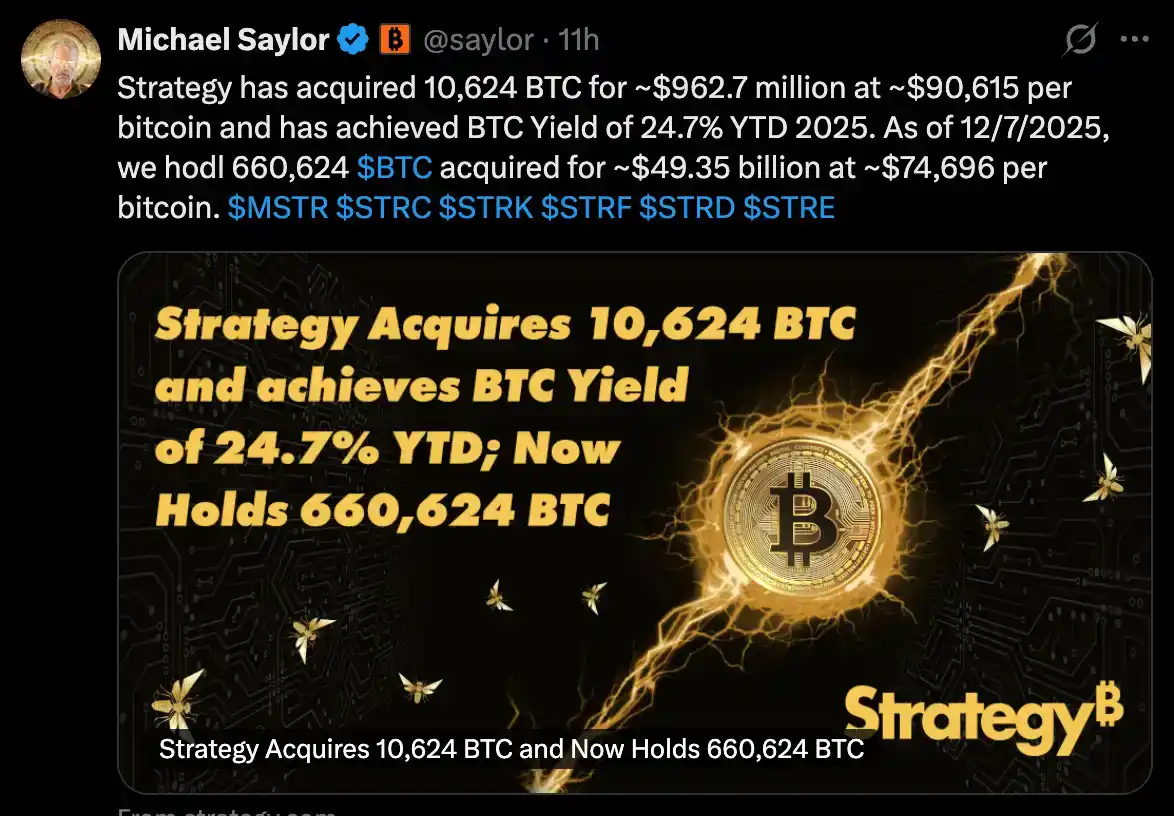
Last week, MicroStrategy increased its Bitcoin holdings by approximately $963 million, to be precise, 10,624 BTC. This is his largest purchase in recent months, even exceeding the sum of his acquisitions over the past three months.

Consider this: the market had been speculating whether MicroStrategy would be forced to sell coins to avoid systemic risk when its mNAV approached 1. Instead, when the price nearly hit that level, he didn't sell; he doubled down, and on such a large scale.
Meanwhile, a similarly dramatic contrarian move was playing out on the ETH side. Tom Lee's BitMine, despite ETH's price plunge and a 60% drawdown in the company's market cap, managed to continuously tap the ATM (at-the-market offering), raising substantial cash, and last week bought $429 million worth of ETH in one go, pushing its holdings to a $12 billion scale.

Even though BMNR's stock price has fallen more than 60% from its high, the team can still consistently raise money through ATM offerings and keep buying.
CoinDesk analyst James Van Straten put it more bluntly on X: "MSTR can raise $1 billion in a week, while in 2020, it took them four months to do the same. The exponential trend continues."

If we look at market cap impact, Tom Lee's move is even "heavier" than Saylor's. BTC's market cap is five times that of ETH, so Tom Lee's $429 million buy order has the "double impact" in weight equivalent to Saylor buying $1 billion worth of BTC.

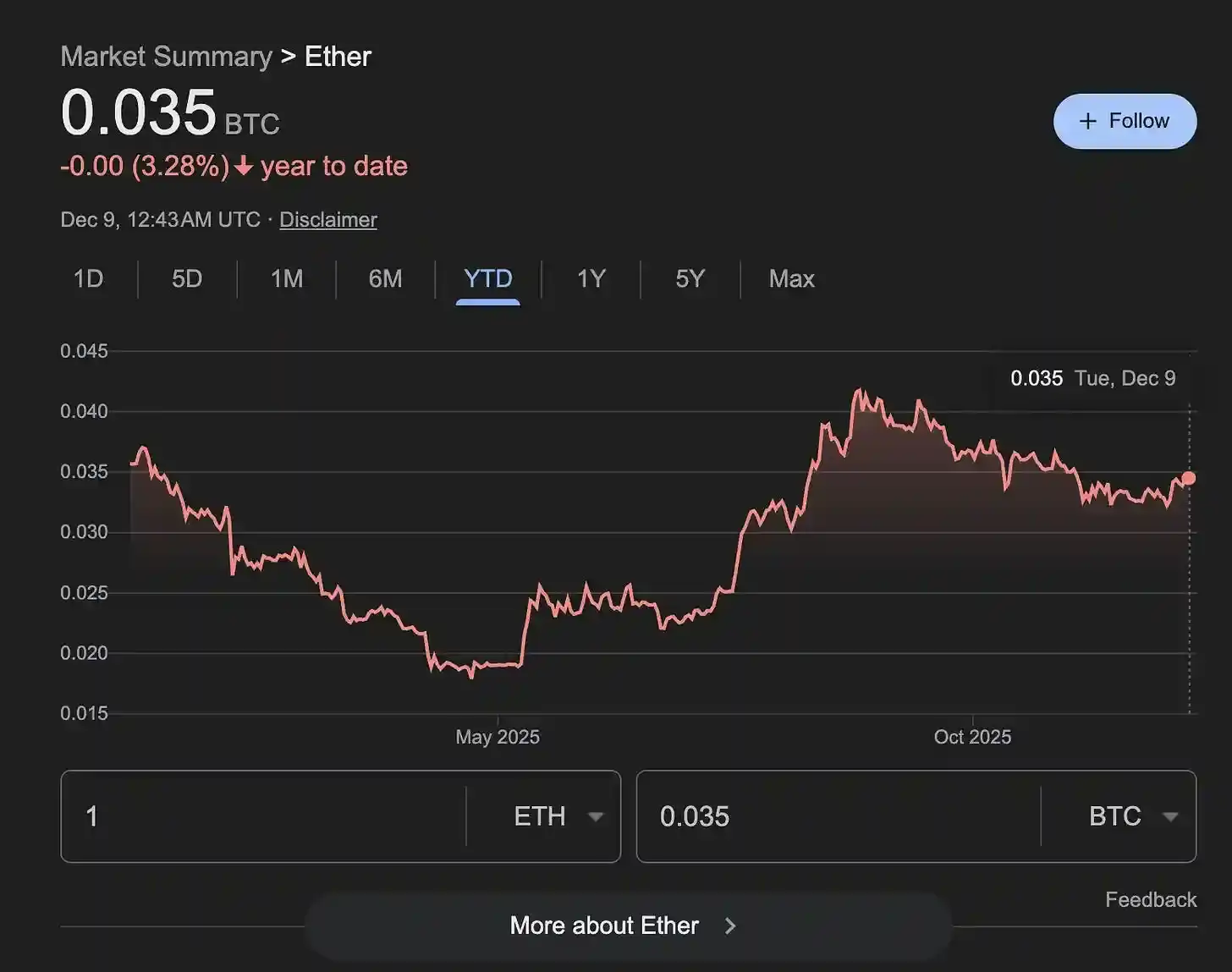
No wonder the ETH/BTC ratio has started to rebound, breaking a three-month downtrend. History has repeated this countless times: whenever ETH leads the recovery, the market enters a brief but fierce "altcoin rebound window."

BitMine now holds $1 billion in cash, and ETH's pullback zone happens to be the perfect place to significantly lower its average cost. In a market where funding is generally tight, institutions that can keep firing are themselves part of the price structure.

ETF Outflows Are Not Flight, But Temporary Withdrawal of Arbitrage Capital

On the surface, Bitcoin ETFs have seen nearly $4 billion in outflows over the past two months, with the price dropping from $125,000 to $80,000, leading the market to quickly draw a crude conclusion: institutions are retreating, ETF investors are panicking, the bull market structure is broken.

But Amberdata offers a completely different explanation.

These outflows are not "value investors fleeing" but "leveraged arbitrage funds being forced to unwind." The primary source is the collapse of a structured arbitrage strategy called the "basis trade." Funds were originally earning a stable spread by "buying spot/shorting futures," but starting in October, the annualized basis fell from 6.6% to 4.4%, spending 93% of the time below the breakeven point, turning arbitrage into losses and forcing the strategy to be dismantled.

This triggered a "two-way action" of ETF selling + futures buybacks.

In traditional terms, capitulation selling typically occurs in extreme emotional environments after continuous declines, where panic peaks, and investors stop trying to cut losses and instead abandon all holdings entirely. Its typical characteristics include: large-scale redemptions across almost all issuers, surging trading volume, cost-indifferent selling pressure, and accompanying extreme sentiment indicators. But this ETF outflow clearly doesn't fit this pattern. Although there were net outflows overall, the direction of funds was inconsistent: for example, Fidelity's FBTC maintained continuous inflows throughout the period, and BlackRock's IBIT even absorbed some incremental funds during the worst phases of net outflows. This shows that the real exodus was only from a minority of issuers, not the entire institutional cohort.

More crucial evidence comes from the distribution of outflows. From October 1 to November 26 (53 days), funds from Grayscale contributed over $900 million in redemptions, accounting for 53% of the total outflow; 21Shares and Grayscale Mini followed closely, together making up nearly ninety percent of the redemption volume. In contrast, BlackRock and Fidelity—the most typical channels for institutional allocation—were net inflows overall. This is completely inconsistent with a true "panic-driven institutional retreat" and looks more like a "localized event."

So, which type of institution was selling? The answer: large funds engaged in basis arbitrage.

The basis trade is essentially a directionally neutral arbitrage structure: funds buy spot Bitcoin (or ETF shares) while shorting futures, profiting from the contango yield. It's a low-risk, low-volatility strategy that attracts significant institutional capital when futures are in contango and funding costs are manageable. However, this model relies on one premise: futures prices must consistently be higher than spot prices, with a stable spread. And starting in October, this premise suddenly disappeared.

According to Amberdata's statistics, the 30-day annualized basis compressed from 6.63% down to 4.46%, with 93% of trading days below the 5% breakeven point required for arbitrage. This meant these trades were no longer profitable, even starting to lose money, forcing funds to exit. The rapid collapse of the basis led to a "systematic unwinding" of arbitrage positions: they had to sell their ETF holdings and simultaneously buy back the futures they had previously shorted to close the arbitrage trade.

This process is clearly visible in market data. The open interest in Bitcoin perpetual contracts fell 37.7% over the same period, a cumulative decrease of over $4.2 billion, with a correlation coefficient of 0.878 to the basis change—almost a synchronous move. This combination of "ETF selling + short covering" is the classic path for basis trade exit; the sudden amplification of ETF outflow规模 was not driven by price panic but was the inevitable result of the arbitrage mechanism collapsing.

In other words, the ETF outflows of the past two months were more like a "liquidation of leveraged arbitrage positions" rather than a "retreat by long-term institutions." It was the unwinding of a highly specialized, structured trade, not panic selling pressure caused by a market sentiment crash.

What's more noteworthy is: after these arbitrage positions are cleared out, the remaining capital structure becomes healthier. Current ETF holdings remain at a high level of approximately 1.43 million Bitcoin, with most shares coming from allocation-oriented institutions, not short-term funds chasing yields. As the leveraged hedging from arbitrageurs is removed, the overall market leverage decreases, there are fewer sources of volatility, and price action will be driven more by "genuine buying and selling forces," not hijacked by forced technical operations.

Amberdata's head of research, Marshall, describes this as a "market reset": after the arbitrage capital retreats, new ETF inflows will be more directional and long-term, structural noise in the market will decrease, and subsequent price movements will more accurately reflect real demand. This means that although it looks like $4 billion flowed out on the surface, it might not be a bad thing for the market itself. On the contrary, it could lay the foundation for the next wave of healthier gains.

If Saylor, Tom Lee, and ETF flows show the attitude of micro-level capital, then the changes happening at the macro level are deeper and more intense. Will the Santa Claus rally come? To find the answer, we might need to look further at the macro picture.

Trump's "Takeover" of the Monetary System

For decades, the Fed's independence has been seen as an "iron law of the system." Monetary power belongs to the central bank, not the White House.

But Trump clearly doesn't agree with this.

Increasing signs show that the Trump team is taking over the Fed in a manner far faster and more thorough than the market expected. It's not just symbolically "replacing the chair with a hawk," but comprehensively rewriting the power distribution between the Fed and the Treasury, changing the balance sheet mechanism, and redefining how the yield curve is priced.

Trump is attempting to restructure the entire monetary system.

Former New York Fed trading desk head Joseph Wang (a long-time researcher of Fed operations) also clearly warned: "The market is clearly underestimating Trump's determination to control the Fed. This change could push the market into a phase of higher risk and higher volatility."

From personnel appointments, policy direction, to technical details, we can see very clear traces.

The most direct evidence comes from personnel arrangements. The Trump camp has placed several key figures in core positions, including Kevin Hassett (former White House economic advisor), James Bessent (key Treasury decision-maker), Dino Miran (fiscal policy智库), and Kevin Warsh (former Fed governor). These individuals share a common trait: they are not traditional "central bank school" and do not insist on central bank independence. Their goal is very clear: to weaken the Fed's monopoly on interest rates, long-term funding costs, and system liquidity, and return more monetary power to the Treasury.

The most symbolic point: it is widely believed that Bessent, considered the most suitable candidate for Fed chair, ultimately chose to remain at the Treasury. The reason is simple: in the new power structure, the Treasury's position can determine the rules of the game more than the Fed chair.

Another important clue comes from changes in term premium.

For the average investor, this indicator might be somewhat unfamiliar, but it is actually the most direct signal for the market to judge "who controls long-term interest rates." Recently, the spread between 12-month and 10-year Treasury yields has approached phase highs again, and this round of increase is not due to an improving economy or rising inflation, but because the market is reassessing: in the future, what determines long-term rates might not be the Fed, but the Treasury.
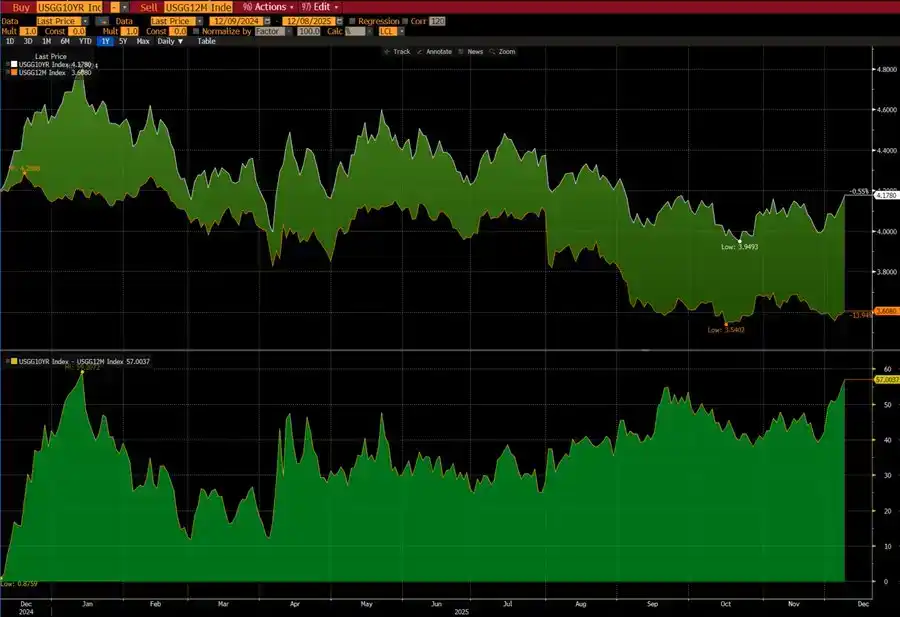
Yields on the 10-year and 12-month Treasury notes are continuing to fall, meaning the market is strongly betting that the Fed will cut rates, and the pace will be faster and more aggressive than previously expected
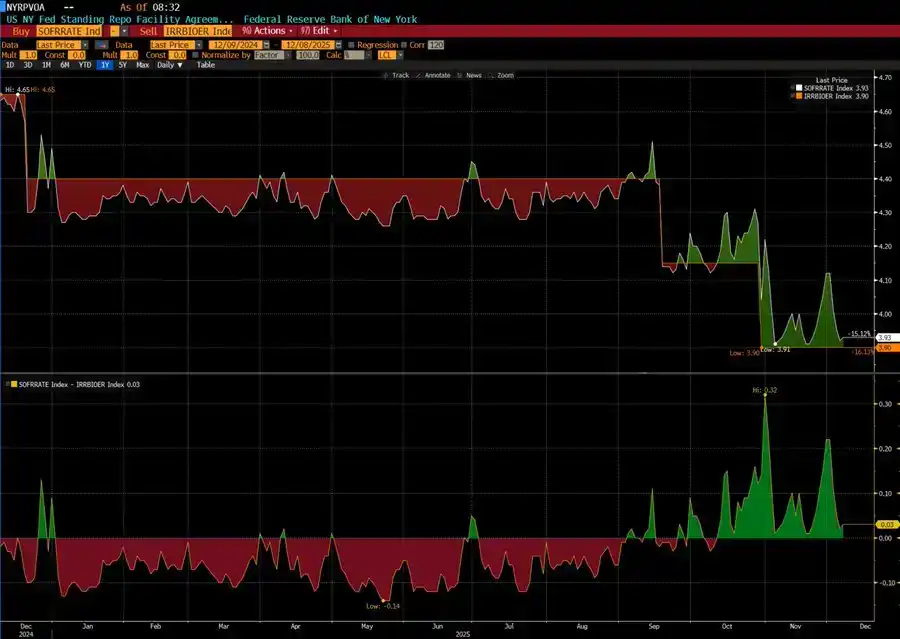
SOFR (Secured Overnight Financing Rate) experienced a cliff-like drop in September, meaning U.S. money market rates suddenly collapsed, signaling a significant loosening in the Fed's policy rate system

The initial spread widening was because the market thought Trump would overheat the economy upon taking office; later, when tariffs and large-scale fiscal stimulus were absorbed by the market, the spread quickly retreated. Now the spread is widening again, reflecting not growth expectations, but uncertainty about the Hassett-Bessent system: if in the future the Treasury controls the yield curve by adjusting debt duration, issuing more short-term debt, compressing long-term debt, etc., then traditional methods of judging long-end rates will become completely obsolete.

More subtle but crucial evidence lies in the balance sheet system. The Trump team frequently criticizes the current "ample reserves system" (where the Fed provides reserves to the banking system by expanding its balance sheet, making the financial system highly dependent on the central bank). But at the same time, they clearly know: current reserves are noticeably tight, and the system actually needs balance sheet expansion to maintain stability.

This contradiction of "opposing balance sheet expansion, yet having to expand" is actually a strategy. They use it as a reason to question the Fed's institutional framework and push for transferring more monetary power back to the Treasury. In other words, they don't want to shrink the balance sheet immediately; they want to use the "balance sheet controversy" as a breakthrough to weaken the Fed's institutional standing.

If we piece these actions together, we see a very clear direction: term premium is compressed, U.S. debt duration is shortened, long-end rates gradually lose independence; banks may be required to hold more U.S. debt; government-sponsored agencies may be encouraged to leverage up and buy mortgage bonds; the Treasury may influence the entire yield structure by increasing short-end debt issuance. Key prices once determined by the Fed will gradually be replaced by fiscal tools.

The result of this might be: gold enters a long-term uptrend, stocks maintain a slow grind higher after volatility, and liquidity gradually improves due to fiscal expansion and repo mechanisms. The market will appear chaotic in the short term, but this is only because the power boundaries of the monetary system are being redrawn.

As for Bitcoin, which the crypto market cares about most, it sits on the periphery of this structural change—not the most direct beneficiary, nor will it be the main battlefield. On the positive side, improved liquidity will put a floor under Bitcoin's price; but looking further out 1-2 years, it will still need to go through a period of re-accumulation, waiting for the framework of the new monetary system to truly become clear.

The U.S. is moving from a "central bank-dominated era" to a "fiscally dominated era."

In this new framework, long-term interest rates may no longer be set by the Fed, liquidity will come more from the Treasury, the central bank's independence will be weakened, market volatility will be greater, and risk assets will face a completely different pricing system.

When the foundation of a system is being rewritten, all prices will behave more "illogically" than usual. But this is a necessary phase as the old order loosens and the new order arrives.

The行情 of the coming months will likely be born from this chaos.

Domande pertinenti

QWhat is the main focus of the market regarding the Fed's upcoming interest rate decision, and why?

AThe market is primarily focused not on the interest rate cut itself, but on whether the Federal Reserve will announce a new liquidity injection program, specifically a plan to purchase short-term bonds, which would effectively expand its balance sheet and provide liquidity easing.

QHow are Michael Saylor's MicroStrategy and Tom Lee's BitMine responding to the recent market downturn?

AMicroStrategy made its largest Bitcoin purchase in months, buying approximately $963 million worth of BTC, while BitMine raised cash and purchased $429 million worth of ETH. Both are significantly increasing their crypto holdings despite the price decline, demonstrating a contrarian bullish stance.

QAccording to the analysis, what was the real reason behind the recent outflows from Bitcoin ETFs, and not the reason?

AThe outflows were not due to panic selling or a retreat by long-term institutional investors. Instead, they were primarily caused by the unwinding of 'basis trade' arbitrage strategies, which became unprofitable as the futures premium (contango) collapsed, forcing funds to sell ETF shares and buy back short futures positions.

QWhat fundamental shift in the US monetary system is the article arguing is underway under Trump?

AThe article argues that the US is transitioning from a 'central bank-dominated era' to a 'fiscally dominated monetary era,' where power is shifting from the independent Federal Reserve to the Treasury Department, redefining the control over long-term interest rates, liquidity, and the balance sheet.

QWhat is the expected impact of this potential 'fiscally dominated monetary era' on various asset classes, including Bitcoin?

AGold is expected to enter a long-term upward trend, stocks may maintain a slow grind higher with volatility, and overall liquidity should improve due to fiscal expansion. Bitcoin is on the periphery; it may get a price floor from improved liquidity but likely needs a longer re-accumulation period as the new monetary framework becomes clearer.

Letture associate

How Many Tokens Away Is Yang Zhilin from the 'Moon Chasing the Light'?

The article explores the intense competition between two leading Chinese AI companies, DeepSeek and Kimi (Moon Dark Side), and the mounting pressure on Yang Zhilin, the founder of Kimi. While DeepSeek re-emerged after 15 months of silence with its powerful V4 model—boasting 1.6 trillion parameters and low-cost, long-context capabilities—Kimi has been focusing on long-context processing and multi-agent systems with its K2.6 model. Yang faces a threefold challenge: technological rivalry, commercialization pressure, and investor expectations. Despite Kimi’s high valuation (reaching $18 billion), its revenue heavily relies on a single product with low paid conversion rates, while DeepSeek’s strategic silence and open-source influence have strengthened its market position and valuation prospects, now targeting over $20 billion. Both companies reflect broader trends in China’s AI ecosystem: Kimi aims for global influence through open-source contributions and agent-based advancements, while DeepSeek prioritizes foundational innovation and hardware independence, notably shifting to Huawei’s chips. Their competition is seen as vital for China’s AI progress, with the gap between top Chinese and U.S. models narrowing to just 2.7% on the Elo rating scale. Ultimately, the article argues that this rivalry, though anxiety-inducing for leaders like Zhilin, is essential for driving innovation and solidifying China’s role in the global AI landscape.

marsbit12 h fa

How Many Tokens Away Is Yang Zhilin from the 'Moon Chasing the Light'?

marsbit12 h fa

Trading

Spot
Futures

Articoli Popolari

Cosa è $S$

Comprendere SPERO: Una Panoramica Completa Introduzione a SPERO Mentre il panorama dell'innovazione continua a evolversi, l'emergere delle tecnologie web3 e dei progetti di criptovaluta gioca un ruolo fondamentale nel plasmare il futuro digitale. Un progetto che ha attirato l'attenzione in questo campo dinamico è SPERO, denotato come SPERO,$$s$. Questo articolo mira a raccogliere e presentare informazioni dettagliate su SPERO, per aiutare gli appassionati e gli investitori a comprendere le sue basi, obiettivi e innovazioni nei domini web3 e crypto. Che cos'è SPERO,$$s$? SPERO,$$s$ è un progetto unico all'interno dello spazio crypto che cerca di sfruttare i principi della decentralizzazione e della tecnologia blockchain per creare un ecosistema che promuove l'impegno, l'utilità e l'inclusione finanziaria. Il progetto è progettato per facilitare interazioni peer-to-peer in modi nuovi, fornendo agli utenti soluzioni e servizi finanziari innovativi. Al suo interno, SPERO,$$s$ mira a responsabilizzare gli individui fornendo strumenti e piattaforme che migliorano l'esperienza dell'utente nello spazio delle criptovalute. Questo include la possibilità di metodi di transazione più flessibili, la promozione di iniziative guidate dalla comunità e la creazione di percorsi per opportunità finanziarie attraverso applicazioni decentralizzate (dApps). La visione sottostante di SPERO,$$s$ ruota attorno all'inclusività, cercando di colmare le lacune all'interno della finanza tradizionale mentre sfrutta i vantaggi della tecnologia blockchain. Chi è il Creatore di SPERO,$$s$? L'identità del creatore di SPERO,$$s$ rimane piuttosto oscura, poiché ci sono risorse pubblicamente disponibili limitate che forniscono informazioni dettagliate sul suo fondatore o fondatori. Questa mancanza di trasparenza può derivare dall'impegno del progetto per la decentralizzazione—un ethos che molti progetti web3 condividono, dando priorità ai contributi collettivi rispetto al riconoscimento individuale. Centrando le discussioni attorno alla comunità e ai suoi obiettivi collettivi, SPERO,$$s$ incarna l'essenza dell'empowerment senza mettere in evidenza individui specifici. Pertanto, comprendere l'etica e la missione di SPERO rimane più importante che identificare un creatore singolo. Chi sono gli Investitori di SPERO,$$s$? SPERO,$$s$ è supportato da una varietà di investitori che vanno dai capitalisti di rischio agli investitori angelici dedicati a promuovere l'innovazione nel settore crypto. Il focus di questi investitori generalmente si allinea con la missione di SPERO—dando priorità a progetti che promettono avanzamenti tecnologici sociali, inclusività finanziaria e governance decentralizzata. Queste fondazioni di investitori sono tipicamente interessate a progetti che non solo offrono prodotti innovativi, ma contribuiscono anche positivamente alla comunità blockchain e ai suoi ecosistemi. Il supporto di questi investitori rafforza SPERO,$$s$ come un concorrente degno di nota nel dominio in rapida evoluzione dei progetti crypto. Come Funziona SPERO,$$s$? SPERO,$$s$ impiega un framework multifunzionale che lo distingue dai progetti di criptovaluta convenzionali. Ecco alcune delle caratteristiche chiave che sottolineano la sua unicità e innovazione: Governance Decentralizzata: SPERO,$$s$ integra modelli di governance decentralizzati, responsabilizzando gli utenti a partecipare attivamente ai processi decisionali riguardanti il futuro del progetto. Questo approccio favorisce un senso di proprietà e responsabilità tra i membri della comunità. Utilità del Token: SPERO,$$s$ utilizza il proprio token di criptovaluta, progettato per servire varie funzioni all'interno dell'ecosistema. Questi token abilitano transazioni, premi e la facilitazione dei servizi offerti sulla piattaforma, migliorando l'impegno e l'utilità complessivi. Architettura Stratificata: L'architettura tecnica di SPERO,$$s$ supporta la modularità e la scalabilità, consentendo un'integrazione fluida di funzionalità e applicazioni aggiuntive man mano che il progetto evolve. Questa adattabilità è fondamentale per mantenere la rilevanza nel panorama crypto in continua evoluzione. Coinvolgimento della Comunità: Il progetto enfatizza iniziative guidate dalla comunità, impiegando meccanismi che incentivano la collaborazione e il feedback. Nutrendo una comunità forte, SPERO,$$s$ può affrontare meglio le esigenze degli utenti e adattarsi alle tendenze di mercato. Focus sull'Inclusione: Offrendo basse commissioni di transazione e interfacce user-friendly, SPERO,$$s$ mira ad attrarre una base utenti diversificata, inclusi individui che potrebbero non aver precedentemente interagito nello spazio crypto. Questo impegno per l'inclusione si allinea con la sua missione generale di empowerment attraverso l'accessibilità. Cronologia di SPERO,$$s$ Comprendere la storia di un progetto fornisce preziose intuizioni sulla sua traiettoria di sviluppo e sui traguardi. Di seguito è riportata una cronologia suggerita che mappa eventi significativi nell'evoluzione di SPERO,$$s$: Fase di Concettualizzazione e Ideazione: Le idee iniziali che formano la base di SPERO,$$s$ sono state concepite, allineandosi strettamente con i principi di decentralizzazione e focus sulla comunità all'interno dell'industria blockchain. Lancio del Whitepaper del Progetto: Dopo la fase concettuale, è stato rilasciato un whitepaper completo che dettaglia la visione, gli obiettivi e l'infrastruttura tecnologica di SPERO,$$s$ per suscitare interesse e feedback dalla comunità. Costruzione della Comunità e Prime Interazioni: Sono stati effettuati sforzi attivi di outreach per costruire una comunità di early adopters e potenziali investitori, facilitando discussioni attorno agli obiettivi del progetto e ottenendo supporto. Evento di Generazione del Token: SPERO,$$s$ ha condotto un evento di generazione del token (TGE) per distribuire i propri token nativi ai primi sostenitori e stabilire una liquidità iniziale all'interno dell'ecosistema. Lancio della Prima dApp: La prima applicazione decentralizzata (dApp) associata a SPERO,$$s$ è stata attivata, consentendo agli utenti di interagire con le funzionalità principali della piattaforma. Sviluppo Continuo e Partnership: Aggiornamenti e miglioramenti continui alle offerte del progetto, inclusi partnership strategiche con altri attori nello spazio blockchain, hanno plasmato SPERO,$$s$ in un concorrente competitivo e in evoluzione nel mercato crypto. Conclusione SPERO,$$s$ rappresenta una testimonianza del potenziale del web3 e delle criptovalute di rivoluzionare i sistemi finanziari e responsabilizzare gli individui. Con un impegno per la governance decentralizzata, il coinvolgimento della comunità e funzionalità progettate in modo innovativo, apre la strada verso un panorama finanziario più inclusivo. Come per qualsiasi investimento nello spazio crypto in rapida evoluzione, si incoraggiano potenziali investitori e utenti a ricercare approfonditamente e a impegnarsi in modo riflessivo con gli sviluppi in corso all'interno di SPERO,$$s$. Il progetto mostra lo spirito innovativo dell'industria crypto, invitando a ulteriori esplorazioni delle sue innumerevoli possibilità. Mentre il percorso di SPERO,$$s$ è ancora in fase di sviluppo, i suoi principi fondamentali potrebbero effettivamente influenzare il futuro di come interagiamo con la tecnologia, la finanza e tra di noi in ecosistemi digitali interconnessi.

75 Totale visualizzazioniPubblicato il 2024.12.17Aggiornato il 2024.12.17

Cosa è $S$

Cosa è AGENT S

Agent S: Il Futuro dell'Interazione Autonoma in Web3 Introduzione Nel panorama in continua evoluzione di Web3 e criptovalute, le innovazioni stanno costantemente ridefinendo il modo in cui gli individui interagiscono con le piattaforme digitali. Uno di questi progetti pionieristici, Agent S, promette di rivoluzionare l'interazione uomo-computer attraverso il suo framework agentico aperto. Aprendo la strada a interazioni autonome, Agent S mira a semplificare compiti complessi, offrendo applicazioni trasformative nell'intelligenza artificiale (AI). Questa esplorazione dettagliata approfondirà le complessità del progetto, le sue caratteristiche uniche e le implicazioni per il dominio delle criptovalute. Cos'è Agent S? Agent S si presenta come un innovativo framework agentico aperto, progettato specificamente per affrontare tre sfide fondamentali nell'automazione dei compiti informatici: Acquisizione di Conoscenze Specifiche del Dominio: Il framework apprende in modo intelligente da varie fonti di conoscenza esterne ed esperienze interne. Questo approccio duale gli consente di costruire un ricco repository di conoscenze specifiche del dominio, migliorando le sue prestazioni nell'esecuzione dei compiti. Pianificazione su Lungo Orizzonte di Compiti: Agent S impiega una pianificazione gerarchica potenziata dall'esperienza, un approccio strategico che facilita la suddivisione e l'esecuzione efficiente di compiti complessi. Questa caratteristica migliora significativamente la sua capacità di gestire più sottocompiti in modo efficiente ed efficace. Gestione di Interfacce Dinamiche e Non Uniformi: Il progetto introduce l'Interfaccia Agente-Computer (ACI), una soluzione innovativa che migliora l'interazione tra agenti e utenti. Utilizzando Modelli Linguistici Multimodali di Grandi Dimensioni (MLLM), Agent S può navigare e manipolare senza sforzo diverse interfacce grafiche utente. Attraverso queste caratteristiche pionieristiche, Agent S fornisce un framework robusto che affronta le complessità coinvolte nell'automazione dell'interazione umana con le macchine, preparando il terreno per innumerevoli applicazioni nell'AI e oltre. Chi è il Creatore di Agent S? Sebbene il concetto di Agent S sia fondamentalmente innovativo, informazioni specifiche sul suo creatore rimangono elusive. Il creatore è attualmente sconosciuto, il che evidenzia sia la fase embrionale del progetto sia la scelta strategica di mantenere i membri fondatori sotto anonimato. Indipendentemente dall'anonimato, l'attenzione rimane sulle capacità e sul potenziale del framework. Chi sono gli Investitori di Agent S? Poiché Agent S è relativamente nuovo nell'ecosistema crittografico, informazioni dettagliate riguardanti i suoi investitori e sostenitori finanziari non sono documentate esplicitamente. La mancanza di approfondimenti pubblicamente disponibili sulle fondazioni di investimento o sulle organizzazioni che supportano il progetto solleva interrogativi sulla sua struttura di finanziamento e sulla roadmap di sviluppo. Comprendere il supporto è cruciale per valutare la sostenibilità del progetto e il suo potenziale impatto sul mercato. Come Funziona Agent S? Al centro di Agent S si trova una tecnologia all'avanguardia che gli consente di funzionare efficacemente in contesti diversi. Il suo modello operativo è costruito attorno a diverse caratteristiche chiave: Interazione Uomo-Computer Simile a Quella Umana: Il framework offre una pianificazione AI avanzata, cercando di rendere le interazioni con i computer più intuitive. Mimando il comportamento umano nell'esecuzione dei compiti, promette di elevare le esperienze degli utenti. Memoria Narrativa: Utilizzata per sfruttare esperienze di alto livello, Agent S utilizza la memoria narrativa per tenere traccia delle storie dei compiti, migliorando così i suoi processi decisionali. Memoria Episodica: Questa caratteristica fornisce agli utenti una guida passo-passo, consentendo al framework di offrire supporto contestuale mentre i compiti si sviluppano. Supporto per OpenACI: Con la capacità di funzionare localmente, Agent S consente agli utenti di mantenere il controllo sulle proprie interazioni e flussi di lavoro, allineandosi con l'etica decentralizzata di Web3. Facile Integrazione con API Esterne: La sua versatilità e compatibilità con varie piattaforme AI garantiscono che Agent S possa adattarsi senza problemi agli ecosistemi tecnologici esistenti, rendendolo una scelta attraente per sviluppatori e organizzazioni. Queste funzionalità contribuiscono collettivamente alla posizione unica di Agent S all'interno dello spazio crittografico, poiché automatizza compiti complessi e multi-fase con un intervento umano minimo. Man mano che il progetto evolve, le sue potenziali applicazioni in Web3 potrebbero ridefinire il modo in cui si svolgono le interazioni digitali. Cronologia di Agent S Lo sviluppo e le tappe di Agent S possono essere riassunti in una cronologia che evidenzia i suoi eventi significativi: 27 Settembre 2024: Il concetto di Agent S è stato lanciato in un documento di ricerca completo intitolato “Un Framework Agentico Aperto che Usa i Computer Come un Umano”, mostrando le basi per il progetto. 10 Ottobre 2024: Il documento di ricerca è stato reso pubblicamente disponibile su arXiv, offrendo un'esplorazione approfondita del framework e della sua valutazione delle prestazioni basata sul benchmark OSWorld. 12 Ottobre 2024: È stata rilasciata una presentazione video, fornendo un'idea visiva delle capacità e delle caratteristiche di Agent S, coinvolgendo ulteriormente potenziali utenti e investitori. Questi indicatori nella cronologia non solo illustrano i progressi di Agent S, ma indicano anche il suo impegno per la trasparenza e il coinvolgimento della comunità. Punti Chiave su Agent S Man mano che il framework Agent S continua a evolversi, diversi attributi chiave si distinguono, sottolineando la sua natura innovativa e il potenziale: Framework Innovativo: Progettato per fornire un uso intuitivo dei computer simile all'interazione umana, Agent S porta un approccio nuovo all'automazione dei compiti. Interazione Autonoma: La capacità di interagire autonomamente con i computer attraverso GUI segna un passo avanti verso soluzioni informatiche più intelligenti ed efficienti. Automazione di Compiti Complessi: Con la sua metodologia robusta, può automatizzare compiti complessi e multi-fase, rendendo i processi più veloci e meno soggetti a errori. Miglioramento Continuo: I meccanismi di apprendimento consentono ad Agent S di migliorare dalle esperienze passate, migliorando continuamente le sue prestazioni e la sua efficacia. Versatilità: La sua adattabilità attraverso diversi ambienti operativi come OSWorld e WindowsAgentArena garantisce che possa servire un'ampia gamma di applicazioni. Man mano che Agent S si posiziona nel panorama di Web3 e delle criptovalute, il suo potenziale per migliorare le capacità di interazione e automatizzare i processi segna un significativo avanzamento nelle tecnologie AI. Attraverso il suo framework innovativo, Agent S esemplifica il futuro delle interazioni digitali, promettendo un'esperienza più fluida ed efficiente per gli utenti in vari settori. Conclusione Agent S rappresenta un audace passo avanti nell'unione tra AI e Web3, con la capacità di ridefinire il modo in cui interagiamo con la tecnologia. Sebbene sia ancora nelle sue fasi iniziali, le possibilità per la sua applicazione sono vaste e coinvolgenti. Attraverso il suo framework completo che affronta sfide critiche, Agent S mira a portare le interazioni autonome al centro dell'esperienza digitale. Man mano che ci addentriamo nei regni delle criptovalute e della decentralizzazione, progetti come Agent S giocheranno senza dubbio un ruolo cruciale nel plasmare il futuro della tecnologia e della collaborazione uomo-computer.

422 Totale visualizzazioniPubblicato il 2025.01.14Aggiornato il 2025.01.14

Cosa è AGENT S

Come comprare S

Benvenuto in HTX.com! Abbiamo reso l'acquisto di Sonic (S) semplice e conveniente. Segui la nostra guida passo passo per intraprendere il tuo viaggio nel mondo delle criptovalute.Step 1: Crea il tuo Account HTXUsa la tua email o numero di telefono per registrarti il tuo account gratuito su HTX. Vivi un'esperienza facile e sblocca tutte le funzionalità,Crea il mio accountStep 2: Vai in Acquista crypto e seleziona il tuo metodo di pagamentoCarta di credito/debito: utilizza la tua Visa o Mastercard per acquistare immediatamente SonicS.Bilancio: Usa i fondi dal bilancio del tuo account HTX per fare trading senza problemi.Terze parti: abbiamo aggiunto metodi di pagamento molto utilizzati come Google Pay e Apple Pay per maggiore comodità.P2P: Fai trading direttamente con altri utenti HTX.Over-the-Counter (OTC): Offriamo servizi su misura e tassi di cambio competitivi per i trader.Step 3: Conserva Sonic (S)Dopo aver acquistato Sonic (S), conserva nel tuo account HTX. In alternativa, puoi inviare tramite trasferimento blockchain o scambiare per altre criptovalute.Step 4: Scambia Sonic (S)Scambia facilmente Sonic (S) nel mercato spot di HTX. Accedi al tuo account, seleziona la tua coppia di trading, esegui le tue operazioni e monitora in tempo reale. Offriamo un'esperienza user-friendly sia per chi ha appena iniziato che per i trader più esperti.

838 Totale visualizzazioniPubblicato il 2025.01.15Aggiornato il 2025.03.21

Come comprare S

Discussioni

Benvenuto nella Community HTX. Qui puoi rimanere informato sugli ultimi sviluppi della piattaforma e accedere ad approfondimenti esperti sul mercato. Le opinioni degli utenti sul prezzo di S S sono presentate come di seguito.

活动图片