On-Chain Scene on Opening Day: $20 Billion Already Staked, How Do On-Chain Contracts Know Who Wins?

marsbitPubblicato 2026-06-12Pubblicato ultima volta 2026-06-12

Introduzione

On the opening day of the 2026 World Cup, over $2 billion had already been wagered on just the "tournament winner" contracts on platforms like Polymarket and Kalshi. This article explores how these blockchain-based prediction markets actually function once the games begin. It breaks down the massive volume and explains how single-game and tournament-long contracts are priced, with values moving between 1-99 cents to reflect implied probabilities. A key mechanism highlighted is "elimination zeroing," where a team's "champion yes" contract immediately settles to zero once they are mathematically eliminated. The core technical question answered is: how does a smart contract "know" who won a real-world match? The answer lies in oracles. The article details two primary paradigms: UMA's "optimistic oracle" (used by most of Polymarket), which allows a challenge period after a proposed result, and Chainlink's multi-source data aggregation (used by FIFA partners like ADI Predictstreet), which automates settlement with minimal dispute windows. Finally, the article injects a note of caution, citing research estimating that a significant portion of historical trading volume on these platforms might be "wash trading" to inflate numbers. It concludes by contrasting the legal status of these "event contracts" under CFTC rules in the U.S. versus traditional, state-regulated sports betting. As the tournament progresses, the real-time operation of this multi-billion dollar machine—its settl...

The World Cup is about to kick off. On opening day, two things happen almost simultaneously.

One is money. As of pre-match, the combined trading volume for the "World Cup Champion" contracts on the Kalshi and Polymarket platforms has exceeded $20 billion—and not a single match has been played yet [1]. The other is legitimacy. Two days before the opening match, crypto exchange Kraken was announced by FIFA as the World Cup's Official Crypto Exchange Supporter (Supporter level, covering North America and Europe; financial terms undisclosed) [5][6][7].

But the real question this article asks is a more fundamental one that sports media won't touch: When the World Cup actually kicks off, how exactly do these on-chain contracts "know" who wins? How do prices move with the match, how are contracts handled when a team is eliminated, who decides the outcome, and how much of those tens of billions staked is real—this is the first day prediction markets move from "pre-match static numbers" into the "operation of the tournament."

Continuing from the previous issue (the pre-match panorama of static data), this issue covers: how this machine truly operates at this very moment of kickoff.

Data as of June 11, 2026. All prices and trading volumes are subject to change and may differ at time of publication. This article does not predict any match outcomes.

Act One · How the $20B Was Stacked—And "Which $20B"

Let's break down that eye-catching number first.

By pre-match, the cumulative trading volume for the "World Cup Champion" contract on Polymarket alone reached about $1.9 billion (since its launch on July 2, 2025) [4]; Kalshi contributed another approximately $132 million with its counterpart contract; combined, they first surpassed $20 billion on June 8 (two days before kickoff) [1]. If we expand the view to all platforms and all World Cup-related contracts (not just the "champion" one), the sector's total trading volume has exceeded $30 billion [3].

Connecting back to the last issue: on June 5, we recorded $1.6 billion for Polymarket alone. Six days later, the same metric reached $1.9 billion. Measured with the same ruler, the curve is continuous.

Looking at the entire sector, Pew Research Center data shows: the combined monthly trading volume of Kalshi and Polymarket grew from less than $5 billion in September 2025 to about $24 billion in April 2026; for comparison, the monthly average betting volume for legal U.S. sports gambling last year was about $14 billion. The scale of prediction markets has now surpassed that of traditional sports betting [3].

As for what the market currently thinks about the champion—as of June 10, Spain is priced around 16.5% on Polymarket and 17.4% on Kalshi, France follows closely around 16%, England and Portugal each around 11%, defending champion Argentina around 9%, and Brazil around 8% [1]. These are just the market's current pricing, not predictions, and certainly not this article's judgment.

Act Two · Per-Match Contracts: How the Machine Operates After Kickoff

The $20 billion is for that one long-term "who wins the championship" contract. But what truly comes to life daily after the tournament starts are the per-match contracts covering each game.

The odds for opening day matches are already posted (the following are current market prices, serving only as on-the-spot snapshots, not constituting any prediction): In the win-draw-lose contracts for the opening match, host nation Mexico is priced as the heaviest favorite; the day's other match, South Korea vs. Czech Republic, is seen by the market as the most evenly contested of the four openers, with South Korea around 37 cents, Czech Republic around 34 cents, and a draw around 32 cents—almost a three-way split; while USA vs. Paraguay is seen as a "coin flip"—USA around 50 cents, Paraguay around 23 cents, draw around 29 cents. The "total goals" contracts for all four opening matches lean toward low scores, with the implied probability for "under 2.5 goals" between 57% and 59% [2][8].

The operating logic for each contract is the same: the price floats between 1 cent and 99 cents, directly read as an implied probability—50 cents means the market assigns about a 50% probability. As the match progresses and the score changes, the price fluctuates accordingly.

And here is a mechanism that will repeatedly occur after kickoff but is rarely explained: elimination zeroing. When a team becomes mathematically impossible to win the championship, its "Champion Yes" contract will immediately zero out and settle as "No" [4]. As the group stage progresses into its later rounds, the first batch of eliminated teams will appear—that will be one of the first large-scale, real-world moments of on-chain contracts zeroing out. It's one of the most critical on-chain moments to watch during the tournament.

Act Three · How On-Chain Contracts "Know" Who Wins: Two Paradigms

This is the one thing most in need of explanation on opening day, yet almost no one explains it.

An on-chain contract is, in itself, just a piece of code. It doesn't watch the game. So, after Mexico and South Africa finish playing, how does that "Mexico Wins" contract on-chain "know" what actually happened in the real world and then pay the people who guessed correctly?

The answer is called an oracle—the bridge that feeds real-world information to on-chain contracts. And currently, the industry has two different paradigms answering this question.

The First: UMA's "Optimistic Oracle," used primarily by Polymarket (accounting for about 78% of its markets). "Optimistic" means: first assume someone's submitted result is correct, then leave a period for others to challenge. The specific process is—a proposer on a whitelist, staking a $750 PUSD bond, submits the result "Mexico wins"; next, there is a 2-hour challenge window where anyone can stake an equal bond to oppose; if no one challenges, the market automatically settles based on this result, with each correct contract instantly receiving $1 and incorrect ones zeroing out, with no need for manual claiming. If someone challenges, the dispute escalates to a vote by UMA token holders for resolution [9].

This whitelist has a history: In March 2025, a market called "Ukraine Minerals" suffered a governance attack affecting approximately $7 million, exposing the structural weakness of "anyone can submit results." So in August, UMA passed the UMIP-189 proposal, restricting proposal rights to a whitelist—expanding from an initial 37 addresses to 177 by November 2025, with the threshold being at least 5 proposals and over 95% accuracy in the past 6 months. But it must be emphasized: challenge rights remain open to everyone—you don't need to be on the whitelist to oppose any result you believe is wrong [10].

The Second: Chainlink's "Multi-Source Aggregation," used by FIFA's official partners ADI Predictstreet and Myriad (Polymarket also uses Chainlink for about 15% of its markets). On June 9, ADI Predictstreet announced the adoption of Chainlink as its exclusive oracle infrastructure, actively aggregating match results from multiple data sources to automate market creation, settlement, and payment, touting "no disputes, second-level settlement" [11].

Placing the two paradigms side by side, the difference becomes clear: faced with the question of "who decides the truth," UMA's answer is "trust first, leave a challenge window, vote in case of dispute," while Chainlink's answer is "aggregate from multiple authoritative data sources, feed automatically, leave almost no room for dispute." This isn't an either-or situation—Polymarket primarily uses UMA but also integrates Chainlink for some markets; for events like World Cup results that are "clear and unambiguous," both paradigms are far safer than for ambiguous political or geopolitical markets.

ESPN will tell you who won. But how an on-chain contract "knows" who won—that's two entirely different designs of decentralization operating behind the scenes.

Act Four · Of Those Tens of Billions, How Much Is Real

This series has been discussing how prediction markets are growing. But as a piece of content that doesn't adopt a casino narrative, we must add a sobering counter-question to this "$20 billion" story.

First, look at how money settles. These contracts are all denominated in dollar-pegged stablecoins like USDC and settle on the Polygon chain [12]. One detail is telling: a contract that is almost certain to win often trades between $0.995 and $0.999 before official settlement—because some traders prefer to sell now at $0.999 to get their money rather than wait a few hours for the oracle process to complete and receive the full $1 [9]. This is the immediacy brought by the stablecoin settlement layer.

But next comes that sobering counter-question. The benefit of being on-chain is that everything is publicly viewable and auditable by anyone. But precisely because it's public, the issues are also visible: researchers at Columbia University estimated in a study that about 25% of Polymarket's historical trading volume might be "wash trading" (i.e., the same party buying and selling from itself to artificially inflate trading numbers) [13]; and for sports-related markets, this proportion was about 45% across all periods, even reaching 90% during one week in 2024 [14].

It must be emphasized that these are estimates from third-party research, not official platform data, and the methodology is also debated—for instance, a statistics professor at Rutgers University believes the narrative about manipulation is exaggerated and may even carry a certain bias. But even discounting the estimates, it still reminds us of one thing: when you see the number "$20 billion," it measures the scale of market activity, not $20 billion of genuine, hand-to-hand exchange from different people.

Platforms are also responding. Kalshi introduced new anti-insider trading rules on June 10—for markets deemed higher risk of manipulation, requiring traders to disclose employer information and introducing a market risk scoring system [15]. This is a hurdle prediction markets must overcome on their path to maturity.

Closing · The Same Bet, Two Identities

Finally, back to the most fundamental matter—what exactly are these contracts considered in your location.

Some put it bluntly: the same $100 bet on France to win the championship, on a sportsbook platform like DraftKings, is "gambling" regulated by individual states and strictly geofenced; while buying a "France Wins" contract on Kalshi is a "trade" legal for adults in all 50 U.S. states. The same bet, the same shout during a penalty shootout, but with vastly different legal identities [16].

This is precisely the core of the regulatory divergence covered in the previous issue of this series: prediction markets take the path of "event contracts" under the U.S. CFTC, while sports betting takes the path of state-by-state licensing. And in these opening days, states like Minnesota, New Mexico, and Nevada still contend that these so-called prediction markets are essentially "sports betting in disguise." The legal battle over "what it actually is" is far from over.

The same World Cup contract can have completely different legal statuses in different jurisdictions. Readers must verify the rules applicable to their own location.

The opening whistle blows, and this machine staked with tens of billions, denominated in stablecoins, adjudicated by oracles, and watched by regulators, begins its real operation. Over the next month, we'll see it settle for real for the first time, zero out for real for the first time, and after the final on July 20th, look back to see who got it right—the market or those supercomputer models.

How it operates might be more worth watching than who ultimately lifts the trophy.

Domande pertinenti

QHow do blockchain-based prediction markets, like those for the World Cup, determine the outcome of a match to settle contracts?

AThey use mechanisms called oracles to bridge real-world data to the blockchain. Specifically, platforms use two main paradigms: 1) UMA's 'optimistic oracle' (used primarily by Polymarket), which allows a whitelisted proposer to submit a result, followed by a challenge period where anyone can dispute it before final settlement. 2) Chainlink's 'multi-source aggregation' (used by partners like ADI Predictstreet), which automatically fetches and verifies results from multiple authoritative data sources for near-instant, dispute-free settlement.

QWhat is the estimated trading volume for World Cup champion contracts across major prediction markets before the tournament's opening match?

AThe combined cumulative trading volume for 'World Cup champion' contracts on Polymarket and Kalshi surpassed $2 billion before the opening match. Specifically, Polymarket's contract saw about $1.9 billion, and Kalshi's contributed approximately $132 million. The broader category of all World Cup-related contracts across platforms exceeded $3 billion in volume.

QWhat is the 'elimination zeroing' mechanism mentioned in the context of World Cup champion contracts?

A'Elimination zeroing' is a mechanism where a team's 'champion Yes' contract immediately settles to 'No' (worth $0) once that team is mathematically eliminated from winning the tournament. This creates a significant on-chain event where many contracts are settled in real-time as teams are knocked out during the group stages and knockout rounds.

QAccording to third-party research cited in the article, what is a significant concern regarding the reported trading volumes on prediction markets like Polymarket?

AThird-party research, such as from Columbia University, estimates that a significant portion of historical trading volume on platforms like Polymarket may be 'wash trading' (self-trading to inflate volume figures). Estimates suggest around 25% of total historical volume and up to 90% in specific weeks for sports markets could be artificial, indicating that reported volume measures market activity scale rather than genuine trading between different parties.

QHow does the legal classification of a World Cup bet differ between a traditional sportsbook like DraftKings and a prediction market like Kalshi in the United States?

AIn the United States, placing a $100 bet on France to win on DraftKings is legally classified as 'sports betting,' which is regulated state-by-state and often geographically restricted. In contrast, buying a $100 'France to win' contract on Kalshi is classified as a 'transaction' in an 'event contract,' a regulatory path overseen by the CFTC (Commodity Futures Trading Commission), making it legally accessible to adults in all 50 states. This creates a fundamental legal distinction for essentially the same activity.

Letture associate

EF's Epic Reorganization: 20% Layoffs, Budget Halved, Is Ethereum Gearing Up for a Leaner Future?

The Ethereum Foundation (EF) has announced a major organizational restructuring, involving a 20% staff reduction (approx. 54 employees) and a division into functional clusters like Protocol, Access, User, Community, and Institutional layers. Co-founder Vitalik Buterin further revealed plans to cut the EF's budget by around 40% over the coming years, aiming to reduce its annual spending rate from about 15% to roughly 5% by 2030, transitioning to an endowment-driven model. This overhaul is seen as a long-overdue correction to the EF's ambiguous role. As Ethereum grew, the foundation faced persistent criticism over ETH sales, perceived lack of execution, and unclear strategy, often becoming a focal point for community frustration amid ETH's price stagnation. The reform aims to redefine the EF's boundaries, narrowing its focus to core protocol research, public goods funding, and ecosystem coordination, while offloading more applied development work to the broader market. Concurrently, ecosystem forces like the newly formed Ethlabs (founded by ex-EF researchers) and other independent groups are stepping in to fill the space, signaling a shift from a centralized model to a more distributed, collaborative ecosystem structure. The move was notably praised by Solana co-founder toly, who viewed a "leaner" EF as potentially more decisive and agile.

Odaily星球日报24 min fa

EF's Epic Reorganization: 20% Layoffs, Budget Halved, Is Ethereum Gearing Up for a Leaner Future?

Odaily星球日报24 min fa

Dragonfly Partner Haseeb: The Fastest-Growing Companies of the Future May All Get Stuck at 149 Employees

Dragonfly partner Haseeb explores the distorted economics of AI model pricing, drawing parallels to tax policy. He notes that startups and small teams (under 150 users) enjoy heavily subsidized, fixed-price AI subscriptions (like Claude Code), where the marginal cost of an additional token is effectively zero. This creates a powerful incentive for them to maximize token usage ("token-maxxing") and innovate aggressively with AI automation. In contrast, large enterprises (over 150 users) are forced onto "Enterprise" plans, paying per-token API fees with high (~75%) markups. This acts like a steep "tax" on AI-powered labor, disincentivizing marginal automation and experimental use, and encouraging them to retain more human workers. Haseeb argues this pricing creates a "150-person cliff," a regulatory notch similar to labor laws in France that discourage firms from growing past 50 employees. He predicts the fastest-growing future companies may deliberately cap their headcount at 149 to avoid the punitive enterprise pricing. This would foster an "AI-first" management philosophy obsessed with automation and outsourcing to stay lean. While not intentionally designed, this bifurcated pricing could become one of the most influential de facto tax policies, shaping how AI replaces labor—not through mass layoffs at big firms, but through agile, AI-native startups outcompeting them.

marsbit36 min fa

Dragonfly Partner Haseeb: The Fastest-Growing Companies of the Future May All Get Stuck at 149 Employees

marsbit36 min fa

How xBubble Breaks Through in the VC-Heavily-Backed OPC Economy

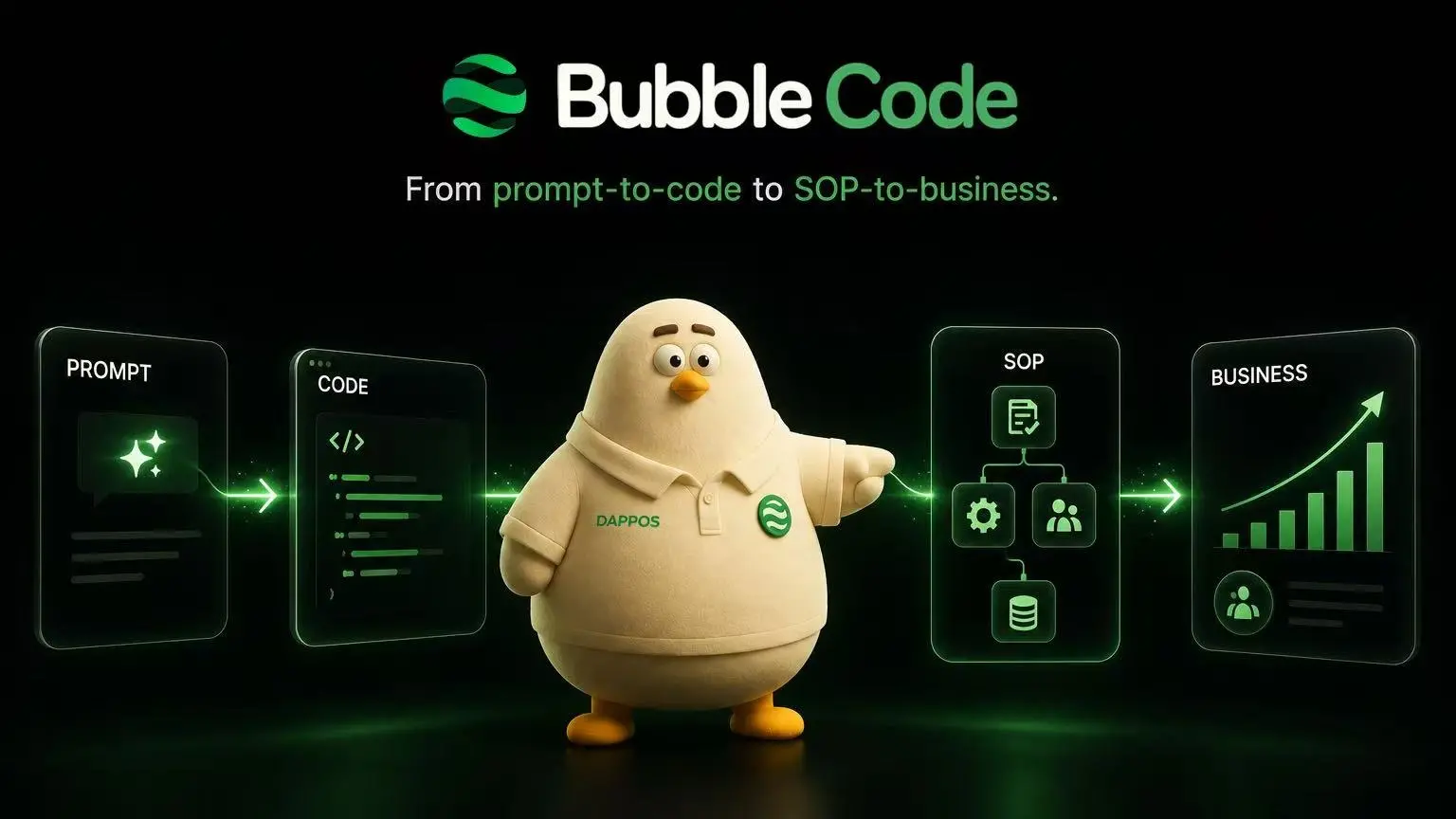
xBubble: Addressing the Structural Gap in the VC-Backed OPC Economy The concept of OPC (One Person Company) is evolving from a buzzword to a significant AI-driven market. While AI coding tools like Replit and Lovable have validated demand from non-technical users wanting to build applications, a key gap remains: the leap from creating a demo to running a stable, evolving business. These tools still require users to manage the development process, including technical judgments for integrations, modifications, and deployments—a major hurdle for OPCs. xBubble, by DAPPOS, tackles this by shifting from "Prompt-to-Code" to "SOP-to-Business." Instead of generating code from instructions, its core is a system of pre-organized SOPs (Standard Operating Procedures) that translate business goals—like "sell World Cup merchandise"—into complete, executable workflows. This includes generating cohesive assets, pages, payment systems, and backend logic. The platform is augmented by a network of third-party service providers who handle infrastructure (hosting, domains, payment setup), acting like "on-site service engineers." Users can pay for these services directly with xBubble credits, simplifying onboarding. This ecosystem aims to deliver not just an app, but a complete, modifiable business launch path. xBubble targets a clear OPC segment: small commercial nodes (e.g., creators, merchants) with existing products, customers, or channels, but for whom a full tech team is unjustifiable. Its potential lies in SOPs accumulating expertise from real cases, improving reliability and reducing delivery costs over time. Additionally, its native support for crypto payments caters to global or digital-native OPCs. In summary, as AI democratizes software creation, xBubble's opportunity is to prove that "SOP-to-Business" provides more immediate value for launching a real, operational business than a powerful but unstructured AI coding tool.

链捕手38 min fa

How xBubble Breaks Through in the VC-Heavily-Backed OPC Economy

链捕手38 min fa

If It's Not a Clear Yes, It's a No: A Nine-Year Retrospective by a VC Who Survived Four Cycles

**"Invest Only When Certain": A Nine-Year Retrospective from a VC Across Four Cycles** IOSG founder Jocy shares hard-earned lessons from nine years and over a hundred investments in Web3. The core challenge isn't identifying successful founders, but understanding why talented founders with solid ideas still fail. Through building a "failed founder database," IOSG identified six recurring failure patterns. **Founder Trait Red Flags:** 1. **Emotionally Unstable:** Founders who react defensively to criticism or publicly lash out under pressure (e.g., 80% drawdowns) often fail. Resilience is key. 2. **Lacking Hunger / Having a Fallback:** Founders with significant safety nets (family wealth, cushy fallback jobs) may lack the "do-or-die" commitment needed to survive crypto's brutal cycles. 3. **Unchecked Ego:** Includes "polished execution machines" who excel in known frameworks but struggle when paradigms shift, and "professor-types" who are technically brilliant but resistant to commercial feedback or coaching. **Project Structure Red Flags:** 4. **Token-First, Not Product-First:** Treating the token solely as a fundraising tool with no real utility or connection to product value is a major warning sign. The project should have value even if the token goes to zero. 5. **No Day-1 Exit Thesis:** Founders must have a clear, staged capital strategy from the start, understanding what each funding round needs to prove to unlock the next. "Exit before entry" is crucial. 6. **No Full-Cycle Experience:** Founders who haven't lived through a complete crypto bull/bear cycle (e.g., 2018, 2022) often underestimate their vulnerability. IOSG limits initial checks for such teams to $250k, sizing for risk. **The Positive Flipside: Desirable Founder Traits** The ideal candidate exhibits: obsessive problem-depth, being a second-time founder with a non-consensus vision, strong communication skills with *controlled* ego, relentless perseverance, and a global perspective with agency and taste (increasingly vital in the AI era). **Three Survival Tips for Founders:** 1. **Cash Flow Over Narrative:** Real revenue is what sustains projects, not vanity metrics. 2. **Tokens Are a Liability:** Avoid issuing a token unless absolutely necessary. The hidden costs (market making, liquidity, compliance) are immense, often a multi-million-dollar burden. 3. **Respect Liquidity:** Sell during peaks to build treasury, buy back to support the protocol during troughs. Be realistic about valuations and your ability to deliver for the next round. The final principle is simple yet paramount: **"If it's a borderline 'yes' or 'no,' don't invest."** In an industry that reinvents itself every few years, the discipline to consistently say "no" is the ultimate secret to longevity.

Foresight News1 h fa

If It's Not a Clear Yes, It's a No: A Nine-Year Retrospective by a VC Who Survived Four Cycles

Foresight News1 h fa

Trading

Spot
Futures
活动图片