On-Chain Metrics Practical Guide: Identifying Real Signals, Avoiding Data Traps

比推Pubblicato 2025-12-25Pubblicato ultima volta 2025-12-25

Introduzione

A practical guide to on-chain metrics for traders, focusing on identifying genuine signals and avoiding data traps. Key concepts include distinguishing between transaction fees (user-paid costs), protocol revenue (actual earnings), and MEV (maximal extractable value), emphasizing that sustainable revenue matters more than high fees. Total Value Locked (TVL) is often misleading due to double-counting, incentive-driven "mercenary capital," and idle stablecoins. Traders should analyze TVL alongside transaction volume and incentives. Daily Active Addresses (DAA) can be inflated by bots and airdrop farmers; it’s only meaningful when correlated with fees and real activity. Cross-chain bridges enable asset transfers but carry risks like smart contract vulnerabilities and centralization. Monitor bridge volumes for liquidity flow insights. Stablecoin supply acts as crypto’s money supply (M2); increasing supply suggests market liquidity, while decreases may signal withdrawals. Token unlocks and emissions create sell pressure; avoid tokens nearing large unlocks unless trading short-term. The ratio of transaction volume to TVL indicates capital efficiency—high ratios reflect active usage, while low ratios suggest "ghost liquidity." In summary, on-chain metrics are analytical tools, not absolute truths. Cross-verify signals and interpret data contextually for informed decisions.

Written by: Dami-Defi

Compiled by: AididaoJP, Foresight News

Original title: A Practical Guide to On-Chain Metrics for Traders


On-chain metrics are something everyone talks about, but few truly understand. This guide will explain their true meaning in a simple and clear way, and how traders should use them.

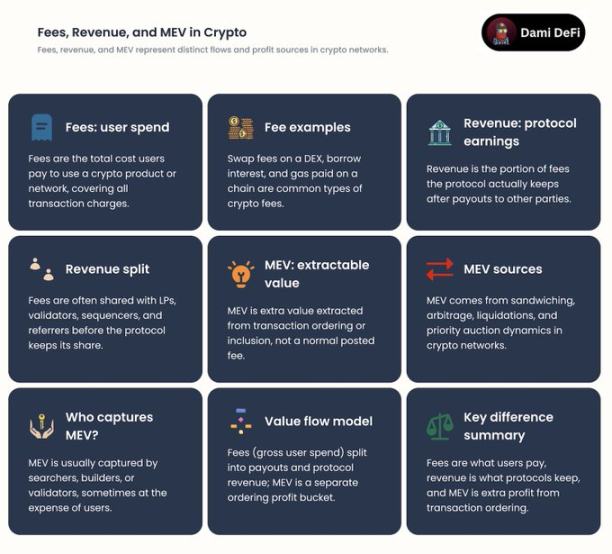
Fees vs. Revenue vs. MEV: The Real Earnings of a Chain

First, clarify a few concepts:

  • Fees: The cost users pay to conduct transactions.

  • Revenue: The portion ultimately kept by the protocol or validators.

MEV (Maximal Extractable Value): Additional profit validators gain by optimizing transaction ordering.

Key Point: High fees do not equal success. The real key is sustainable revenue. If users are driven away by $50 fees, this model is difficult to sustain.

Trader's Perspective:

Focus on public chains where real revenue is growing and the token model is reasonable. Models overly reliant on MEV are fragile; once trading volume declines or competition intensifies, prosperity can quickly fade.
TVL: The Three "Lies" of Total Value Locked

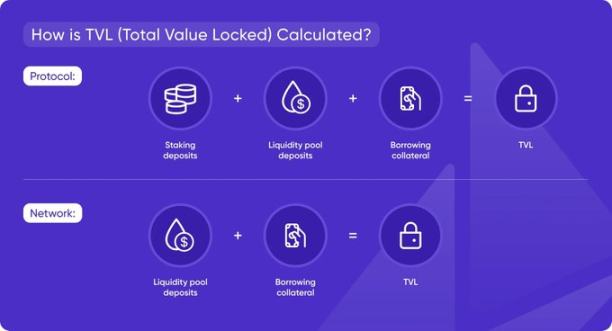
Total Value Locked represents the total capital locked in a protocol or chain. It shows market trust but can also be very misleading.

The Three "Lies" of TVL:

  • Double Counting: The same capital is collateralized across different protocols, inflating the total.

  • Incentive-Driven TVL: "Mercenary capital" arrives for short-term incentives and leaves quickly once rewards end.

  • Idle Stablecoins: Large amounts of funds sit in wallets, counted in TVL but never used.

Trader's Perspective:

Never look at TVL alone; it must be analyzed alongside trading volume and incentive programs. Real usage is far more important than vanity metrics.
DAA / Daily Active Addresses: Real Users or Market Noise?

Daily Active Addresses count the number of addresses that have performed operations on the chain. It is often used as a proxy for real users but is also easily manipulated.

Common Issues:

  • Bulk operations by bots.

  • Airdrop farmers creating massive numbers of addresses.

  • Protocol internal transfers inflating data.

Key Point: DAA is meaningful only when it grows in sync with fees, trading volume, and real activity. If the number of addresses surges while revenue stagnates, it's likely a manufactured metric.

Trader's Perspective:

Treat DAA as a secondary confirmation signal, not a primary buy indicator. It only serves to validate growth when supported by other fundamentals.
Cross-Chain Bridges: How Funds Move Across Chains and Where the Risks Lie

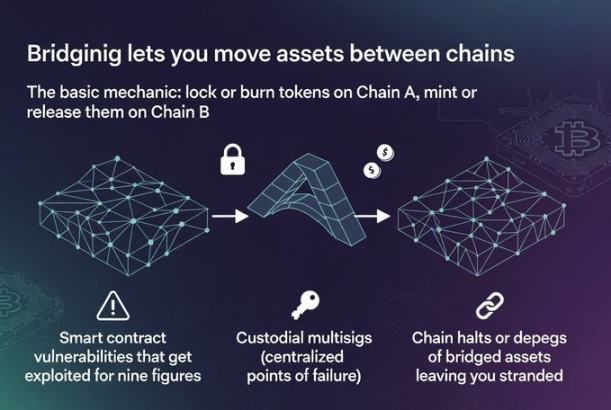
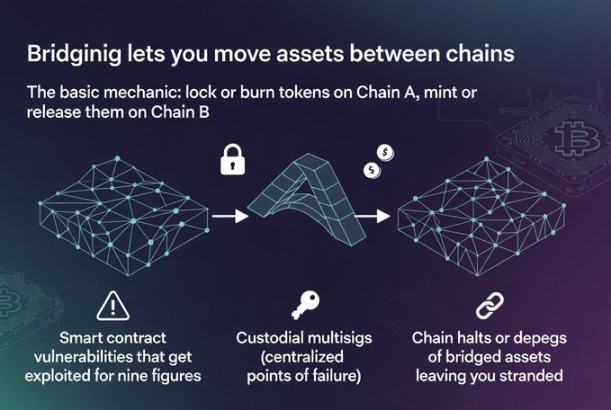
Cross-chain bridges enable the transfer of assets between different blockchains. The basic principle is: lock or burn tokens on Chain A, mint or release an equivalent amount on Chain B. The concept is simple, but the risks are complex.

Main Risks:

  • Smart Contract Vulnerabilities: Can lead to huge financial losses.

  • Custodial Multi-Sigs: Represent centralized points of failure.

  • Chain Outages or Asset De-pegging: Can result in assets being trapped.

Trader's Perspective:

Avoid storing large amounts of funds long-term on higher-risk cross-chain bridges. However, monitor the trading volume of bridges as a leading indicator of capital flow. For example, funds moving from Ethereum to an L2, or migrating between different ecosystems, signal changes that may present trading opportunities.
Stablecoins: The Money Supply of the Crypto World

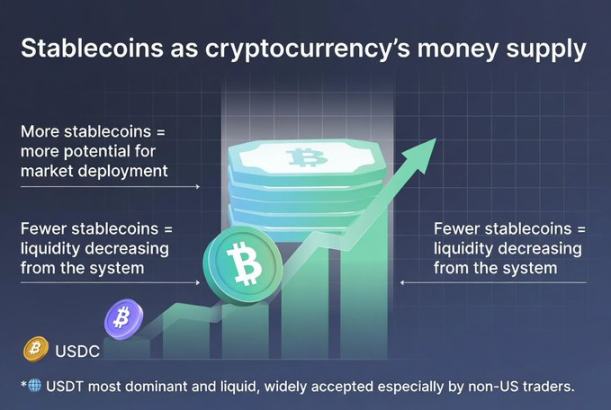
Stablecoin supply is equivalent to the broad money supply (M2) of the crypto world.

  • Supply Increase: Means more "ammunition" waiting to enter the market.

  • Supply Decrease: Indicates liquidity is withdrawing.

Market Status:

USDT dominates due to its high liquidity and wide acceptance (especially favored by non-US traders). USDC is more transparent and compliant but has a slightly narrower usage.

Trader's Perspective:

A rising total stablecoin supply generally supports larger market trends; a shrinking supply means tightening liquidity, which can curb rallies. This is a crucial reference indicator for macro positioning.
Token Unlocks & Emissions: Future Selling Pressure

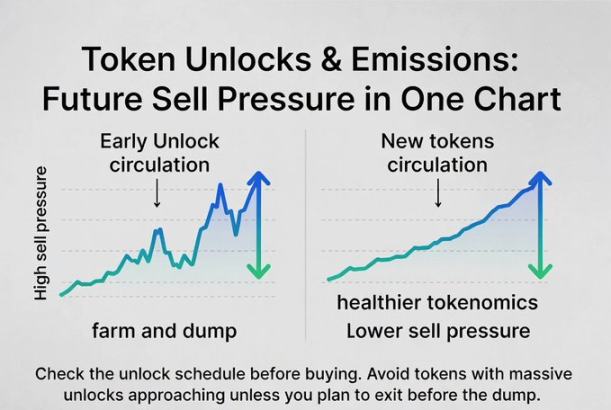
Unlocks and emissions mean new tokens entering the circulating market. Large-scale unlocks are often accompanied by automatic selling: teams cashing out, VCs reducing holdings, reward releases causing a supply surge.

Simple Judgment:

  • Early, High Unlocks: Often indicate a "farm-and-dump" model.

  • Long-term, Gradual Unlocks + Real Demand: Typically represent healthier tokenomics.

Trader's Perspective:

Always check the unlock schedule before buying. Avoid tokens nearing large unlocks, unless you are trading short-term and plan to exit before the selling pressure hits.
On-Chain Volume vs. TVL: Is the Capital Active or Dormant?

  • TVL: How much capital is deposited.

  • Volume: How frequently the capital moves.

A pool with a TVL of $100 million but a daily volume of only $5,000 is essentially "dead capital".

Key Ratio: Volume / TVL Ratio.

  • High Ratio: Capital is active, usage is high.

  • Low Ratio: Could be "ghost liquidity" or idle funds.

Trader's Perspective:

Look for protocols with solid TVL and strong trading volume. You need real usage, not fake prosperity.

Summary

On-chain metrics are not magic, but they are the closest thing to "financial statements" in the crypto world. Use them as analytical tools, not absolute truths. Always cross-verify multiple signals and constantly think about the real meaning behind the data.


Twitter:https://twitter.com/BitpushNewsCN

Bitpush TG Discussion Group:https://t.me/BitPushCommunity

Bitpush TG Subscription: https://t.me/bitpush

Original link:https://www.bitpush.news/articles/7598316

Domande pertinenti

QWhat is the key difference between 'fees' and 'revenue' in the context, and why is it important for traders?

AFees are what users pay to conduct transactions, while revenue is the portion that the protocol or validators ultimately keep. The key point is that high fees do not equal success; the true focus should be on sustainable revenue. This is crucial for traders because a model that drives users away with high fees (e.g., $50) is not sustainable in the long run.

QWhat are the three main 'lies' or misleading aspects of Total Value Locked (TVL) as discussed in the guide?

AThe three main misleading aspects of TVL are: 1. Double-counting, where the same capital is collateralized across different protocols, inflating the total. 2. Incentive-driven TVL, where 'mercenary capital' arrives for short-term rewards and leaves quickly afterward. 3. Idle stablecoins, where large amounts of capital are held in wallets, counted in TVL, but never actually used.

QWhy should traders be cautious about relying solely on Daily Active Addresses (DAA) as a metric?

ATraders should be cautious because DAA can be easily manipulated by bots performing bulk operations, airdrop farmers creating massive numbers of addresses, and internal protocol transfers inflating the data. DAA is only meaningful when it grows in sync with other fundamentals like fees, transaction volume, and real activity. It should be used as a secondary confirmation signal, not a primary buy indicator.

QAccording to the guide, what does the stablecoin supply represent in the crypto ecosystem, and how should traders interpret changes in it?

AThe stablecoin supply represents the broad money supply (M2) of the crypto world. An increase in supply means there is more 'ammunition' waiting to enter the market, typically supporting larger market trends. A decrease indicates that liquidity is being withdrawn, which can suppress price increases. This is an important macro indicator for traders to consider for overall market positioning.

QWhat is the significance of the 'Volume/TVL Ratio' for a protocol, and what does it indicate to a trader?

AThe Volume/TVL Ratio measures how actively the locked capital is being used. A high ratio indicates that the capital is active and being used efficiently. A low ratio suggests the presence of 'ghost liquidity' or idle funds, like a pool with high TVL but very low daily volume. Traders should look for protocols with solid TVL and strong transaction volume, as this indicates real usage rather than false prosperity.

Letture associate

Why Not Short Even When Bearish? Munger Did the Math on a 'Losing Trade'

Why Not Short Even When Bearish? Charlie Munger's Calculated "Loss-Making Account" Many traders, drawn to speculative tools like futures contracts, often face repeated failures. As the article notes, unless one is a genius, such instruments should be avoided for long-term profit-seeking. Similarly, the practice of short selling is viewed with caution. The author firmly states a policy of not shorting, even when bearish, preferring to simply wait. The core reason? Successful short selling requires exceptionally difficult conditions to profit. Legendary investors Warren Buffett and Charlie Munger have themselves reflected on painful short-selling experiences. Munger highlights two critical flaws in the mathematical logic of shorting: 1. Asymmetrical Risk/Reward: A long position has a maximum loss of 100% but unlimited upside. A short position caps profit at 100% (if a stock falls to zero) but carries theoretically unlimited loss potential. 2. The "Promoter" Problem: Fraudulent or struggling companies can prolong their decline. As Munger said, "You can run out of money before the promoter runs out of ideas," meaning short sellers may be forced to cover positions at a loss before the company's true fate unfolds. The article cites Stanley Druckenmiller, a famed hedge fund manager. He once shorted 12 companies that all eventually went bankrupt. However, intense market rallies forced him to cover his positions within three weeks, resulting in massive losses—$200 million of his capital plus an additional $600 million. He concluded he likely never made money shorting in his career. His experience perfectly illustrates Munger's points: facing unlimited losses and being wiped out before being proven right. The conclusion is clear: for most investors, complex instruments like short selling and derivatives are not viable paths to stable, long-term gains. Self-reflection is advised before repeatedly wasting time and capital on such speculative strategies.

marsbit19 min fa

Why Not Short Even When Bearish? Munger Did the Math on a 'Losing Trade'

marsbit19 min fa

For Hedging, Buy Gold and Oil; For Explosive Growth, Buy AI; Bitcoin, the 'Outdated' Asset, Enters a Bear Market

Bitcoin’s price has recently fallen sharply, hitting a two-month low near $66,000, with Ethereum also dropping to a three-month low. While surface explanations point to ETF outflows, geopolitical tensions, and corporate selling, a deeper issue is emerging: Bitcoin is losing a crucial asset competition. For years, Bitcoin thrived in a low-rate environment where investors sought alternatives amid inflation fears and dissatisfaction with traditional options. Now, the market landscape has shifted, leaving Bitcoin stuck in an "awkward middle ground," facing challenges on three fronts: 1. **As an inflation hedge, gold is winning.** Investors worried about persistent inflation are turning to tangible assets like gold, energy stocks, and commodity producers, which offer more direct pricing power and physical backing. 2. **For growth exposure, AI is winning.** Those seeking high growth now favor AI-related companies with actual revenues and profits, an area where Bitcoin's lack of cash flow puts it at a disadvantage. 3. **Within crypto, infrastructure and stablecoins are winning.** Even investors wanting crypto exposure have alternatives like exchanges, stablecoin issuers, and tokenization firms, whose performance is directly tied to real-world adoption and offers clearer operational leverage. The recent market reaction to inflation warnings highlights this shift. Instead of boosting Bitcoin as "digital gold," such news now drives flows toward traditional inflation-sensitive assets. Therefore, recent events like ETF outflows and corporate selling are seen not as causes, but as symptoms of this new reality. Capital has more compelling options, and investors are becoming more selective. The emerging bear case for Bitcoin is no longer about it being a fraud or failed technology, but rather that **scarcity alone is no longer enough**. It is no longer seen as the best hedge, the best growth asset, or the only crypto play.

marsbit35 min fa

For Hedging, Buy Gold and Oil; For Explosive Growth, Buy AI; Bitcoin, the 'Outdated' Asset, Enters a Bear Market

marsbit35 min fa

SaaS Battle Royale: The Survivors Who Win All Share One Common Trait

**Summary** The AI revolution has triggered a "SaaS apocalypse," forcing a brutal market shakeout. The key dividing line is the pricing model. Companies like Snowflake and Datadog, which charge based on consumption (e.g., data processed or compute used), are thriving. AI workloads actively *generate* more demand for their services, fueling growth. Datadog's accelerating revenue is a prime example. Microsoft and Palantir, as platform/ecosystem players, also benefit by acting as essential channels for AI deployment. In contrast, traditional SaaS firms built on per-seat or per-task licensing (e.g., Intuit, Adobe) face direct pressure, as AI threatens to automate the very human tasks their software supports. Companies like Salesforce, a per-seat giant, are caught in the middle. While showing strong AI monetization (e.g., its Agentforce platform) and experimenting with consumption-based "Flex Credits," its stock remains under pressure, illustrating that the market rewards *completed* transitions, not just the intent. The recent Microsoft Build conference underscored key trends: AI is evolving from an assistant to an autonomous "agent," and platform providers like Microsoft are consolidating their control. The market's recovery is highly selective, focused on identifying which companies are "fed by AI" versus "eaten by AI." Future focus will be on the diffusion of this recovery to transforming companies and the real-world adoption data of AI agents like Microsoft Copilot.

marsbit52 min fa

SaaS Battle Royale: The Survivors Who Win All Share One Common Trait

marsbit52 min fa

Trading

Spot
Futures

Articoli Popolari

Come comprare BILL

Benvenuto in HTX.com! Abbiamo reso l'acquisto di Billions Network (BILL) semplice e conveniente. Segui la nostra guida passo passo per intraprendere il tuo viaggio nel mondo delle criptovalute.Step 1: Crea il tuo Account HTXUsa la tua email o numero di telefono per registrarti il tuo account gratuito su HTX. Vivi un'esperienza facile e sblocca tutte le funzionalità,Crea il mio accountStep 2: Vai in Acquista crypto e seleziona il tuo metodo di pagamentoCarta di credito/debito: utilizza la tua Visa o Mastercard per acquistare immediatamente Billions NetworkBILL.Bilancio: Usa i fondi dal bilancio del tuo account HTX per fare trading senza problemi.Terze parti: abbiamo aggiunto metodi di pagamento molto utilizzati come Google Pay e Apple Pay per maggiore comodità.P2P: Fai trading direttamente con altri utenti HTX.Over-the-Counter (OTC): Offriamo servizi su misura e tassi di cambio competitivi per i trader.Step 3: Conserva Billions Network (BILL)Dopo aver acquistato Billions Network (BILL), conserva nel tuo account HTX. In alternativa, puoi inviare tramite trasferimento blockchain o scambiare per altre criptovalute.Step 4: Scambia Billions Network (BILL)Scambia facilmente Billions Network (BILL) nel mercato spot di HTX. Accedi al tuo account, seleziona la tua coppia di trading, esegui le tue operazioni e monitora in tempo reale. Offriamo un'esperienza user-friendly sia per chi ha appena iniziato che per i trader più esperti.

91 Totale visualizzazioniPubblicato il 2026.05.07Aggiornato il 2026.06.02

Come comprare BILL

Cosa è ATWO

I. Introduzione al ProgettoArena Two è una piattaforma interattiva decentralizzata che consente ai fan di svolgere un ruolo attivo e tokenizzato nei risultati degli eventi in tempo reale. A differenza dei modelli di trasmissione tradizionali che riducono i fan a spettatori passivi, Arena Two sfrutta la tecnologia blockchain per consentire ai fan di votare direttamente in tempo reale e influenzare i risultati sul campo.II. Informazioni sul TokenNome del token: ATWO(Arena Two)III. Link CorrelatiSito web:https://arenatwo.com/Esploratori:https://basescan.org/token/0x499D35eBE6cEe9B2Ac35Fd003fcBbeeB9CFc7B32Twitter:https://x.com/arenatwoXNota: L'introduzione al progetto proviene dai materiali pubblicati o forniti dal team ufficiale del progetto, che è solo a scopo di riferimento e non costituisce consulenza sugli investimenti. HTX non si assume responsabilità per eventuali perdite dirette o indirette derivanti.

59 Totale visualizzazioniPubblicato il 2026.05.18Aggiornato il 2026.06.02

Cosa è ATWO

Come comprare ATWO

Benvenuto in HTX.com! Abbiamo reso l'acquisto di Arena Two (ATWO) semplice e conveniente. Segui la nostra guida passo passo per intraprendere il tuo viaggio nel mondo delle criptovalute.Step 1: Crea il tuo Account HTXUsa la tua email o numero di telefono per registrarti il tuo account gratuito su HTX. Vivi un'esperienza facile e sblocca tutte le funzionalità,Crea il mio accountStep 2: Vai in Acquista crypto e seleziona il tuo metodo di pagamentoCarta di credito/debito: utilizza la tua Visa o Mastercard per acquistare immediatamente Arena TwoATWO.Bilancio: Usa i fondi dal bilancio del tuo account HTX per fare trading senza problemi.Terze parti: abbiamo aggiunto metodi di pagamento molto utilizzati come Google Pay e Apple Pay per maggiore comodità.P2P: Fai trading direttamente con altri utenti HTX.Over-the-Counter (OTC): Offriamo servizi su misura e tassi di cambio competitivi per i trader.Step 3: Conserva Arena Two (ATWO)Dopo aver acquistato Arena Two (ATWO), conserva nel tuo account HTX. In alternativa, puoi inviare tramite trasferimento blockchain o scambiare per altre criptovalute.Step 4: Scambia Arena Two (ATWO)Scambia facilmente Arena Two (ATWO) nel mercato spot di HTX. Accedi al tuo account, seleziona la tua coppia di trading, esegui le tue operazioni e monitora in tempo reale. Offriamo un'esperienza user-friendly sia per chi ha appena iniziato che per i trader più esperti.

48 Totale visualizzazioniPubblicato il 2026.05.18Aggiornato il 2026.06.02

Come comprare ATWO

Discussioni

Benvenuto nella Community HTX. Qui puoi rimanere informato sugli ultimi sviluppi della piattaforma e accedere ad approfondimenti esperti sul mercato. Le opinioni degli utenti sul prezzo di A A sono presentate come di seguito.

活动图片