On-Chain Data Analysis of Tudou Guarantee's Shutdown Event: A Chain-Based 'Black Industry Migration' Triggered by US Sanctions

marsbitPubblicato 2026-01-19Pubblicato ultima volta 2026-01-19

Introduzione

On January 16, Tudou Guarantee announced the cessation of its services and the closure of all public groups. Beosin Trace conducted an on-chain data analysis of the incident, revealing that Tudou was a major black/grey market escrow platform on Telegram. After the shutdown of Huione Guarantee in May 2025, Tudou became its main successor, experiencing a significant increase in transaction volume. However, from December 2025, Tudou's deposit activities declined sharply, with almost no activity after January 10, 2026. A refund address saw a spike in outflows on January 11, aligning with the platform’s shutdown preparations. Many former Tudou merchants migrated to Xinbi Guarantee, which saw a surge in USDT deposits, averaging 2,700–2,800 transactions per day between January 8–16. These addresses have been flagged as high-risk by Beosin KYT. The shutdown is linked to increased U.S. sanctions targeting Southeast Asian cybercrime throughout 2025, including actions against entities in the Philippines, Cambodia, and Myanmar, which disrupted illegal operations and forced platforms like Huione and Tudou to cease operations.

On January 16, Tudou Guarantee announced that it would cease operations and disband all public groups effective immediately. Regarding this Tudou Guarantee shutdown event, the Beosin team conducted a statistical analysis of transaction data from related addresses using the blockchain tracking and analysis tool Beosin Trace, and shares the results as follows:
Tudou Guarantee: One of the Largest Escrow Platforms

In various illegal/suspicious transaction scenarios, the two parties involved often require an "escrow" middleman role to facilitate and complete the transaction. The core function of an escrow platform is to act as an intermediary guarantor throughout the entire transaction process, providing a trust guarantee for both parties.

As an emerging type of matching platform, escrow platforms have seen rapid growth in both user base and capital volume in recent years. According to statistics from Beosin, in 2025, the number of users placing deposits on mainstream escrow platforms exceeded 330,000, the number of deposit transactions exceeded 1.26 million, and the total deposit transaction volume exceeded 8.7 billion USDT.

Tudou Guarantee was a platform providing black and gray market escrow services via Telegram. After Huione Guarantee was shut down by Telegram in May 2025, it became the primary successor to Huione Guarantee. Huione Guarantee transferred its business to Tudou Guarantee through means such as acquiring shares and redirecting customers. The deposit transaction volumes for the two platforms in 2025 are shown in the figure below:
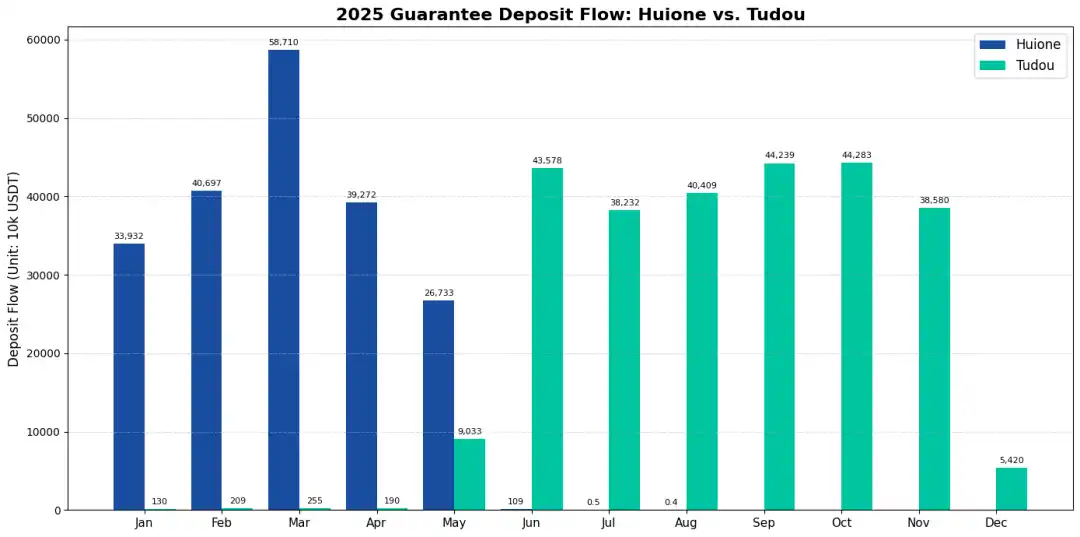
As can be seen from the figure, after Huione Guarantee was banned in May 2025, Tudou Guarantee's transaction volume began to rise significantly, before seeing a sharp decline in December. On January 16, 2026, Tudou Guarantee officially announced it was ceasing operations.

Significant Business Contraction Since December Last Year

By analyzing Tudou Guarantee's deposit addresses and refund addresses using Beosin Trace, we can observe that starting from December 2025, the number of transactions on its deposit addresses decreased sharply, with almost no activity after January 10, 2026.
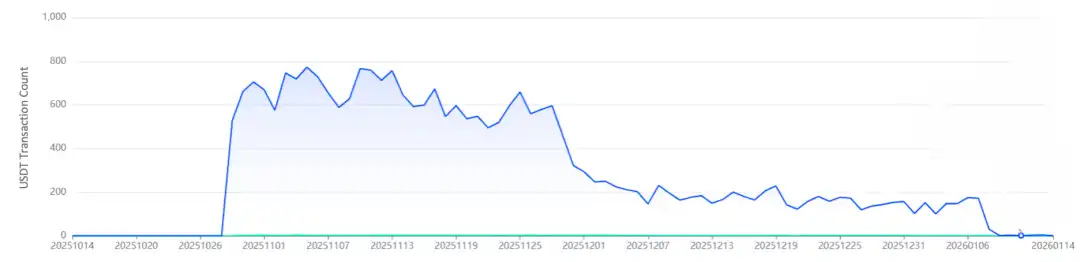
Beosin Trace Statistical Data

On January 11, 2026, Tudou Guarantee's refund addresses experienced a peak in the number of fund outflows, coinciding with the period when Tudou Guarantee was preparing to cease operations and refund users.
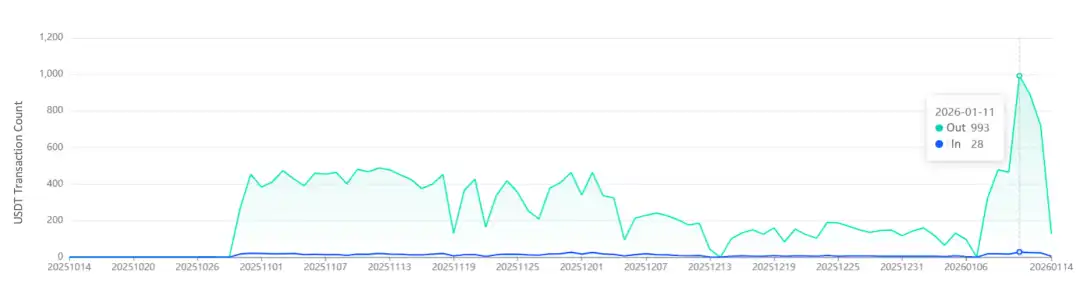
Beosin Trace Statistical Data

Currently, some merchants formerly with Tudou Guarantee, after receiving refunds, have directly moved to Xinbi Guarantee to place deposits and continue their operations. The on-chain activity data for its deposit addresses is shown below. From January 8 to 16, the number of daily USDT inflow transactions to Xinbi Guarantee's deposit addresses remained at 2700-2800/day, indicating a surge in business volume:
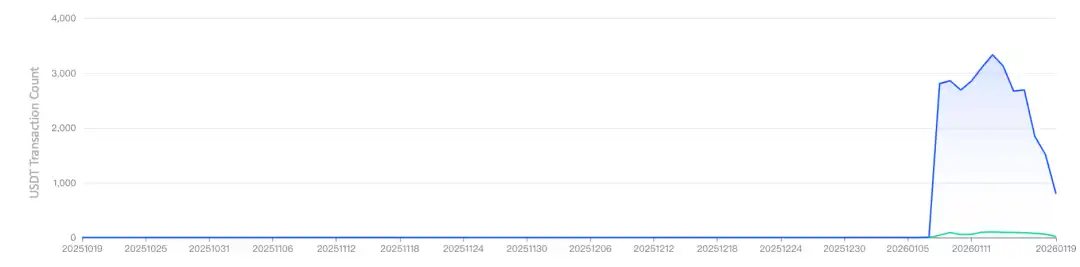
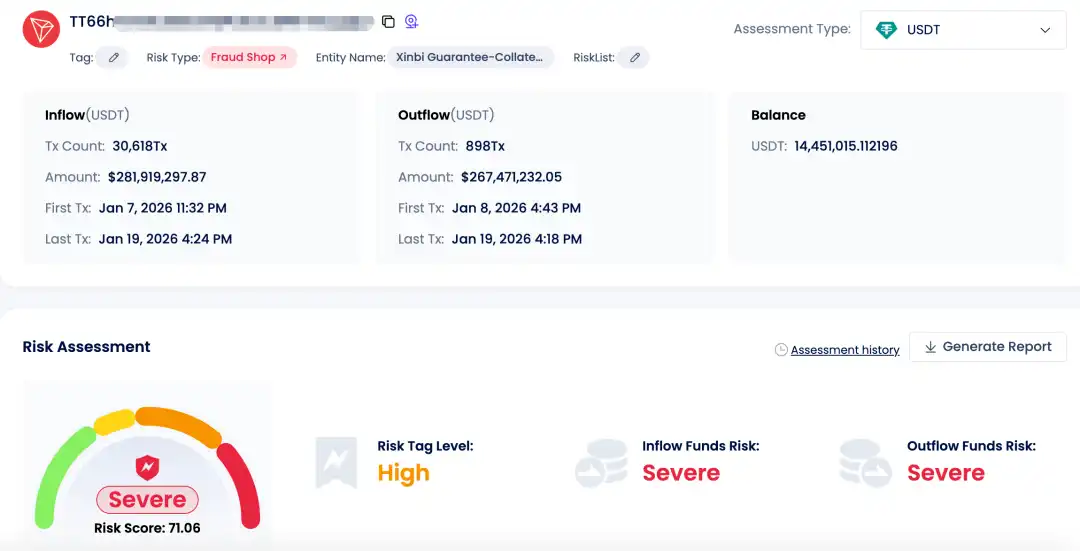
Beosin Trace Statistical Data. The addresses of the above escrow platforms have all been identified and flagged as high-risk addresses by Beosin KYT. Taking the currently active Xinbi Guarantee deposit address as an example:

Beosin KYT Risk Assessment Result

Conclusion

In 2025, the United States increased sanctions against cybercrime in Southeast Asia. In May, the US announced sanctions against the Philippines-based Funnull Technology Inc. and its principals involved in virtual asset pig-butchering scams; in October, sanctions were imposed on Cambodia's Prince Group and 146 related individuals, freezing and seizing 127,271 Bitcoin (valued at approximately $15 billion at the time), and formally cutting off the Huione Group's access to the US financial system; in November, sanctions were imposed on organizations in Myanmar involved in online fraud. This series of sanctions forced various criminal organizations in Southeast Asia to either cease operations or make adjustments and relocate. Among them, Huione Pay announced a suspension of operations, and now Tudou Guarantee has announced it is shutting down.


Domande pertinenti

QWhat was the main reason for Tudou Guarantee to announce its shutdown on January 16th?

ATudou Guarantee announced its shutdown and began clearing all public groups due to increased U.S. sanctions on Southeast Asian cybercrime, which pressured illegal or suspicious operations to cease or relocate.

QHow did Tudou Guarantee's transaction volume change after Huione Guarantee was banned in May 2025?

AAfter Huione Guarantee was banned in May 2025, Tudou Guarantee's transaction volume significantly increased as it became the main successor, absorbing Huione's business through share acquisitions and customer referrals.

QWhat significant trend was observed in Tudou Guarantee's deposit address activity starting December 2025?

AStarting December 2025, Tudou Guarantee's deposit address transactions decreased sharply, with almost no activity after January 10, 2026, indicating a major contraction in operations.

QWhich担保平台 did some merchants from Tudou Guarantee migrate to after its shutdown, and what was its activity like?

AAfter Tudou Guarantee's shutdown, some merchants migrated to Xinbi Guarantee, where deposit address activity surged to 2,700-2,800 USDT transactions per day from January 8 to 16, 2026.

QWhat actions did the U.S. take against Southeast Asian cybercrime in 2025 that impacted担保平台 like Tudou?

AIn 2025, the U.S. imposed measures including sanctions on entities like Funnull Technology Inc. in the Philippines, the Prince Group in Cambodia (freezing 127,271 BTC), and cutting off Huione Group from the U.S. financial system, forcing platforms like Tudou Guarantee to shut down or relocate.

Letture associate

From Banning Doubao to Embracing Honor: Why Did WeChat Suddenly 'Change Its Face'?

The article explores the sudden shift in WeChat's strategy towards AI assistants from mobile phone manufacturers, transitioning from strict opposition to active collaboration. For over a year, WeChat fiercely resisted attempts by phone AI assistants (like ByteDance's Doubao in late 2025) to control its features via GUI automation ("simulated clicking"), citing security and data control concerns. This stance created a significant barrier for system-level AI integration. Now, Tencent has initiated A2A (Agent-to-Agent) partnerships with major phone brands like Honor, Xiaomi, OPPO, and vivo. This model allows a phone's system AI (e.g., Honor's YOYO) to parse a user's voice command and send a structured request directly to WeChat's own internal AI agent via secure APIs. WeChat then executes the action (e.g., sending a message) and returns the result. The article attributes Tencent's "change of face" to strategic pressure. While leading in social app usage, Tencent trails rivals like ByteDance and Alibaba in standalone AI app popularity. WeChat, with its vast mini-program ecosystem, is Tencent's key asset for an AI comeback. The upcoming WeChat AI agent aims to handle tasks like booking and payments within the app. However, phone system assistants remain the primary AI entry point for most users. The A2A collaboration allows Tencent to extend WeChat's AI reach to this crucial system layer while maintaining control over its core functions and data. For phone manufacturers, embracing A2A is a pragmatic move. The GUI route proved unviable due to WeChat's blocks. A2A offers a compliant path to integrate a vital service, enhancing their AI assistants' usefulness. It allows them to focus on developing their own AI ecosystems for other services while cooperating on WeChat access. The collaboration is framed as a mutual, strategic necessity: Tencent gains a distribution channel, and manufacturers gain a key functionality. The partnership relies on a "dual authorization" mechanism for security, requiring both user and app consent for each action. While questions about long-term data privacy practices remain, experts note A2A is more secure and compliant than GUI automation. Ultimately, this cooperation is seen as a tentative, calculated truce. Tencent's long-term goal is to make WeChat an AI-powered "service OS." Phone manufacturers aim to make their system AI the central user interface. Their paths may converge or clash in the future, but for now, the A2A deal represents the opening chapter in the battle for the AI-era user入口, driven by necessity and strategic calculus on both sides.

marsbit52 min fa

From Banning Doubao to Embracing Honor: Why Did WeChat Suddenly 'Change Its Face'?

marsbit52 min fa

On-Chain Figures on the Eve of Kickoff: 1.6 Billion Traded Before the World Cup Even Begins

"On-Chain Numbers on the Eve of the World Cup: $1.6 Billion Traded Before Kick-off" Analysis of on-chain markets before the 2026 FIFA World Cup reveals significant crypto integration into football. The most striking figure is the approximately **$1.6 billion** in total trading volume on the single "World Cup Winner" contract on the Polymarket prediction market platform, accumulated before a single match was played. This represents explosive growth for a sector whose annual volume surged from ~$16B in 2024 to ~$64B in 2025. The ecosystem is maturing beyond speculation. Key developments include: 1) **Infrastructure upgrades** like Polymarket's migration to native, regulated USDC stablecoin for settlements; 2) **Reliable data oracles**, such as Chainlink, being used to resolve real-world match outcomes on-chain; and 3) **Official recognition**, with FIFA appointing its first-ever "Prediction Markets" partner. Over 100 contracts now cover everything from the outright winner to individual match results and even non-sporting risks like venue relocation. This evolution marks a fundamental shift. While crypto firms are absent from FIFA's top-tier sponsor list, the technology has deeply penetrated the tournament's financial and predictive infrastructure through regulated stablecoin settlements, decentralized oracles, and new official partnership categories. The regulatory landscape remains complex and varies by jurisdiction, but on-chain markets for the World Cup are already a multi-billion-dollar reality.

marsbit1 h fa

On-Chain Figures on the Eve of Kickoff: 1.6 Billion Traded Before the World Cup Even Begins

marsbit1 h fa

From SpaceX's IPO to the Future of Crypto: Which Crypto Sectors Will Host the Trillion-Dollar Narrative?

From the SpaceX IPO, which targets a $750 billion raise at a $1.77 trillion valuation, we can extrapolate capital flow trends relevant to crypto. The focus shifts from speculative narratives to foundational infrastructure and real-world asset (RWA) integration. Key crypto sectors poised to benefit include: 1. **AI Infrastructure**: The narrative is moving from consumer-facing AI applications to underlying, scarce resources like compute power and decentralized GPU networks (e.g., TAO, RENDER, AKT, IO). These protocols are positioning as the essential "picks and shovels" providers for the AI economy. 2. **Real-World Assets (RWA)**: Beyond tokenized treasury bonds, RWA's future lies in on-chain equity and pre-IPO assets like SpaceX. This could democratize access to high-growth assets and reshape global capital flows, benefiting infrastructure projects like ONDO, LINK, and Plume that facilitate issuance, data, and liquidity. 3. **Core Financial Infrastructure**: Stablecoins, payment networks, and DePIN (Decentralized Physical Infrastructure Networks) are critical for settling the future on-chain economy. Their role expands from internal trading tools to foundational layers for global finance, AI systems, and real-world asset networks, leading to potential value reassessment. In summary, the next cycle may prioritize long-term infrastructure value—AI compute, asset tokenization networks, and settlement layers—over short-lived application hype, mirroring the broader market's shift towards funding the foundational systems of the future.

marsbit2 h fa

From SpaceX's IPO to the Future of Crypto: Which Crypto Sectors Will Host the Trillion-Dollar Narrative?

marsbit2 h fa

Trading

Spot
Futures
活动图片