Oil Again Becomes the Main Subject on the Chain|TradeXYZ Weekend Watch

marsbitPubblicato 2026-06-22Pubblicato ultima volta 2026-06-22

Introduzione

Tensions surrounding the Iran-US ceasefire memorandum and the Strait of Hormuz drove volatile market movements over the weekend of June 19-22. Despite an initial announcement of a deal, friction escalated when Israel continued airstrikes in Lebanon, prompting Iran to threaten closing the strait. This pushed crude oil prices to a peak near $79. Subsequent aggressive rhetoric from Trump, including threats to potentially take control of the strait, added to volatility. However, by June 22, negotiations in Switzerland showed progress, with Iran indicating it would not block the strait for 60 days, causing oil prices to retreat nearly 6% from their highs. US stock indices traded flat to slightly lower, with minor declines in major tech and growth stocks. In commodities, gold and silver gained, supported by falling yields and a weaker dollar amid receding inflation fears rather than traditional safe-haven demand. Natural gas prices rose (+2.51%) following an explosion at a key Qatari LNG facility, though this was partially offset by signals that Qatari LNG shipments were preparing to resume. Overall, geopolitical developments in the Middle East remained the primary driver for oil and related asset prices.

Last weekend, Trump announced 'an agreement with Iran is complete' and the Strait of Hormuz would open. But peace is never delivered by a single post from Trump. This weekend, the implementation of the ceasefire Memorandum of Understanding (MOU) encountered its first significant friction—and oil prices, precious metals, and stock indices all moved back and forth in a complete cycle, pulled by this main narrative.

On June 19-20, Israel conducted sustained airstrikes against Lebanon. Iran once postponed talks with the US as a result, with the Revolutionary Guards declaring a 'high state of alert' and threatening to withdraw from negotiations if Israeli strikes continued.

On June 20, Trump, while stating that 'about 700 ships are transiting the Strait, and Iran must reach an agreement within 60 days,' described the ceasefire MOU in an interview as 'basically Iran's unconditional surrender,' and threatened 'further action' if no deal is reached within 60 days. Tehran was thoroughly angered. Later that day, Iran's Supreme Military Joint Headquarters once declared the Strait of Hormuz closed due to US-Israeli 'violations of the ceasefire MOU.' Although US Central Command refuted this, claiming 'Iran does not control the Strait,' 55 commercial vessels still passed through that day.

On June 21, technical-level quadrilateral (US, Iran, Qatar, Pakistan) consultations commenced in Bürgenstock, Switzerland, led personally by Vice President Vance, with Iranian Foreign Minister Araghchi sitting at the same table. During the initial 80-minute closed-door session, the Iranian delegation briefly left in protest over Trump's remarks but soon returned.

By June 22 (this morning), the atmosphere had noticeably warmed. Qatar and Pakistan issued a joint statement announcing three phased outcomes: the establishment of a high-level political oversight committee, the locking-in of a 60-day roadmap for a final agreement, and the activation of a mechanism for resolving the Lebanon conflict. The mediators described the negotiation atmosphere as 'extremely positive and constructive.' Pakistan also revealed that Iran would not obstruct ship passage through the Strait in the next 60 days, and passage would be free of charge. An Iranian Foreign Ministry spokesperson stated that 'the Swiss talks have made good progress.'

Crude Oil

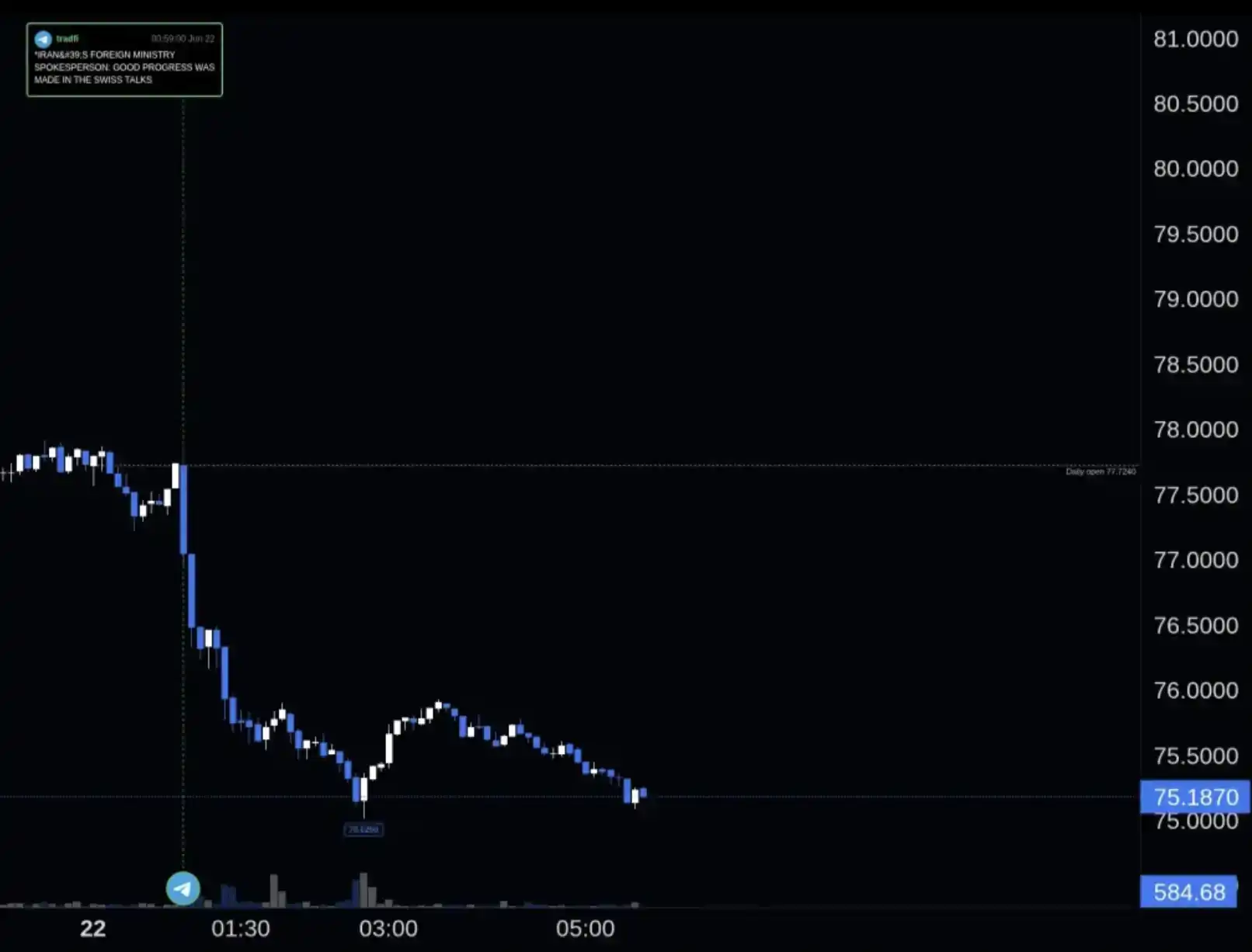
Crude oil continued to oscillate with the news over the weekend but maintained an overall downtrend.

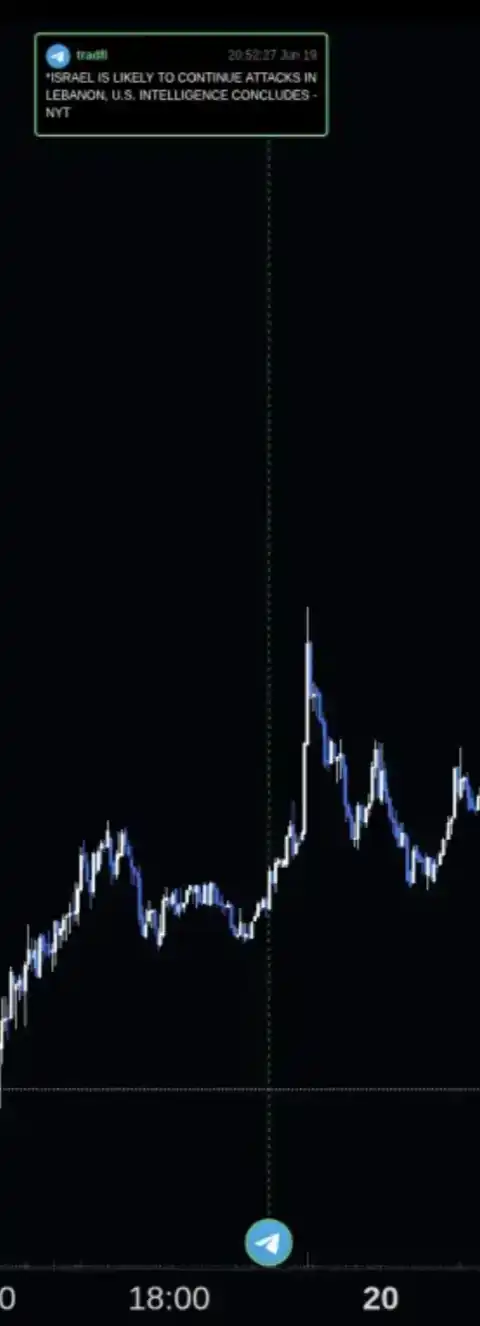
On June 19, citing US intelligence, The New York Times reported that 'Israel is likely to continue striking Lebanon,' pushing oil prices from $76.5 to around $78.
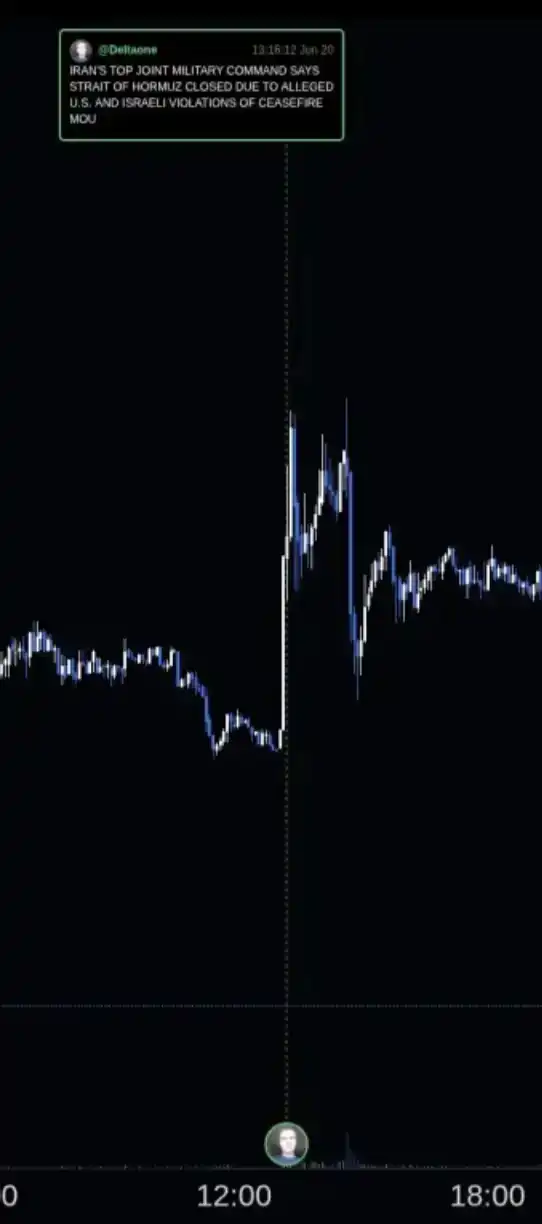
On the evening of June 20, when Iran's Supreme Military Headquarters declared the 'closure of the Strait,' oil prices surged instantly to a high of $79.
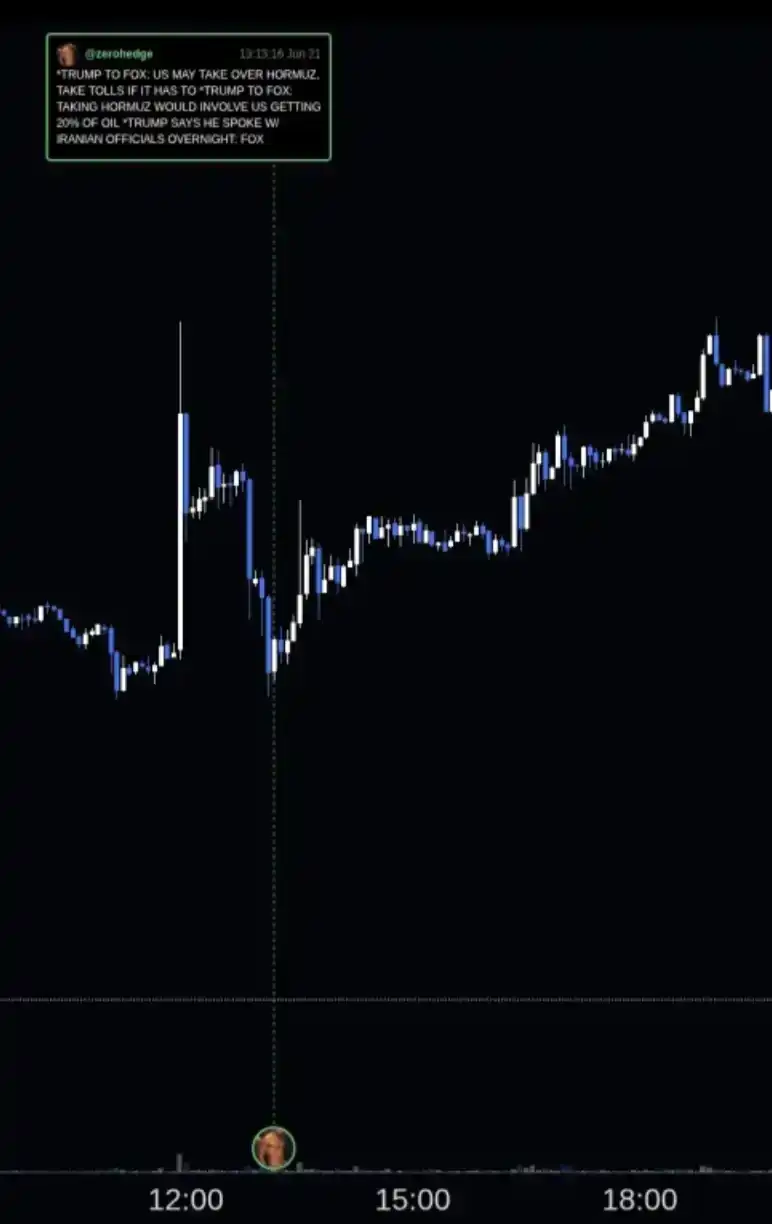
Subsequently, Trump made more aggressive remarks to Fox: 'The US may take over the Strait of Hormuz and charge tolls if necessary,' 'taking over the Strait means the US gets 20% of the oil,' and claimed to have had overnight calls with Iranian officials. Crude oil then rose slowly.
In the early hours of June 22, the Iranian Foreign Ministry's characterization that 'the Swiss talks have made good progress' led crude oil futures to retreat nearly 6% from the weekend's highs.
US Stocks

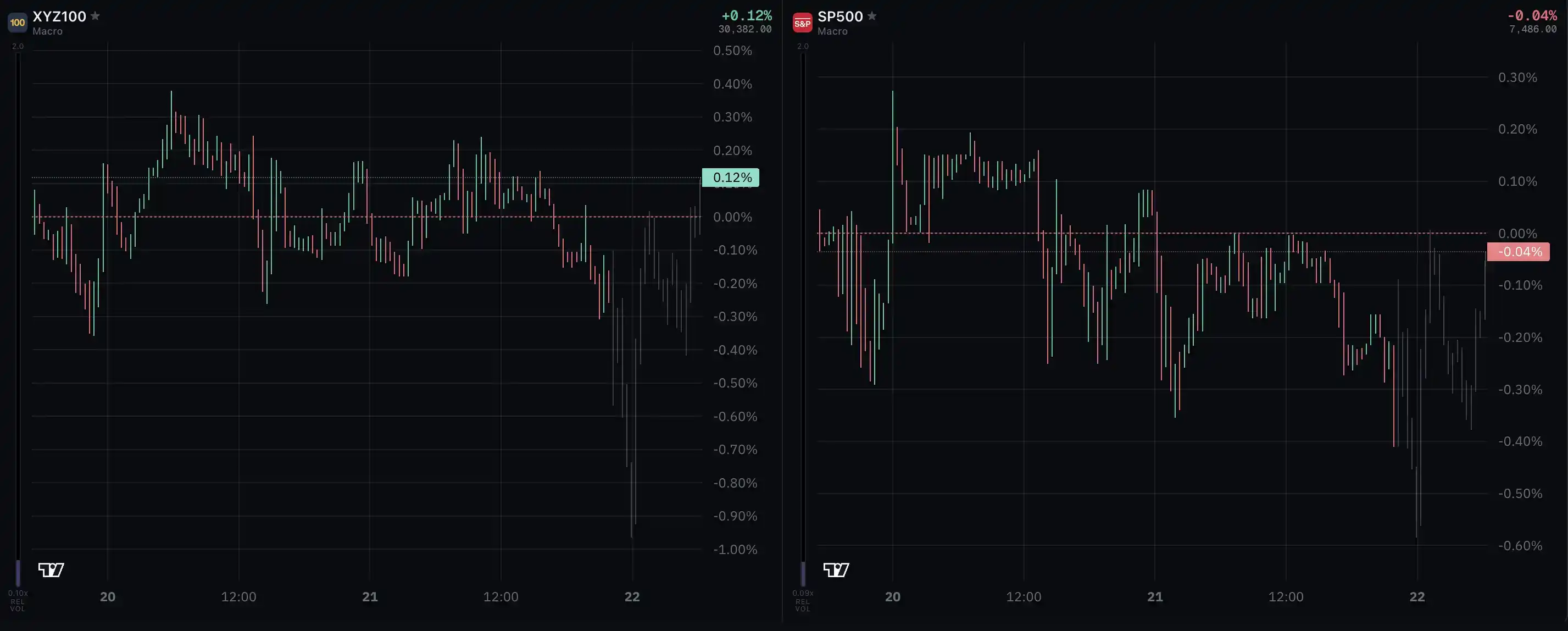
Compared to crude oil's sharp volatility, US stocks performed much more flatly this week.

On the index front, XYZ100 and SP500 basically oscillated around the zero line throughout the weekend, weakening intraday at one point (SP500 briefly probed near −0.6%) before recovering alongside the opening gains in index futures.
At the individual stock level, most followed the broader market slightly lower: tech sector SKHX −0.79%, MU −0.63%, NVDA −0.8%, SMSN −3.0%;
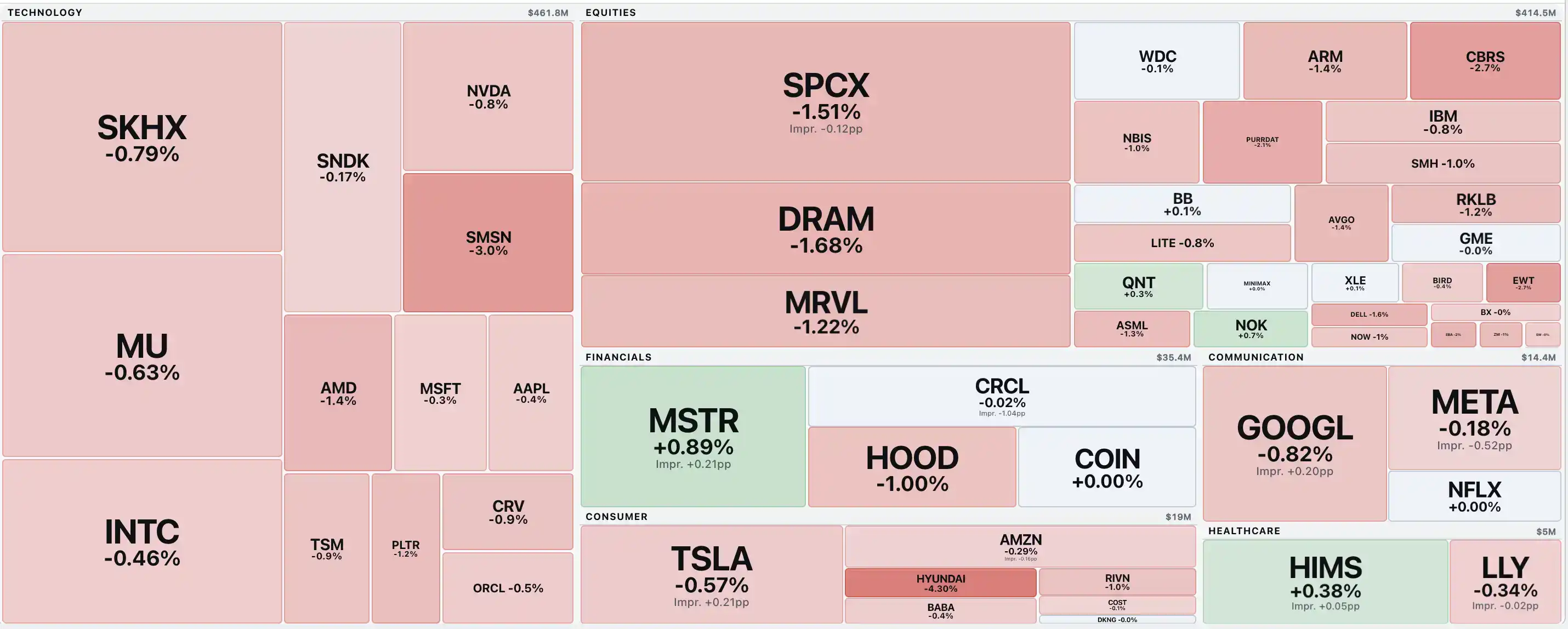
High-beta growth stocks SPCX −1.51%, DRAM −1.68%, MRVL −1.22% also pulled back in sync; relatively strong stocks included MSTR +0.89% and HIMS +0.38%.

Commodity Futures

Gold and silver saw a gap-up at the futures market open. This continued the 're-pricing of easing' logic that emerged last weekend. Falling oil prices reinforced expectations of peak inflation, lower yields, and a weaker dollar, which instead supported precious metals, rather than traditional safe-haven buying.
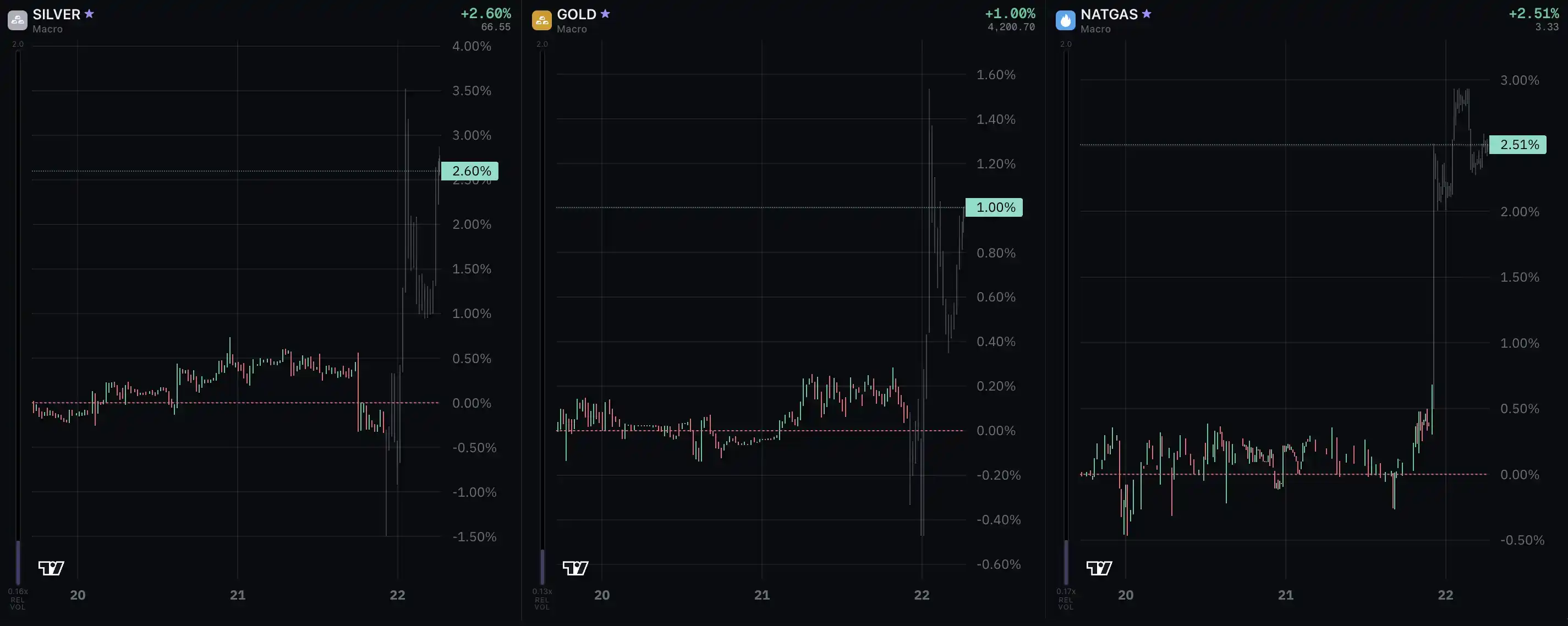
An unexpected move was the counter-trend rise in natural gas (+2.51%).

The increase may stem from an accident. Earlier today, a fire and explosion occurred at a natural gas plant at Qatar's core LNG processing base, Ras Laffan, injuring 54 people with 18 missing. The Barzan gas plant at this base supplies gas for Qatar's domestic industry and power generation. It is still unclear if LNG production is affected. Qatar was the world's second-largest LNG exporter before the war and had temporarily suspended production due to facility attacks and Strait closures in the early stages of the conflict.
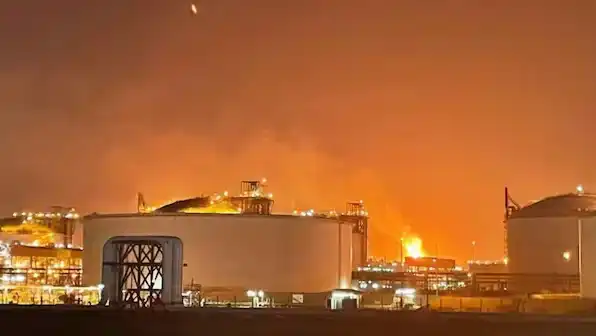
In subtle contrast to this explosion was another 'production resumption' signal: Qatar has begun recalling empty LNG carriers to re-enter the Persian Gulf, with market predictions that gas supply from Qatar is about to resume.

Domande pertinenti

QAccording to the article, what were the key events from June 19 to June 22 that caused volatility in the price of crude oil?

AOn June 19, crude oil rose from $76.5 to near $78 after a New York Times report suggested Israel would likely continue strikes in Lebanon. On the evening of June 20, it surged to a high near $79 after Iran's top military command announced the closure of the Strait of Hormuz. It saw further slow gains following Trump's aggressive comments about potentially taking control of the Strait. Finally, on the morning of June 22, prices fell nearly 6% from the weekend's high after Iran's Foreign Ministry characterized the Swiss talks as having 'made good progress.'

QHow did the US stock market, specifically indices and tech stocks, perform over the weekend described in the article?

AThe US stock market performance was relatively flat. Major indices like the XYZ100 and SP500 oscillated near the zero line, with the SP500 briefly dipping to around -0.6% before recovering. In the tech sector, stocks like SKHX fell -0.79%, MU -0.63%, NVDA -0.8%, and SMSN -3.0%. High-beta growth stocks such as SPCX, DRAM, and MRVL also saw declines of over 1%.

QWhat was the unexpected commodity that rose in price over the weekend, and what event likely caused this increase?

ANatural gas was the unexpected commodity that rose in price, gaining +2.51%. The increase was likely triggered by an explosion and fire at the Barzan gas plant in Qatar's key Ras Laffan LNG processing complex. The incident resulted in 54 injuries and 18 missing persons, raising concerns about potential supply disruptions.

QWhat was the outcome of the four-party technical-level consultations held in Switzerland, as mentioned in the article?

AAccording to statements from Qatar and Pakistan, the consultations in Switzerland yielded three main results: 1) The establishment of a high-level political oversight committee, 2) A finalized 60-day roadmap for a final agreement, and 3) The launch of a mechanism to resolve the conflict in Lebanon. Mediators described the atmosphere as 'extremely positive and constructive.' Pakistan also indicated that Iran would not block ships from passing through the Strait of Hormuz for the next 60 days and that passage would be free.

QAccording to the article, what was the primary market logic supporting the prices of gold and silver over the weekend, rather than traditional safe-haven buying?

AThe primary logic supporting gold and silver prices was a 'loose re-pricing' driven by macroeconomic factors. Falling oil prices reinforced expectations of peak inflation, leading to lower bond yields and a weaker US dollar. This environment was supportive for precious metals, rather than direct safe-haven demand due to geopolitical tensions.

Letture associate

Ilya Delivers, Huang Jen-Hsun Bets 50 Billion on SSI, First Model Suspected to Launch This Week

Ilya Sutskever's Safe Superintelligence (SSI) lab, backed by a rumored $5 billion investment from NVIDIA granting exclusive access to next-gen systems, may release its first groundbreaking model as early as this week. Industry insiders are hinting at a major breakthrough from a non-major player, with some claiming AI will be "utterly transformed." The model is speculated to fundamentally differ from current large language models like ChatGPT. Instead of relying on massive, static pre-training and ever-larger context windows, SSI's approach reportedly centers on **Test-Time Training (TTT)**. This would allow the model to **update its own internal weights in real-time** as it processes information, effectively "learning on the fly" and internalizing new knowledge like a human, rather than just referencing it from a large prompt. This aligns with Ilya Sutskever's long-stated vision of moving beyond the "pre-training" and "scaling" era. He envisions superintelligence not as a monolithic, pre-loaded database, but as an adaptive, "infinitely curious 15-year-old genius" capable of continual learning through interaction. SSI's strategy has been focused solely on this goal of "safe superintelligence" through efficient continual learning and alignment, explaining its prior silence. If successful, this model could disrupt the entire AI industry, challenging the current reliance on vast compute resources for training and the business models built around context windows. It suggests that core technological leaps, not just financial scale, remain decisive in the AI race.

marsbit36 min fa

Ilya Delivers, Huang Jen-Hsun Bets 50 Billion on SSI, First Model Suspected to Launch This Week

marsbit36 min fa

Demand Test: Bitcoin Whales Earn Record $1.2 Billion, Ethereum Holders Return to Profitability

In just three days after Bitcoin's price recovery, new Bitcoin whales have realized over $1.2 billion in profit, marking the largest profit-taking event for this cohort on record according to CryptoQuant. The peak occurred on August 20 with roughly $614 million, setting a daily record. Analysts note this selling pressure began after Bitcoin rose above the realized price of short-term whales, which was around $68,900. With Bitcoin trading near $77,700 on August 23, these whales were sitting on an average profit of about 12.8%. The market recovery allowed investors who were previously at breakeven or at a loss to lock in gains. CryptoQuant described the situation as a key test for Bitcoin demand; sustained prices above whale cost-basis with normalized profit-taking could signal strong new demand, while continued selling pressure could turn the rally into a mere break-even exit. Simultaneously, large Ethereum holders have also returned to an unrealized profit zone following its rally, as noted by CryptoQuant analyst Darkfost. Current profit levels, however, remain relatively low and are not seen as creating significant selling pressure. The Unrealized Profit/Loss Ratio for different whale cohorts stands at 0.075 (for 1k-10k ETH holders), 0.16 (10k-100k ETH), and 0.38 (over 100k ETH). This marks a significant improvement from June, when these whales were in substantial unrealized loss, with Ethereum having risen over 65% since then. The increased profitability is viewed as a positive sentiment signal for the Ethereum market.

cryptonews.ru48 min fa

Demand Test: Bitcoin Whales Earn Record $1.2 Billion, Ethereum Holders Return to Profitability

cryptonews.ru48 min fa

Kinetiq Team Announces Elysium L2 Network for Hyperliquid

On August 24, the liquid staking protocol Kinetiq announced Elysium, a new L2 network for the Hyperliquid ecosystem. It aims to increase HyperEVM's throughput and simplify the launch of spot markets, tokens, and DeFi applications. Elysium will use $HYPE for gas fees and plans direct integration with HyperCore's trading engine, giving apps access to its liquidity and orderbook data. Technical details and partners will be revealed later, with a launch date set for "soon." A primary reason for Elysium's development is to overcome HyperEVM's limitations, such as low throughput and rising fees during high load. Kinetiq claims the L2 will start with significantly higher block production and transaction speeds, later aiming to approach HyperCore's performance. This targets applications needing frequent state updates like high-frequency spot trading and AMMs, and will provide them deeper access to HyperCore orderbook data. The network also proposes to streamline the process of launching new assets within Hyperliquid, allowing a token to progress from AMM liquidity to HyperCore's spot orderbook and eventually to perp markets via HIP-3 in a unified flow. Regarding revenue, Kinetiq's model allocates 50% of sequencer fees to buy back and burn $KNTQ, 25% to developers using Elysium's block space, and 25% to the Kinetiq treasury. Elysium marks Kinetiq's expansion beyond its core liquid staking product, kHYPE.

cryptonews.ru49 min fa

Kinetiq Team Announces Elysium L2 Network for Hyperliquid

cryptonews.ru49 min fa

Trading

Spot
活动图片