OCC Proposes Framework To Implement GENIUS Act, Targets Stablecoin Yield Workarounds

bitcoinistPubblicato 2026-02-27Pubblicato ultima volta 2026-02-27

Introduzione

The Office of the Comptroller of the Currency (OCC) has released a proposed framework to implement the GENIUS Act, a landmark stablecoin regulation signed into law in 2025. The 376-page proposal outlines rules for stablecoin issuers under OCC jurisdiction, including reserve standards, liquidity requirements, and risk management controls. A key focus is addressing potential workarounds to the Act’s ban on interest payments for stablecoin holders. The OCC warns that issuers might use third-party arrangements to circumvent the prohibition and proposes a presumption that certain deals with affiliates or related parties would be considered illegal yield payments. The agency is seeking public feedback on the proposal to shape the final rule.

The Office of the Comptroller of the Currency (OCC) has asked the public for feedback on its proposed framework to regulate stablecoins under the landmark crypto regulation, including proposals to address potential workaround on the interest payments ban.

OCC Lays Out Framework For GENIUS Act Implementation

On Wednesday, the OCC issued a proposed rulemaking to implement the landmark stablecoin legislation, the Guiding and Establishing National Innovation for U.S. Stablecoins (GENIUS) Act.

The GENIUS Act was signed into law by US President Donald Trump on July 18, 2025. The legislation establishes a regulatory framework for payment stablecoin activities in the US.

In the 376-page document, the agency included regulations for permitted payment stablecoin issuers and foreign payment stablecoin issuers under the OCC’s jurisdiction and certain custody activities conducted by OCC-supervised entities.

Notably, the OCC will have regulatory authority over certain issuers, such as subsidiaries of national banks or federal savings associations, federal qualified issuers, state qualified issuers, and foreign issuers.

The proposed rules cover all regulations the OCC is required to promulgate under the GENIUS Act, including reserve asset standards, liquidity and custody requirements, risk management controls, audits, and supervisory examinations.

However, it exempts rules related to the Bank Secrecy Act, Anti-Money Laundering, and Office of Foreign Assets Control sanctions, which will be addressed in a separate rulemaking alongside the Department of the Treasury.

“The OCC has given thoughtful consideration to a proposed regulatory framework in which the stablecoin industry can flourish in a safe and sound manner,” said Comptroller of the Currency Jonathan Gould in a statement.

“We welcome feedback on the proposal to inform a final rule that is effective, practical and reflects broad industry perspective. The OCC will continue its work to implement the GENIUS Act and provide OCC regulated entities with more opportunities to meet the needs of their customers and communities,” he added.

Rules To Address Stablecoin Yield Workarounds

The proposed draft also tackled a key issue related to the regulation of these assets: the payments of interest or yield on stablecoins. For context, the legislation prohibits interest payments on the holding or use of payment-purpose stablecoins, but only addresses permitted issuers.

Based on this, the banking sector has argued that the GENIUS Act has “loopholes” that could pose risks to the financial system and has urged senators to include language in the crypto market structure bill, known as the CLARITY Act, that also bans digital asset exchanges, brokers, dealers, and related entities from offering yield.

The OCC expanded on the GENIUS Act ban, highlighting potential areas that must be addressed to prevent these “loopholes.” The agency argued that issuers could attempt workarounds to “make prohibited payments of interest or yield to payment stablecoin holders through arrangements with third parties.”

However, it noted that due to the large and changing variety of such arrangements, it would be impossible to identify and address all of them. Therefore, it proposed to include a presumption that “certain types of arrangements with certain types of persons” would be prohibited payments of yield or interest by the issuer.

The OCC would presume that an issuer is paying the holder any form of interest or yield if: the issuer “has a contract, agreement, or other arrangement with an affiliate or a related third party to pay interest or yield to the affiliate or related third party;” and if the affiliate or related third party “has a contract, agreement, or other arrangement to pay interest or yield (...) to a holder of any payment stablecoin issued” by the permitted issuer “solely in connection with the holding, use, or retention” of these tokens.

Nonetheless, the OCC clarified that the prohibition is not intended to prevent a merchant from independently offering a discount to a holder for using payment stablecoins. It is also not intended to prevent an issuer “from sharing in the profits derived from the payment stablecoin with a non-affiliate partner in a white-label arrangement.”
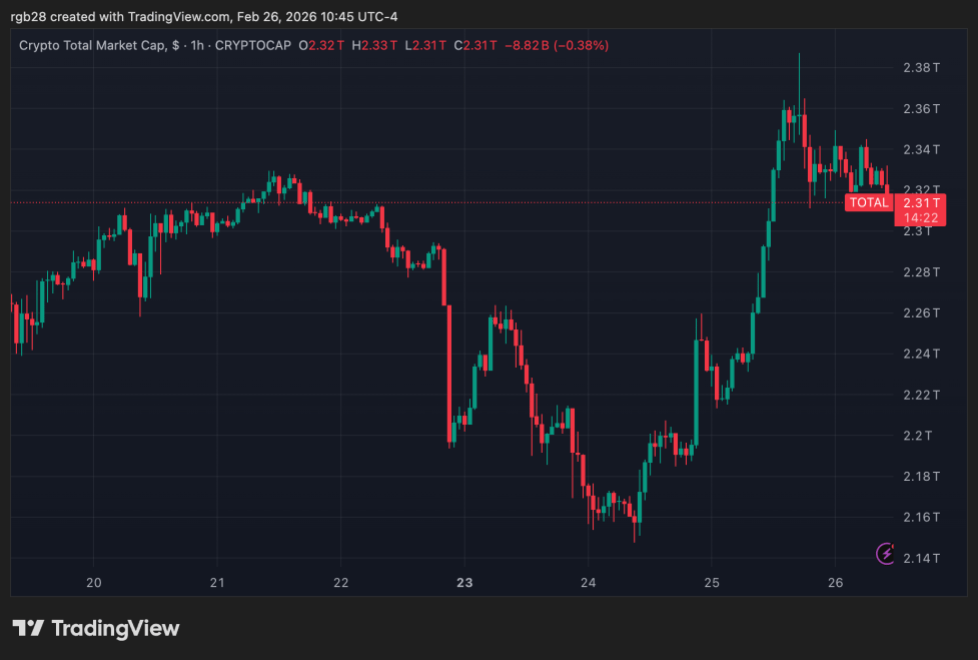
The total crypto market capitalization is at $2.31 trillion in the one-week chart. Source: TOTAL on TradingView


Domande pertinenti

QWhat is the main purpose of the OCC's proposed framework?

AThe main purpose of the OCC's proposed framework is to implement the GENIUS Act and establish regulations for stablecoin activities, including reserve asset standards, liquidity requirements, and measures to address potential workarounds on the interest payments ban.

QWhat specific entities will the OCC have regulatory authority over under the proposed rules?

AThe OCC will have regulatory authority over subsidiaries of national banks or federal savings associations, federal qualified issuers, state qualified issuers, and foreign issuers of payment stablecoins.

QWhat key issue related to stablecoin yield does the OCC's proposal specifically address?

AThe proposal specifically addresses the issue of potential workarounds where issuers might attempt to pay prohibited interest or yield to stablecoin holders through arrangements with third parties, such as affiliates.

QAccording to the OCC, what two conditions would lead to a presumption that an issuer is paying prohibited yield?

AThe OCC would presume an issuer is paying yield if: 1) it has an arrangement with an affiliate or related third party to pay them interest, and 2) that affiliate or third party has an arrangement to pay that interest to a stablecoin holder solely in connection with holding or using the tokens.

QWhat types of activities are NOT intended to be prevented by the OCC's proposed rules on yield?

AThe rules are not intended to prevent a merchant from independently offering a discount for using stablecoins, or to prevent an issuer from sharing profits with a non-affiliate partner in a white-label arrangement.

Letture associate

From Robinhood to Polymarket: Is the Era of Integrating All Assets on a Single Platform Coming?

From Robinhood to Polymarket: The Era of All-in-One Asset Platforms Is Coming Asset classes are rapidly converging. Platforms that once specialized in single categories—such as stocks, cryptocurrencies, or prediction markets—are now moving toward offering all three. Robinhood pioneered this model, starting with equities, adding crypto in 2018, and prediction markets in 2025. This strategy has proven resilient: when crypto revenues fell, other segments like options and stocks filled the gap. Now, prediction market leaders Polymarket and Kalshi are moving in the same direction, both announcing perpetual futures trading on April 21, 2026, pending regulatory approval. These futures will cover assets like Bitcoin, gold, and stocks such as Nvidia. This trend mirrors the consolidation seen in consumer tech, like smartphones replacing dedicated cameras and MP3 players. Younger users, accustomed to interacting with multiple asset types from an early age, will increasingly demand unified platforms. A key competitive advantage in prediction markets is collateral utilization—idle assets locked during betting periods. Polymarket’s move into perpetuals may be a strategy to generate yield from that capital, similar to earlier DeFi integrations like PolyAave. As the regulatory landscape evolves, traditional finance is also likely to incorporate crypto and prediction markets, further accelerating this convergence.

marsbit5 min fa

From Robinhood to Polymarket: Is the Era of Integrating All Assets on a Single Platform Coming?

marsbit5 min fa

OpenAI Goes Left, DeepSeek Goes Right

On April 24, 2026, DeepSeek released V4, a Chinese large language model offering a free "million-token context window," enabling it to process vast amounts of data like entire books or years of corporate documents in one go. In contrast, OpenAI’s GPT-5.5, released around the same time, is more powerful but significantly more expensive, charging up to $180 per million output tokens. DeepSeek’s strategy represents a shift from a pure AI research firm to a heavy-infrastructure player, building data centers in Inner Mongolia’s Ulanqab to bypass U.S. chip export restrictions. This move, supported by Huawei’s Ascend chips and China’s cheap green electricity, highlights a fundamental divergence in AI development models: U.S. firms focus on high-cost, high-margin services, while Chinese players like DeepSeek prioritize accessibility and affordability. Facing intense talent poaching from tech giants, DeepSeek is seeking a $44 billion valuation funding round to retain researchers and scale infrastructure. Meanwhile, Chinese manufacturers are compressing AI models to run on smartphones, making AI accessible offline and across the Global South. Through open-source models and localized solutions, Chinese AI is empowering non-English speakers and low-income users, driving a form of "digital equality." While Silicon Valley builds walled gardens, DeepSeek and others are turning AI into a public utility—like tap water—flowing freely to those previously left behind.

marsbit31 min fa

OpenAI Goes Left, DeepSeek Goes Right

marsbit31 min fa

$292 Million KelpDAO Cross-Chain Bridge Hack: Who Should Foot the Bill?

On April 18, 2026, an attacker stole 116,500 rsETH (worth ~$292M) from KelpDAO’s cross-chain bridge in 46 minutes—the largest DeFi exploit of 2026. The stolen assets were deposited into Aave V3 as collateral, causing $177–200M in bad debt and triggering a cascade of losses across nine DeFi protocols. Aave’s TVL dropped by ~$6B overnight. This legal analysis argues that KelpDAO and LayerZero Labs share concurrent liability, with fault apportioned 60%/40%. KelpDAO negligently configured its bridge with a 1-of-1 decentralized verifier network (DVN)—a single point of failure—despite LayerZero’s explicit recommendation of a 2-of-3 setup. LayerZero, which operated the compromised DVN, failed to secure its RPC infrastructure against a known poisoning attack vector. Both protocols’ terms of service cap liability at $200 (KelpDAO) or $50 (LayerZero), but these limits are likely unenforceable due to unconscionability, gross negligence exceptions, and potential securities law invalidation (if rsETH is deemed a security under the Howey test). Aave’s governance also faces fiduciary duty claims for raising rsETH’s loan-to-value ratio to 93%—far above competitors’ 72–75%—without adequately assessing bridge risks, amplifying the systemic fallout. Practical recovery targets include LayerZero Labs (a registered Canadian entity), KelpDAO’s founders, auditors, and identifiable Aave governance delegates. The incident underscores escalating legal risks for DeFi protocols, infrastructure providers, and governance participants.

marsbit1 h fa

$292 Million KelpDAO Cross-Chain Bridge Hack: Who Should Foot the Bill?

marsbit1 h fa

Trading

Spot
Futures
活动图片