OCC Proposes Framework To Implement GENIUS Act, Targets Stablecoin Yield Workarounds

bitcoinistPubblicato 2026-02-27Pubblicato ultima volta 2026-02-27

Introduzione

The Office of the Comptroller of the Currency (OCC) has released a proposed framework to implement the GENIUS Act, a landmark stablecoin regulation signed into law in 2025. The 376-page proposal outlines rules for stablecoin issuers under OCC jurisdiction, including reserve standards, liquidity requirements, and risk management controls. A key focus is addressing potential workarounds to the Act’s ban on interest payments for stablecoin holders. The OCC warns that issuers might use third-party arrangements to circumvent the prohibition and proposes a presumption that certain deals with affiliates or related parties would be considered illegal yield payments. The agency is seeking public feedback on the proposal to shape the final rule.

The Office of the Comptroller of the Currency (OCC) has asked the public for feedback on its proposed framework to regulate stablecoins under the landmark crypto regulation, including proposals to address potential workaround on the interest payments ban.

OCC Lays Out Framework For GENIUS Act Implementation

On Wednesday, the OCC issued a proposed rulemaking to implement the landmark stablecoin legislation, the Guiding and Establishing National Innovation for U.S. Stablecoins (GENIUS) Act.

The GENIUS Act was signed into law by US President Donald Trump on July 18, 2025. The legislation establishes a regulatory framework for payment stablecoin activities in the US.

In the 376-page document, the agency included regulations for permitted payment stablecoin issuers and foreign payment stablecoin issuers under the OCC’s jurisdiction and certain custody activities conducted by OCC-supervised entities.

Notably, the OCC will have regulatory authority over certain issuers, such as subsidiaries of national banks or federal savings associations, federal qualified issuers, state qualified issuers, and foreign issuers.

The proposed rules cover all regulations the OCC is required to promulgate under the GENIUS Act, including reserve asset standards, liquidity and custody requirements, risk management controls, audits, and supervisory examinations.

However, it exempts rules related to the Bank Secrecy Act, Anti-Money Laundering, and Office of Foreign Assets Control sanctions, which will be addressed in a separate rulemaking alongside the Department of the Treasury.

“The OCC has given thoughtful consideration to a proposed regulatory framework in which the stablecoin industry can flourish in a safe and sound manner,” said Comptroller of the Currency Jonathan Gould in a statement.

“We welcome feedback on the proposal to inform a final rule that is effective, practical and reflects broad industry perspective. The OCC will continue its work to implement the GENIUS Act and provide OCC regulated entities with more opportunities to meet the needs of their customers and communities,” he added.

Rules To Address Stablecoin Yield Workarounds

The proposed draft also tackled a key issue related to the regulation of these assets: the payments of interest or yield on stablecoins. For context, the legislation prohibits interest payments on the holding or use of payment-purpose stablecoins, but only addresses permitted issuers.

Based on this, the banking sector has argued that the GENIUS Act has “loopholes” that could pose risks to the financial system and has urged senators to include language in the crypto market structure bill, known as the CLARITY Act, that also bans digital asset exchanges, brokers, dealers, and related entities from offering yield.

The OCC expanded on the GENIUS Act ban, highlighting potential areas that must be addressed to prevent these “loopholes.” The agency argued that issuers could attempt workarounds to “make prohibited payments of interest or yield to payment stablecoin holders through arrangements with third parties.”

However, it noted that due to the large and changing variety of such arrangements, it would be impossible to identify and address all of them. Therefore, it proposed to include a presumption that “certain types of arrangements with certain types of persons” would be prohibited payments of yield or interest by the issuer.

The OCC would presume that an issuer is paying the holder any form of interest or yield if: the issuer “has a contract, agreement, or other arrangement with an affiliate or a related third party to pay interest or yield to the affiliate or related third party;” and if the affiliate or related third party “has a contract, agreement, or other arrangement to pay interest or yield (...) to a holder of any payment stablecoin issued” by the permitted issuer “solely in connection with the holding, use, or retention” of these tokens.

Nonetheless, the OCC clarified that the prohibition is not intended to prevent a merchant from independently offering a discount to a holder for using payment stablecoins. It is also not intended to prevent an issuer “from sharing in the profits derived from the payment stablecoin with a non-affiliate partner in a white-label arrangement.”
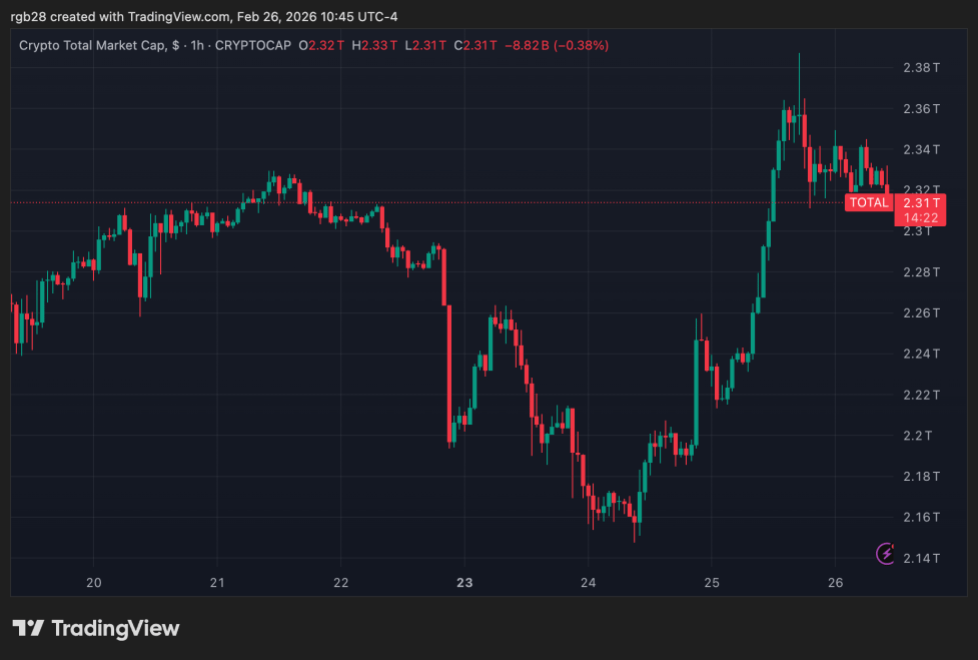
The total crypto market capitalization is at $2.31 trillion in the one-week chart. Source: TOTAL on TradingView


Domande pertinenti

QWhat is the main purpose of the OCC's proposed framework?

AThe main purpose of the OCC's proposed framework is to implement the GENIUS Act and establish regulations for stablecoin activities, including reserve asset standards, liquidity requirements, and measures to address potential workarounds on the interest payments ban.

QWhat specific entities will the OCC have regulatory authority over under the proposed rules?

AThe OCC will have regulatory authority over subsidiaries of national banks or federal savings associations, federal qualified issuers, state qualified issuers, and foreign issuers of payment stablecoins.

QWhat key issue related to stablecoin yield does the OCC's proposal specifically address?

AThe proposal specifically addresses the issue of potential workarounds where issuers might attempt to pay prohibited interest or yield to stablecoin holders through arrangements with third parties, such as affiliates.

QAccording to the OCC, what two conditions would lead to a presumption that an issuer is paying prohibited yield?

AThe OCC would presume an issuer is paying yield if: 1) it has an arrangement with an affiliate or related third party to pay them interest, and 2) that affiliate or third party has an arrangement to pay that interest to a stablecoin holder solely in connection with holding or using the tokens.

QWhat types of activities are NOT intended to be prevented by the OCC's proposed rules on yield?

AThe rules are not intended to prevent a merchant from independently offering a discount for using stablecoins, or to prevent an issuer from sharing profits with a non-affiliate partner in a white-label arrangement.

Letture associate

Within Strategy's Framework, STRC's Dividend Yield Remains at 12% as Share Price Stays Below Par Value

Michael Saylor, Executive Chairman of Strategy (MSTR), confirmed that the dividend rate for its STRC perpetual preferred shares will remain at 12.00% through August 2026. The rate has increased from 9% at its July 2025 launch to the current high via a "ratchet" mechanism, which permanently raises the rate by 0.5% whenever the share price falls below $95. This mechanism is intended to push the price back toward its $100 par value and support Strategy's "at-the-market" (ATM) program for issuing new shares to fund Bitcoin purchases. However, the mechanism has not worked as intended. STRC shares closed at $89.46 on July 31, remaining about 10-11% below par value despite the record-high dividend. Competition from rival Strive's higher-yielding SATA securities has pressured demand. The persistent discount has forced Strategy to suspend new STRC issuances via its ATM program, limiting this funding channel for Bitcoin acquisitions. STRC's struggles reflect Bitcoin's own volatility, as the preferred shares historically move in tandem. Analysts have warned the ratchet structure carries long-term, one-way risk. A law firm is investigating Strategy's ability to maintain dividend payments if Bitcoin's price stays low. Retail investors own roughly 83% of outstanding STRC shares, a group seen as prone to panic selling during downturns. In response, Strategy has established financial reserves, including a liquidity cushion covering about 26 months of dividend/interest obligations, and a $2 billion share buyback program alongside a Bitcoin monetization framework, though the company emphasized it is not obligated to sell any Bitcoin.

cryptonews.ru23 min fa

Within Strategy's Framework, STRC's Dividend Yield Remains at 12% as Share Price Stays Below Par Value

cryptonews.ru23 min fa

Analyst: Bitcoin's Price Will Drop to $60k in August, Then Rebound to $70k

Financial analyst Andrey Poroshin has provided a new forecast for Bitcoin's price dynamics in August. Poroshin, an analyst at the Bitbanker exchange, expects the cryptocurrency market to experience a downturn this month, with prices retesting the $60,000 level due to a lack of supportive macroeconomic catalysts. He noted that the recent US Federal Reserve decision to hold interest rates did not significantly impact the market, while inflation remains above the 2% target. Poroshin stated that Bitcoin is ending July under pressure from moderate volatility and a lack of new macroeconomic stimuli, leading to continued market caution. According to his base scenario, Bitcoin will drop to a range of $60,000 to $62,000 before recovering to $70,000. He pointed out that even $70,000 remains below the cost of mining in the US, which has prompted some miners to shift towards AI data center operations. Poroshin cited the winding down of BitMEX's operations as a potential catalyst for a price rebound, suggesting the exit of weaker players often coincides with market reversals and reduced short-term selling pressure. He believes Bitcoin is currently less susceptible to geopolitical shocks, such as the Iran-US conflict, and does not expect significant market changes in August related to the pending CLARITY Act. Looking ahead, Poroshin forecasts that September will bring more active price fluctuations driven by potential Fed rate decisions and possible discussions or approval of the CLARITY Act.

cryptonews.ru23 min fa

Analyst: Bitcoin's Price Will Drop to $60k in August, Then Rebound to $70k

cryptonews.ru23 min fa

Trading

Spot
活动图片




