OCC boss says ‘no justification’ to judge banks and crypto differently

cointelegraphPubblicato 2025-12-09Pubblicato ultima volta 2025-12-09

Introduzione

OCC Acting Comptroller Jonathan Gould stated that crypto companies seeking federal bank charters should be treated equally with traditional financial institutions, arguing there is "no justification" for differential treatment of digital assets. He emphasized that banks should not be confined to outdated technologies and noted that custody services have long been electronic. Gould revealed the OCC received 14 new bank applications this year, including from digital asset firms, nearly matching the total from the past four years. He dismissed concerns from traditional banks about crypto charters, stating such opposition risks stifling innovation, and expressed confidence in the OCC's ability to supervise crypto-native banks fairly.

Crypto companies seeking a US federal bank charter should be treated no differently than other financial institutions, says Jonathan Gould, the head of the Office of the Comptroller of the Currency (OCC).

Gould told a blockchain conference on Monday that some new charter applicants in the digital or fintech spaces could be seen as offering novel activities for a national trust bank, but noted “custody and safekeeping services have been happening electronically for decades.”

“There is simply no justification for considering digital assets differently,” he added. “Additionally, it is important that we do not confine banks, including current national trust banks, to the technologies or businesses of the past.”

The OCC regulates national banks and has previously seen crypto companies as a risk to the banking system. Only two crypto banks are OCC-licensed: Anchorage Digital, which has held a charter since 2021, and Erebor, which got a preliminary banking charter in October.

Crypto “should have” a way to supervision

Gould said that the banking system has the “capacity to evolve from the telegraph to the blockchain.”

He added that the OCC had received 14 applications to start a new bank so far this year, “including some from entities engaged in novel or digital asset activities,” which was nearly equal to the number of similar applications that the OCC received over the last four years.
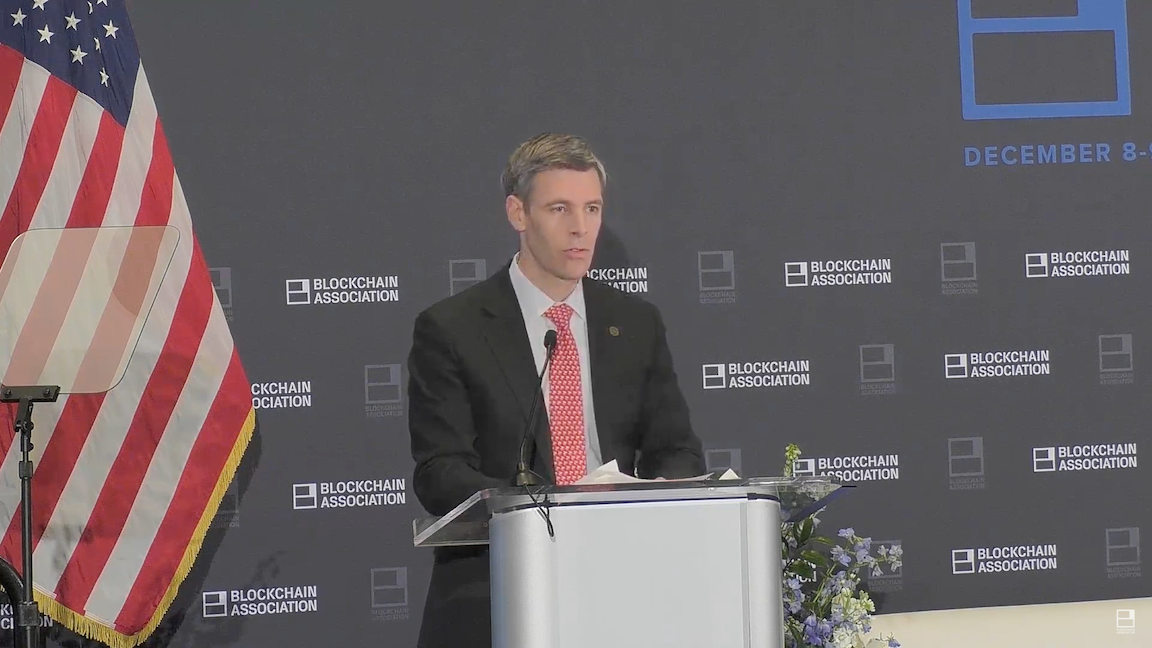
Comptroller of the Currency Jonathan Gould giving remarks at the 2025 Blockchain Association Policy Summit. Source: YouTube

“Chartering helps ensure that the banking system continues to keep pace with the evolution of finance and supports our modern economy,” he added. “That is why entities that engage in activities involving digital assets and other novel technologies should have a pathway to become federally supervised banks.”

Gould brushes off banks’ concerns

Gould noted that banks and financial trade groups had raised concerns about crypto companies getting banking charters and the OCC’s ability to oversee them.

Related: Argentina weighs letting traditional banks trade crypto: Report

“Such concerns risk reversing innovations that would better serve bank customers and support local economies,” he said. “The OCC has also had years of experience supervising a crypto-native national trust bank.”

Gould said the regulator was “hearing from existing national banks, on a near daily basis, about their own initiatives for exciting and innovative products and services.”

“All of this reinforces my confidence in the OCC’s ability to effectively supervise new entrants as well as new activities of existing banks in a fair and even-handed manner,” he added.

Legal Panel: Crypto wanted to overthrow banks, now it’s becoming them in stablecoin fight

Letture associate

From Theft to Re-entry: How Was $292 Million "Laundered"?

A sophisticated crypto laundering operation was executed following the $292 million hack of Kelp DAO on April 18. The attack, attributed to the North Korean Lazarus group, began with anonymous infrastructure preparation using Tornado Cash to fund wallets untraceably. The hacker exploited a vulnerability in Kelp’s cross-chain bridge, stealing 116,500 rsETH. To avoid crashing the market, the attacker used Aave and Compound as laundering tools—depositing the stolen rsETH as collateral to borrow $190 million in clean, liquid ETH. This move triggered a bank run on Aave, causing an $8 billion drop in TVL. After consolidating funds, the attacker fragmented them across hundreds of wallets to evade detection. A major breakpoint was THORChain, where over $460 million in volume—30 times its usual activity—was processed in 24 hours, converting ETH into Bitcoin. This shift to Bitcoin’s UTXO model exponentially increased tracing complexity by shattering funds into countless untraceable fragments. The final destination was Tron-based USDT, the primary channel for illicit crypto flows. From there, funds were cashed out via OTC brokers in China and Southeast Asia, using unlicensed underground banks and UnionPay networks outside Western sanctions scope. Ultimately, the laundered money supports North Korea’s weapons programs, which rely heavily on crypto hacking for foreign currency. The incident underscores structural challenges in DeFi: its openness, composability, and lack of central control make such laundering not just possible, but inherently difficult to prevent.

marsbit3 h fa

From Theft to Re-entry: How Was $292 Million "Laundered"?

marsbit3 h fa

Trading

Spot
Futures
活动图片




